Just when the first digital currency was launched, perhaps no one thought that blockchain would ever become a household name. But years down the line, its influence has expanded beyond cryptocurrency. Blockchain has become a foundational technology that’s now joining forces with artificial intelligence to change how people secure data and build trust. As a result, Precedence Research estimates the global blockchain market at $41.15 billion in 2025 and anticipates it to reach $1.9 trillion by 2034.
Clearly, the days when people only associated blockchain with checking crypto prices on exchanges are slowly passing away. Of course, that doesn’t mean that people no longer monitor cryptocurrency today. Various exchanges still make it possible for users to view crypto prices in real time and execute trades. But blockchain’s role goes beyond that, extending to other sectors like artificial intelligence.
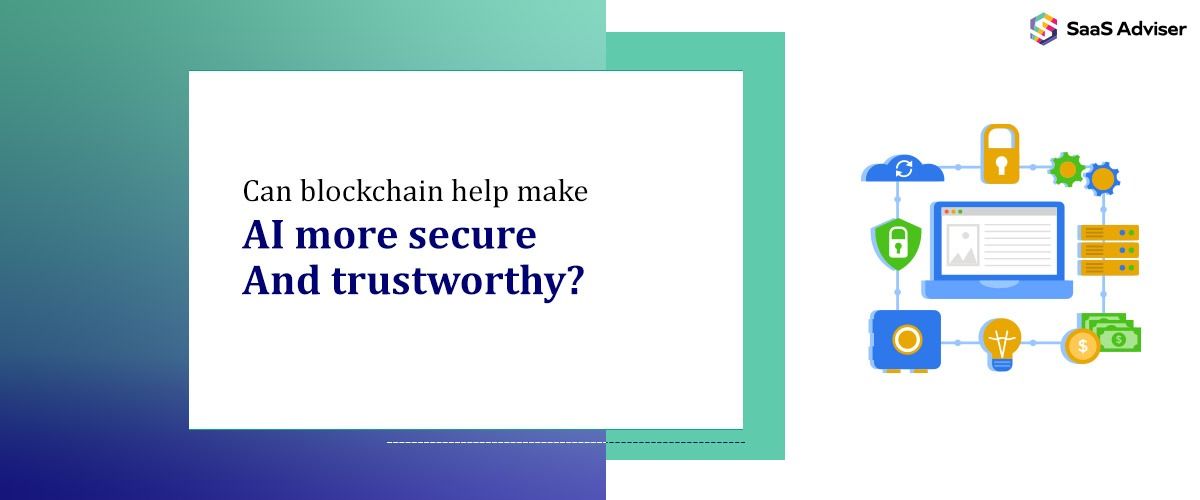
Remember, for an AI system to operate at its full potential, it needs a secure and transparent infrastructure. This is where blockchain’s strengths become handy. Through its immutable and decentralized ledger, blockchain can help reinforce some of the key pillars of AI security, such as data integrity, accountability and transparency. And if you really want to know how this is possible, then hanging around will help.
The Growing Importance Of Security
Before diving into this subject, it’s important to highlight why security has become a crucial concern in the first place. Just recently, Data Economy made a projection that global cybercrime costs would reach $11.3 trillion in 2026, up from $9.5 trillion in 2024. This is after SQMagazine valued the cost of a single breach at $4.67 million.
Imagine losing almost $5 million from a single data breach, not to mention the cascading costs of downtime and regulatory fines. For a forward-thinking company, this is definitely a route you wouldn’t want to take. And beyond downtime and regulatory fines, breaches can have far-reaching consequences on your reputation. They may affect how users view your products and, in turn, make you less competitive.
Come to think of it: According to PwC, 78% of customers will stop interacting with a platform for several months following a breach. 35% say they will never return to the platform. Given the rate at which customer acquisition costs are increasing, these are not losses you want to incur. And if you offer AI-based services, the stakes might even be higher. A single breach could erode trust and, in turn, cause users to abandon your platform permanently. But thanks to blockchain, AI companies are not entirely without hope.
The Transparency and Democratization Issue in AI
Do you know that, according to Bismart, worldwide consumer trust in artificial intelligence has fallen from 61% to 53% over just the past five years? Well, this could be surprising, because you’d naturally expect this technology to gain more trust as it becomes increasingly woven into daily life.
Unfortunately, artificial intelligence systems sometimes operate as black boxes. In other words, they make decisions based on complex algorithms that even their creators sometimes struggle to fully explain.
And when people don’t understand how or why a model reaches a particular conclusion, they’re naturally hesitant to place their trust in it. With most users preferring to transact with businesses they trust, this hesitation can directly impact adoption and engagement. Before adopting a model, users want to know how their data is being used and what factors influence the AI’s decisions.
Without offering this kind of transparency, it becomes difficult to appeal to these users. Also, even small errors can feel like a breach of confidence when a model operates as a black box. But with decentralized systems, developers can actually overcome these challenges.
These systems offer a solution by providing a permanent, tamper-proof record of every action and decision an AI system takes. Picture a scenario where a digital ledger logs every input and output generated by an AI model. Such a ledger becomes handy because it allows you to trace and verify what once seemed mysterious.
The Challenge Of Centralized Access
Beyond transparency, decentralized systems help democratize access to artificial intelligence technologies. As you may know, the development and deployment of AI models has, for some time now, been dominated by large companies. Small businesses often struggle to compete because they lack the required resources to train advanced models.
This can be problematic because it creates a security bottleneck. When only a handful of entities control advanced AI models, they become high-value targets for cyberattacks. And just one breach can have devastating consequences at scale.
In 2024, for instance, attackers exploited misconfigurations in the widely used Snowflake cloud data and AI platform. They mercilessly compromised the environments of at least 160 organizations and exposed large volumes of sensitive customer data. This became one of the most significant breaches of the decade, showing how when lots of a company’s workloads are hosted on a centralized platform, a single breach can have massive downstream effects.
Thankfully, blockchain-based systems are quickly changing this narrative by enabling the distribution of resources across a decentralized network. In this way, the technology removes control from a single authority so that even if one part of the network is attacked, the rest of the system remains operational
Solana AI is a perfect example. As a distributed AI marketplace, the platform makes it easier for users to access artificial intelligence resources. And as Binance notes, this platform has already onboarded more than 3.3 million on-chain accounts. If that’s not all, over 1.4 million daily users now actively interact with models and datasets on the platform.
What Bbout AI-Related Cybersecurity Concerns?
Although AI can help combat cyberattacks, the technology itself is also vulnerable to compromise. Through data poisoning, malicious actors can manipulate the training data and cause models to make incorrect or biased predictions. The unfortunate thing is that the effects of poisoned data may not always be visible.
A model could even pass testing but still produce flawed outputs once deployed in real-world scenarios. Think of it as having a financial model that incorrectly flags legitimate payments as fraudulent because it was trained on manipulated data. Or think of another scenario where the model actually approves fraudulent transactions. These scenarios are not just hypothetical. According to a recent report by IT Brief UK, about one in four UK and US businesses witnessed operational disruptions due to compromised AI systems.
At the same time, malicious actors are using this technology to advance their efforts. Attacks like deepfakes, which use AI-generated audio or video to impersonate individuals, have surged remarkably in recent years. According to Keepnet Labs, deepfakes now account for 6.5% of all fraud attacks, a more than 2,000% increase from 2022.
AI-Related Attacks Also Evolve
The danger doesn’t stop at fraud. AI-powered malware and phishing campaigns have become more complicated, adapting in real time to evade detection. And since they’re able to modify their behaviour based on system responses, it becomes difficult for traditional security measures to fight them effectively. However, with decentralised environments, managing these threats proactively becomes possible.
The technology’s decentralized nature allows every participant in a network to access and view all the transactions. And once a transaction is added to the chain, it can’t be changed. Any attempt to alter historical data would require rewriting every subsequent block across all copies of the ledger, which is virtually impossible for large networks.
So, if someone tries to use a fake video, it becomes easy to trace it back and see exactly where it came from. Likewise, if a hacker compromises training data, the decentralised ledger makes sure you have a verifiable record where you can easily isolate corrupted data.
But just because blockchain is inherently secure doesn’t mean it can’t be compromised. According to Frontier Africa Reports, crypto-related attacks increased by 214% between December 2025 and January 2026 alone. This resulted in a total loss of appromately $370 million!
To avoid such losses, you can combine AI with blockchain to help flag suspicious transactions before they escalate into full-blown security breaches.
When Intelligence Meets Trust
It’s no surprise that the global blockchain AI market is expected to grow at a 22.9% CAGR over the next 10 years. According to this estimate by Future Market Insights, the sector could jump from $0.7 billion in 2025 to $5.2 billion by 2035. Given the growing need for both smart and transparent interactions, these two technologies may continue to join forces to build ecosystems where intelligence is both verifiable and trustworthy.
The growing popularity of AI-related attacks, for instance, makes it difficult for businesses to rely only on traditional technologies to protect themselves. Scams like deepfakes are evolving too quickly for conventional defences to keep up. As such, businesses are pairing their strategies with blockchain’s immutable infrastructure to avoid falling into the hands of malicious actors.
Similarly, since blockchain also has its own security challenges, combining it with AI helps address these weaknesses. Artificial intelligence comes in handy in assessing blockchain’s large datasets and detecting patterns before they can cause harm. In simple terms, these two technologies, working together, create an environment where data is handled both transparently and intelligently.
No, artificial intelligence is not completely secure on its own. While AI can strengthen cybersecurity by detecting fraud and suspicious activities, the technology itself can be vulnerable to threats such as data poisoning and adversarial attacks.
Not always. Even though artificial intelligence can process large amounts of data quickly, its results are not always accurate. In some cases, AI may generate confident-sounding responses that are technically incorrect, which is why human verification remains essential.
Blockchain can help reduce certain cybersecurity risks by eliminating single points of failure and improving data transparency. However, like any technology, blockchain systems may also face vulnerabilities or potential attacks.
Combining AI with blockchain can significantly strengthen security. Blockchain provides tamper-proof and decentralized data storage, while artificial intelligence detects anomalies and potential threats in real time before they escalate.