
What we'll cover
Share with your community!


Get Free Consultation
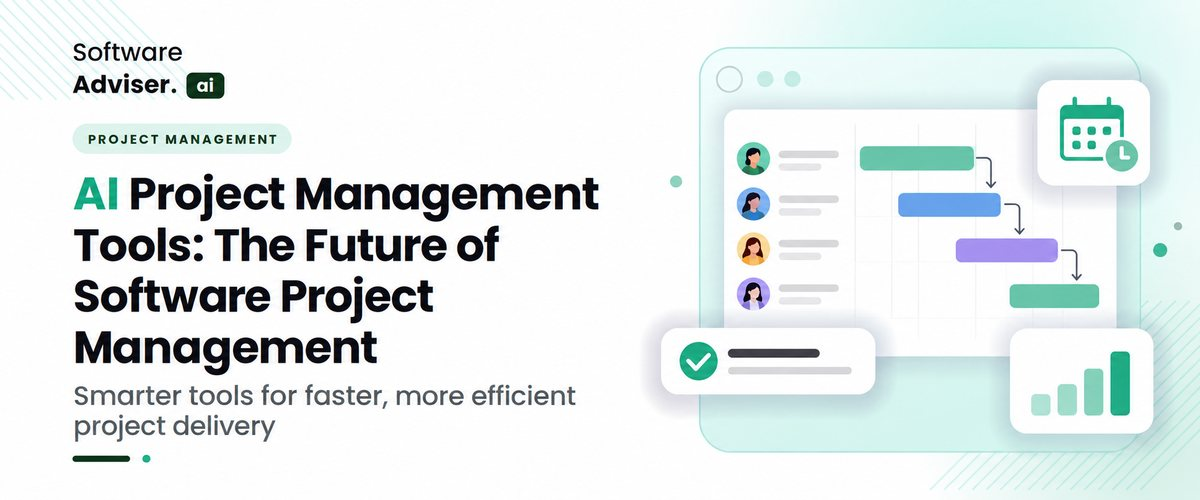
AI Project Management Tools: The Future of Software Project Management
 Dokas mile
Projects rarely fall behind because teams cannot plan. They fall behind when small things pile up: missed updates, overdue tasks, changing priorities, scattered information, and hours spent putting together reports.
That's where AI project management tools are beginning to make a difference. They can convert project briefs into tasks, provide meeting minutes, identify risks, and automate repetitive tasks, as well as make it easier for teams to find key project information.
The real question for U.S. companies is: can AI run a business? It's the place where AI can minimize time and enhance choices without removing the decision-making power from the hands of those managing the project.

Quick Answer
AI project management software allocates AI to assist teams in planning projects, developing and prioritizing tasks, identifying project risks, summarizing project activity, automating workflows, organizing project resources, and producing project reports. As opposed to conventional project management programs, they can analyze the data of a project and make suggestions or take specific actions. There is a need for human oversight for decisions related to scope, budget, deadlines, resources, and stakeholders.
What Are AI Project Management Tools?
AI project management platforms are tools designed to help you plan, execute, monitor, communicate and report using artificial intelligence. They can leverage machine learning, natural language processing, generative AI, predictive analytics, or AI agents, depending on the platform.
Typical project management software is primarily used to organize work. Another feature of AI project management software is that it can understand project information and recommend the next steps.
You can use an AI assistant to break down a project brief into tasks and milestones for a team. The system could then summarize the meetings, highlight work that is overdue, show who on the team is overloaded, or produce a status report.
AI can't replace the project manager. It is more of a planning and analysis assistant rather than human review, for priorities, budgets, scope, quality, and stakeholder commitments.
 Looking for AI Project Management Tools? Check Out Software Advisor. AI List of best AI Project Management Software in USA for your business.
What Can AI Project Management Tools Actually Do?
|
Project Task |
What AI Can Do |
|
Project planning |
Create a starting plan from a brief |
|
Task management |
Create, break down, prioritize, and summarize tasks |
|
Scheduling |
Suggest timelines and identify conflicts |
|
Risk management |
Flag patterns that may indicate delays |
|
Reporting |
Generate project status summaries |
|
Resource management |
Surface workload and capacity issues |
|
Meetings |
Summarize decisions and action items |
|
Communication |
Draft stakeholder updates |
|
Workflow automation |
Trigger actions based on project events |
|
Project search |
Find answers across project information |
How AI Project Management Software Works
AI project management software generally combines project data with AI models and workflow rules. The workflow often looks like this:
1. Collect project data: The platform collates data from tasks, schedules, documents, conversations, time records, dependencies, and related systems.
2. Interpret the information: That context is fed into AI which can then summarize information, detect patterns, categorize work, or answer a natural language query.
3. Recommend actions: The system can prioritize, set tasks, review a plan, write a report or mark something as a potential delay.
4. Keep a human in control: Changes which impact scope, resources, deadlines and customers are approved by a manager who reviews them first.
Key Features of AI Project Management Tools
AI Task Management
AI can convert natural language instructions into tasks, divide up larger work into subtasks, provide activity summaries, and assist in prioritizing a backlog. When a project begins with a brief work breakdown, that's a time when AI Task Management comes in handy.
Automated Project Planning
Automated project planning can create a starting project plan based on a goal and/or existing context. AI can provide project managers with task sequences, dependencies, and milestones for review.
Predictive Project Analytics
AI can analyze historical and present project information, pinpointing trends linked to delays, workload issues, or other dangers. The more complete and reliable the data is, the more useful predictive project analytics will be.
Workflow Automation
AI can trigger actions based on project events, such as notifying a stakeholder when work is blocked or moving a task after an approval. Project workflow automation reduces repetitive coordination work. Good project workflow automation also keeps routine handoffs consistent.
AI Reporting and Summaries
The project managers get to spend some time preparing weekly updates. AI can summarize task changes, blockers, decisions, and milestones into a draft report for the manager to edit.
Resource Allocation
AI can compare workloads, availability, skills, and deadlines when teams assign resources. Resource allocation recommendations can reveal conflicts, although managers still need to consider context that may not exist in the project system.
Benefits of AI in Project Management
Reduce Administrative Work
Automate routine updates, summaries, task creation, reminders, and reporting using AI. This leaves project managers with more time to make decisions, communicate with stakeholders, and solve problems.
Improve Project Visibility
Teams do not have to wait for a weekly status meeting to find the latest information on a project and to easily discover what is late, blocked and changing. This also aids project risk management as issues can be reviewed earlier when there is better visibility.
Support Earlier Risk Detection
AI can surface signals that deserve attention before a delay becomes obvious. For example, repeated task slippage combined with a growing dependency backlog may indicate a delivery risk.
Speed Up AI Project Planning
AI can create a first draft of a project plan, task list, or schedule quickly. This is one practical example of AI in project management. The team can then refine the output using actual requirements and constraints.
Make Project Reporting Easier
AI project reporting can turn project activity into a readable update without requiring a manager to manually collect information from multiple views.
Improve Team Coordination
With AI summaries, the need to read lengthy conversations or participate in all status meetings can be minimized. Key decisions, blockers and next steps can be obtained faster.
Do You Know?
AI project management is moving beyond simple chat assistants. In 2026, project management platforms are increasingly adding AI that can create work, break down tasks, summarize project activity, automate workflows, and assist with multi-step actions. AI agents to execute specific functions are also being launched on some platforms for project-situations. From answering questions with AI, to enabling teams to work more efficiently, managers still make key decisions.
Traditional Project Management Software vs. AI-Powered Tools
|
Feature |
Traditional Software |
AI-Powered Software |
|
Create tasks |
Manual |
Can generate tasks from prompts or project context |
|
Project planning |
Mostly manual |
Can suggest plans and milestones |
|
Status reports |
Manager prepares them |
AI can draft them |
|
Risk monitoring |
Manager reviews data |
AI can flag potential patterns |
|
Meeting follow-up |
Manual notes |
AI can summarize decisions and actions |
|
Workflow |
Rule-based automation |
Rules plus AI-driven actions |
|
Project search |
Keyword/filter based |
Natural-language questions |
|
Decision-making |
Human |
AI supports, human decides |
You may also Check-
AI vs Traditional Project Management Software: What’s Changing?
AI Agents in Project Management
AI agents are becoming a newer layer of AI project management software. An AI agent is able to think about a specific objective and can use project context as well as specific actions within permissions provided to it, in contrast with a basic AI assistant that answers questions or generates content.
For example, an AI project management agent may review project activity, identify tasks that need attention, create or update work items, prepare a status report, or flag a potential risk. Microsoft Planner's Planner Agent can execute assigned tasks and requires users to review its output before marking those tasks complete.
How AI Agents Work in Project Management
An AI agent can typically:
- Understand project context: Analyze tasks, documents, conversations, deadlines, and other available project information.
- Identify what needs attention: Detect overdue work, blockers, dependencies, or other signals.
- Take defined actions: Create tasks, organize work, update information, or prepare reports based on its permissions.
- Ask for input: Request additional information when it does not have enough context to complete a task.
- Keep people involved: Send important decisions or changes to a project manager for review.
Limitations and Risks to Consider
One of the most practical constraints is the quality of data. If there are missing tasks, deadlines, or dependencies, or if the project information is incomplete, AI might have limited context and make poor recommendations.
Data privacy is another consideration. It is important for businesses to be aware of the data an AI feature handles, its retention history, its applications, and administrative measures that can be put in place.
Over-automation is another hazard to watch for among teams. Many decisions that involve customers, budgets, staffing, contractual obligations or significant scope changes involve human judgment.
For organizations evaluating AI software, governance should be part of the buying process.
How U.S. Teams Use AI Project Management Software
Marketing team
A marketing manager can provide AI with a campaign and instruct it to create content, design, paid media, approval and launch tasks. The manager reviews the plan before assigning deadlines.
Software development team
AI can summarize sprint discussions, break requirements into work items, identify dependencies, and surface tickets that may affect a release.
Professional services team
AI can summarize client meetings, convert action items into tasks, and draft project status updates for clients.
Operations team
AI can monitor recurring workflows, flag overdue activities, and summarize exceptions that need manager attention.
How to Choose AI Project Management Tools
Start with the project problems you want to solve rather than the AI label on a product page.
Look for:
- AI features connected to real project data
- Task and workflow automation
- Risk and forecasting capabilities
- Integrations with existing business tools
- Permissions and data controls
- Human approval workflows
- Reporting and audit visibility
- Pricing that fits your team size and usage
- A practical learning curve
If your team already has a project management platform, check its AI capabilities before replacing it. Existing platforms are increasingly adding AI to established workflows.
Pro-tip
Experiment with an AI capability on one project and then use it throughout the company. Look at the time saved and the level of accuracy of its suggestions, and how often people have to correct the output. A little pilot can disclose a lot more than a product demo.
AI Project Management Software Checklist
Before choosing AI project management software, check:
- Can AI create and break down tasks?
- Can it summarize project activity and generate reports?
- Can it identify potential risks and delays?
- Can it analyze workloads and resource availability?
- Can it automate repetitive project workflows?
- Does it integrate with your existing tools?
- Can managers review and approve AI-generated changes?
- Are AI permissions and project data controls available?
- Does the pricing fit your team and usage?
- Can you test the AI features on a real project?
Key Note: Don't just select a platform that has the most tools and features related to AI.Instead, focus on the AI features that will actually resolve the problem that your team is having with project management.
The Future of AI Project Management
AI project management is moving from simple assistance toward more proactive workflows. Tools can already help with AI project planning, task creation, project analytics, workload analysis, and workflow automation. The next step is helping teams identify issues earlier and recommend what to do next. For U.S. businesses, the goal is not fully autonomous project management, but using AI project management software to reduce administrative work while keeping people in control of important decisions.
Conclusion
AI project management tools with the widest AI capabilities are not necessarily the most useful. It's the one that takes the rough edges off your team's operation.
Managers could save hours of chasing updates, rebuilding schedules, compiling reports, or sifting through project data, as AI can assist with some of these tasks. The human side of project management still matters. The difference is that teams can spend less time maintaining the project system and more time making the decisions that move the project forward.
FAQ's
You can use AI to create tasks, summarize meetings, automate workflows, analyze project data, identify risks, and prepare project reports.
Yes. Many AI project management tools can generate a starting plan from a project goal or prompt, which you can review and adjust.
AI can automate and assist with many project tasks, but project managers still provide judgment, leadership, stakeholder management, and decision-making.
Focus on useful AI features, integrations, data controls, automation, reporting, ease of use, and fit with your existing workflow.
Yes. Small teams can use AI project management tools to reduce administrative work, organize tasks, automate updates, and improve project visibility.
Sales pipelines that draw on a black box serve as a signal for many alarming issues. You can witness how leads become inaccessible due to the fact tha [...]
Dokas mile
The U.S. healthcare market is fiercely competitive nowadays for the owners of a pharmacy or a medical supply business. Independent businesses are caug [...]

David N. Wilks
Mastering search engine visibility requires a major shift away from rigid, manual keyword stuffing and towar [...]