
What we'll cover
Share with your community!


Get Free Consultation
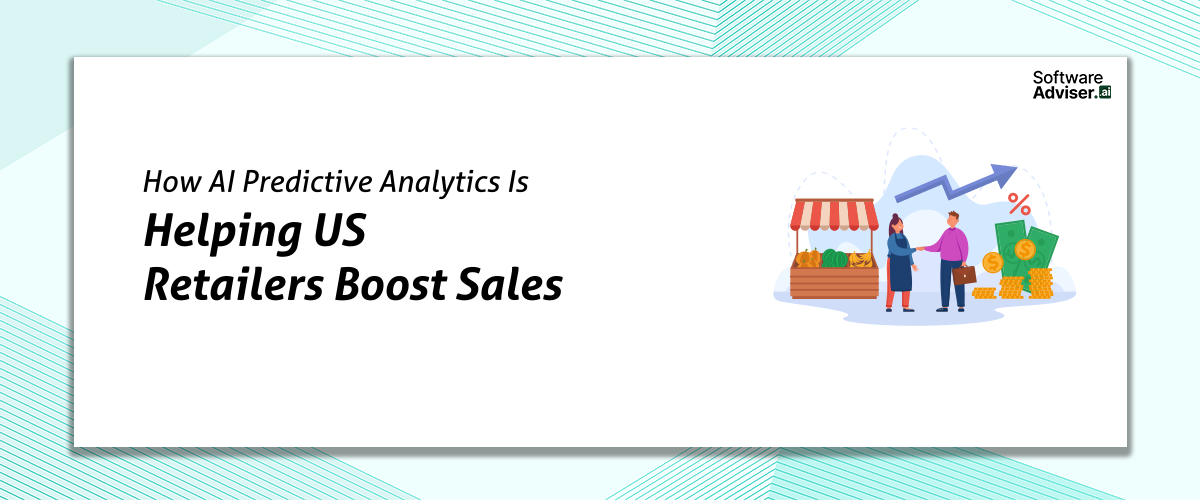
How AI Predictive Analytics Is Helping US Retailers Boost Sales
 David N. Wilks
A stockroom packed with unsold winter coats during an unseasonably warm November. Empty shelves the morning after a social media trend spikes demand for a niche beauty product. These aren't rare edge cases; they are the exact operational bottlenecks US retailers face constantly when supply chains rely on backward-looking data. Decisions about what to stock, how to price it, and who to target were made on historical spreadsheets or merchant instinct, without any reliable signal about what was actually coming.
Looking for AI predictive analytics software? Check out Software Advisor's List of the Best AI Predictive Analytics Software in the USA for Your Business.
Thin retail margins leave no room for that kind of guesswork. Progressive companies have abandoned reactive models for something more defensible, combining specialized predictive analytics tools and consumer analytics software into their processes to examine consumer patterns before even a purchase occurs. This structural change converts fragmented data points into definite, quantifiable income increases, lower acquisition costs, and dependable supply networks free of pricey operational surprises.
What is AI predictive analytics, and how does it work?
AI predictive analytics integrates historical sales records, machine learning algorithms, and live external inputs to map upcoming consumer behavior patterns. Where traditional business intelligence tools look backward—telling a brand what already happened—predictive models look forward to determine what happens next.
The mechanism isn't simple linear forecasting. It runs a continuous loop:
|
Stage |
What Happens |
|
Data Ingestion |
Historical sales and real-time external trends feed into the engine |
|
AI Processing |
Machine learning identifies patterns across hundreds of variables simultaneously |
|
Predictive Modeling |
Advanced Predictive Analysis Models generate probability-weighted forecasts |
|
Actionable Output |
Insights and automated decisions delivered directly to retail operations |
Variables the algorithm tracks simultaneously include localized weather shifts, regional economic indicators, web browsing history, and global supply chain transit times. The result is a multi-layered map of customer intent that no spreadsheet team could build manually.
Implementing this technology typically involves connecting cloud data warehouses with a specialized AB testing platform or pricing engine to validate forecasts in real time. The AI data analytics cuts personal bias out of market planning, keeping speculative guesswork away from high-stakes financial choices.
For retail brands, deploying these solutions connects raw data directly to storefront operations. This bypasses the need for manual review entirely, so analysis becomes instant execution.
How US Retailers Are Using AI Predictive Analytics to Increase Sales
Shifting from passive tracking to proactive execution is how retailers protect margins in a low-tolerance operating environment. A unified AI predictive analysis approach across digital and physical channels allows companies to optimize every customer touchpoint rather than reacting to problems after they've already cost money.
Demand Forecasting and Inventory Optimization
Unsold inventory sitting in regional warehouses doesn't just take up space — it ties up working capital that could be deployed elsewhere. US retailers use AI analytics to align production schedules with hyper-local demand patterns rather than national averages.
The precision matters. These models forecast how many units of a specific SKU will sell in a specific zip code during a specific week, not just broad category performance across a region. High-demand products stay in stock. Overstock liquidations that erode margins get eliminated. The financial difference between getting this right and getting it wrong at scale is significant.
Personalized Product Recommendations
Generic banner ads and bulk email blasts have low conversion rates for a reason: they treat every customer identically. Data analytics software changes that by analyzing individual buying histories, click-through paths, and real-time session behavior to serve the exact product a specific user is most likely to purchase next.
The business impact is direct. Average order value increases. Cart abandonment rates drop. Customers who feel like a platform understands their preferences spend more and return more often than those who don't.
Dynamic Pricing and Promotion Strategies
Such strategic foresight has no room for the half-measures of slashing catalog prices to meet quarterly gross sales gains targets at any cost, violating long-term brand equity in ways that harm their competitive positioning for years thereafter.
So, the predictive pricing engine dynamically adjusts prices in real-time response mode built upon competitor information about intent, inventory constraints, and localized urgency of the buying sentiment to optimize margin capture during peak traffic windows, while discounting campaigns are initiated only among those segments that exhibit actual price sensitivity: A pricing strategy grounded upon empirical market reality rather than conjecture.
Customer Retention and Churn Prediction
AI predictive analytics have many advantages for retail businesses. When new customers are more expensive, losing one becomes increasingly challenging. Advanced predictive modeling forecasts subtle behavior changes—infrequent log-in to an application, an extended gap between two purchases, or lowered engagement with emails—which monitors all signs preceding cancellation.
Once those signals appear, the system triggers personalized retention incentives automatically. The intervention happens while the customer is still reachable, not after they've already signed up with a competitor.
Key Benefits of AI Predictive Analytics for Retail Businesses
In short, autonomous machine-driven decision-making, as opposed to conventional legacy forecasting, has the following structural advantages on the balance sheet, which indeed happens, not metaphorically:
|
Core Business Area |
Legacy Operational Approach |
AI Predictive Analytics Approach |
Immediate Financial Impact |
|
Inventory Control |
Bulk ordering based on last year's historical performance. |
Dynamic, automated reordering matches localized demand. |
Reduced carrying costs and minimized stockouts. |
|
Marketing Execution |
Blanket discounts are sent to the entire subscriber list. |
Hyper-segmented offers based on individual buying intent. |
Higher conversion rates and protected profit margins. |
|
Operational Speed |
Weeks of manual data collecting and spreadsheet review. |
Automated, real-time insights given right to dashboards. |
Quicker execution of significant business plans. |
- Better Inventory Management: Corporate capital stays fluid when stock investment aligns with actual upcoming demand rather than historical assumptions.
- Better Customer Experiences: Perfect, simple interactions across online, mobile, and physical stores become possible when systems predict what customers want before they ask.
- More Profitability and Revenue: Maximizing price floors, cutting product waste, and boosting baseline conversion rates over many quarters, all of which show on the balance sheet, helps to drive higher sales and profitability.
- Faster Decision Making: Proven data trends help supply chain and merchandising teams to make decisions free from inside debate.
Do You Know?
McKinsey research found that retailers deploying AI-driven predictive analytics software reduce inventory costs by up to 20% and improve forecast accuracy by 50% compared to those relying on traditional planning methods. The operational gap between AI-enabled and legacy retailers is widening every quarter.
The Future of Predictive Analytics in Retail Beyond 2026
Different corporate technology stacks converging into integrated AI business solutions are fast altering the retail scene. Looking past the current financial year, the reliance on human oversight for routine data interpretation will continue to drop significantly.
Real-Time AI Decision-Making
The next generation of artificial intelligence software won't just provide static recommendations on a dashboard; it will operate autonomously. Shifting digital marketing spend, adjusting manufacturing supply volumes, and rerouting shipping logistics in direct response to predictive market signals without manual managerial sign-offs. The human role shifts from making routine operational decisions to setting strategic parameters within which the system operates.
Hyper-Personalized Shopping Experiences
Personalization goes beyond the browser as physical stores get more closely connected with cloud infrastructures. Advanced retail management software will let stores change their digital signs, smart shelf pricing, and associate recommendations in real time as a consumer moves down the aisle to fit the expected profile of the particular customer entering the door.
Advanced Predictive Analytics Models
Future core data models will process unstructured data inputs with unmatched accuracy. Algorithms will seamlessly scan live video streams, consumer sentiment shifts across decentralized social media networks, and complex global macroeconomic shifts simultaneously, providing retail teams with an incredibly resilient, predictive view of global consumer behavior.
The Growing Role of AI Data Analytics in Strategy
Corporate leadership will increasingly treat AI data analytics not as IT support infrastructure but as the foundational driver of long-term business strategy. Where to build the next flagship location. Which product categories to enter? Which markets to exit? Every major capital decision will run through predictive simulation models before commitment, protecting investment and replacing boardroom debate with verified data.
Conclusion
Reactive retail operations, built around last year's data and merchant instinct, are structurally unprepared for the speed and complexity of 2026 consumer behavior. AI Predictive Analytics replaces that model with one built on continuous data ingestion, real-time pattern recognition, and automated execution that doesn't wait for a weekly planning meeting to act. The return on the technology investment depends on how completely the organization commits to it. Predictive analytics software handles the statistical processing. The organizations that get the most from it are the ones that build a culture of experimentation around it, testing forecasts, acting on the outputs, measuring the results, and feeding that data back into the models. That loop is where the compounding advantage builds over time.
FAQ's
A sophisticated data approach combining past sales data, machine learning, and statistical techniques to forecast future market trends and consumer behavior with great accuracy.
Using actual customer data instead of operational projections, it assists businesses maximize regional inventory levels, run targeted campaigns, and apply dynamic pricing reflecting actual market conditions.
Specific mathematical models and machine learning techniques meant to manage massive datasets, identify undetected patterns, and compute precise probability-weighted forecasts of following outcomes.
AI always chooses from new consumer behavior to hasten predictions, therefore enhancing model speed, adaptability, and accuracy over time as more data is collected.
Less costs associated with extra inventory, improved digital conversion rates, greater margin capture through dynamic pricing, and faster executive decision-making based on tried and true facts.
Indeed, cloud-based solutions include scalable membership levels that provide growing brands with access to robust forecasting free from the IT costs usually needed for business deployment.
Complete autonomous supply chains, real-time in-store customization, and predictive engines answering changing worldwide consumer demand without human operational involvement need
Think for a second about a global network that truly breathes, learns from its mistakes, and anticipates trouble before it begins. This isn't a scene [...]
David N. Wilks
HR professionals can easily be overwhelmed by the questions they receive from employees, which results in delayed replies and unsatisfied employees. A [...]

Dokas mile
In 2026, the landscape of project management software is undergoing a monumental shift, transitioning from passive task-tracking repositories into pro [...]