
What we'll cover
Share with your community!


Get Free Consultation
AI Interview Scoring Under Scrutiny: Bias Audits and What Regulators Expect
 Dokas mile
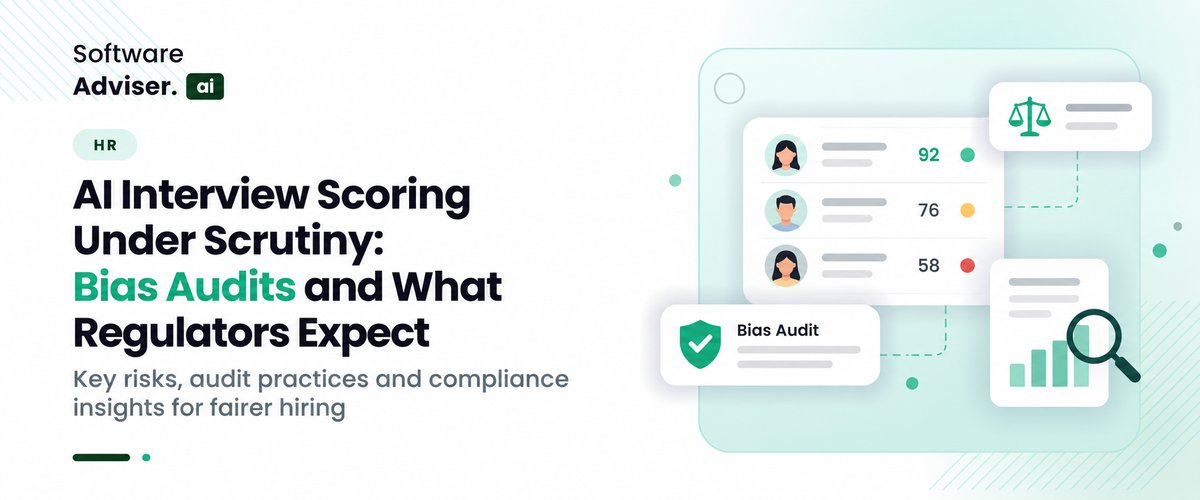
As organizations are increasingly integrating artificial intelligence into their talent acquisition processes, automatic interview scoring tools computational technologies that analyze candidates’ speech patterns, facial gestures, and language use are going through a new level of scrutiny. Numerous authorities, including state entities, federal government agencies like the Equal Employment Opportunity Commission, and local jurisdictions in the United States, have created stringent regulations to ensure that these systems do not lead to biased algorithms or discrimination against certain groups. For American companies, compliance is no longer about obeying the fairness claims put forward by software vendors. In fact, regulatory authorities are introducing obligatory independent audits of algorithms for bias detection, strict notification rules for job candidates, as well as compulsory impact assessments that ensure AI hiring processes comply with such legal frameworks as Title VII and the Americans with Disabilities Act.
What is an AI Employment Decision tool Under U.S. Regulation?
According to U.S. regulations, an automated employment decision tool, or AEDT, is any software that relies on AI machine learning, artificial intelligence, or data analysis to assess job applicants and assist with or even automate hiring practices. Legislation such as Local Law 144 in New York City created this definition, and similar variations have emerged in other states, including Colorado and California. An AEDT can be defined as such if its output, such as a score, candidate ranking, or recommendation, affects or substitutes for human judgment concerning recruitment, hiring, promotions, or terminations.
The legal concept applies broadly to many HR technologies commonly in use, such as resume parsing software, video analysis technology that evaluates tone and facial expressions, personality assessment tests, and algorithmic matching tools. The primary distinction between AEDTs and regular corporate software has to do with the fact that the former have real effects on the employment eligibility of individuals and, therefore, are subject to strict regulations preventing discrimination resulting from the use of algorithms.
While purely administrative tools like basic scheduling assistants, word processors, or spam filters do not normally fall under this category, any algorithmic feature that functions as a main or significant factor in filtering applicants will require strict legal requirements. For employers in the United States applying software categorized as AEDT will face compulsory obligations according to local and state legislation and will be subject to oversight by federal companies like the Equal Employment Opportunity Commission (EEOC). JAXBElement examples of AEDT requirements include mandatory annual independent bias audits, an obligation to publish impact ratios for protected groups, and illustrative provisions of job applicants on the technology of evaluation before they are subjected to it.
Why do AI interview Scoring Algorithms display Demographic bias?
One major cause of demographic bias in AI video interviewing scoring systems relates to their base of knowledge that uses historical hiring data evidencing human biases and systemic inequalities. When developers build these algorithms on the behavior of past employees and recruitment choices made by top leaders, the systems become trained on the demographic characteristics and preferences of those selected people. If the organization historically has employed people with certain racial, economic, or gender backgrounds, the AI might use these characteristics as indicators of success, thus perpetrating discriminatory practices.
Another important source of bias is the specific type of computer vision, speech recognition and NLP systems. The scoring systems analyze the candidates’ voice and behavior and are usually trained on samples drawn exclusively from native English speakers. As a result, candidates with accents distinctive of their regions or people with abnormal behavior receive lower scores for some parameters like confidence, clarity, or fit.
Algorithmic biases persist because programmers utilize imperfect proxy variables to quantify subjective characteristics as cultural fit or leadership potential. Algorithms cannot directly measure ability, so they utilize superficial indicators that correlate unevenly within demographic groups. In the absence of methodological continuous audits, feature suppression, and diverse validation datasets, automated scoring systems routinely exaggerate existing inequalities, discriminate against classified groups under federal civil rights legislation, and present social prejudices as objective evaluation.
What triggers a mandatory bias audit for U.S. employers?
- State and Local Statutes: Certain jurisdictional laws prescribe the need for annual independent audit. For instance, as per New York City Local Law 144, whenever an employer or a job agency applies an Automated Employment Decision Tool (AEDT) to evaluate or screen a potential candidate or worker who lives in the city, an audit becomes mandatory.
- Significant Dependency on Output of Algorithm: An auditing requirement is triggered whenever the tool is used as a simpler scoring, classification, or key screening method that replaces human judgment on the matter of hiring, firing or promotion/advancement. Devices that only carry out administrative tasks (such as simple scheduling or typing) do not fall under this rule.
- Disparate Impact by the EEOC & Defense Under Federal Law: Despite the absence of a legal prescription in the form of federal laws like the ADA, Title VII, and the ADEA, having AI deployed by employers that leads to unreasonably high exclusion rates among minority groups will expose them to liability. Employers typically conduct a pre-deployment bias audit, which serves as their defense since they will be able to demonstrate that the algorithm they are using is appropriate for the task at hand, conforms to business necessity, and is unbiased.
- The Need for the Vendor to Comply with Various Regulatory and Contractual Requirements: As increasingly more states are introducing anti-bias frameworks, HR departments are automating a number of audit procedures with respect to vendor procurement. Employers are now requiring software vendors to provide independent third-party bias audit certifications prior to rolling out their scoring algorithm for live recruiting purposes.
How do Independent Auditors Measure Disparate Impact in Hiring AI?
Independent auditors assess disparate impact by determining if an AI recruiting system has resulted in statistically significant differences in success between protected demographic categories (e.g., race, ethnicity, gender, and intersectional categories). Rather than assessing code and intent, auditors focus on real-life outcome data using legally standardized metrics, statistical testing, and proxy analysis.
- Metric binarization and demographic categorization
Auditors start the process by classifying applicants according to the Equal Employment Opportunity Commission (EEOC) measures. Since the results depend on the tool, auditors will convert them into binary pass/fail evaluations.
- Classification models, like pass/fail models and rank models, measure the selection rate of different demographics,
- while Regression Models (continuous scoring models) depend on the use of continuous values (such as candidate match scores that run from 0 to 100). The auditor processes the continuous values by binarizing them, using the median as the threshold for the binarization process.
- Using the four-fifths rule and implications of the impact ratio, according to regulations mandated by EEOC (and other local laws, such as the Law 144 of NYC).
- Identifying the Benchmark the group that has the highest selection/scoring rate is used as the basis for comparison.
- Calculate Ratios the selection rate of other groups is divided by the reference group.
- Using the 80% Standard if the ratio is below 80%, it implies that there is a likelihood of an adverse impact on a non-benchmark group.
What Transparency Disclosures must Companies provide to Job Candidates?
- Preceding Notification of AI Evaluation: A precise, concise message sent to applicants preceding the assessment (typically at least ten working days in specific regional areas) informing them that an automated tool or computer program will assess their application or interview results.
- Assessment Criteria and Analyzed Job Attributes: A full explanation of the exact job facts, skills, and personal traits that the computer program is designed to evaluate (details should include attention to keywords, voice tone, body language, etc.).
- Data Types Collected and Used: A summary of primary data types being captured from the applicant (examples are facial video clips, speech recordings, resume papers, or behavior data gathered from other sources).
- Data Retention and Confidentiality Policy: Information on how candidate information will be kept, how long video recordings and evaluation indicators will be stored, and if this information will be used to teach software providers in the future.
- Audit Compliance Notification and Disparate Impact Findings: Public or immediate disclosure, with a summary of the latest independent third-party bias audit findings, including the impact ratio and the demographic composition of the affected groups.
- Instructions for Declination, Adjustments, or Human Review: Clear explanation of how candidates can decline to participate, seek reasonable adjustments (for example, with respect to a disability or dialect barrier), or ask for human assessment.
How are Federal Agencies like the EEOC Enforcing AI Discrimination Laws?
Leading federal regulatory agencies, such as the Equal Employment Opportunity Commission (EEOC), the Department of Justice (DOJ), and the Federal Trade Commission (FTC), are responsible for applying anti-discriminatory laws regarding the use of artificial intelligence in hiring as stated in the following six core methods they employ:
- Holding Employers Responsible According to Title VII (Disparate Impact): The Equal Employment Opportunity Commission (EEOC) sees AI recruiting mechanisms, automated interview assessments, and ranking algorithms in the light of traditional selection procedures defined in Title VII of the Civil Rights Act.
- The federal agency checks algorithmic: Effects in influence on applicants by means of the Four-Fifths (80 percent) Rule, which prescribes that if an AI systems chooses candidates from the protected classes at a rate lower than 80 percent of that of the most successfully selected group, the federal reserve find that this system is discriminatory and thus can hold the employers responsible for misuse unless the employer proves that its practices are entirely job-related and necessary.
- Utilizing the Americans with Disabilities Act (ADA) in evaluation of Algorithmic Screening Tools: Federal enforcement presumes application of AI systems that may discriminate people with disabilities without knowing that they are doing this. The EEOC
- Treating Software Vendors as Employers’ Agents: In an unprecedented change brought about through aggressive litigative actions, the EEOC pushes the notion that AI vendors are liable as agents or indirect employers under Title VII, the ADA, and the ADEA. This aims to stop employers from shifting the responsibility onto algorithms.
- Targeting Intentional Discrimination and Systemic Oppression: Federal investigators rely on systemic bias practices to bring Commissioner Charges against employers based on their algorithms featuring intentional bias. This encompasses situations where algorithms are based on demographic data (like postal codes, names of high schools, or continuous unemployment) to exclude certain groups.
- Cross-Agency Enforcement Coalitions Against Automated Crime: Under numerous federal initiatives involving the EEOC, the FTC, the DOJ, and the CFPB, regulatory agencies combine their powers to fight against unfair practices. The FTC investigates the vendors’ claims regarding whether the tools are really free from bias and punishes vendors for untruthful statements. At the same time, the EEOC targets the discriminatory hiring results that follow.
Conclusion
With increasing scrutiny from regulators around AI scoring of job interviews, companies in the USA need to focus on transparency, ongoing audits for discrimination, and strict compliance with laws in order to reduce the risks of discrimination. In this rapidly changing regulatory environment, companies will need to select HR technology that is trustworthy as well as ready for audits and which enables them to achieve optimum algorithmic efficiency while also being fair and accountable. To help businesses in their search for compliant hiring software, they can go to softwareadviser.ai which allows businesses to get technology in a straightforward manner. By using recognized systems and human involvement, organizations can innovate recruitment while meeting the needs of candidates and the legal requirements of regulators.
FAQ's
An AI bias audit is an independent evaluation conducted by a third party to measure whether an automated interview scoring tool produces discriminatory outcomes across protected demographic groups.
Bias audits are explicitly required by laws like NYC Local Law 144, while federal agencies like the EEOC and state regulations in California and Colorado enforce strict anti-discrimination liabilities that effectively make independent audits necessary for compliance.
Regulators primarily evaluate the impact ratio and disparate impact across protected categories like sex, race, and ethnicity, often applying standards such as the EEOC’s 80% (four-fifths) rule.
No, regulators require clear human oversight ("human-in-the-loop") and prohibit fully automated rejections unless candidates receive prior transparency disclosures and an alternative evaluation path.
Independent bias audits must be performed at least annually, alongside continuous monitoring to ensure the system’s algorithms do not drift or introduce new biases over time as new data is processed.
Should your company create texts, be they posts, promotions, descriptions, or correspondence, the idea of using automated writing software may have cr [...]

David N. Wilks
The conventional landscape of Human Resources is undergoing a seismic shift. As we navigate through 2026, AI in HR isn't just a futuristic idea stated [...]
David N. Wilks
With the rapid growth of contingent workforces in many US multinational companies, managing local labor laws across numerous global jurisdictions has [...]