
What we'll cover
Share with your community!


Get Free Consultation
AI Recognition Nudges: Prompting Managers Before Appreciation Gaps Widen
 Dokas mile
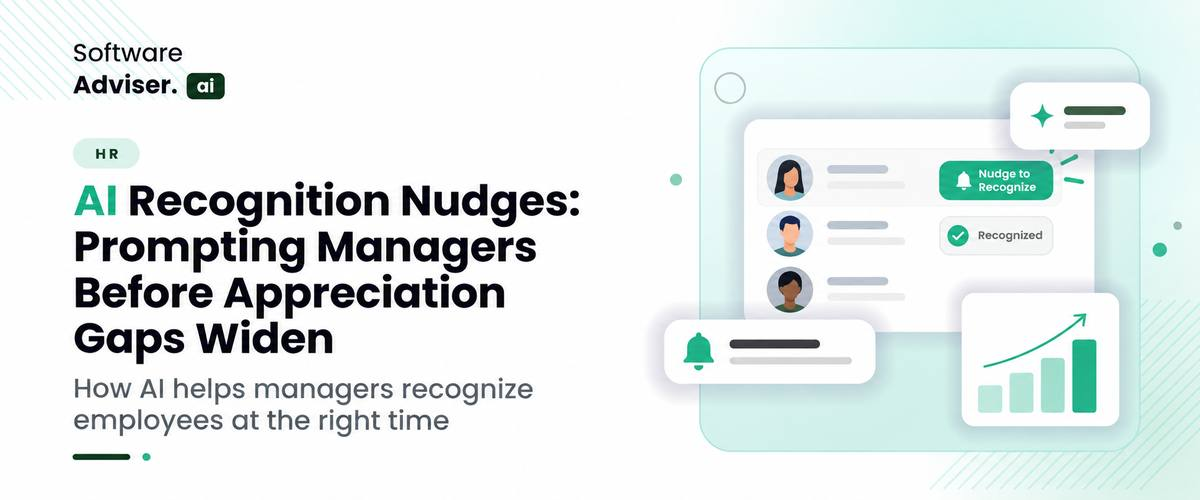
In rapidly moving American businesses, AI employee recognition is frequently placed on the back burner until the time of an annual performance review or exit interview which produces long periods of time when all the hard work remains invisible causing gradual and silent depletion of morale levels. Artificial intelligence gives a revolutionary solution for the problem in the form of recognition nudges, that is, predictive and data-based prompts sent straight to managers using platforms like Slack or Teams when the gaps in appreciation arise. The intervention may work by recognizing real-time signals within the workflow, which means that it may analyze the following metrics: completed tasks, successful collaboration with colleagues, and prolonged working hours. Converting recognition from a reaction to a habit-forming operation may help companies maintain engagement, enhance psychological safety, and cut down staff turnover rates, which is of high significance these days.
What is an AI Recognition Nudge?
An AI recognition nudge is a smart automated tool that prompts managers when it is necessary to thank an employee for their work. The system makes this possible by accumulating daily workflow insights like task achievements, feedback from coworkers, or hours spent on various projects and discovering unnoticed contributions that employers tend to forget. The solution allows notifying managers about the good work of employees instead of waiting until the next review.
In the modern fast-paced, busy world, it is common for managers to forget about the importance of AI employee recognition at work and appreciation, which can cause problems like high turnover. AI helps solve the problem of forgetting about praise and adapting recognition to be incorporated into a daily routine. This is achieved through on-time and precise opportunities to recognize employees’ achievements, so human resources can create a stronger atmosphere of psychological safety in the workplace.
Do you know?
AI recognition nudges not only help boost morale but also help reduce the chances of employees searching for new jobs by over 50%. Companies with praise cultures have a turnover rate 31% lower than companies that use traditional annual employee reviews.
Why are Managers missing Recognition Gaps Today?
Managers in today’s U.S. workplaces are faced with endless cycles of AI employee scheduling , changing corporate priorities, and a storm of digital communications as they go about their days busy putting out fires. As they go about their workdays reacting to important events, proactive leadership practices such as acknowledging the contributions of employees are necessarily abandoned. Regular achievements or small wins are almost always overlooked due to urgent matters, and employees’ accomplishments are inevitably put off until the end of period performance evaluations.
The significant recent movement to remote and hybrid offices has also made people’s ability to witness what their colleagues do during the workday even more difficult. In the absence of physical interactions in one office, the observation of day-to-day, unspectacular work is lost to the leaders. Major accomplishments happen in virtual offices (such as Slack channels or project management software), where employees remain unheard unless they draw attention to themselves or something goes wrong.
Conventional corporate structure plays a part in promoting this delay using retrospective evaluation systems. Annual evaluations and quarterly recognitions treat employee recognition as a one-time occurrence instead of a continuous operational process. By utilizing managers' memories and inflexible timelines, companies allow numerous months of work to stay unrecognized, causing wide recognition gaps that lead to quiet quitting and unpredictable turnover even before the next evaluation cycle.
How do AI Tools Spot Silent Employee Burnout?
- Monitoring Excessive After-Hours Activities
AI HR analytics tools analyze metadata collected from workers' collaboration tools such as Slack, Microsoft Teams, or email programs to identify patterns of increased messages during the night or weekends. Rather than marking just one night, algorithms catch the process and identify continuous behavior that indicates unsustainable what is on employees' plates.
- Evaluation of Changes in Communications and Attitude
AI collects information through Natural Language Processing (NLP) tools in public communication channels to point out the drop in positive emotions, change of style of language, or unusually short writing. A team member who changed from a positive and participative style to nervy, exhausted, and apathetic attitudes is alerted.
- Indicating Erroneous Time Off and Absence of Breaks
Algorithms link together time-tracking information with calendars and holiday request databases to find employees who skip lunch breaks, work through weekends or otherwise leave unpaid time unused. Spotting such cases alerts managers to take action before exhaustive labor leads to severe fatigue.
- Detecting Abrupt Dips in Meeting Participation
AI technologies analyze engagement patterns across calendar data and video conferencing applications to recognize disengagement. If a previously creative and interactive individual suddenly becomes silent by turning off the video permanently or missing community events, the flag of disengagement goes up.
What data triggers an appreciation prompt?
1. Milestones In Tasks And Projects
- Progress trackers (closing major tasks in projects, achieving objectives early, or dealing with many complex support tickets).
- Developer platforms (important code submissions, solving severe bugs, or doing in-depth peer code reviewing).
2. Signals Of Collaboration And Mood
- Workplace chats (increases in positive responses to messages emojis, activation across departments in public chats, or positive references in team discussions).
- Peer acknowledgement tools (noticed acknowledgements or digital greetings through internal evaluation tools).
3. Patterns Of Workload And Activity
- Calendar and email systems (performing severe project cycles, conducting unusually long meetings, or recording off-hours work to meet deadlines).
- Human resource systems (tracking staff milestones such as anniversaries at work, time on service, or length of time since the last recognition from the manager).
How do Managers Respond to Automated Reminders?
The responses of managers to automated alerts for giving recognition to others fall under two categories true gratitude towards this useful buddy or mild skepticism towards this method of coaching. Those leaders who appreciate the tool see it as a silent assistant that allows them to stay in touch with their people’s progress during the very busy workdays. While average managers use a standard template and send cursory messages, effective ones think of that prompt as a new opportunity and use the same context to write a personal note that looks authentic.
However, the success of automated reminders depends significantly on the way they are designed and incorporated into daily practices. If managers are inundated with differing reminders about the completion of every minor task, nudge fatigue occurs, and leaders begin ignoring those reminders. In order not to let leaders see the prompts as obligatory corporate notices, successful companies teach managers to treat prompts as signals of awareness, which allow them to personalize their messages to keep them sincere.
Does AI-driven Praise feel Genuine to Employees?
When it comes to AI-assisted gratitude, workers see the effect of it entirely depending on who delivers the message and how it is expressed. Once the employees learn that the note of gratitude was produced automatically by a machine or copy-pasted from a template, the intended effect is lost. It feels like a transactional, unfeeling act that can even be seen as a form of insult in a subtle way. People would like to be appreciated by their supervisors, not processed by an algorithm.
When the role of AI is simply that of a spotter rather than a writer, the scenario changes. Employees might not be bothered by the fact that their manager has received a notification from a system that told him about their performance; what is important is that this time their manager spared a moment to check the background, get in touch, and thank them personally. If AI works as a hidden helping device, while the manager hands out a real appreciation, then the gratitude is genuine, timely, and meaningful. Thus, AI has to show that people deserve to be praised, but it is the responsibility of people to discuss it.
How do Automated Nudges improve Workforce Retention?
-
Filling the Visibility Gap for Understated Contributors
Automation of reminders elevates the unique contribution from the background appraisal systems, allowing high achievers and able performers to be recognized regularly and valued accordingly.
-
Ensuring Continuity in Manager Working Style
These systems are capable of transforming incidental compliments based on their managers’ memories into a day-by-day series so that the praises are constant and do not initial encounter any interruptions.
-
Recognizing the Threat of Attrition before It becomes Strong
Thanks to the monitoring of high loads at work and the decrease in the teams’ moods, a company will be notified in a timely.
-
Appreciation of Trust between Managers and Employees
An adequate management distribution of praise based on facts allows building psychological comfort for workers since they feel this way that their work is significant for the company.
-
Fostering Voluntary Labor Turnover Decline
The automatic system of timely recognition of success leads to a marked reduction of voluntary labor turnover.
Pro-tip
Use AI prompts as a simple guide for where leaders should look. Do not let the system send praise for a manager unless the manager has added their own notes. People can spot scripted thanks right away. It feels fake. That kind of message weakens trust. For better retention, ask managers to pull in the tool’s context and then write the thanks in their own voice, with real details.
Conclusion
AI-based recognition can help when leaders are overloaded. It can also help teams get credit sooner, before issues grow. When the tool uses up-to-date workplace signals, it can point out work that might otherwise be missed. Then managers can respond with real recognition. Done well, this supports morale and can reduce the risk of people leaving. As work changes over time, adding these tools into daily routines can help keep effort visible. If you want to check newer HR options, compare modern platforms at softwareadviser.ai.
FAQ's
An AI recognition nudge is an automated prompt that alerts managers to team member accomplishments so praise can be given in real time.
It analyzes workflow signals across workplace apps, such as completed project milestones, high peer collaboration, or extended work hours.
No, the AI simply alerts managers to missed wins, allowing leaders to deliver personalized, genuine appreciation.
They ensure quiet contributions are consistently acknowledged, eliminating appreciation gaps that often lead to silent burnout and quitting.
Yes, these prompts deliver notifications directly into existing team platforms like chat channels, calendars, and project dashboards.
The landscape of American workforce management is shifting rapidly, and US-based companies are increasingly turning to AI HR chatbot software to stay [...]

David N. Wilks
Buying AI software is the easy part. Getting your team to actually use it, without grinding the daily work to a halt, is where most companies trip. Th [...]
David N. Wilks
For any business owner, handling payroll taxes in the USA can be truly stressful. Keeping track of federal withholdings, the ever-changing local tax l [...]