
What we'll cover
Share with your community!


Get Free Consultation
AI Labour Forecasting: Matching Restaurant Staffing to Predicted Covers
 Dokas mile
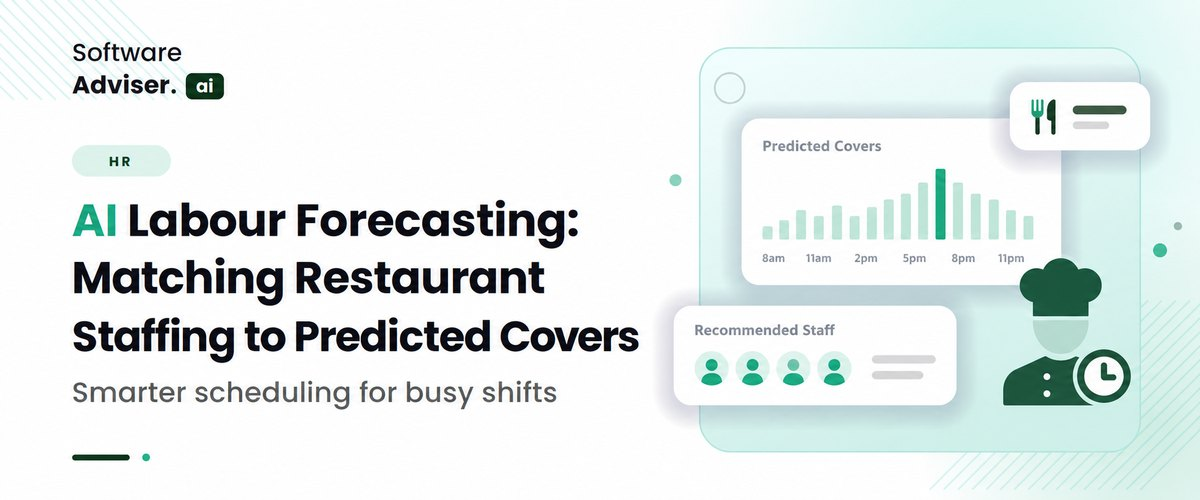
In the contemporary restaurant business in the United States, with labor representing 30% to 36% of gross revenue and the increasing minimum wage, traditional shift scheduling based on a manager’s intuition or simple year-over-year averages is no longer beneficial. AI-based labor forecasting is the solution for this problem because it provides businesses with workforce schedules based on operational data. Instead of using static sales goals, machine learning solutions examine previous sales data by quarter hours and combine it with different external factors that impact sales, such as local weather, regional events, and seasonal shifts. By providing the right number of employees in front-of-house and back-of-house, the system allows operators to avoid problems with overstaffing during short periods of time with no customers and understaffing during times of unexpectedly high demand.
What is AI Labor Forecasting in U.S. Restaurants?
Restaurant businesses in the United States spend over 35% of their revenue on labor costs, leading to poor operational decisions when managers use their instinctive skills to schedule shifts. Artificial intelligence forecasting solves that problem by communicating with point-of-sale systems to obtain data on historical sales and predict future traffic. It utilizes the data to analyze and create schedules that are no longer based on assumptions but based on actual demand.
For accurate scheduling to take place, AI machine learning programs must analyze foot traffic and consider local factors like weather, sports activities, events that take place in the area at the time, and existing trends. The software creates shifts for kitchen staff and servers, based on where and when workers are needed. In this way, the operators manage to prevent overstaffing when there is slow work or understaffing when there is a peak in the restaurant's popularity.
Do you know?
Can you imagine that AI labour forecasting can forecast hourly customer counts ("covers") with up to 95% accuracy after analyzing years of data from point-of-sale systems, weather patterns, and nearby event schedules? In the United States, where staffing solutions account for almost 39% of all staffing software processes used in the restaurant industry, companies relying on AI technology for forecasting report savings of up to 22% in overstaffing costs. Thanks to this software, restaurant managers are able to create schedules automatically instead of trying to make any guesses as to how many staff members they need, which in turn helps them to avoid any losses related to overstaffing during rush hours.
What data does AI use to Predict Hourly Covers?
The AI cover forecasting system is based on years of data collected from point-of-sale systems. This technology analyzes sales trends and guest counts by breaking years of sales records into intervals of 15 to 30 minutes. It tracks sales decreases in specific seasons, as well as monitors real-time data reflecting customers’ channels of choice. An algorithm powered by machine learning is capable of adjusting its operation beyond the level of the original data it analyzes by processing various hyperlocal external information streams continually. For example, weather forecasts deliver hyperlocal data related to temperature, precipitation, snowfall, and other phenomena influential on people’s decision to go out for dinner.
The software monitors local calendars that contain information about sports events, concerts, school schedules, parades, as well as holidays that take place the AI restaurant work, thus ensuring the prediction of foot traffic patterns based on historical data regarding those events. Lastly, the models study all the internal factors and variables influencing changes in traffic. This type of research encompasses monitoring the current marketing campaigns, seasonal offers, happy-hour prices, and advertisement spendings. Furthermore, modern AI solutions include information regarding reservations and table booking as well as road and construction news nearby the restaurant. By combining all the internal data and external information regarding environmental conditions, the AI creates a trustworthy, dynamic model of expected visitors’ number.
How does AI Balance Labor Costs with Service Quality?
1. Demand Matching in Micro-Increments
AI gives an effective forecast of the clients’ flow by minute instead of hours. This means that there are no quiet hours when unnecessary employees have nothing to do, and at the same time the necessary number of employees is present at the needed moments.
2. Dynamic Staggered Scheduling
AI employee database work time schedules not with the help of rigid blocks of workdays (e.g., from 5 p.m. to 1 a.m.), but with the help of different starting and ending times for each individual‘s shift. Thus, clients are provided with personnel in a greater number than it actually required.
3. Optimal Shift Planning Based on Skills
AI finds the link between the flow of visitors and the skills of each particular employee. Thus, during rush hour, people with appropriate skills will cope with the task professionally.
4. Timely Day Adjustments
The use of real-time AI POS input data tracking facilitates early warnings for managers on unusual sales trends during shift periods. If a major downturn in sales occurs, managers can decide to send home some of the staff early.
5. Prevention of Overtime Issues
Algorithms monitor the weekly pattern of employee hours to signal soon-approaching overtime limits and tiredness due to consecutive long-hour shifts. This means that workloads are kept at acceptable levels and errors are not made in customer service.
6. Channel-Based Splitting of FOH
The systems help separate forecasting data for dine-in and takeout/ delivery/ drive-thru orders. This enables operators to reduce FOH staffing during peak takeout times, keeping the kitchen staffed properly too and avoiding bottlenecking in the line while avoiding over-staffing in the dining space as well.
How do managers adjust shifts mid-day using AI?
1. Keep an Eye on Live Variance Alerts: Automated Push Notifications
- The AI technology continuously evaluates actual business output against targets set as expectations. When sales figures miss the required value, e.g., the business is doing 15 percent less business by 1 p.m., a mobile device or AI POS alerts the manager.
2. Analyze the Template for Cuts and Call-Ins: The decision is made primarily by computer algorithms.
- The AI reduces the need for managers to calculate cuts. Instead, it ranks options for such decisions.
- Downtime employees to be let off early are nominated based on their arrival time at work, wages, and overtime.
- The AI identifies employees on standby who will be able to work without causing labor violations or overtime.
3. Carry Out One-Touch Mobile Updates: Instant communication with the team.
- One tap on the screen confirms approval of the necessary changes.
- Employees will receive notifications about their earlier working hours through their devices.
- The system sends data about available open shifts to off-duty employees and awards the task to the first responder according to the rules established beforehand.
How does AI help Restaurants follow U.S. fair Scheduling Laws?
1. Automated Enforcement of Advance Notification Deadlines
Various U.S. states have enacted the Fair Workweek and predictive scheduling laws that compel restaurants to issue their work schedules from 7 to 14 days in advance. Using historical guest data, AI platforms automatically create the most efficient schedules weeks in advance and thus ensure compliance with deadlines for publishing, which implies no financial penalties for late notifications.
2. Eradication of Clopening Offenses
Fair scheduling laws require a minimum rest period (generally 10 to 11 hours) between consecutive shifts to avoid clopening situations (that is, working as a closing bartender right before the following shift, which is opening). AI systems check time-off requests and employee histories to provide managers with an automatic ban on scheduling shifts that violate local rest periods.
3. Automatic Calculation of Predictability Pay Premiums
Local labor laws often state that when an emergency shift change occurs, the employer is obliged to provide its employees with "predictability pay" or inconvenience payments. Therefore, whenever there are changes made in the work schedules after they are already published, the system records all the changes, performs all the necessary calculations of extra payments that should be provided to the affected employees, and automatically makes them available for payroll.
4. Priority Protections Regarding Access to Hours
Certain U.S. fair scheduling laws obligate businesses to provide existing eligible part-time employees with any additional available hours before considering new recruitment. AI scheduling software assesses existing employees’ availability and abilities, thus offering open shifts first to qualified employees.
5. Credible Good Faith Estimates for New Workers
Often, predictive scheduling laws state that in hiring employees, employers need to provide them with readily available written “Good Faith Estimate” about the anticipated average work hours and shift patterns. The data-driven predictions are made by AI platforms while analyzing sales and job positions simultaneously, which prevents misunderstandings regarding work hours.
How much Labor Cost can U.S. Restaurants Save with AI?
1. Cut Total Payroll Expenditures
AI-powered scheduling systems enable a reduction in overall labor costs by about 10%-15% for the majority of American restaurants. Such systems, which understand real-time staffing demand and alter working hours accordingly, enable lowering unnecessary baseline payroll costs.
2. No Unnecessary Overtime Payments
Overtime payment (1.5 times regular pay) can reduce earnings significantly. The AI stores information about employees’ hours in their weekly schedules and gives a signal to the managers if a worker is about to work overtime.
3. Reducing Idle Hours and Overstaffing
Conventional scheduling requires managers to overstaff in anticipation of a rush. With the help of AI, businesses get rid of 1-2 idle hours for employees on average during slow periods in the morning or afternoon.
4. Avoiding Fines for Unpredictable Schedules
Fair Workweek laws in The Big Apple and other important U.S. cities impose penalties for late schedule modification. However, AI anticipates demand and assists managers in publishing their schedules considerably in advance, thus helping to avoid costly fines from the local labor authorities.
5. Decrease in Turnover and Onboarding Expenses
The restaurant industry in the United States faces an average turnover rate of over 70%, with each employee leaving costing approximately $5,800 to replace. AI scheduling provides equitable distribution of shifts, allows for the swapping of shifts via a mobile application, and a predictable schedule, which helps to tackle burnout and reduce recruitment costs.
6. Saving Time for Managers
Restaurant managers spend up to 4-6 hours weekly on planning work schedules, changing spreadsheets, and making calls to substitute for absentees. AI scheduling sites are able to create fully compliant and optimized schedules in minutes, allowing managers to concentrate on operational tasks and improving customer experience, leading to increased revenue.

Pro-tip
To get the best results from cost-saving opportunities, do not let the managers override the AI schedule recommendations unless a major unforeseen event occurs. Use a 15-minute prediction of job replacements combined with real-time tracking of the POS system in order to notify managers in important moments. Make sure that the AI system is fully integrated and its results do not need inputting changes by a human.
Conclusion
The use of AI labor forecasting revolutionizes restaurant operations in the United States from uncertain scheduling into an accurate, profit-saving strategy. By aligning kitchen and front-of-house staff levels with accurate hourly cover estimates, operators can avoid unnecessary extra dues and stay compliant with labor scheduling law enforcement constraints. The wide range of automated labor solutions accessible in the market can be confusing, but it becomes easier to find appropriate solutions for your point-of-sale system and dimensions of the venue due to softwareadviser.ai – a one-stop platform providing information about various business software solutions helpful in increasing profits.
FAQ's
AI labor forecasting is technology that analyzes historical POS sales, foot traffic, weather, and local events to automatically predict guest covers and schedule front- and back-of-house staff efficiently.
Most AI platforms deliver highly accurate 15- to 30-minute cover predictions 7 to 14 days in advance, helping operators publish schedules that comply with U.S. predictive scheduling laws.
U.S. restaurant operators typically reduce total payroll costs by 10% to 15% by eliminating overstaffing during lulls, avoiding overtime pay, and lowering manager administrative time.
Yes, managers can review real-time POS data on mobile devices or POS terminals to approve mid-shift cuts or call-ins suggested by the AI based on live traffic variations.
AI labor software requires a cloud-based point-of-sale (POS) system and internet access, enabling seamless integration with existing payroll platforms and employee mobile devices.
Should your company create texts, be they posts, promotions, descriptions, or correspondence, the idea of using automated writing software may have cr [...]

David N. Wilks
Models for ranking candidates use algorithms that have been trained using data from previous hiring, certain features of resumes, and assessments of c [...]
Dokas mile
The problem with most project management setups is not a lack of data. It is a lack of signal. Every tracking tool gives you tasks, timelines, and sta [...]