
What we'll cover
Share with your community!


Get Free Consultation
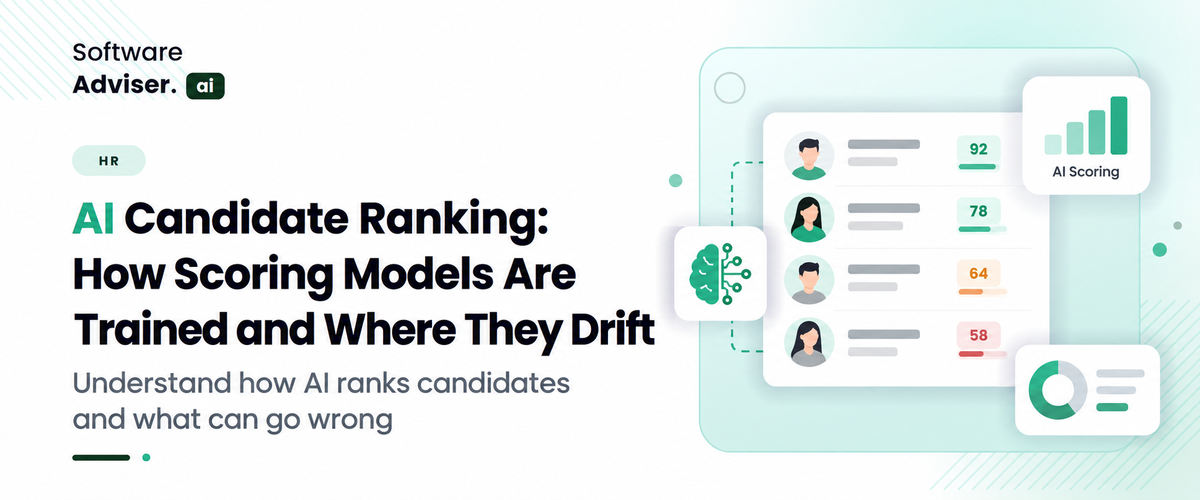
AI Candidate Ranking: How Scoring Models Are Trained and Where They Drift
 Dokas mile
Models for ranking candidates use algorithms that have been trained using data from previous hiring, certain features of resumes, and assessments of candidates’ skills to determine which candidate is suitable for a job. They may still be affected by systemic drift in case of changes that take place in the entire workforce landscape. These candidate ranking models are built on supervised learning based on the outcomes of the previous hiring practices, where great performers, the chances of being invited for an interview, or successful employment are taken as target variables. Nevertheless, they suffer from certain types of drift. The models also experience concept drift in case of any changes in the job positions and proxy drift in case of relative biases such as favoritism toward certain universities and evaluation of employment gaps. Moreover, data feedback loops contribute to the reinforcement of historical hiring patterns. In the absence of monitoring, such drift leads to the exclusion of great candidates.
What is AI Candidate Ranking?
AI candidate ranking involves applying AI machine learning software techniques for the automatic assessment and arrangement of candidates in consideration of their suitability for a specific job position. The use of this platform frees recruiters from reading through numerous applications because the software reviews candidate details (such as skills, previous job positions, etc.) before giving a score to each candidate. This means making recruitment fast and straightforward, as it enables recruiters to spend less time searching through resumes as they can concentrate their attention on the strongest candidates.
The machine forms its predictions based on supervised learning that evaluates the previous hiring history as well as metrics such as how successful previous hires were, the interviews passed by applicants, etc. It allows the computer system to discover the types of signals or patterns of behavior that show successful people in the job. However, since the system learns from the ‘historical’ experience, it needs to be analyzed regularly to avoid any disturbances with biases or to eliminate atypical applicants.
Did you know?
Can AI candidate ranking systems accidentally eliminate the best talents as they utilize new job titles or skills that are not covered by historical datasets? This issue, commonly referred to as concept drift, prevents scoring systems from properly assessing the latest skills of the candidates. Consequently, organizations that rely completely on automated machine learning algorithms and do not conduct regular audits may lose a very talented employee just because his resume does not include the necessary keywords.
What data Features and Historical Signals are used to Train Scoring models?
- Explicit Resume Skills & Keywords: Any skills including hard and soft skills, technical certifications, industry-specific tools, and other terminology as listed in the applications of the applicants.
- Work History & Title Hierarchies: The job titles of the applicants along with the total years of relevant experience, the levels of leadership achieved within the organization, and the career development history.
- Educational Background & Credentials: The degrees obtained, area of expertise, technical certifications attained, and the previous data obtained from the testing of the selected candidates.
- Tenure and Stability Signals: The average length of the job held previously, the number of changes related to work, and the data obtained from other companies used for checking stability.
- Historical Hiring Outcomes: Any data available from the organization indicating who passed the screening and the AI video interviewing successfully.
- Post-Hire Employee Performance: The evaluation and performance of the employee on the job obtained through performance evaluations, promotions, and retention tracking information.
How do these models Calculate Applicant Rankings and Target Retention Metrics?
Calculating Applicant Rankings
- Feature Extraction and Vectorization: The software scrapes resumes and job applications and evaluates skills tests, converting data into numbers. For example, a software engineer who understands will have their credentials converted into numbers based on the skills, AI remote work experience, and career record.
- Pattern Matching Using Supervised Learning: Scoring models are built using gradient-boosted tree models (XGBoost) or neural networks and compare against the elements of other high-rated applicants' characteristics in order to score candidates.
- Pairwise and Listwise Ranking: In contrast to a common scoring mechanism based on a 1 to 100 scaling system, these algorithms can take scores of pairs of candidates against each other, thus creating a list anew.
Targeting Retention Indicators
- Survivor Models: To predict how long a new applicant will be in a company, organizations utilize survivor models trained on the data of previous employees.
- Risk Score Weighing: Models can generate a risk score or projected tenure based on algorithms where information about the person is analyzed.

Pro-tip
In the process of auditing candidate ranking algorithms, do not rely on the raw static scores of candidates; rather, require a continuous application of the pairwise rank validation process along with survival-model-based predictions of lifetime work tenure. It is also important to regularly re-normalize candidate vectors with respect to new job posting requirements, so that the outdated skill weights do not adversely affect the rankings of top candidates. Finally, don't forget to compare flight risk labels assigned through automation with qualitative information from interviews conducted with recruiters.
Why do Trained AI Scoring models gradually drift and lose Predictive accuracy over Time?
1. Concept Drift (Changing Roles and Abilities): Concept drift arises when the statistical ties connecting the input features and target label change with time.
- Evolving Demands: In 2020, a candidate for Senior Software Engineer would have been assessed on commonly used cloud and full-stack technologies. By 2026, this particular position might incorporate certain elements of generative AI, advanced cybersecurity techniques, or blockchain systems.
- Outdated Selection Criteria: The qualities that defined a successful employee some five years ago do not correspond with the qualities that define a successful employee today. As the statistics show, the model still rewards patterns that are no longer relevant.
2. Feedback Loop and Confirmation Bias: Like it is with many contemporary candidate screening systems, the AI technology utilized could experience closed-loop feedback.
- Self-Fulfilling Prophecies: If an algorithm gives better scores to applicants from targeted universities, recruiters will always look for applicants from those particular universities.
- Absence of Counterfactuals: The algorithm does not imply the candidates who were not selected for hire, so it does not get any performance estimation of those missing candidates.
3. Proxy Drift (Changing Demographic & Socioeconomic Factors): The phenomenon known as proxy drift happens when certain features that are harmless and used by the model as indicators change their meanings or unintentionally represent aspects of a protected class.
- Changing Resume Standards: The norms that define resumes keep changing, and examples of that would be the use of remote work, non-linear job trajectories, gaps in the work history due to caring for children, or gig economy work.
- Inadvertent Bias: Algorithms trained on previous corporate data could categorize gaps in employment and drastic job changes as signs of a bad employee record. With the emergence of job hopping and flexible employment as new industries’ norms, the use of such features as quality indicators rejects many qualified candidates.
How does Model drift impact EEOC Compliance and Algorithmic Fairness in US Recruiting?
Bringing about Illegal Unequal Impact
- The Civil Rights Act: Title VII divides the concept of employment discrimination into two types: disparate treatment that encompasses deliberate prejudice and disparate impact, which confirms that a seemingly neutral mechanism disproportionately creates barriers for certain disadvantaged groups. Model drift is one of the hidden causes of disparate impact.
- Non-Compliance with the Rule of Four-Fifths: According to UGESP, all forms of discrimination are believed to exist when the selection rate concerning a protected group does not reach 80% of the selection rate of the best-performing group.
- The Drift Effect: A model that has been experiencing either a proxy drift or a concept drift will be making mistakes when interpreting the demographic proxies. As a result, the model that has been used to similarly evaluate the demographic groups will end up discriminating against women or minorities in 2 years.
Loss of Job-Relatedness and Business Necessity Defense
- Validation Failure: In the process of job evolution, a scoring model continues to score applicants based on irrelevant metrics.
- Inability to Defend Legally: In the instance of adverse action against the applicant, the employer will be unable to defend against the use of the tool, specifically by being able to establish that the low scores produced by this model adequately characterize the skills of applicants to perform tasks associated with new job responsibilities.
Exposing Employers to Liability
- Many hiring managers erroneously: think that the AI software vendors bear the burden of potential bias brought by an algorithm. However, the courts and the EEOC have made it clear that the employers remain completely liable for the selection instruments from third-party vendors.
- If a company purchases a scoring: Tool that was licensed and validated by a vendor in 2023, after two years of operation of the tool, it will still retain full liability.
How often must Employers Retrain and Audit Candidate Ranking Algorithms to Prevent Failure?
In order to avoid issues like operational failure, bias erosion, and legal liability in accordance with US labor legislation, employers ought to avoid viewing candidate ranking software as "do-nothing" automatic solutions. In order to ensure AI recruitment system effectiveness, fairness, and compliance, one needs to develop a comprehensive approach to continuous operation monitoring, frequent retraining, and annual auditing procedures.
|
Cadence |
Operational Task |
Primary Focus |
Legal / Compliance Driver |
|
Monthly |
Real-Time Statistical Checks |
Monitor selection rates across race, ethnicity, and gender; calculate Four-Fifths (80%) Rule ratios. |
EEOC Disparate Impact Monitoring |
|
Quarterly |
Calibration & Model Retraining |
Ingest fresh hiring, interview performance, and post-hire retention data; adjust feature weights. |
Preventing Concept Drift |
|
Bi-Annually |
Feature & Proxy Audits |
Inspect feature importance; remove or re-weight emerging proxy variables (e.g., zip codes, gap years). |
Preventing Proxy Drift |
|
Annually |
Formal Third-Party Audit |
Conduct an independent, published bias audit of selection impact ratios across protected groups. |
NYC Local Law 144 / UGESP Compliance |
Conclusion
AI employee selection software helps rapidly go through numerous candidates in recruitment processes, but if not monitored properly, it leads to problems associated with algorithm drift, hidden bias, and changing job duties. Managing the process can be achieved through human intervention. Having humans in the process makes it easier for organizations to establish clear boundaries as far as recommending automation technology is concerned.
FAQ's
AI candidate ranking is the automated process of using machine learning algorithms to evaluate, score, and order job applicants based on how closely their profiles match specific job requirements.
Scoring models are trained using resume keywords, work history, education, skill assessment scores, past hiring decisions, and historical employee performance data.
Models utilize survival analysis and risk-score weighting trained on historical employee tenure data to predict how long a candidate is likely to stay with the company.
Models lose predictive accuracy over time due to concept drift (evolving job roles), proxy drift (shifting demographic markers), and feedback loops that continually reinforce historical hiring biases.
Employers should perform real-time monthly bias checks, quarterly model retraining, and mandatory annual third-party audits to maintain accuracy and guarantee legal compliance under US employment laws.
Insurance has in no way been an industry recognised for velocity. Forms, again-and-forth telephone calls, weeks of waiting on a claim choice- that was [...]

David N. Wilks
A decade ago, recording your screen meant hitting record, talking for twenty minutes, then spending another hour trimming dead air and adding captions [...]
Dokas mile
For decades, the annual review was treated as gospel — one meeting, once a year, where a manager handed down a verdict on twelve months of work. Mos [...]