
What we'll cover
Share with your community!


Get Free Consultation
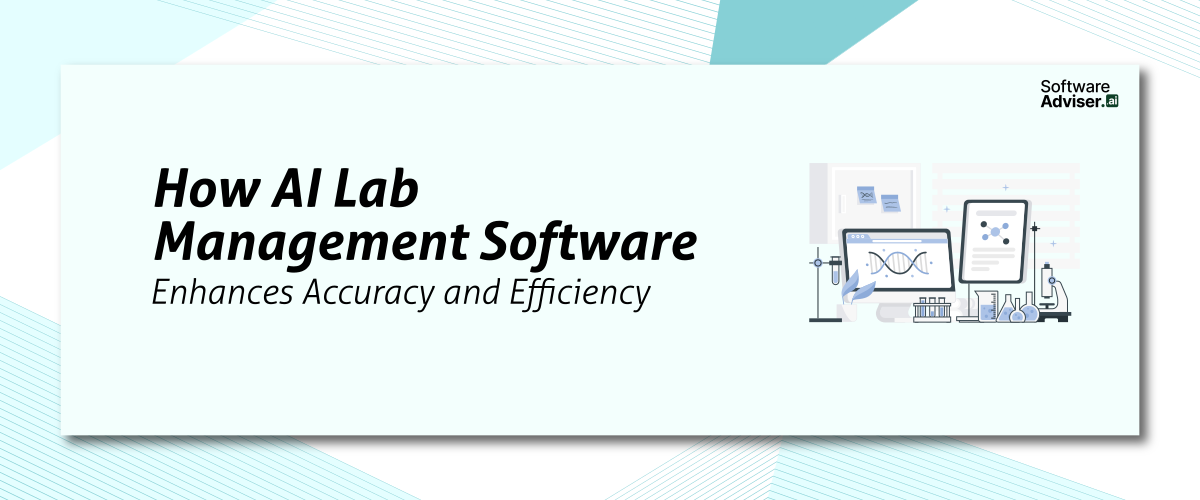
How AI Lab Management Software Enhances Accuracy and Efficiency
 David N. Wilks
The rapid speed of scientific progress places a great strain on laboratories to generate correct and fast results from vast data sets. Historically, laboratories have dealt with human error in inputting data and bottlenecks due to the manual management of laboratory operations; however, with AI-based Laboratory Management Software, laboratories will now experience a fundamental transformation. The use of artificial intelligence will significantly decrease human error through automation of many repetitive tasks, prediction of maintenance of equipment, and prompt identification of irregularities in raw data.
What Exactly Is AI Lab Management Software, And Why Does It Matter?
Software designed to manage laboratories in today's age of AI is a true SMART (smart, automated, responsive, metrics-driven) digital laboratory and automates, streamlines, and optimizes the day-to-day functions of a lab. Unlike traditional solutions, which typically just bring data together, the solution uses machine learning and artificial intelligence to analyze and keep track of experiments being done at the various laboratory locations. This is done by collecting large amounts of data (high volume data entry) automatically and integrating with multiple types of laboratory equipment (hardware)." The system continually monitors raw analytical findings to identify abnormalities, forecast when equipment requires repair before it fails, and optimize inventory tracking. It’s basically a digital, intelligent co-pilot for scientists, taking care of the boring admin and operational heavy lifting so researchers can get on with genuine discoveries.
There are two big reasons scientific teams enjoy this technology: it saves them a ton of time, and it delivers rock-solid data integrity. Labs employing AI software report a huge decrease in transcription mistakes and experimental bottlenecks, as the technology substitutes cumbersome human spreadsheets with real-time, automated data gathering. This speeds up project schedules and increases total throughput, while also guaranteeing that all results are completely traceable and meet rigorous regulatory criteria. At the end of the day, researchers appreciate it because it removes the cognitive load of paperwork and operational disarray, allowing them to do what they do best: innovate and solve hard scientific issues with great confidence.
How Does AI Lab Management Software Improve Accuracy In US Labs?
Laboratories around the United States have a primary priority when it comes to data integrity, since regulatory organizations like the FDA and EPA have set exceedingly stringent standards. Conventional and manual tracking methods cannot cope with the sheer amount of contemporary data without taking risks. Smart AI lab management software and AI data analysis software are dramatically cutting human error in US research facilities.
These sophisticated tools automatically collect data straight from analytical instruments, avoiding the transcription mistakes that may be associated with researchers manually keying in results into spreadsheets. This digital laboratory transformation delivers the bulletproof traceability needed to successfully pass stringent federal audits and ensure the legitimacy of scientific conclusions by tracing every data point from when it is created.
This program does more than normal data logging, optimizing the scientific process by using machine learning to find anomalies that can easily be missed by the human eye. AI-powered laboratory information management systems (LIMS) used in high-throughput American research and clinical settings monitor experimental conditions and provide alerts for any out-of-range aberrations in real time.
This is coupled with predictive maintenance of equipment, where the software analyses instrument performance indicators to inform workers before a machine falls out of calibration or fails. US laboratories can improve overall laboratory operational efficiency by maintaining automated laboratory workflows that safeguard sample viability and ensure instrument accuracy, while still providing highly accurate, reproducible results that shorten time-to-market for critical medical and scientific breakthroughs.
How Does AI Lab Management Software Boost Efficiency In Laboratory Workflows?
1. Data Logistics Hands-Free
Manual data input and transcription really slow down how fast you can work in the lab to a crawl. The raw data is automatically captured, structured, and harmonized by AI algorithms straight from the integrated analytical equipment. It reduces the administrative friction that often affects AI project management software timelines because scientists don't need to manually input data into spreadsheets or ELNs. This means researchers may focus on high-value analysis rather than copy-pasting.
2. Smart Exception Handling
Normally, with this kind of procedure, an out-of-spec result is essentially in limbo until a technician personally evaluates the batch and opens an investigation. AI software functions as a real-time command center that uses semantic data frameworks to automatically detect abnormalities as they are created. If a sample column deviates from typical specifications, the AI may promptly route it for re-testing or queue an automatic troubleshooting process, saving whole workflow lines from grinding to a halt.
3. Resource Optimization Dynamic
On top of individual samples, AI dramatically lowers equipment downtime. The program continually checks the performance characteristics of the instrument to precisely forecast when a piece of machinery might wander out of calibration or need physical repair. By dynamically re-routing testing queues to active instruments and arranging preventative service calls during off-hours, scheduling modules save days lost to unexpected hardware failure, allowing the entire lab to operate at full efficiency.
What Problems does AI Lab Management Software solve for US Healthcare Labs?
1. Eliminating Diagnostic Burnout and Mistakes
In the US alone, billions of clinical tests are conducted yearly, and professional fatigue is a direct risk to patient safety. This is solved by smart lab automation that develops automated laboratory workflows to take care of dull, manual operations such as aliquoting, sorting, barcoding, and initial data logging. AI data recovery cuts down on human error in research and diagnostics and automatically pulls data from multi-omics pipelines and digital pathology scanners, highlighting abnormalities or key patient values immediately. It reduces the cognitive strain on overworked lab workers by orders of magnitude, diverting their attention from administrative data shuffling to high-value scientific process improvement and troubleshooting.
2. Regulatory-Grade Quality, Uptime Assured
Uncalibrated equipment or an unexpected malfunction might endanger patient samples, leading to catastrophic regulatory fines for healthcare laboratories. AI technologies proactively address this by enabling predictive equipment maintenance that analyzes instrument data to plan servicing before a machine malfunctions. Such rigorous control safeguards data integrity in the laboratory from being compromised. Each sample journey is carefully recorded, along with ongoing AI tracking. The net effect is a dramatic increase in overall laboratory operating efficiency that provides American clinical laboratories with the exact audit trails and dependable test turnaround times necessary to fulfill demanding FDA and CMS compliance criteria.
How does AI Lab Management Software reduce human errors?
1. Direct, Zero-Touch Data Collection
Data input by hand is particularly prone to basic human mistakes, such as putting a decimal point in the incorrect place or misreading a sample ID. AI software is directly integrated with laboratory instruments like mass spectrometers, liquid handling, and PCR machines. It automatically collects, parses, and records raw data points directly into the central platform without ever touching a human keyboard. This removes manual transcribing mistakes altogether.
2. Smart Cross-Referencing & Delta Checks
A human reviewer may miss a minor change in a patient’s historical baseline, but AI wouldn’t. The program does automatic delta checks comparing current findings for a sample against the patterns in the patient or project history. If a value changes in a way that is unlikely to have occurred physiologically or chemically based on the previous data, the AI will immediately flag it as a potential sample mix-up or contamination incident before the findings are completed.
3. Intelligent Protocol Enforcement in Context
If the lab worker is in a hurry or tired, he or she may overlook a little but vital step in a Standard Operating Procedure (SOP). Smart lab automation software takes advantage of step-by-step digital guided workflows that block a user from moving to the next phase of an experiment until particular parameters (such as sensor-verified temperature, volume, or reagent lot validation) are systematically fulfilled and checked off.
4. Machine Learning Sample Integrity Checks
In the pre-analytical phase, deterioration of the sample can be readily missed by the human eye in an early stage. At the intake stage, AI-enabled computer vision systems scan the samples to automatically detect problems such as hemolysis (ruptured red blood cells), lipemia (excess fats), or insufficient sample volume. Detecting these sub-optimal samples at the door stops technicians from undertaking costly, faulty procedures that result in bad results.
What Features Make AI Lab Management Software Essential For Modern Labs?
- Automated Data Capture: Automatically collects and records raw data straight from analytical equipment, removing any manual transcription and copy-paste mistakes.
- Predictive Maintenance Alerts: Utilizes machine learning to AI employee monitoring instrument health telemetry to alert when calibration drifts and schedule servicing before a costly failure.
- Real-time Anomaly Detection: Detects out-of-range findings, contamination events, or procedure violations as they happen, in large datasets, in real-time.
- Intelligent Guided Workflows: Digital step-by-step conformity with standard operating procedures is guaranteed, stopping technicians from moving further until all trial parameters are confirmed.
- End-to-End Sample Traceability: Automatically tracks and records the whole lifetime of a sample from intake to archiving, providing an ironclad audit trail for regulatory compliance.
Why should US labs invest in AI Lab Management Software?
For US laboratories, investing in AI Lab Management Software is no longer a luxury; it is a need for long-term operational survival. American labs are locked in a perfect storm of the nation’s most severe lab worker deficit in decades, exponentially increasing datasets, and intensive regulatory supervision.
For forward-thinking lab directors, investing in an AI-led digital transformation will directly address these cumulative market pressures:
1. Addressing the US Lab Labor Shortage Crisis
The American Society for Clinical Pathology (ASCP) has repeatedly identified a critical shortage of medical and research laboratory personnel nationwide. Labs are subjected to substantially more work with far fewer workers. AI software is a force multiplier. It can automate repetitive cognitive low-hanging fruit like data input, sample sorting, and preliminary page layout, freeing up your precious human resources. This allows your current personnel to spend 100% of their time on high-value analysis and complicated problem-solving, substantially decreasing burnout and increasing retention.
2. Full compliance with FDA, CLIA, and CAP requirements
The regulatory landscape in the US is famously tough. Even one mistake in data integrity or an uncalibrated device might result in hefty penalties, failed audits, or a total closure of operations under CLIA or FDA requirements. AI software mitigates this financial and legal risk by providing a fully automated, robust audit trail. Everything is time-stamped, logged, and locked into the system from sample intake, instrument calibration to the final certified result. This data integrity can easily pass the most demanding federal inspections.
3. Eliminating hidden operational overheads
Unplanned equipment downtimes and lost reagents owing to human mistakes are huge, silent drains on American laboratory budgets. Predictive equipment maintenance: AI solutions detect hardware breakdowns weeks in advance, so you can arrange repair during off-hours instead of catastrophic mid-run failures. This uptime (along with a nearly 0% sample re-test rate due to the software's automatic error-blocking algorithms) means the platform pays for itself fast, decreasing cost-per-test metrics and boosting your lab's profit margins.
Conclusion
Choosing AI-based laboratory management software is not only a future-oriented decision; it is a strategic imperative for laboratories aspiring to excel in precision and efficiency. This system allows scientific teams to eliminate manual data bottlenecks, forecast equipment breakdowns, and maintain 100% data integrity so they may spend all their time on revolutionary discoveries instead of administrative turmoil. When you’re ready to upgrade your facility infrastructure, softwareadviser.ai, the leading SaaS marketplace, is the appropriate platform to easily find, evaluate, and purchase the right business software for your laboratory’s particular operating needs.
FAQ's
It is an intelligent digital platform that utilizes machine learning and automation to monitor, streamline, and optimize daily laboratory operations and data workflows.
It extracts and logs data directly from analytical instruments to the cloud, entirely eliminating manual copy-paste and transcription slips.
It automates tedious administrative logistics and dynamically routes testing pipelines, vastly accelerating sample turnaround times.
The software analyzes instrument performance metrics to flag calibration drifts and schedule service weeks before a costly hardware breakdown occurs.
It automatically creates an unalterable, end-to-end digital audit trail that tracks a sample’s entire lifecycle from initial intake to final approved result.
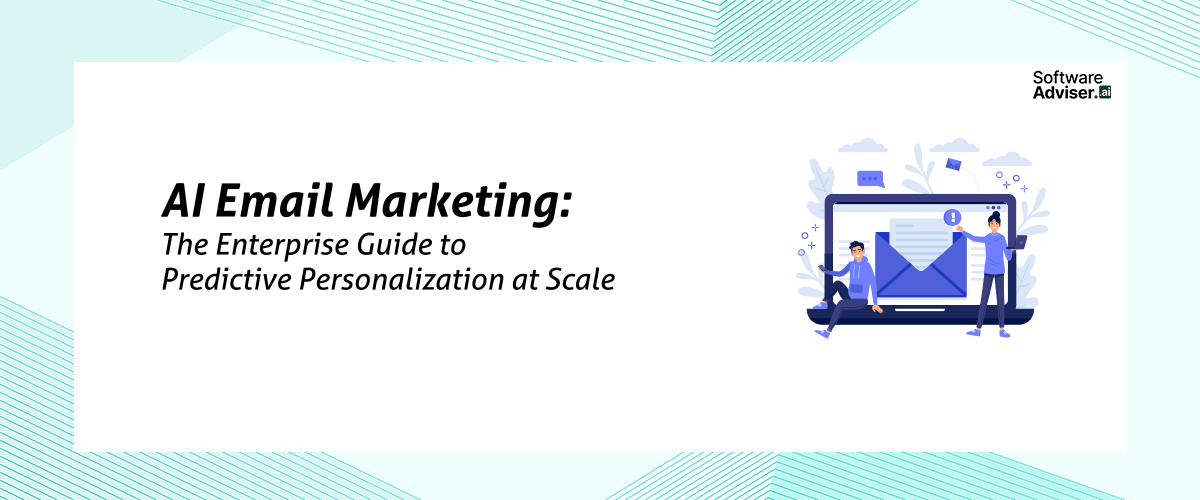
The enterprise inbox has reached a critical turning point. Moving past the foundational era of using machine learning as a basic text assistant, AI em [...]
David N. Wilks
Evaluating and rewarding what your team brings to the table has officially outgrown those stale, once-a-year evaluations. Forward-thinking companies a [...]
David N. Wilks
Somewhere in your industry, a company is six months into an expensive AI deployment. Getting almost nothing back. It's common. An MIT study put the fa [...]