
What we'll cover
Share with your community!


Get Free Consultation
How AI HR Analytics Software Is Changing HR: Benefits and Tactics for 2026
 Dokas mile
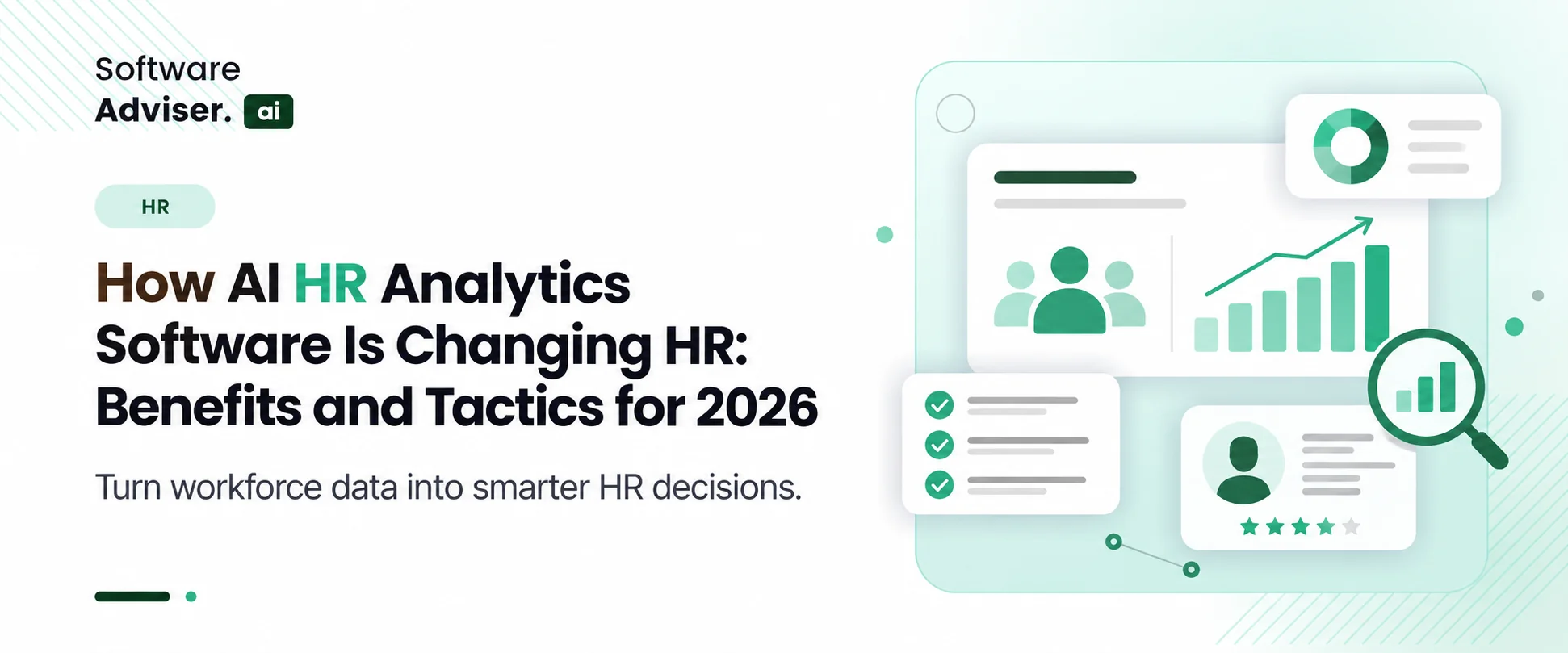
In 2026, the advent of AI-driven HR analytics technology has radically transformed the U.S. workforce through its transformation of human resources from reactive administrative tasks to predictive strategic insights. Enabled by autonomous AI agents, workforce dashboard tools, and skills-focused hiring strategies, American companies have turned to machine learning to predict employee attrition, identify skill shortages, and enhance the employee experience within dispersed hybrid workforces. In place of outdated yearly evaluations and hunch-based management, American HR leaders are making use of continuous data modeling to control labor expenses, improve retention, and maintain algorithmic fairness in a highly regulated environment, thus elevating people-related metrics to be equal to financial metrics in importance.
What Is AI HR Analytics Software?
AI HR analytics applications (also known as people analytics) are a specific group of business technologies that use machine learning, natural language processing, and predictive analysis to work with workforce and other business data. Instead of using spreadsheet analyses and guessing, such solutions connect directly to the existing HR Information Systems (HRIS), payroll software, recruiting applications, and engagement surveys, turning all workforce data into intelligent information. The new generation of people analytics solutions not only provides descriptive reporting, which just answers what has happened in the past. By asking plain English questions via natural-language interfaces, business and HR managers get insight into various trends, find out employees who may be leaving soon, detect skill shortages, and get recommendations for improving retention and workforce productivity.
In the U.S. market, this technology has developed very quickly from being a specialized solution for Fortune 500 company data professionals to becoming an operational platform for firms of any size. Fuelled by cloud subscription services that integrate effortlessly with existing payroll and HCM systems, adoption in the U.S. has grown tremendously and touches on tens of millions of employees in the country as organizations strive to get a grip on their labor costs and handle hybrid workforces. In the U.S., HR analytics is helping to bridge the divide between human resources and the C-Suite so that HR and Finance executives can develop workforce scenarios along with financial plans. In the meantime, the focus in the U.S. is strong on algorithmic transparency and built-in governance to meet new state and local regulations such as mandatory bias testing of automated hiring systems.
Did you know?
The cost of replacing an individual salaried worker in America usually ranges from 50% to 200% of the yearly salary of the individual, and this is where AI HR analytics steps in to eliminate such high cost to the company’s profit margins. Through early identification of signals that indicate potential issues, such as burnout, lack of engagement, or stunted salary increases before the actual letter of resignation is sent, predictive analytics enables American organizations to reduce turnover rates by up to 20% to 30%.
Why Is AI HR Analytics Software Changing HR Across the US?
AI-powered human resource analytics software is revolutionizing human resources in America, as market forces, evolving expectations from the workforce, and the development of technology are making it impossible for intuition-driven people management practices to survive. As the American market for AI in human resources grows fast—from $6.6 billion in 2026 to $15.0 billion in 2031- the companies use these solutions to address their critical needs:
- Managing Labor Expenses and Connecting People with Earnings: Amid growing budget constraints and increased need for accounting transparency, CFOs and CEOs ask for a direct link between people and money in their company. Through AI-driven analytics, the company's leaders can estimate the cost of employing a certain number of people, spot discrepancies in salary expenses and overtime, and reconcile staffing costs and financial forecasting.
- Transitioning from After-the-Fact Reporting to Predictive Retention: The old HR used exit interviews that analyzed the reasons behind the employee resignation after the situation had become critical. Today's algorithms constantly assess AI sales engagement levels, compensation, communication with managers, and working patterns to identify the risk of burnout and departure.
- Hiring and Moving Employees Based on Their Skills: In an era where technology is evolving rapidly and making the traditional job titles obsolete, organizations in the United States are now moving towards skills-based models of hiring people. AI analytics reveals the hidden skills of the existing workforce, detects the important skill gaps, and then places the existing employees in available positions or helps them develop their skills further.
- Managing Distributed/Hybrid Workforces Effectively: In the modern era where the workforce of American organizations is distributed across several states and different time zones as well as working in remote-hybrid ways, it becomes difficult for managers to use the walking around technique to get an idea about the functioning of the organization.
What Are the Top Benefits of AI HR Analytics Software?
- Preventing Proactive Employee Burnout & Turnover: Through the use of engagement scores, salary comparisons, workload trends, and manager relationships, predictive models will detect burnout and turnover risks with high accuracy, thus enabling managers in the United States to carry out stay interviews and make changes to retention strategies before top employees leave.
- Hiring Speed & Skill Matching Optimization: The process of talent AI open source will be simplified through AI analytics that will measure skills relevant to the position and match both internal and external candidates to vacant positions, thus reducing time-to-hire and costs associated with external hiring processes.
- Enhanced Staffing & Financial Forecasting: With the use of people data connected to live financial and payroll systems, management can conduct headcount simulation and analyze the effect of various salary increases on staff retention vs. work flexibility benefits, as well as any overtime and payroll discrepancies.
- Tailored Skills Development & Career Advancement Opportunities: Through matching current staff skills with future organizational requirements, machine learning analytics identifies key skills gaps in the organization and provides learning recommendations along with suggestions for micro-certifications and internal career path options.
- Improved Compliance & Reduction in Biased Algorithms: Fairness checks, uniform criteria of evaluation for candidates, and automatic audits of pay equity allow U.S. organizations to reduce unconscious human bias and remain compliant with local AI employment laws in states like New York City Local Law 144 and Illinois’s AI employment laws.
How Are US Companies Using AI HR Analytics Software Today?
In the United States, there has been a transition from pilots to AI HR analytics software being incorporated within the day-to-day workings of the workforce in organizations. Unlike in the past when people analytics was simply treated like another back-office report, in the US, organizations in healthcare, technology, retail, manufacturing, and financial sectors are adopting this tool in multiple processes such as:
- Forecasting Burnout and Retaining Critical Employees: Employers in the US are looking for any signs of burnout in their employees by monitoring such things as overtime, frequent shifts, lack of advancement, and sentiment through pulse surveys. This is helping them identify at-risk critical workers in advance, even in healthcare and distributed technology companies.
- Skills-First Recruiting and Internal Talent Marketplace Approach: American businesses no longer filter out candidates on the basis of their pedigree alone or based on job titles but rely on talent intelligence solutions to analyze skills, project history, and learning speed. Once there is an opening, the artificial intelligence looks through the internal workforce and identifies those employees who have 70%–80% skills matching and offers micro-courses for closing the remaining gap without having to spend money on external recruitment efforts.
- Continuous, Data-Driven Performance Review Process: Several U.S. businesses are switching from the subjective performance review process conducted once a year to the continuous one that combines goal achievement and 360-degree peer reviews. With the help of AI, objective summaries for performance reviews are being prepared by gathering data on these elements and highlighting areas requiring attention and recommending leadership coaching moments.
- Payroll Pre-Check and Shift Management: Retail, logistics, and manufacturing companies use AI to cross-check production schedule data, attendance records, and local labor laws. AI highlights unusual spikes in overtime and payroll discrepancies before the payroll check run and makes seasonal labor requirements forecasts per facility/store.
How Can You Build a Winning AI HR Analytics Software Strategy?
The right approach for implementing a game-changing AI HR analytics strategy in 2026 is to treat people analytics as a central business function rather than as a separate IT enhancement project. Here are some practical recommendations for how U.S. HR leaders can do that:
- Begin With High-Impact Business Challenges: Never buy software looking for a challenge. Start by defining one or two critical business challenges such as year one turnover in strategic positions, expensive overtime costs, recruiting delays, etc., and develop ROI metrics (hours saved, turnover reduction, or cost of recruiting decreased) before picking a vendor.
- Fix the Data Foundation First: The more accurate the records are, the more predictive the models will be. Clean and connect the data from your HRIS, Payroll, ATS, and AI machine learning so that your employee record systems, job architecture, and skill taxonomy systems integrate seamlessly and without duplicates.
- Incorporate Governance, Privacy, and Disparate-Impact Audits from the Get-Go: With U.S. municipalities imposing stringent restrictions on the usage of automated recruitment tools (such as New York City’s Local Law 144 and Illinois’s AI employment provisions), set some parameters right off the bat. Decide how much automation of different processes is allowed by AI vs. which ones require a human decision-maker; restrict access to sensitive data about employees; conduct disparate impact audits.
- Form a Cross-Functional Steering Group: HR cannot develop an analytics strategy alone. Work closely with Finance (to link headcount forecasts to current P&L budgets); with IT/Security (to secure appropriate data access and integrate with enterprise systems); and with Legal (for compliance), but at the same time keep ownership of the talent strategy within HR.
- Conduct Targeted Pilots and Prove Your ROI: Deploy a narrow 90- to 180-day pilot in one functional area or in one specific use case like alerts for employees who pose a higher risk of leaving in highly mobile departments or internal skill matching for tech openings. Measure your results against pre-pilot baselines to quantify your ROI for the C-suite.
What Challenges Come With AI HR Analytics Software?
Although the use of AI in HR analytics yields useful and actionable insights about an organization’s workforce, the following are some of the barriers for US businesses:
- Bias in Algorithms and Legal Liability: Predictive algorithms that use past data about hiring, promotion, and performance could perpetuate discrimination at work. Employers in the US are facing increasingly stringent regulations on matters of bias audit, disclosure requirements, and anti-discrimination measures such as the EEOC guidelines, in addition to local and municipal regulations such as the NYC Local Law 144 and AI employment provisions in Illinois; hence, the use of unaudited algorithms can result in lawsuits.
- Data Privacy and Workplace Surveillance Repercussions: Contemporary HR analytics is based on a massive amount of personal and behavioral data as well as productivity. The continuous monitoring of employees' online communications, keystrokes, and attendance can lead to employees’ opposition to workplace surveillance and compliance issues with state regulations like the California Consumer Privacy Act (CCPA/CPRA).
- Silos of, or Incomplete/Poor Data: There are many U.S.-based organizations that have siloed technology architectures wherein their AI HRIS, payroll, applicant tracking, and learning solutions are not seamlessly integrated. Inputting inaccurate or duplicate job titles, performance history, or any other data into predictive analytics systems results in incorrect predictions.
What AI HR Analytics Software Trends Will Shape HR in 2026?
In 2026, AI-driven HR analytics software is advancing from experimental dashboard to autonomous, predictive, and integrated solutions for workforce intelligence throughout the U.S. market. The following key developments are reshaping American corporate practices for managing talent:
- From Chatbots to Autonomous AI Superagents: HR technologies are transitioning from query-and-response style dashboards to fully autonomous AI superagents that handle end-to-end workflows. These superagents are embedded directly into Slack and Microsoft Teams environments and can immediately respond to Tier-1 employee queries, launch onboarding processes, issue coaching tips in advance of tough manager review sessions, and escalate difficult cases to human specialists with full context.
- Real-Time Monitoring vs. Periodic Reporting: Traditional quarterly and annual HR reporting is being substituted by continuous workforce sensing. Today's workforce intelligence platforms are monitoring live signals such as increased overtime, changes in engagement level and collaboration patterns, to alert on risky situations and prevent the flight of talented employees before their resignation.
- Predictive and Prescriptive Workforce Simulation: The top American companies are transitioning from using historical volume metrics (e.g., number of employees or training hours) to futuristic impact metrics. The prescriptive models enable HR and financial officers to simulate tradeoffs between different HR policies (e.g., estimate the retention effect
- Predictive and Prescriptive Workforce Simulation: America’s leading companies are moving beyond backward-looking volume metrics, such as headcount and training hours, to forward-looking impact metrics. Prescriptive simulation enables HR and finance executives to explore trade-offs, such as retention effects of a 5% increase in pay vs. increased hybrid work options, and directly link people analytics to revenue-per-employee and P&L projections.
- Skills-First Talent Intelligence & Adjacency Mapping: With the increasing irrelevance of static job titles and resumes, AI-powered analytics platforms are now mapping detailed skill sets of employees against future company needs. Based on skills adjacency, companies can find their closest match to the new roles they plan to recruit for and provide personalized microlearning courses embedded into the flow of work instead of expensive hires from outside the company.

Pro-tip
Think of AI-based HR analytics as a decision support copilot and not as an autopilot when it comes to people. Connect just two to three clean data sources – for example, your HRIS, payroll, and pulse surveys focused on just one measurable goal – such as reducing the first-year attrition rate, and always augment algorithmic insights with human decision-making and open communication. American HR leaders who use predictive analytics.
Conclusion
By 2026, the adoption of artificial intelligence HR analytics tools will not be a luxury but a requirement that will drive agile and data-driven U.S. human resources practices. By transforming employee-related data into predictions, skills-first recruitment processes, and automated task management, the tools will ensure that workforce metrics create a tangible difference in the boardroom. The key to successful implementation involves combining reliable data and algorithmic governance with compassionate human leadership. Want to learn more about the perfect tool for your company? Head on over to SaaSAdviser.ai.
FAQ's
It is an enterprise platform that uses machine learning and predictive modeling to analyze workforce data and deliver real-time insights on retention, hiring, and productivity.
It detects early burnout signals, engagement drops, and compensation gaps so managers can intervene proactively before top talent resigns.
Modern platforms include built-in algorithmic bias audits and explainable AI features to help US employers comply with federal EEOC rules and state laws like NYC Local Law 144.
Organizations use it for skills-first internal hiring, continuous performance tracking, pre-run payroll auditing, and autonomous workflow automation inside tools like Slack and Teams.
Start with one high-impact business problem such as cutting first-year attrition and connect clean HRIS and payroll data before scaling enterprise-wide.
For decades, creating an animated video meant embracing a slow, repetitive grind. Artists sat at desks or drawing tablets, meticulously tweaking detai [...]

David N. Wilks
A CRM may store thousands of customers' records, sales activities, emails and notes. It's not enough to have all of that information in one place—yo [...]
Dokas mile
Managing a website is currently much more than just uploading simple text files onto a server. Enterprises often have issues keeping up with making da [...]