
What we'll cover
Share with your community!


Get Free Consultation
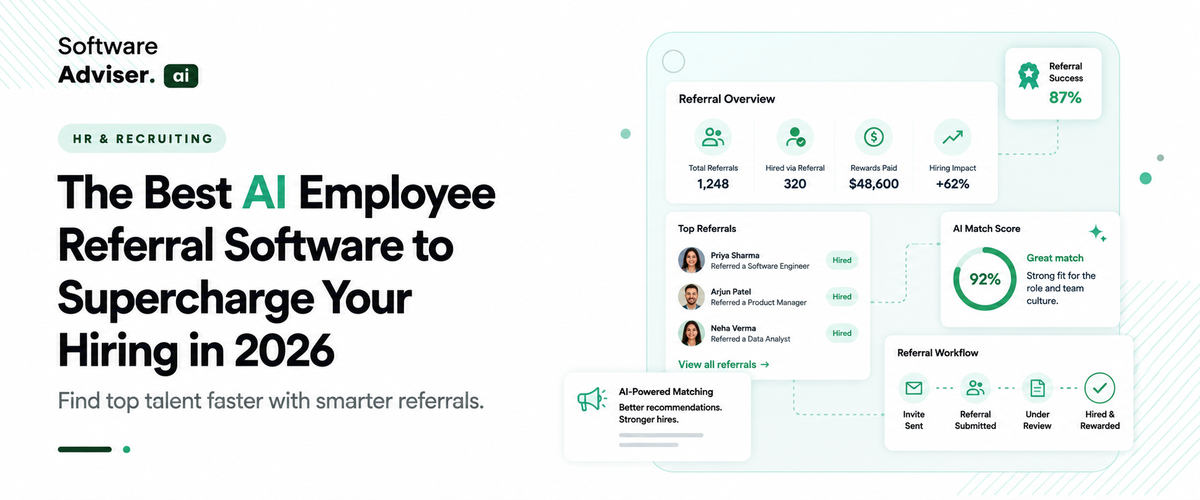
The Best AI Employee Referral Software to Supercharge Your Hiring in 2026
 Dokas mile
Employee referrals are sort of seen as the holy grail of recruitment, because they always bring in strong quality candidates who stick around longer and match the company culture really well. Still, the usual referral programs start to gather dust, because people just don’t have the time to manually dig through their networks, or even recall which roles are open. When you add artificial intelligence to the mix, it changes everything. AI can do the heavy lifting by automatically scanning connected professional networks to identify the right passive candidates for your available openings, and then it nudges AI employee referral software to generate personalized outreach that’s ready for sharing. So what used to feel like a passive, easily forgotten HR thing turns into an active, automated hiring engine. Its advantage is that it allows talent acquisition teams to save a lot of time and gain access to previously unavailable talent pools.
What is AI Employee Referral Software, and how does it work?
AI-powered employee referral software is a modern recruiting tool that maintains the principle of word-of-mouth recruiting. Rather than requiring employees to remember the vacancies available and go through their connections, the software does the work by itself using machine learning and data analysis. The system connects to the employees’ professional network (LinkedIn, etc.) and looks through thousands of passive profiles to find people whose experience and background match the open positions.
When a good candidate is detected in the employee’s network, the system automatically initiates contact. It notifies the AI employee referral software about the match and creates a personalized message that’s ready to send, or a unique referral link that they can forward with one click. Then it keeps running in the background, tracking the full journey of the application and handling things like automated candidate nurturing and also calculating referral bonuses. By removing the admin load, plus that awkward networking vibe, the platform changes what used to be a passive, easily forgotten HR initiative into a smooth, efficient automated pipeline of trusted candidates.
What Features should you look for in AI Employee Referral Software in 2026?
- Passive Network Matching: The AI should automatically take a look at connected professional networks and sort skills against open roles, basically. That reveals strong passive candidates without asking employees to go digging manually through their own connections, or whatever.
- One-Click Share & Appless Access: Aim for text-to-refer, Slack, or Teams integrations that do not require app downloads. This removes the little bits of friction, so deskless or just busy employees can forward ready-made referral messages right away.
- Automated Candidate Nurturing: The system has to use conversational AI chatbots that start talking with referred candidates the moment they submit. This helps keep top talent warm, and it also screens them automatically before a recruiter even gets involved or steps in.
- Transparent Status Dashboards: Employees should get real-time, AI workflow automation updates that show where a referral is sitting inside the hiring pipeline. That transparency helps kill the black hole effect, and it also makes people more motivated to keep sending candidates in.
- Gamification & Dynamic Incentives: The platform really needs automated leaderboards, point systems, and tier-based challenges that keep participation high. It should also track and trigger bonus payouts automatically, so HR doesn’t end up in spreadsheet chaos with constant copying and checking.
- Integrated with the Main Applicant Tracking and HRIS: The ability to synchronize directionally with the key applicant tracking system and payroll resources contributes to great efficiency. It allows you to have one unique information source, which prevents duplicating data entries.
Which AI Employee Referral Software Platforms are Leading in 2026?
1. Workable
Workable basically functions like an all-in-one recruiting setup, with an autonomous AI recruiting agent tucked in that deals with heavy info processing, kind of behind the scenes. Rather than requiring companies to set up separate referral systems, the platform uses artificial intelligence (AI) to continuously comb through a huge international candidate database and old internal applicant pools to find and keep bringing to the surface quality passive candidates. The AI takes care of outreach to prospects and conducts initial conversation screening, which allows recruiters to get a ranked shortlist of candidates. Overall, it seems that this service is designed for mid-market and enterprise-level organizations wishing to incorporate AI-based referral sourcing into their ATS.
2. Deel
Deel, conversely, focuses on international compliance and workforce management, and thus works particularly well for global referral systems. The product excels at automating localized referral agreements and rewards payments in various currencies, as well as performing regulatory checks when employees refer individuals in different countries. It works like a big network layer that takes care of the complicated backend logistics for global referral incentives, while still helping teams scale workforce operations. Deel is best matched to fast-growing, distributed businesses that frequently hire remote talent across regions, and need a hands-off compliance engine that can manage international rewards without you micromanaging everything.
3. Eqo
Eqo kinda is a dedicated employee referral platform that’s engineered for frontline, high-turnover workforces such as healthcare, retail, and hospitality. The whole system leans on a localized, text-based setup, so there are no app downloads or these heavy logins. That means deskless employees can send referrals via text message in under a minute, more or less. It also has an AI-powered copilot called Eve, which takes care of external referrals, tidies candidate profile information, and then automatically starts dynamic SMS engagement sequences. Eqo tends to be the top choice for large organizations, especially those with 2,000+ employees who need to automate the more complex payout eligibility and keep reaching people in the non-desk workforce.
4. Pinpoint
Pinpoint is a modern, flexible ATS that comes with a built-in, dedicated internal referral portal for in-house HR teams. The platform creates automated, unique referral links for employees, tracks where inbound candidates come from on a dashboard, and it can automatically manages partial milestone payout calculations. There’s also a native AI companion that helps improve the candidate career page experience, so referred prospects land in a tailored, frictionless application pathway. Pinpoint is purpose-built for multi-brand or multi-region organizations, because they want one clean platform that works end to end, without buying separate, disjointed referral tools.
How does AI Employee Referral Software reduce Time-to-Hire?
AI employee referral software kinda dramatically reduces time-to-hire by removing a huge bottleneck from manual top-of-funnel candidate sourcing. In the old-fashioned setup, recruiters end up spending as much as fourteen hours a week actually hunting around on job boards. Meanwhile, internal referral programs are sitting there, passive and not really used the way they should be. The AI software flips that entirely; it does the work behind the scenes, instantly. It continuously reviews the connected professional networks of your current employees, then it matches passive talent to open roles based on genuine skills fit rather than just basic keyword matches. Instead of taking weeks to locate high-potential warm prospects, the system surfaces them in minutes, and it basically avoids the slow spray-and-pray distribution stage altogether.
After the system finds a credible match, it speeds up candidate engagement too, by cutting the logistical friction out of the process. Employees don’t have to memorize job descriptions or type out messages from scratch. The AI produces pre-vetted personalized outreach sequences that employees can simply forward using Slack, SMS, or email with one click. Since those candidates get contacted by a trusted friend or colleague, not some cold recruiter, the response rates climb fast. And the elapsed time from “first contact” to “active applicant” shrinks from days to hours. This automated, active nurturing way keeps top-tier people entering the hiring pipeline far more quickly than traditional sourcing.
The software shaves those critical days off the mid-funnel screening and scheduling bits by connecting straight into your Applicant Tracking System (ATS). Referred candidates are kind of already pre-checked for cultural alignment, not just by recruiters but also by their peers, and then the AI kind of double-confirms that, scoring + ranking their profiles immediately against the role rubric that fits best. After that, the whole thing runs conversational screening and interview scheduling on autopilot, so the usual admin back and forth that so often drags the process out just disappears. When teams turn a fragmented, human-dependent workflow into this more continuous conveyor, companies using AI referral tools often cut overall time-to-hire by something like 30% to 50%, which means they can lock in top talent while competitors are still finishing those first resume reviews.
Conclusion
The process of finding the right AI employee referral software can turn your stagnant hiring process into a fast-moving, productive one. Thanks to the use of advanced machine learning, automated outreach, and direct ecosystem integrations, these platforms give your current workforce enough power to connect passive talent with your open positions seamlessly. If you are ready to evaluate your options and find the perfect technical match for your organization's unique requirements, visit softwareadviser.ai. It is the premier digital hub where you can easily discover, compare, and buy any business software to confidently scale your recruitment engine.
FAQ's
Traditional programs rely on employees manually remembering open positions and searching their own contacts, whereas AI software automatically runs background matches against employee networks to surface ideal passive candidates.
No, enterprise-grade platforms respect privacy laws by only analyzing professional data that employees intentionally choose to link, ensuring compliance with strict data protection frameworks like GDPR.
Yes, top-tier platforms feature text-to-refer and SMS architectures that allow frontline, deskless, or hourly employees to submit and track referrals without needing an app download or single sign-on credentials.
The system evaluates semantic criteria, analyzing holistic career trajectories, underlying skills, and contextual experience to score and rank candidates against specific role parameters.
No, because modern systems feature native, bi-directional integrations that push referred profiles straight into your primary ATS, keeping all application data and hiring stages entirely unified.
A typical small-to-midsize US medical practice runs on 8 to 12 separate software platforms. One handles scheduling. Another does billing. Patient remi [...]

David N. Wilks
We are experiencing a significant change in how we manage our data. For example, it has been noted that by 2026, the amount of data companies have now [...]
David N. Wilks
As an owner of a small business in the USA, you are responsible for multiple functions, thus spending very little time managing relationships with cus [...]