
What we'll cover
Share with your community!


Get Free Consultation
What Is AI ERP ? How Artificial Intelligence Is Transforming Enterprise Software
 David N. Wilks
Artificial intelligence is transforming Enterprise Resource Planning (ERP) systems from traditional record-keeping platforms into intelligent decision-making ecosystems. In 2026, AI-powered ERP systems will help organizations automate workflows, predict business outcomes, optimize operations, and enable autonomous decision-making through AI agents.
Enterprise data is no longer just stored; it is synthesized in real time. This definitive guide explores how AI in ERP operates today, its real-world use cases, the rise of agentic architectures, and how your enterprise can navigate this digital transformation.
What Is AI in ERP?
AI in ERP refers to integrating machine learning (ML), generative AI, natural language processing (NLP), predictive analytics, and autonomous AI agents into ERP platforms to improve business processes.
Instead of relying on human operators to manually extract, clean, and analyze information, artificial intelligence in ERP acts as an internal engine that continuously reviews system activity, flags anomalies, and streamlines processes.
By injecting data models directly into core modules—such as finance, supply chain, human resources, and manufacturing—AI in ERP systems shift software from a passive database to an active collaborative operational partner.
|
Traditional ERP |
AI-Powered ERP |
|
Stores business data |
Understands business patterns |
|
Manual reporting |
Predictive insights |
|
Rule-based automation |
Intelligent automation |
|
Human-driven decisions |
AI-assisted and autonomous decisions |
How Is AI Used in ERP Systems?
Understanding how is ai used in erp requires looking at core enterprise functions. AI does not replace the ERP layout; it updates individual modules to eliminate functional friction.
AI in Finance ERP
Finance departments deal with high transaction volumes that require absolute accuracy. AI updates these workflows through:
- Automated Invoice Processing: NLP and computer vision read incoming invoices, match them against purchase orders, and flag discrepancies without human input.
- Fraud Detection: Machine learning algorithms monitor transactional baselines in real time, instantly pausing payments that exhibit anomalous routing or structuring.
- Cash-Flow Forecasting: Predictive models analyze historical cycles, macroeconomic indicators, and current payment behaviors to forecast working capital constraints.
- Expense Analysis: GenAI categorizes line-item employee expenses, flagging policy violations automatically.
AI in Supply Chain ERP
Modern logistics demand predictive precision. Supply chain modules leverage AI for:
- Demand Forecasting: Algorithms combine historical enterprise sales data with external variables like weather trends, economic shifts, and social data to predict exact SKU requirements.
- Inventory Optimization: Multi-echelon inventory systems calculate safety stock dynamically, balancing cash flow with fulfillment risks.
- Supplier Risk Prediction: AI crawls news feeds, financial filings, and geopolitical reports to predict supplier insolvencies or delivery delays before they impact production.
AI in HR ERP
Human Capital Management (HCM) modules utilize AI to improve retention and streamline hiring:
- Employee Analytics: Predictive models evaluate engagement metrics and system activity to identify attrition risks before top performers resign.
- Workforce Planning: AI analyzes project pipelines to map future skills gaps, suggesting proactive training or hiring paths.
- Recruitment Automation: Semantic search matches candidate resumes directly to complex job requirements, filtering for internal cultural and technical fit.
AI in Manufacturing ERP
On the factory floor, AI drives maximum asset utilization:
- Predictive Maintenance: IoT sensor feeds are mapped against ERP asset data, scheduling repairs before equipment failures cause unplanned downtime.
- Production Optimization: Genetic algorithms continuously re-sequence production schedules based on raw material arrivals, machine availability, and variable energy costs.
AI in Sales ERP
Front-office intelligence feeds back into the core enterprise ecosystem:
- Customer Forecasting: AI models calculate Customer Lifetime Value (CLV) and churn probabilities, giving sales teams early warning signals.
- Sales Recommendations: Next-best-action models prompt account executives with exact cross-sell opportunities derived from historical B2B buying patterns.
AI in ERP Examples: Real-World Enterprise Use Cases
To satisfy modern search intent and search engine AI overviews, practical implementations of ai in erp examples must be concrete. The table below outlines how specific business areas execute AI workflows within an ERP database.
|
Business Area |
AI ERP Example |
Operational Impact |
|
Finance |
AI detects unusual transactions |
Lowers audit cycles and stops multi-million dollar billing errors. |
|
Procurement |
AI recommends alternative suppliers |
Mitigates supply chain disruption when primary vendors stall. |
|
Inventory |
AI predicts stock requirements |
Decreases carrying costs while maintaining a 99%+ order fill rate. |
|
Customer Service |
ERP AI chatbot answers billing queries |
Resolves tier-1 ledger discrepancies without accounting intervention. |
|
Reporting |
AI generates real-time business insights |
Converts raw SQL/NoSQL databases into plain-language executive briefs. |
What Are AI-Powered ERP Systems?
An ai powered erp system is not a standard platform with a superficial chatbot plugin. True ai powered erp systems are built on an architectural data layer where the core database feeds directly into localized machine learning pipelines.
When evaluating an erp with ai, organizations look for systems capable of parsing multi-modal structured data (ledgers, tables) alongside unstructured data (contracts, emails).
Vendor Ecosystem Overview
Major enterprise vendors approach AI integration with slight functional variations:
- SAP AI Capabilities: Built heavily around SAP Joule, their copilot infrastructure focuses deeply on contextual business processes, master data management, and automated extensions within SAP S/4HANA Cloud.
- Oracle AI ERP Features: Embedded natively into Oracle Fusion Cloud ERP, these features emphasize autonomous accounting, predictive procurement, and deep cash-flow optimization models.
- Microsoft Dynamics AI Capabilities: Leveraging pervasive Dynamics 365 Copilot frameworks, Microsoft infuses generative AI across CRM and ERP data layers, pulling fluidly from Microsoft 365 applications.
- Industry-Specific AI ERP Platforms: Vendors like Epicor or Infor offer deeply tuned ML models tailored out of the box for precise aerospace, automotive, or distribution workflows without requiring long training periods.
Agentic AI in ERP: The Future of Autonomous Enterprise Systems
The biggest shift in 2026 is the transition from copilot models (which require a human prompt) to autonomous architectures. Agentic ai in erp represents a paradigm shift where software moves beyond assisting to executing complex multi-step workflows independently.
When deploying agentic ai in erp systems, an organization transitions from configuring strict rule-based workflows to provisioning a specialized ERP AI agent with predefined goals, guardrails, and access privileges.
[Goal Defined] ➔ [Agent Plans Actions] ➔ [Monitors & Queries ERP Data] ➔ [Executes Autonomous Workflows]
1. Finance AI Agent Case Study
- Goal: "Reduce days sales outstanding (DSO) and capture overdue payments without damaging client relationships."
- Agent Actions:
The agent regularly scans the accounts receivable ledger. It identifies accounts that have missed payment terms, references past email exchanges to assess customer sentiment, drafts customized reminders matching historical tones, triggers localized payment links, and updates the internal ERP record once settlement occurs. If an anomaly arises, it securely escalates the file to a human credit manager.
2. Supply Chain AI Agent Case Study
- Goal: "Prevent inventory shortages across regional distribution hubs while controlling freight expenditures."
- Agent Actions:
The agent monitors global stock levels alongside shipping transit logs. Seeing an impending raw material shortage in an European hub due to shipping disruptions, it evaluates alternative suppliers approved in the ERP, simulates total landing costs across vendors, automatically generates a purchase requisition, signs it off within its authorized budget limit, and notifies logistics teams of the updated arrival timeline.
How AI Decision Support Improves Operational Efficiency in ERPs
Implementing how ai decision support improves operational efficiency in erps transforms leadership from reactive fire-fighting to proactive strategy.
- Faster Decision Making: Instead of waiting for month-end close cycles, executives can query current operational margins. AI analyzes thousands of ERP records instantly, revealing underlying profitability drivers in seconds.
- Reduced Manual Work: Data entry, invoice matching, reconciliation, and compliance logging are offloaded to intelligent agents. This eliminates high-volume, low-leverage administrative tasks.
- Better Forecasting: Traditional forecasting uses static linear regressions. AI scales this by incorporating thousands of non-linear external data currents to accurately forecast sales demand, cash flow, and complex inventory profiles.
- Improved Accuracy: Manual entries introduce data degradation. By shifting validation, data extraction, and cross-system ledger adjustments to machine models, businesses mitigate human errors, flag duplicate processing runs, and clear reporting bottlenecks.
Benefits of AI in ERP Systems
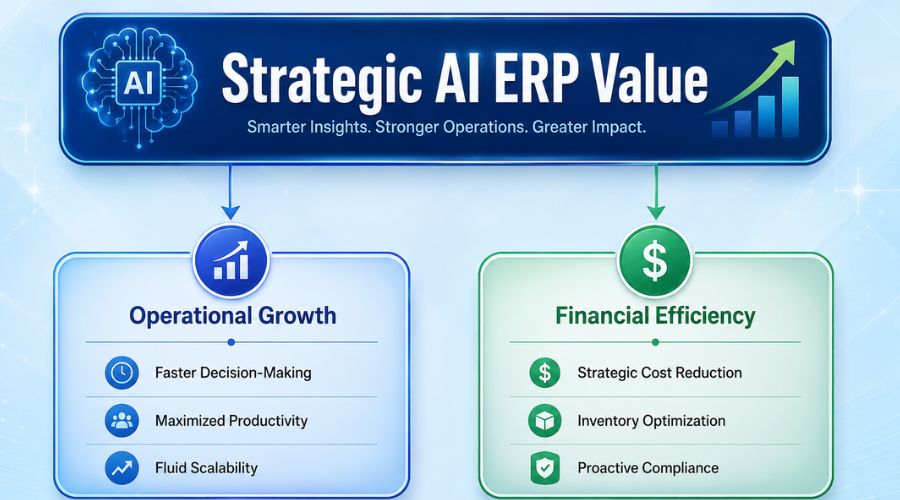
Deploying an enterprise platform augmented by AI in ERP yields measurable structural returns across six distinct operational domains:
1. Intelligent Automation
AI handles exceptions, not just rules. If an incoming invoice is off by two cents, standard RPA fails; AI-driven systems recognize the rounding error, approve the payment within tolerance bounds, and log the ledger adjustment autonomously.
2. Real-Time Business Insights
Traditional business intelligence tools report on what has happened. AI in ERP continually tracks running data, identifying margin leakage, unusual overhead changes, or production inefficiencies as they occur.
3. Predictive Decision Making
By running continuous Monte Carlo simulations against internal capacities and external market demand, the ERP warns leadership of capacity bottlenecks months before they materialize.
4. Lower Operational Costs
Automating systemic processes reduces overall processing costs per invoice, order, and HR ticket, letting enterprises scale up production volume without linearly increasing administrative headcount.
5. Improved Customer Experience
With AI managing order-promising engines directly connected to real-time shop floor capacity, delivery timelines provided to B2B clients are remarkably accurate.
6. Better Sustainability Monitoring
Modern compliance mandates strict environmental accounting. Advanced organizations deploy specialized AI tools for sustainability monitoring ERP integration to calculate scope 1, 2, and 3 emissions directly from procurement, logistics, and manufacturing data, automating auditable ESG reporting.
AI ERP Chatbots and AI ERP Bots: Conversational ERP Management
The enterprise UI has changed. Employees no longer need to navigate deep, nested menus to extract information; they use natural language interfaces powered by an ERP AI chatbot or specialized ERP AI bot.
User Query: "Show last quarter sales performance for our Midwest division and isolate the top three declining product lines."
ERP AI Engine Response: Processes natural language → converts it into structured query logic → scans the sales ledger → filters by region and date → generates a clean visual breakdown along with a summary text of the underperforming SKUs.
Beyond standard data extraction, these bots handle transactional executions, such as initiating internal balance transfers, booking leaves, or verifying warehouse locations via voice or text.
Best AI ERP Software and Solutions in 2026
Selecting the best AI ERP software requires evaluating how deeply AI is woven into the architecture. The best ERP AI platforms offer robust native models alongside custom training infrastructure.
|
ERP Platform |
Native AI Engine / Copilot |
Core AI Capabilities & Functional Focus |
|
SAP S/4HANA Cloud |
Joule |
Process automation, master data governance, contextual line-of-business extensions. |
|
Oracle Fusion Cloud |
Oracle Guided Outcomes |
AI-driven financial close, intelligent procurement, autonomous log management. |
|
Microsoft Dynamics 365 |
Dynamics 365 Copilot |
Generative reporting, cross-app workflow synthesis, conversational intelligence. |
|
Industry ERP Solutions |
Vendor-specific native ML |
Specialized shop-floor sequencing, compliance modeling, distribution analytics. |
Enterprise Evaluation Criteria
When choosing AI ERP solutions, IT leaders must look beyond marketing decks and grade vendors on five specific operational capabilities:
- AI Capabilities: Is the AI built natively into the database layer, or is it a third-party API wrapper prone to latency and connectivity dropouts?
- Integration: Can the AI models easily access legacy applications and peripheral operational software?
- Security: Does the vendor isolate your enterprise training data to ensure internal IP never leaks into public foundational models?
- Scalability: Can the system process millions of continuous inference requests without slowing down transactional throughput?
- Industry Fit: Does the underlying model understand your specific business vernacular, compliance rules, and operational workflows?
SAP AI Integration Tools for Reducing Manual Intervention
As a dominant player in large enterprise markets, choosing the best sap erp integration tools for reducing manual intervention is highly critical for technical architecture teams.
To maximize SAP S/4HANA efficiency, organizations leverage specific automation extensions:
- SAP Build Process Automation: Combines workflow management, RPA capabilities, and embedded embedded AI insights to automate cross-application approvals and data entries without heavy custom code.
- SAP Business Technology Platform (BTP): Acts as the central integration layer, hosting ready-to-use AI business services like document information extraction, business entity recognition, and customized data pipeline routing.
- SAP Integration Suite: Connects non-SAP transactional endpoints directly to core ledgers, utilizing machine learning to accurately map mismatched data schemas automatically.
Challenges of Implementing AI in ERP
Achieving a high-performing autonomous architecture requires addressing major data and operational hurdles.
- Data Quality: AI models are limited by their training data. If your historical ERP records contain duplicated customers, mismatched item descriptions, or fragmented financial ledgers, the AI outputs will be flawed.
- Security Concerns: Feeding proprietary enterprise data into large learning models requires strict access controls, zero-data retention policies from providers, and immutable audit logging to protect highly sensitive financial data.
- Integration Complexity: Marrying cutting-edge AI models with heavily modified, multi-decade-old on-premise legacy ERP codebases presents complex architectural and data translation challenges.
- Employee Adoption: Moving from manual controls to autonomous validation requires significant upskilling. Teams must transition from data entry clerks to analytical model supervisors.
How Businesses Can Implement AI ERP Transformation
To minimize execution risk, work with an experienced AI ERP transformation vendor and follow a structured implementation framework.
1.Identify High-Value Processes:Target high-volume, low-complexity areas first.
Isolate repetitive, manually intensive workflows with high error rates—such as three-way invoice matching or basic inventory log validation—to prove quick ROI.
2.Prepare ERP Data:Fix legacy data gaps before training models.
Execute comprehensive data cleaning initiatives. Standardize product taxonomies, eliminate duplicate accounts, and fix missing values across historical records.
3.Select the Right AI ERP Solution:Match capabilities with your operational scale.
Choose between upgrading to a native cloud-based AI ERP platform or extending your legacy footprint using modern AI middleware layers via APIs.
4.Start With Pilot Projects:Test with isolated operational teams.
Deploy your chosen AI models or autonomous agents within a single department or geographic branch. Monitor performance closely against clear baseline KPIs.
5.Scale Across Departments:Expand based on pilot learnings.
Once the pilot stabilizes, roll the AI integration out to adjacent functional modules, connecting finance, procurement, and logistics into a unified ecosystem.
Future of AI in ERP: What to Expect Beyond 2026
The evolution of enterprise software points toward complete system autonomy. Looking beyond 2026, ERP systems will shift toward:
- Fully Agentic ERP Networks: Chains of autonomous enterprise agents that securely negotiate, purchase, reconcile, and settle accounts with vendor ERP networks without human intervention.
- Autonomous Corporate Finance: Self-closing ledgers that balance and audit themselves continually, making month-end closes obsolete.
- Self-Optimizing Global Supply Chains: Closed-loop fulfillment models that reroute international freight lines dynamically based on real-time climate, political, and port-congestion sensor inputs.
- Generative Hyper-Customized Reporting: On-demand application interfaces built by AI in real time to suit an executive's precise analytical style.
Conclusion: The Bottom Line on AI in ERP
The integration of AI in ERP marks the transition from legacy databases to autonomous enterprise hubs. By embedding machine learning, generative AI, and agentic workflows into daily operations, companies can eliminate manual bottlenecks, predict market shifts, and streamline cross-departmental operations.
To achieve a successful AI ERP transformation beyond 2026, keep three core priorities in focus:
Prioritize Data Integrity:Clean, well-structured data is the fuel that runs enterprise AI models.
Target Incremental Success:Build immediate momentum by piloting low-risk, high-volume automated workflows (like invoice matching) before scaling up.
Adopt an Agentic Approach:Shift your focus from basic conversational chatbots to autonomous ERP AI agents designed to independently execute end-to-end tasks.
The future belongs to the automated enterprise. Organizations that proactively align their business strategy with intelligent, predictive ERP platforms today will unlock unmatched operational efficiency, accuracy, and market agility tomorrow.

Open any business app today, and you will notice a sparkling clean button inviting you to generate text, predict sales, or automate your morning routi [...]
David N. Wilks
Marketing teams are drowning under a heavy wave of unstructured digital assets. The speed of creative execution forces content departments to manage t [...]

Dokas mile
For decades, learning animation required months of practicing complex drawing, rigging, and lighting. However, generative media has completely shatter [...]