
What we'll cover
Share with your community!


Get Free Consultation


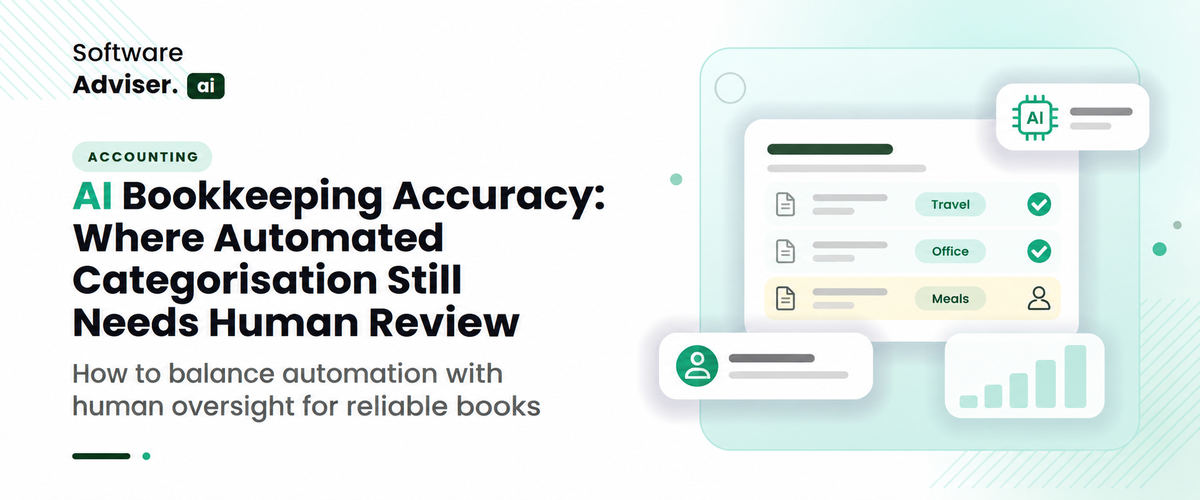
AI Bookkeeping Accuracy: Where Automated Categorisation Still Needs Human Review
 Dokas mile
In the realm of bookkeeping, AI has revolutionized transaction coding through the fast coding of transactions at high volumes in a repetitive fashion, but it has not been flawless in its categorization process. Modern machine learning algorithms may be proficient in identifying predictable and repetitive vendor transactions, but the process does not involve any business intentions or context. This means that artificial intelligence becomes unable to classify situations where there are ambiguities involved, such as classification of capital vs. operating expenditure in a hardware store, separation of personal and business transactions, and proper classification of unique tax classifications.
What is AI Bookkeeping?
The description of AI bookkeeping is that it involves the use of artificial intelligence and machine learning combined with optical character recognition to perform tasks associated with bookkeeping and accounting without involving any manual data entry procedure. Rather than the traditional method of entering bank details, item entries classification, or matching the receipt to invoices manually by a clerk, the software reads the digital feed and classifies the documents.
The labor market in the industry has always been structurally short of people, and thus platforms have implemented machine learning and natural language models within cloud software enterprise ERP systems. Thanks to such implementation, the North American market accounts for the largest market share in the global market for AI accounting software, with over 80% of US accountants currently using AI-powered software for workflow routing, automation, and transaction validation. Rather than being substituted for by technology, accountants in the US employ AI in order to undertake high volumes of compliance tasks and engage in advisory services for clients.
Did You Know?
Though AI is widely used in finance operations, even state-of-the-art AI solutions continue to be vulnerable to a weakness referred to as contextual blindness. This occurs when an entrepreneur buys coffee at a gas station; AI will categorize it automatically as Meals & Entertainment. But if the same entrepreneur purchases windshield wiper fluid or gasoline at the very same cashier’s desk, it will categorize it wrongly as “meals” without human intervention into what the items on the receipt actually are.
What is Automated Categorization?
The process of automated categorization involves a computer-based system that enables accounting software to automatically allocate general ledger accounts, tax codes, and expenses to raw transactions from bank statements. The process does not involve a bookkeeper manually interpreting raw transactions and entering the entries, but artificial intelligence and OCR engines will be used to analyze metadata, such as vendors' names, dollar amounts, merchant codes, and so forth, and allocate the data directly to a chart of accounts through previous experience.
In the US market, the technology has become an inherent component of popular accounting systems. With the growing trend of using digital payments and credit cards, American companies have to process hundreds of millions of routine feed entries every day, significantly reducing the time that accountants need to reconcile transactions.
However, this method is highly dependent on the history of transactions rather than on the context of each particular company, making it ineffective. For example, an automated system is not capable of knowing what was purchased by the company: printer paper or expensive equipment. Therefore, despite the usage of automated categorization for clearing up routine transactions, human expertise is required to avoid tax errors.
What is AI Bookkeeping Accuracy?
The accuracy of AI bookkeeping is defined by the exactness of the process of collecting, classifying, and reconciling the information with no misclassifications or mistakes made. Although many platforms assure their users of a high automated match rate of up to 90%, the real accuracy lies in the ability of software to use context, follow the tax code standards, and put all transactions in the right general ledger accounts.
In the American market, the accuracy of AI bookkeeping has become quite high for predictable transactions such as utility bills, software subscriptions, and regular AI payroll transactions. It is important to say that the American accounting system is highly dependent on it in order to process all transactions, thus reducing the amount of manual work for small businesses and accounting firms.
Nevertheless, even though the accuracy rate on paper can be quite high, there is no guarantee of absolutely safe accounting. The thing is that 95% accuracy means that out of 100 transactions, 5 will be made wrong; these will be complex transactions such as combined personal/business expenses, capital asset threshold, and multi-state sales taxes. Therefore, there is a need for human control in this case.
What are the Limits of Automated Categorization?
1. Contextual Blindness
These automated programs identify transactions using merchant names rather than by the real purpose/intent behind the purchase.
- The General Merchant Problem: Amazon, Walmart, Target, or Costco are stores that provide products ranging from office supplies (operating cost) to furniture (capital cost) and lunch food (food & supplies). The AI program will have a default classification for the merchant name, misidentifying the mixed transaction.
- Dual-Purpose Merchants: Transactions done at a gas station or neighborhood drug store can be fuel, maintenance of a AI vehicle, meals for the business client, or personal stuff.
2. Inability to Differentiate Between Capital Expenses and Operational Costs
As per the accounting policies (for example, US GAAP or IFRS), any acquisition beyond a particular dollar limit (say, $2,500 according to the de minimis safe harbor of the IRS) needs to be capitalized and then gradually depreciated over the life cycle rather than expensed.
- An AI engine: It usually pays more attention to the vendor than the actual dollar amount or life cycle of the asset.
- Illustration: An acquisition of $4,000 for a laptop from Apple or BestBuy is likely to be automatically classified as Computer & Software Expense rather than Fixed Asset, which is inaccurate for the profit/loss account and against the rules of taxation.
3. Unclear or Mysterious Bank Descriptions
Feeds from banks or credit cards usually abbreviate the vendor name or show strange payment processor codes (for example, SQ BLDNG-SUPPLIES-12, TST RESTAURANT, or PAYPAL JSMITH).
- Payment: In case of transactions where the narrative of payment does not have any identifiers, the automated engines generally classify such payments as an Uncategorized Expense.
4. Failure to Separate Multi-Lined Invoices and Mixed Charges
The automatic import process of the bank feed will capture information at a summarized level (date, merchant, total) but not at a detailed level of each receipt line item.
- Tax & Freight Splitting: An invoice can have sales tax, freight cost, taxable items, and non-taxable items, which should be segregated into different categories.
- Blurring of Personal & Business Line Item Spending: In small businesses, the owner purchases goods that belong to personal and office use from the same card; AI cannot segregate personal line items without capturing receipt information individually.
What is Human Review in AI Bookkeeping?
- Contextual Verification: Ascertains the intention behind the transaction independent of the name of the business involved, whether the transaction was the purchase of office supplies from Amazon, presents for clients, or rental of equipment for long periods.
- Line Item/Receipt Verification: Makes use of itemized receipts in order to verify sales tax, shipping charges, or personal spending hidden within AI feed that is not evident from the total bank transaction.
- Capitalization Thresholds Management: Utilizes IRS and GAAP guidelines to report large capital expenditures (typically over $2,500) as capitalized AI asset rather than expenses.
- Accrual Timing Adjustments: Recognizes one-time or annual expenses requiring classification as prepaid assets to be allocated throughout the year rather than at once.
- Classification for Tax Deductibility: Classifies ambiguous transactions according to pertinent guidelines in order to determine proper tax deductibility criteria (50% or 0%).
- Intercompany/Routing Classifications: Appropriately routes owner draws and equity investments to prevent false revenue or expense reporting.
- AI Feed Feedback and Training: Corrects the error in AI classification right in the software to train the machine-learning algorithm to catch those mistakes in the future.
What are Common Categorization Errors?
1. Identification Error and Generic Classification
- Generic Merchant Truncation: Banks often assign payment processor information on the line items to a generic Uncategorized Expenses account or misclassify them for any other irrelevant local business having a similar name.
- Multi-Categories Merchant: Transactions performed in big stores that offer different kinds of products and services, such as Amazon, Target, Walmart, or Costco, are automatically classified as Office Supplies regardless of the purchase.
2. Charging Fixed Assets (CapEx vs. OpEx)
- Ignoring Thresholds: Expensive fixed asset purchases (such as purchasing a server for $3,500 or office furniture for $4,000 from regular electronics or retail stores) are incorrectly recorded as Operating Expenses instead of properly capitalized as Fixed Assets that can be depreciated.
3. Mistreating Capital Transactions and Owner's Transactions
- Recording Loan Payments as an Expense: Loan repayments made and payments received are sometimes recorded completely in Loan Expense and Revenue without properly recognizing both principal and interest.
- Recordings of Owner Draw/Investments: Owner draws, or AI real estate marketing of cash or other resources by the owner, are sometimes recorded as operating expense or sales instead of being correctly recorded.
- Intercompany Transactions: Movements between related business bank accounts or subsidiaries/parent entities are recorded as twice-recorded expenses and incomes.
4. Poor Tax Accounting and Meal Deductions
- Classification Problems of Meals & Entertainment: The AI accounting software incorrectly places any purchase made under the generic and 100% deductible Meals account while ignoring the proper classification of 50% deductible client-related meal costs, non-deductible entertainment such as sporting events, and 100% deductible company-wide functions.
- Bundling of Sales Tax and Shipping Costs: Since the feeds automatically capture only the amount spent for the purchase, the sales tax and any shipping costs involved are captured under the principal cost account and not separately in the sales tax and shipping cost accounts.
5. Booking of Prepaid Expenses in a Single Month
- Booking in a Single Month: Significant prepayment expense incurred at one time in the year, like an annual software licensing cost of $12,000 per year, is charged to the month’s expense account and not accrued to the "Prepaid Expenses" asset account.
6. Personal and Business Line Items Combined
- Commingled Expense Records: In the case where an employee or business owner purchases both business and personal items at the same time using the business credit card, the automated process classifies the whole cost as a business expense without separating the personal expenses to an Owner’s Draw or Employee Receivable account.
What is the Best Approach: AI + Human Review?
AI + Human Review, otherwise referred to as Hybrid Model or Human-in-the-Loop (HITL) – uses the advantages of speed and scale of artificial intelligence alongside judgment and regulatory accuracy of human accountants.
Here is how the hybrid model operates to serve as an ideal operational model:
- Division of labor based on transaction complexity: The artificial intelligence deals with predictable, scalable, repeatable tasks (standard utility bills, periodic software subscription fees, payroll feeds), and human reviewers only deal with high-risk edge case transactions, complex transfers, and non-repetitive purchases.
- Continuous machine learning through feedback loop: Whenever a human bookkeeper overrides a flawed AI suggestion (re-classification of a $3,500 Apple Store purchase as Office Supplies to Fixed Asset), the system takes note of this and keeps improving its predictive algorithms for subsequent transactions.
- Routing transactions based on materiality: It is possible to set automated systems according to dollar value so that routine purchases below a certain value (for instance, under $250) get categorized right away, while those above the value require human review.
- Documentation and verification of receipts: The AI quickly pulls information from the receipts and invoices using OCR, while humans verify whether the itemized breakdowns of the receipts, such as sales tax, shipping costs, or personal expenses, correspond exactly to the sum total of bank feed numbers.
- Implementation of tax and accrual accounting laws: Human professionals are necessary because of the understanding of business context needed for compliance with the IRS and GAAP. They will handle issues such as 50% and 100% deductibility of meals, prepaid expense amortization over multiple years, or intercompany loans.
- Detection of fraud and anomalies: Although the AI can detect anomalies statistically, humans are able to exercise their professional skepticism to detect vendor fraud, duplicate invoicing, or unusual draws by owners before the closing of books.
- Transition from mundane work to strategic advisory: The delegation of mundane tasks such as data entry to an AI system would allow humans to move into more valuable work of providing proactive tax advice, financial forecasting, and financial advice based on ledger accounts.
Conclusion
While AI algorithms help with the speed of transaction handling, it is essential to have a human eye to identify contextual misclassifications, strictly follow tax policies, and maintain audit quality. Purely relying on automated solutions puts financial reports at risk of making ledger mistakes, which obscure cash flow and compliance. If you wish to create a solid financial stack, we recommend checking out the Softwareadviser.ai, a solution where you can find, compare, and purchase any business software.
FAQ's
Automated categorisation uses machine learning algorithms to analyze transaction descriptions and automatically assign them to specific chart-of-accounts categories.
Human review is essential to verify ambiguous merchant descriptions, apply nuanced tax rules, and handle complex split-line or multi-category transactions correctly.
When an AI encounters unfamiliar vendor names or irregular amounts, it flags them with a low confidence score and sends them to a human bookkeeper for verification.
No, while AI organizes day-to-day data entry, a qualified professional must review ledger entries to ensure full compliance with regional tax codes and deduction laws.
Combining AI automation with human review eliminates repetitive manual data entry while maintaining high accounting precision and preventing costly balance sheet errors.

Think about the last time you waited two days for customer service to answer an easy query. Now believe your customers having that identical problem a [...]

David N. Wilks
For years, Drift and Intercom led the way in chat-based customer interactions. By 2026, the picture changed quickly. Intercom moved beyond simple mess [...]
David N. Wilks

By 2026, hospitality technology must migrate away from labor-intensive legacy platforms and move towards flexible, AI-based automated solutions that d [...]