
What we'll cover
Share with your community!


Get Free Consultation
Drift vs Intercom: Best AI Chatbot for Your Business in 2026
 David N. Wilks
For years, Drift and Intercom led the way in chat-based customer interactions. By 2026, the picture changed quickly. Intercom moved beyond simple messaging and built itself around an AI helper named Fin, reshaping how support works. Then, in 2024, Salesloft acquired Drift and pulled it into a larger system focused on sales outreach. Because of that shift, comparing the two the old way no longer makes sense. What worked before simply does not fit anymore.

Looking for AI Chatbot Software? Check out Software Adviser’s List of the Best AI Chatbot Software in the USA for your business.
One clear truth stands out when you weigh Drift vs Intercom: Drift brings buyers in, while Intercom keeps them coming back. The features differ sharply between these two AI chatbot platforms. Pricing shapes who can access what, support sets the pace, and sales outcomes come down to small but important differences. A small shop might lean one way while a large team finds better footing elsewhere. The choice is not about which tool wins overall, but about where each one performs best under real pressure.
Quick Overview of Drift And Intercom
Each platform grew up solving a different kind of problem. Both have earned their place over time, backed by thousands of businesses you would recognize. Their purposes, though, never matched, even as both grew stronger.
One spot holds it all in real-time chats, sits beside group message hubs, and blends support tickets with how to articles, while Fin, the internal AI tool, quietly automates tasks. Small teams lean on it. Big ones do too. Answering inquiries? Sure. But making people stay? That’s where it really works.
Drift focuses squarely on the early stages of a sale. It turns visitor chats into scheduled demos through smart automation, channeling attention toward lead capture rather than customers after a deal closes. In short, it converts anonymous clicks into contact details worth pursuing. Built for sales momentum, it leaves post-sale support outside its purpose entirely.
Drift vs Intercom: Side-by-Side Overview
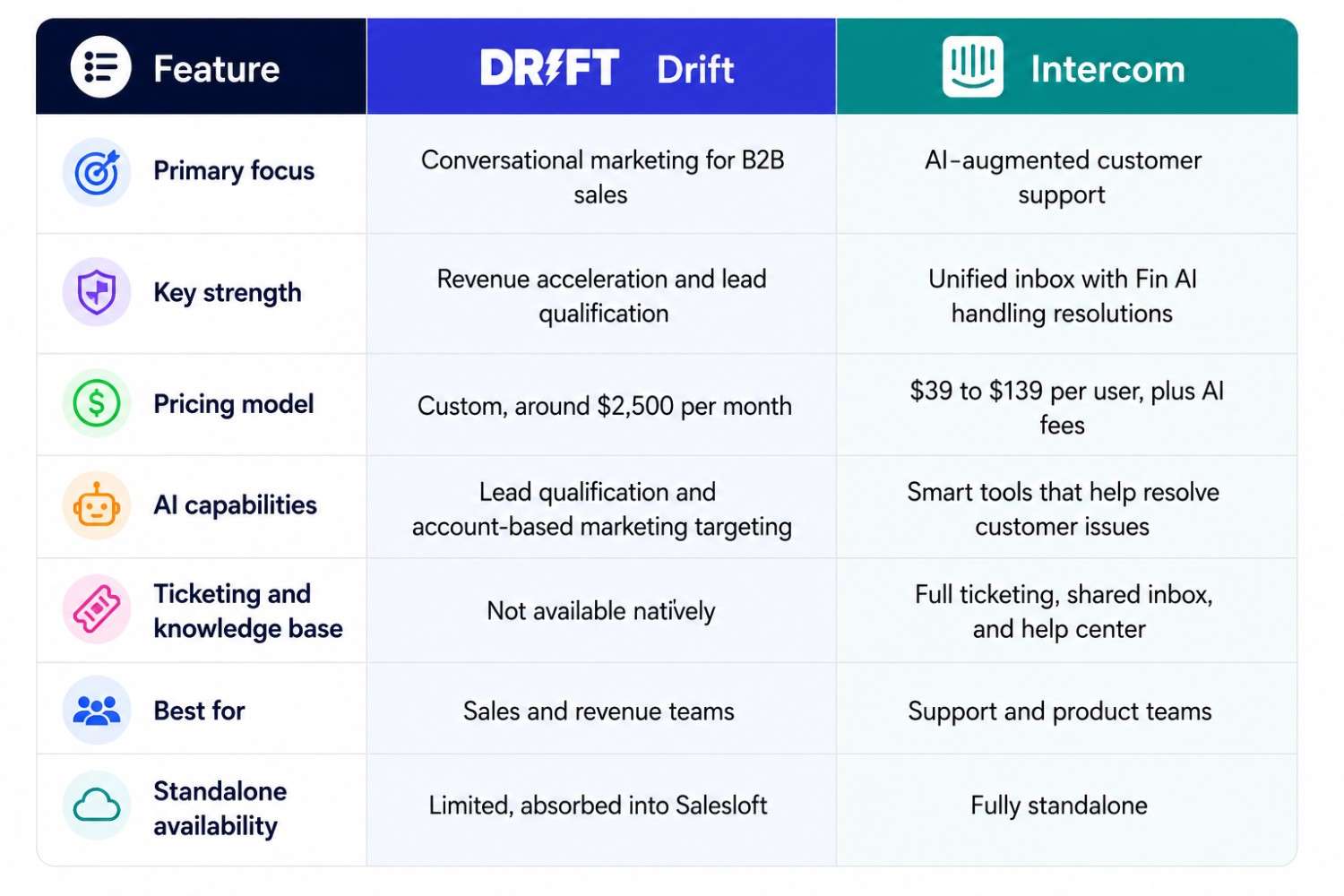
Drift vs Intercom: Features Compared
Live Chat and Messaging
Intercom offers a smooth messenger with adjustable tools, guided walkthroughs, and in-app features, and it also connects through email, text, WhatsApp, and social platforms. Drift centers on website visitors who show interest, using signals to spot key companies and then sending those leads straight to sales reps without delay. Support tasks fit better under Intercom, while filling a B2B sales funnel is a stronger match for Drift. Even their chat boxes look different: Intercom packs several options into a single window, while Drift stays minimal, shaped only for fast deal conversations.
Bots and Automation
This is where the two split most clearly, and it is the heart of the Drift vs Intercom difference. Most times, Intercom’s Fin AI pulls answers straight from your guides, handling customer queries without human help. That means fewer support tickets piling up. Drift moves another way entirely its chat tools scan visitors, pick out serious ones, then lock in meetings before interest fades. Post-purchase guidance is not their strength. Both tools work around the clock, but what they actually do is not the same job at all.
Integrations
Most days, your team likely opens Salesloft first. Drift fits naturally there, woven deep into the routine. Tools stack up differently with Intercom, though; it pulls in over 400 apps, from support boxes to tracking dashboards, often feeding broader customer loops. Picture where clicks land most often. That’s probably the clue you need.
How Each AI Chatbot Gives Your Team Back Hours
What matters most with an AI chatbot is not the technology itself, but how much time your people get back. Both tools return that time, just at different stages of the customer journey. Day and night, Drift helps sales teams skip unqualified visitors, spot real interest, and schedule conversations without manual steps, so effort goes only toward likely buyers. Support staff feel the benefit differently: Intercom lets bots like Fin handle common questions on their own. The numbers show what this means. Strong AI setups answer half to seven-tenths of incoming messages when fed solid information, and moving from a 45 percent to a 60 percent resolution rate across many monthly chats frees up roughly one person's worth of work. When weighing Drift vs Intercom, where you gain depends simply on whether too few leads or too many requests are slowing you down.
Which One Works Better for Customer Support?
Intercom clearly takes the lead here. A single workspace brings together messaging, case tracking, response deadlines, self-help articles, and smart replies powered by AI, and it all fits together. Customers find answers fast through a built-in library and get tips right inside the conversation, which cuts down how many requests come in because people solve problems on their own. Drift, by contrast, was built only for sales chats before a purchase. It lacks key pieces like case handling, time-based rules, and a built-in knowledge base, so teams must attach outside apps just to cover the basics.
There is one catch that both tools share. Take Intercom's Fin: By design, it pulls answers only from your docs. Tasks like processing refunds or changing account details across systems do not happen without a human stepping in. So while Intercom leads as a customer support solution, tricky cases and personal account needs still land on human desks.
Which One Works Better for Sales?
Drift stands out in B2B sales by design. Because it focuses on specific accounting tools and reads visitor behavior in real time yet connects seamlessly to follow-up steps, that combo creates momentum. The instant a key prospect arrives, a signal fires off, sparking faster contact from sales, a detail teams chasing growth tend to appreciate. While Intercom includes bots and filters for leads, its foundation leans heavily toward support, making sales features seem tagged on rather than central. For teams laser-focused on filling their funnel, Drift fits like it was made for exactly that job.
Pricing Comparison: Drift vs Intercom
This is where Drift and Intercom stop feeling similar, and price makes it clear.
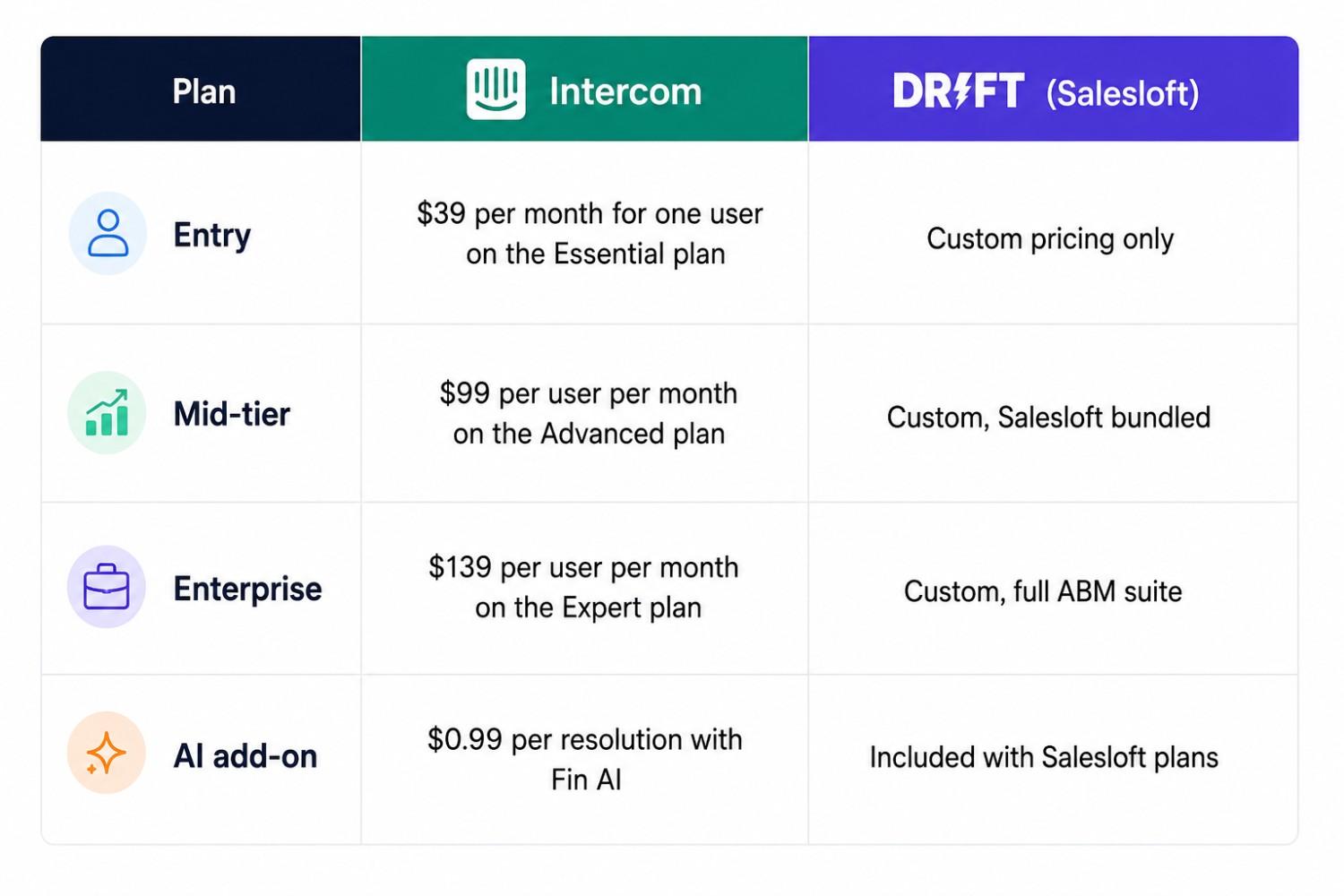
Intercom's pricing looks clear at first, since each seat has a set cost. The complexity creeps in as features stack up. You might start at a few hundred dollars a month, then watch the total climb as more users join. Hit your contact caps and the cost edges higher. Turn on Fin, and each resolved ticket adds charges that grow fast. Here is what catches some teams off guard: even an incomplete answer from Fin can count as a full resolution, which makes the bill harder to predict by the end of the month.
Drift's pricing turned murkier once Salesloft took over. Users report that a basic plan with around ten seats runs close to $2,500 a month before extras. Adding more users or the full ABM toolset pushes that up quickly. A 50-member sales team might see numbers near $3,700 a month on paper. Bundles with Salesloft usually come at a discount, though, which makes the combined package look like the smarter buy. These deals are not posted online; they are worked out one conversation at a time.
Pros and Cons of Each Tool
Drift Pros and Cons
Pros:
- Excellent at converting website visitors into qualified leads
- Smart account-based strategies that start with real-time buying signals instead of guesswork, then flow into systems that guide each follow-up step based on how a prospect engages
- Sorts through potential customers day and night, booking meetings without pause
- Deep integration with the Salesloft revenue platform
Cons:
- No longer sold as a simple standalone product, since it now comes bundled into Salesloft
- High, quote-based pricing with no public transparency
- No native ticketing, no service-level tracking, and no built-in help center, which leaves support tools split apart
- Weak for post-sale customer support
Intercom Pros and Cons
Pros:
- A full set of tools right in your workspace, where messages flow through a shared inbox, issues move forward as tracked threads, and answers live where users can grab them fast
- Category-leading AI resolution through Fin
- Broad marketplace with more than 400 integrations
- Transparent, seat-based pricing that is easy to forecast
Cons:
- Costs can climb without warning as usage increases under tiered billing
- Resolution-based fees can grow as volume increases
- Fin cannot take fully autonomous actions without a human
- Sales features feel secondary to its support focus
Which Tool Is Best for Your Business Size?
Your business size shapes whether Drift or Intercom fits better, and so does how you operate. The Drift vs Intercom decision shifts as a company grows. A startup might lean one way and a bigger team another. Needs shift, and the right tool follows. What works now may not work later, so your structure should guide the choice more than trends do.
For small teams that want basic lead tracking along with everyday support, Intercom often fits better as a single solution. Its starting price is easier to manage, and the built-in tools cover most daily needs. As requests grow, it helps to compare the cost of each fin resolution, since the total expense can shift over time.
Mid-sized businesses focused on sales tend to lean toward Drift when they already use Salesloft, while teams built around customer support usually go with Intercom. What shapes the pick is often where the company puts its energy. When closing deals drives the daily work, automation tools like Drift feel more natural. Support-first groups find Intercom fits how they engage. The pattern is not absolute, but it shows up often enough to notice.
Larger companies go where things move fastest. Revenue teams running account-based outreach often stick with Drift when they use Salesloft, while support and product groups lean toward Intercom, since its all-in-one layout helps them close tickets quickly.
Which One Should You Choose?
Whichever way your team leans, toward conversations or toward workflows, that is where one tool pulls ahead. Drift suits teams building faster replies into their rhythm, while Intercom fits teams tuning long-term engagement. One sharpens immediacy, the other deepens tracking over time. Your needs shape what feels missing, and strength follows focus.
Choose Drift if:
- Your goal is generating qualified pipeline from website traffic
- Your team is sales-led and runs account-based marketing
- You already use Salesloft, or you want a tool built around real sales conversations
- You sell higher-value B2B deals that justify a sales-led tool
Choose Intercom if:
- Your goal is supporting and retaining existing customers
- You need ticketing to track every request, a shared inbox to keep replies together, and support articles that live online where people find them easily
- You want AI that answers routine questions and resolves problems before they become tickets, so help arrives without forms or waiting
- You prefer transparent, seat-based pricing you can forecast
Conclusion
Choosing between Drift vs Intercom is no longer really about features; it is about where your energy goes now. If filling the funnel matters most, go with Drift, especially when sales drives the work and your conversations need to sort and route leads fast, and even more so if Salesloft already runs in the background. When keeping users happy becomes the priority, Intercom steps in, ideal for teams shaped by support or product thinking and built on smart bots that handle routine questions without pulling humans into every thread. Time savings show up either way, but they land in different corners: Drift gives sellers breathing room, while Intercom unburdens the people answering tickets. Line the choice up with how your company moves, and one option stands out plainly, whatever your size.
FAQ's
Intercom is the better choice for customer support with its AI-powered ticketing, knowledge base, and automation features.
Drift focuses on lead qualification and sales conversations, while Intercom specializes in customer support and engagement.
Look for AI automation, live chat, knowledge base integration, lead qualification, analytics, and CRM connectivity.
Yes, AI chatbots can automate support, qualify leads, answer common questions, and improve customer engagement around the clock.
Choose an AI chatbot based on whether your priority is customer support, lead generation, team size, integrations, and budget.
Managing a small enterprise today requires wearing multiple hats, but the digital shifts of this year are completely transforming how local companies [...]
David N. Wilks
Buying AI software is the easy part. Getting your team to actually use it, without grinding the daily work to a halt, is where most companies trip. Th [...]
David N. Wilks
Building a modern email marketing strategy by manually segmenting lists, guessing send times, and writing individual copy variants is a losing battle. [...]