
What we'll cover
Share with your community!


Get Free Consultation
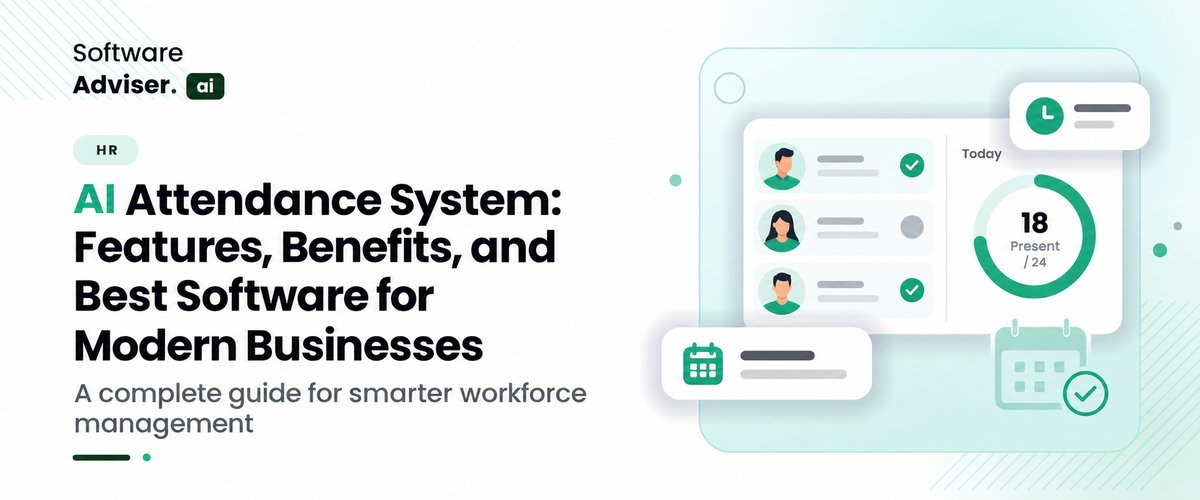
AI Attendance System: Features, Benefits, and Best Software for Modern Businesses
 Dokas mile
A manager of a distribution company with forty employees spends every second Friday comparing paper sign-in sheets to badge swipes, finding discrepancies that remain unaccounted for. Buddy punching, forgetfulness, and rounding differences are normal issues that waste payroll time and lower employee morale. An AI attendance system tracks and registers time worked by each individual employee and reconciles the data automatically without requiring any form of supervision. At this point, the software has evolved beyond novelty and has entered the realm of everyday business practice for most, if not all, US-based employers with any significant level of complexity in their operations. How such systems work, what functionality to prioritize, where the liability exposure is, and how to select an appropriate vendor over an alternative are discussed further in the paper.
What This Technology Actually Does
That is a significant problem because the attendance data is used for payroll, overtime calculations, shift coverage, and even determining client billing. Bad data will inevitably lead to errors in these downstream processes. It usually comes to light during an audit or a wage claim, by which point it is much too late to go back and correct it.
The Technology Powering the Process
Face and Fingerprint Verification
During enrollment, the software converts a photo or fingerprint into a mathematical template rather than storing the image itself. At clock-in, a new capture is compared against that template and scored for similarity. Better products add liveness detection, which tests whether the camera is seeing a real person instead of a printed photo or a video on a phone. Lighting, camera quality and workforce diversity all affect accuracy, so a pilot on real shifts tells you more than a sales demo.
Location and Anomaly Checks
Mobile clock-ins rely on GPS coordinates, Wi-Fi networks or geofences drawn around job sites. The system then looks for inconsistencies, including impossible travel times, repeated identical timestamps and edits made after the fact. Managers see a short exception list instead of scanning every timesheet. That is where most of the time savings come from, because the software reviews everything while people review only what looks wrong.
Key Features That Matter Most
Feature lists look alike on vendor websites, so it helps to separate what affects daily accuracy from what merely looks impressive in a demo. Four capabilities tend to matter most.
AI Attendance Management Software
Core attendance management software takes care of clock-ins, breaks, leave balances and approvals in one place. The system should have configurable rules, because different settings are required for a warehouse with rotating shifts and a clinic with split schedules. Audit trails are equally important, because every edit should be visible, along with the name of the editor, date and reason. That way the log becomes a reliable source of information during a dispute.
AI Biometric Attendance Software
Biometric options include facial recognition, fingerprint readers and palm scanners. Each offers a trade-off. Fingerprints are difficult, for example, for construction workers or for people working in a kitchen. Face recognition depends on where the camera is placed. Contactless methods have gained popularity, especially after 2020, but they raise even more privacy concerns. Sound AI powered biometric attendance software should offer a non-biometric alternative where state law requires it.
AI Image Recognition Software
Image recognition goes beyond matching a face at a kiosk. Some platforms verify a photo taken at a remote job site, confirm a worker is wearing required safety gear, or read a badge from a camera feed. AI image recognition software works best when the purpose is narrow and disclosed. Broad, always-on video monitoring tends to create more employee distrust than it solves in attendance problems.
AI GPS Tracking Software
Field teams, delivery drivers, and home-care aides rarely work at a fixed address. The time of their arrival and departure is recorded by AI GPS tracking software, but some products record the routes taken. Geofencing is usually sufficient to mark someone as present. Constant tracking can be seen as an intrusion on personal time, particularly if it continues after they are due to clock out, so limit what is recorded to when they are working and tell them clearly what is being captured.
How Integrated Tools Turn Attendance Data Into Actionable Insights
AI Time Tracking App & Software
Good time tracking software offers suggestions for project codes, reminds you when you’ve missed to time log and can automatically populate your timesheets based off your calendar or device activity. Most critical for agencies, consultants and contractors who get paid by the hour. One of the most common mistakes we see clients make is turning on suggestion features without some form of review process resulting in inflated or incorrect charges to clients.
AI Employee Scheduling Software
Scheduling is where attendance history becomes useful. AI employee scheduling software studies past patterns such as no-shows, peak hours and overtime spikes, then proposes rosters that match expected demand. Retail, restaurants and healthcare benefit most because their demand shifts daily. Several US cities and states have predictive scheduling rules that require advance notice of shifts, so confirm the tool can produce compliant schedules before relying on its suggestions.
AI Payroll Software
Payroll is the point where attendance errors turn into money. AI payroll software imports approved hours, applies overtime and differential rules, and highlights entries that deviate from an employee's normal pattern. It does not replace a payroll specialist. It reduces the manual checking that consumes most of a pay cycle. Integration quality matters more than the feature list, so ask whether hours sync automatically with your existing payroll provider or need a weekly export.
Integrated HR and Workforce Management Solutions
Some vendors bundle attendance into larger suites, and the labels overlap. Sorting them out saves time during vendor calls.
AI HR Software
AI HR software usually covers onboarding, records, leave requests and policy questions, with attendance as one module. It suits companies that want a single employee record. Specialist attendance tools often go deeper on shift rules and biometrics, so a fast-growing company may end up pairing a dedicated attendance product with a general HR system.
AI Employee Management Software
AI employee management software focuses on day-to-day supervision: task assignment, performance signals, engagement check-ins and attendance trends. Handle performance scoring carefully. Attendance data alone is a poor measure of contribution, and using it that way can penalize employees with approved medical or caregiving needs.
AI Workforce Management Software
AI workforce management software is designed for top-level operations. It covers forecasting, scheduling, time/attendance tracking, cost control, and compliance with labor laws for large-scale and multistate businesses. Companies that manage hundreds of employees and operate in different states need this software, whereas a small office employing twenty people does not. The last one would have been wasting money on unnecessary modules, which is one of the most frequent causes of software overpayment.
Real-World Benefits and Potential Challenges
The value proposition is most compelling in terms of accuracy. By eliminating the transcription step where many timesheet errors occur and verification of hours worked to prevent buddy punching, automated capture reduces payroll errors and saves managers and payroll staff time spent auditing and correcting timesheets. Employees also benefit from automated timesheets that are captured and stored consistently rather than relying on a manager's recollection.
The limits deserve equal honesty. Biometric accuracy is not identical across every lighting condition or demographic group, so error rates should be tested locally. Setup takes real effort, particularly when importing legacy records and defining pay rules. Small businesses with a handful of salaried employees may find a basic time clock is enough. And no software fixes a culture where employees feel watched rather than supported.
What Employers Need to Know Before Choosing
The Fair Labor Standards Act requires employers to keep accurate records of hours worked and for the Department of Labor to retain these records upon request. Time-keeping software is of little use if the records can be easily altered and not readily available. State laws add additional requirements, including meal and rest break laws in California and predictive scheduling laws in Chicago and Seattle.
Biometric data presents a sharper risk. Illinois' Biometric Information Privacy Act requires written consent prior to gathering fingerprint or face geometry data, and that private party lawsuits may be brought against an employer. Texas and Washington have their own biometric statutes and several other states have passed broad privacy laws which implicate this data. Employers should ensure that consent workflows, retention limits and deletion practices have been reviewed by legal counsel prior to implementation. This article is general information and is not legal advice.
Making the Right Software Selection
Questions to Ask Vendors
Begin your evaluation by focusing on data processing. Learn where and for how long the templates of your biometric data will be stored and/or deleted after you leave the company. Ask about accuracy and clocks in/out when there is no access to the internet. Determine whether you will be able to export this data when switching to another provider and what third-party applications can be integrated with the chosen software (payroll and HR systems). Get references from companies that are similar to yours and request a conversation with someone who has been using the service for over a year.
Common Mistakes
Companies often buy on features and skip the pilot. A two-week trial with one team exposes problems that a demo hides, confusing mobile screens or rules that miscalculate overtime.Another common mistake is presenting roll-out without explaining the rationale. It is important to help the teams understand what information will be gathered, who will have access to it, and how mistakes can be amended. The costs are also a significant consideration, as the pricing in the US is usually based on a per-user-per-month basis. Therefore, it is essential to estimate the costs considering the expected number of users plus the equipment and training costs.
Conclusion
Attendance technology can be a good buy if erroneous hours are bleeding out actual dollars and/or fueling disputes or payroll delays. Not the tool promising the most features is usually the right one. Choose the tool whose verification method, scheduling logic and payroll integration fits how your people work, and whose privacy practices you can defend.
FAQ's
It uses AI to automate employee attendance tracking, identity verification, and attendance data management.
It can be legal, but biometric privacy and consent requirements vary by state.
Pricing typically depends on employee count, features, integrations, and hardware requirements.
Yes, especially businesses managing hourly employees, multiple locations, or frequent attendance-related payroll issues.
AI features such as liveness detection and location validation can significantly reduce common attendance fraud methods.
Basic cloud-based systems can often be implemented within a few weeks, while complex integrations may take longer.
Search engines have changed more in the last two years than they did in the decade before that, and a lot of business owners are scrambling to keep up [...]

David N. Wilks
Buying AI software is the easy part. Getting your team to actually use it, without grinding the daily work to a halt, is where most companies trip. Th [...]
David N. Wilks
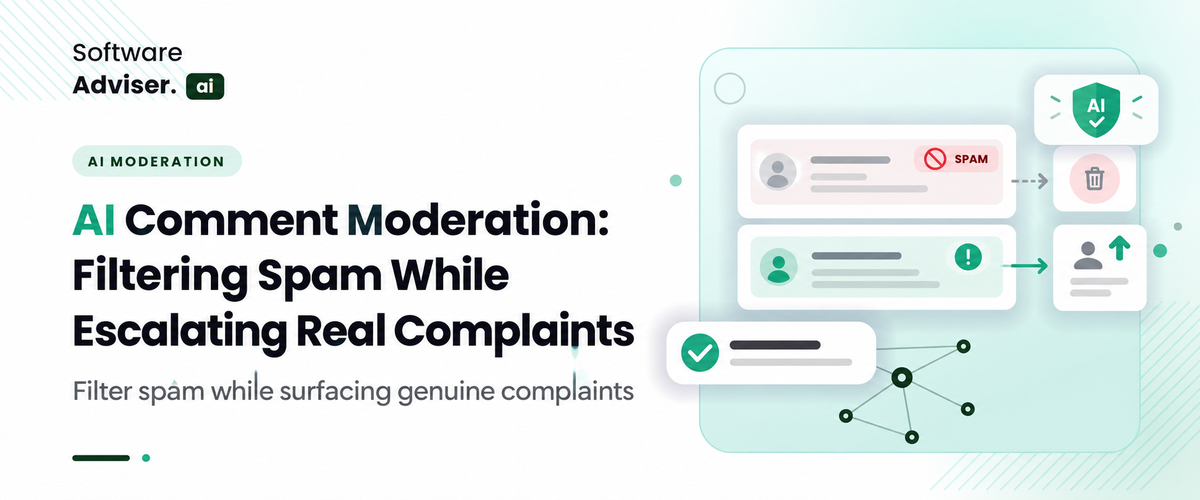
Moderating online comments through automation involves overcoming the challenge of balancing speed when filtering the content while still being able t [...]