
What we'll cover
Share with your community!


Get Free Consultation


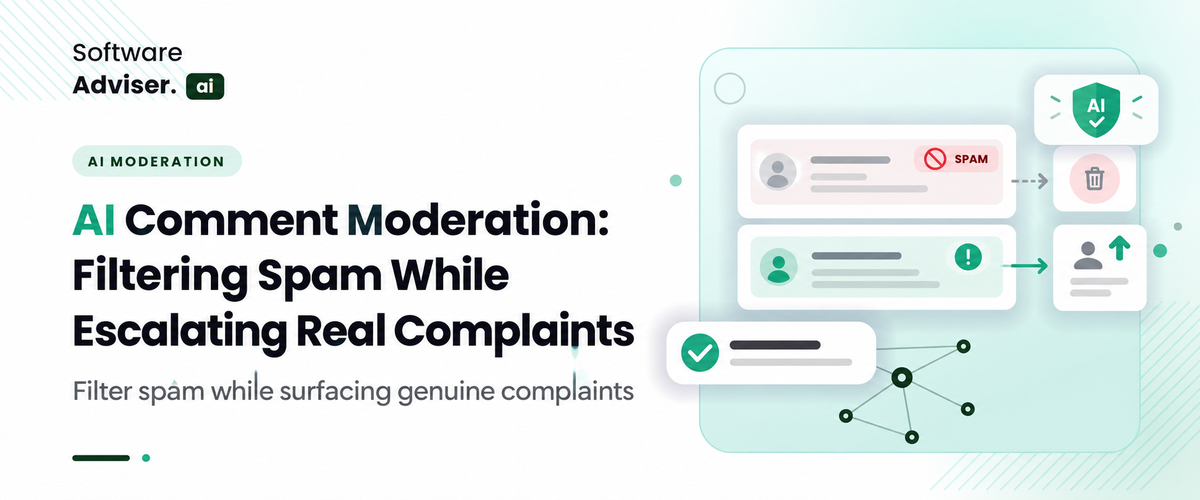
AI Comment Moderation: Filtering Spam While Escalating Real Complaints
 Dokas mile
Moderating online comments through automation involves overcoming the challenge of balancing speed when filtering the content while still being able to ensure consumers' loyalty on US digital platforms. Businesses can accomplish this by using AI to process a great deal of user-generated content and eliminate spam and other forms of unwanted content even before its distribution to consumers. They can also tell the difference between a real complaint and a note about a service or a product. Sometimes they even catch softer clues that do not read like a plain gripe.
What is AI Comment Moderation, and how does it balance Filtering Spam with escalating Real complaints?
By using Natural Language Processing, AI comment moderation is able to implement an automatic scanning and acting system for user-generated AI content management present in forums, social media, and commerce sites in real time. Rather than using an outdated keyword system, AI algorithms are capable of analyzing text context, sentiment, and intent of the user with the purpose of making online areas clean. For US businesses, which are in charge of processing a huge amount of comments every day, automated systems ensure users’ feeds remain interesting and relevant, as they are able to block spam, advertising links, and abusive comments completely automatically.
The advantage of this system is its ability to combine automation with a proper escalation process. Using machine learning methods, the system is capable of determining the customer’s sentiment; it is able to identify important phrases such as disputes, complaints regarding goods, or any other negative issues. Rather than getting rid of them under layers of spam comments, the AI marks them with the highest level of priority and sends them to the team of human operators who will resolve the situation quickly.
Did You Know?
Advanced AI moderation systems can detect unhappy customers' intentions using sentiment analysis, which doesn't necessarily depend on the use of profane language. With the assistance of this automated system, large companies can solve urgent customer issues 80% quicker than using manual reviews. As this happens, the support teams can engage their energy in the matters of more serious customer service problems instead of checking through piles of promotional emails.
Why are Traditional Keyword Filters failing to catch modern US Spam and Toxic Comments?
- Tactics of evasion and Leetspeak: Modern-day spammers avoid blocks based on exact-match technologies through their use of clever typos, use of symbols, variations of Unicode, or zero-width spaces.
- Inability to understand the Context of a Conversation and Irony: Keyword blocklists identify particular words rather than their intended meaning, leading to serious mistakes like blocking a client praising the great offer and, on the contrary, not filtering the passive-aggressive toxic harassment.
- Rapidly changing US slang and terms used on the Internet: Online slang, memes, and coded harassment tend to change daily on social platforms, forcing the support teams to update their lists manually, which becomes obsolete quite soon.
- Algorithmic Spam Generation: Modern spam networks utilize AI technologies to generate millions of messages from a company with a unique style of speaking, thus bypassing all other blocklists while collecting links from its lists.
- Unawareness of visual and emoji-based Spam: Malicious users as well as bot AI accounting utilize emojis very well when communicating abuse or promoting scams. But standard filtering tools that only take words into account are unable to identify this content.
- The Scunthorpe Problem: People using just text-matching often block comments from genuine users and valid enquiries about products without realizing it, as they keep blocking spam-related terms occurring naturally in innocent words.
How does Natural Language Processing differentiate between Spam and a Genuine Customer Complaint?
- Unawareness of visual and emoji-based spam: Malicious users as well as bot accounts utilize emojis very well when communicating abuse or promoting scams. But standard filtering tools that only take words into account are unable to identify this content.
- The Scunthorpe Problem: People using just text-matching often block comments from genuine users and valid enquiries about products without realizing it, as they keep blocking spam-related terms occurring naturally in innocent words (e.g. “ass” inside assignment).
- Extraction of Entities: In this process, the models look for specific and particular pieces of information that are relevant to the field, such as order numbers, transaction numbers, particular product batches, or dates of transaction.
- Syntactic Structure and Style: Natural Language Processing allows determining whether the text is made up of a variety of phrases and grammatically different sentences; thus, while the spam messages created by the bots usually use fixed and repeated constructions, the serious complaints display the performance of the human language capabilities.
- Linkage and Call to Action: AI Technologies check external links, tags, phone numbers, and exits in the sentence context to identify hidden spam and ignore ordinary user messages.
What Should US Brands Set for Automatic Spam Deletion Versus Human Escalation?
|
Action Tier |
AI Confidence Score |
Triggered Content Examples |
Primary System Action |
|
Instant Deletion |
90% – 100% |
Bot links, explicit threats, scam URLs, duplicate promo codes |
Auto-remove or hard block instantly |
|
Soft Hide / Quarantine |
75% – 89% |
Borderline spam, affiliate links, subtle profanity, suspicious accounts |
Hidden from public feed; moves to secondary queue |
|
Human Escalation |
50% – 74% |
Billing issues, product failures, PR/brand risks, ambiguous feedback |
Priority queue route to CX team with metadata |
|
Auto-Approve |
Below 50% Spam |
Positive comments, casual chatter, general brand praise |
Publicly published immediately |
Primary Guidelines Set for US Brands
- Hard-Delete Critical Offenses: Maintain a rigid determination where any phishing content, hateful speech, or obvious bot-related behavior must be deleted if there is at least 90% certainty.
- Quarantine Instead of Deleting Unclear Posts: Use a soft delete (only the original poster can see it) approach for posts that score higher than 75%. It has been found that this action eliminates the risk of eliminating public channels by mistake.
- Accelerate the Raising of Support Requests: Any post that indicates customer distress (for example, order numbers or phrases that show the inability to perform) will go directly to the human agents with all necessary information on the case without being processed as a spam message.
How can AI Moderation Protect your Brand Reputation during a viral Customer Service Crisis?
When a company faces a customer service issue that generates a significant volume of negative comments, like an outage, safety recall, or poor PR move, directing the efforts of the PR team by filtering and helping their customer service with automation tools can help save the brand.
- The First Step to Detect Spikes in Activity: Algorithms assess velocity and sentiment parameters and signal the crisis team as soon as the number of negative mentions exceeds the threshold value.
- The Next Step is Automation in Responding to the Customer: Instead of allowing emergency requests to get lost amid the thousands of negative comments, Artificial Intelligence can determine the most important requests for assistance and send them to the experienced customer care agents.
- The Third Step is Blocking the Scammers: Bad posts attract bad people who post phishing ads, fake refunds, and other scams.
- Sentiment Analysis in real time and Mapping of Narrations: With the help of AI, incoming comments are categorized into topics (shipping issues versus application crashes), which allows businesses to know the actual reason for the customer dissatisfaction and compose relevant statements.
- Dynamic filtering of Content to Prevent Situations from Worsening: AI can temporarily hide offensive comments, personal information that was revealed without permission, and hate speech, which ensures civility in comment sections and prevents them from turning into chaos.
- Automating responses in the status updates and masking of frequently asked questions: AI can respond automatically to repetitive questions using certain updates or redirecting customers to the page with crisis response, which keeps customers informed and gives human agents a chance to deal with more complex issues.
What are the Data Privacy and Legal Compliance Considerations for AI Moderation?
Deploying AI comment moderation systems in the US requires navigating a complex landscape of data privacy laws, liability protections, and algorithmic fairness regulations.
- Section 230 Liability and Good Samaritan Protections: Section 230 of the Communications Decency Act provides US companies immunity from claims about third-party user-generated content. This protection allows businesses to engage in good-faith efforts of automatic moderation, which seeks to eliminate undesirable content.
- Data Privacy Regulations (CCPA/CPRA and State Laws): Data protection laws treat user comments and related metadata (IP addresses, User IDs) as Personal Information (PI). Businesses are required to act in response to users’ requests about deletion of the user’s content as well as obtain consent before utilizing consumers’ comments for the purposes of training third-party machine learning algorithms.
- Compliance with COPPA for Data Regarding Minors: The Children’s Online Privacy Protection Act sets very strict limitations concerning collection of data from children aged under 13. AI moderation methods, when functioning on platforms where kids are active, have to ensure that text content is not collected or processed.
- FTC Regulations Related to Algorithmic Bias and Deception: Under Section 5 of the Federal Trade Commission Act, the Federal Trade Commission punishes unfair or deceptive practices. Companies have to put in efforts to prevent automated moderation solutions from showing any signs of systemic discrimination against any protected demographic groups, nor stealthily hiding genuine negative product reviews.
- Rules on Automated Decision-Making Technology (ADMT): Various state laws, like California’s CPPA law, require companies using automated decision-making technologies to give clear notice of their practices, provide the possibility of opting out from profiling, and perform formal risk evaluations to assess high-risk AI implementations.
- Data Minimization and Model Retraining Protection: The third-party AI moderation APIs must comply with strict Data Processing Agreements (DPAs) concerning data storage and use and must not keep or train any general LLMs utilizing neural networks powered by users’ comments.

Pro-tip
always conclude Zero-Data-Retention agreements with third-party AI moderation companies, guaranteeing that flagged comments are treated on the fly and removed from the system immediately. This architectural condition decreases the amount of legal liability significantly, allowing businesses to avoid data violation accusations arising from US state privacy legislation.
What key Performance indicators prove the return on Investment of AI Comment Moderation?
To validate the return on investment of an AI comment moderation program, one needs to establish the gain achieved through savings associated with operational processes efficiency, risk prevention techniques, and brand equity gains.
- Cost per post: Measurement of operational costs associated with the processing of comments in the AI comment processing system as compared to the completely human approach to comment moderation. An automated comment processing approach can decrease the cost by 70% to 90% in comparison to the traditional human labor costs.
- Cycle-time compression: Measurement of the time passed from the moment the comment has been posted and the moment some action is taken. AI comment processing systems can perform such operations almost instantly, so the time delays are eliminated.
- Automation: This term refers to the measures of successfully processed or deleted comments by AI without resorting to human involvement. Higher rates of AI workflow automation can result in lower costs of human labor.
- Escalation metrics: Evaluation of the success rate of the AI processes and the proper classification of important customer complaints as compared to the messaging not subjected to AI classification.
- First Response Time (FRT) for Priority Leads: This tracks how quickly customer support addresses legitimate complaints which are flagged by AI as opposed to normal queue time. The faster FRT contributes to increases in Net Promoter Scores (NPS) and reduces customer turnover rate.
- Crisis Exposure Time & Risk Mitigation Value: This defines the length of time that a potentially hazardous, harmful, or phishing comment remains visible on a public platform until it is taken down. Decreasing the exposure time helps to preserve the company's image and decrease the costs of legal/PR cleanup operations.
Conclusion
The problem of digital noise can be solved with AI moderation, as it removes massive amounts of spam and ensures that significant customer complaints reach real customer support by people. Moving away from out-of-date keyword filters to context-based Natural Language Processing, American companies are able to take care of their public reputation, reduce the time for problem resolution, and get measurable operational ROI. It is important to choose the appropriate moderation architecture for your tech stack for future scalability. You can do research, compare, and select the best AI moderation platforms at softwareadviser.ai, where you can find leading enterprise software solutions.
FAQ's
AI comment moderation uses natural language processing to automatically analyze, filter spam, and flag contextually sensitive user comments in real time.
It evaluates context, tone, and user intent rather than matching isolated keywords to separate promotional noise from genuine customer distress.
Keyword filters are easily bypassed by leetspeak, intentional misspellings, visual emojis, and AI-generated conversational spam.
The system automatically escalates the post to a high-priority human support queue with full contextual details attached.
Yes, by instantly clearing away spam, support agents can focus exclusively on resolving flagged customer issues up to 80% faster.
Buying AI software is the easy part. Getting your team to actually use it, without grinding the daily work to a halt, is where most companies trip. Th [...]

David N. Wilks
The conventional yearly employee survey is no longer relevant. Nowadays, to keep up with the fast-moving business environment, companies in the US can [...]
Dokas mile

A typical small-to-midsize US medical practice runs on 8 to 12 separate software platforms. One handles scheduling. Another does billing. Patient remi [...]