
Best Work Operating System in
Are you looking for Work Operating System for your Business in ? SaaS Adviser brings you the best Work Operating System to ease your worries. In order to make your work smooth and swift, SaaS Adviser has compiled a list of the best software available. Compare the Best software features, pricing, free demo, and trial to select the best Work Operating System for your organization.
 Researched and Written by Akash Patel
Top 3 Featured Softwares


List of Top Work Operating System

Get Free Consultation


Zoho FSM

Seamless Operations, Memorable Service Experiences
Zoho FSM is an end-to-end field service management platform built for service businesses and contractors. Zoho FSM streamlines and enhances end-to end operations, increase firs...
View Profile

Monday Ready
By Monday Ready
Monday Ready is an adequate employee appraisal management platform that enables managers to conduct periodic reviews of their team members. It also helps to improve the communicati...
View Profile
Teletrac Navman DIRECTOR
By Teletrac Navman
What is Teletrac Navman DIRECTOR?Teletrac Navman DIRECTOR is a fleet management and GPS tracking solution designed for real-time vehicle monitoring. It helps businesses streaml...
View Profile
eptura
Drive more value from your facilities assets workplace
Eptura is a comprehensive workplace technology platform designed to manage and optimize assets, facilities, and employee experiences within hybrid work environments. As a unifi...
View Profile
.png "EZ_SOP")
EZ_SOP
Create and Manage Standard Operating Procedures in Smart Factories with inbuilt Annotation ToolsEZ_SOP simplifies the creation and management of Standard Operating Procedures in factories by providing an intuitive and user-friendly interface. Using the built-in tools, such as...
View Profile

Table of Content
What is a Work Operating System?
A Work Operating System (Work OS) is an exclusive platform meant to minimize manual work and increase collaboration and productivity across the company. It's the Business Operating System Software that lets clients plan, track, and handle tasks, projects, and processes seamlessly. The best Work Operating System in USA provides flexible workflows, real-time updates, and integrations with various tools to create a unified workspace. With the help of Work OS which not only simplifies complex operations but also promotes team collaboration, companies can stay organized and efficient. The only tool that, be it a daily task, or large-scale project, a reliable Work OS, assures the collective stays aligned and targets the achieved goals. A well-run performance will be a mechanism that gets to the expected business outcomes as a priority for businesses hoping to render operations efficiency. One of the methods that contribute to efficiency at the firm is the acquisition of Software as a Business OS to facilitate the control of the operations.
1. Conclusion
The work operating system (Work OS) is one of the most important tools for firms Currently, it ensures quality workflows, collaboration, and growth. With top-notch business operating system software, you are normalizing the practice of automation of the most repetitive tasks apart from allowing users to make more efficient use of time by reading the exact page where another colleague is. This flexible attitude towards dealing with new possibilities allows the company to work faster and more flexibly. Here we go. Your choice is based on the possibility of good integrations, the feature of personalization or easy management of the project without any redundant steps are among the strengths of a Work OS you can have to get a new dimension of your business development. Ready to transform the way your team works and thrives? The right Work OS is waiting for you!
2. Potential Barriers to Adopting the Work OS
Adopting a work operating system (Work OS) can come with challenges. Resistance to change is standard, as employees may hesitate to shift from familiar methods. High initial costs, especially for small businesses in India, and concerns about data security in cloud-based business operating system software also pose hurdles. Compatibility issues with existing tools and a lack of technical expertise can slow implementation. Scalability and customization limitations may prevent businesses from fully leveraging the platform. Additionally, perceived complexity, insufficient vendor support, and gaps in training can hinder user adoption. Despite these challenges, choosing the best work operating System in India and addressing these barriers head-on can unlock immense productivity and growth opportunities.
3. Features of Work Operating System
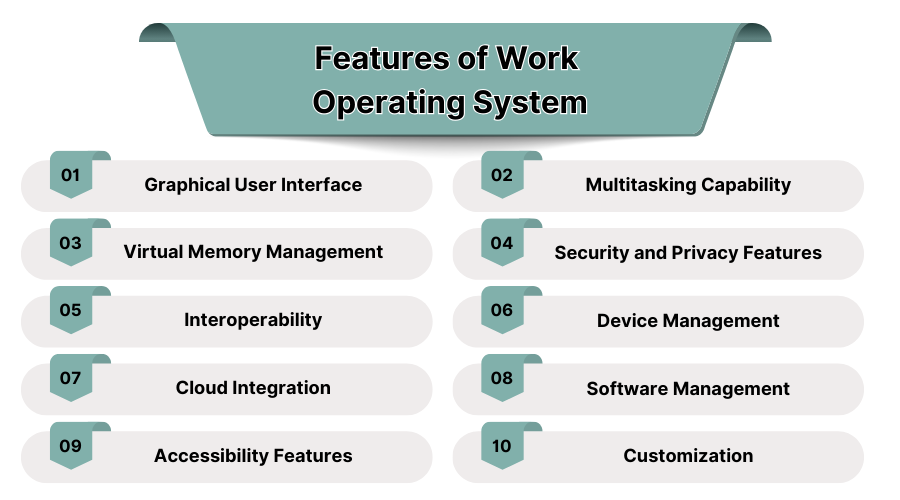
A Work Operating System (Work OS) is more than a productivity tool but a powerhouse that was created to streamline workflows, enhance collaboration and make procedures much more efficient. Let's explore its key features:
1. Graphical User Interface
A user-friendly Graphical User Interface simplifies complex tasks by providing intuitive visual elements. The GUI of an operating system software allows users to interact seamlessly with dashboards, tools, and data, making navigation effortless even for non-technical users.
2. Multitasking Capability
With advanced multitasking capabilities, a work operating system ensures you can juggle multiple tasks, projects, and applications without lag. It optimizes resource allocation, so your system remains smooth and responsive, even during high workloads.
3. Virtual Memory Management
Efficient virtual memory management ensures your system uses storage intelligently, preventing crashes and maintaining performance. This feature allows your work operating system to effortlessly handle large files and applications.
4. Security and Privacy Features
Modern Work Operating Systems come bug-free loaded with end-to-end security and privacy capabilities meant to safeguard your sensitive data. Preserving your operations is the most important of the encrypted communications and the two-step verification process.
5. Interoperability
Seamlessly connect with other tools and platforms! A work OS's interoperability enables integration with popular apps and services, ensuring smooth data flow across systems.
6. Device Management
A Work OS simplifies device management by providing centralized control over connected devices. Whether it’s a laptop, smartphone, or tablet, the system ensures all devices function harmoniously.
7. Cloud Integration
Maximize the cloud to your advantage by embedding cloud integration with it. Through this process, you can reach your files, and get them improved in real-time with your team, and to begin with, you can confirm that your data is secure anytime, anywhere.
8. Software Management
Keep your tools up to date with efficient software management features. A Work OS automates updates, manages licenses, and monitors performance to minimize downtime and maximize productivity.
9. Accessibility Features
Inclusivity matters. A work operating system incorporates accessibility features like voice commands, screen readers, and customizable settings to ensure it’s usable for everyone, regardless of their abilities.
10. Customization
Adapt your Work Operating System to suit your needs. With extensive customization options, you can tailor workflows, dashboards, and notifications to align perfectly with your processes and goals.
4. Why do we Need Work OS?
Businesses in the current fast-changing business environment need a Work Operating System (Work OS) to ensure efficiency, collaboration, and scalability. A Work OS acts as the main hub for teams to develop, execute, and monitor workflows on a real-time basis, thereby diminishing the disorder of scattered tools and miscommunication. For companies that are in the growth stage, the best Work Operating System in USA will include the feature of task automation, integrated communication, and customizable workflows that are tailored to specific needs. Remote team management, complex project management, and Business Operating System Software which helps in enhancing performance, are some of the many ways that organizations can use a BEP to streamline the processes and, thus increase productivity. The basic concept of the Work OS is not only about remaining organized or aligned, but it’s also about giving your team the power and the resources to be faster and more effective in their strategies. It’s the backbone of a modern, well-run business.
5. How to Select the Right Work OS?
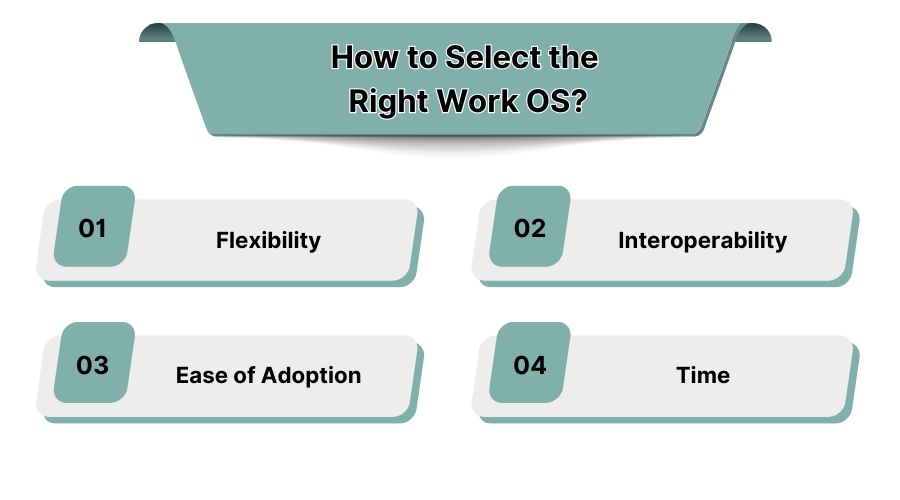
Choosing the right Work Operating System (Work OS) can transform the way your team collaborates and manages tasks. With so many options available, focusing on key factors like flexibility, interoperability, ease of adoption, and time can guide you to the ideal choice. Here's what to consider:
1. Flexibility
The best Work Operating System in USA should adapt to your unique business needs. Look for customisable workflows, task management, and features catering to your team's processes. A flexible Work OS allows you to scale effortlessly as your organisation grows.
2. Interoperability
An effective Business Operating System Software seamlessly integrates with your existing tools, such as CRMs, marketing platforms, or communication apps. Interoperability ensures smooth data sharing and eliminates silos, enabling your team to work more efficiently.
3. Ease of adoption
Your ideal Work OS should be intuitive and easy for your team to adopt. A user-friendly interface reduces training time and helps everyone transition smoothly. Look for platforms that offer excellent support and resources to assist your team during onboarding.
4. Time
Time is a valuable resource. Choose a Work OS that saves time by automating repetitive tasks, providing real-time updates, and simplifying workflows. The right platform helps your team focus on high-impact work rather than manual coordination.
6. Best Work OS Software in USA
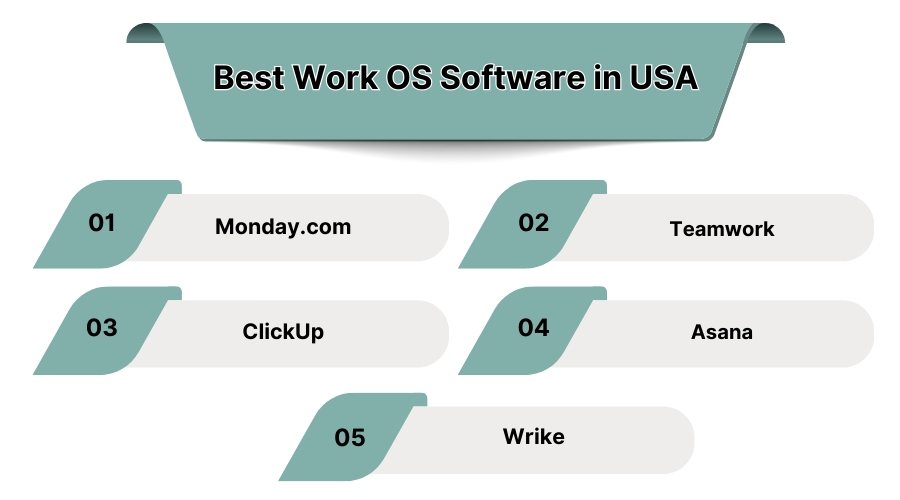
1. Monday.com
Monday.com is a Work OS that is fully customizable and facilitates the aspect of team collaboration and project management. Easy-to-understand design and freedom of movement are among the factors that contribute to it being a widely recognized and liked solution for enterprises in the search for the optimal way of aligning their working processes.
Features:
- Customizable Workflows
- Visual Project Dashboards
- Time Tracking
- Automation & Integrations
- Real-Time Collaboration
Pros:
- Highly Customizable: Tailor workflows to fit your unique business needs.
- User-Friendly: Simple interface that can be quickly adopted by teams.
Cons:
- Can Be Overwhelming for Small Teams: The abundance of features can be too much for smaller teams.
- Pricing: More expensive than some other options for basic features.
Pricing:
- Free Plan: $0 up to 2 seats
- Basic Plan: $9 per user/month
- Standard Plan: $12 per user/month
- Pro Plan: $19 per user/month
2. Teamwork
Teamwork is a robust business operating system software that excels in project and task management. It's particularly beneficial for client-facing teams and those in need of detailed reporting features.
Features:
- Task Management & Time Tracking
- Resource Management
- Collaboration Tools
- Milestone Tracking
- Reporting & Analytics
Pros:
- Advanced reporting tools for data-based better decision-making.
- Ideal for agencies or service-based businesses that need to manage client interactions.
Cons:
- Steeper Learning Curve: More complex than simpler project management tools.
- Limited Integrations: Fewer integrations compared to other Work OS platforms.
Pricing:
- Free Plan: For basic teams
- Grow Plan: $10.99 per user/month
- Business Plan: $19.99 per user/month
3. ClickUp
ClickUp is a work operating system that lets you manage different work and integrates project management, document collaboration and teamwork all in one place. Teams who want to manage projects from beginning to end would find this to be a perfect solution.
Features:
- Task Management & Prioritization
- Goals & OKRs Tracking
- Docs & Knowledge Management
- Automation & Integrations
- Time Tracking & Reporting
Pros:
- The All-in-One Tool turns task management, documentation, and team collaboration into a seamless process.
- Offers ample functionality at cost-effective prices.
Cons:
- A huge number of features may be confusing for those who are new to the platform.
- Occasional Glitches: Some users report technical bugs and slowdowns.
Pricing:
- Free Plan: Limited features
- Unlimited Plan: $7 per user/month
- Business Plan: $12 per user/month
4. Asana
Asana is a leading operating system software for businesses whose main goal is to facilitate team cooperation and project tracing. It is particularly suitable for groups that emphasize the aspects of task assignments, timelines, and clarity.
Features:
- Task Management & Assignments
- Project Timelines & Gantt Charts
- Workflow Automation
- Team Collaboration Tools
- Integration with 100+ Apps
Pros:
- Simple interface: An easy-to-use and navigate user interface is minimalistic in design.
- Flexible Project Views: Offers multiple ways to view tasks, from list views to timelines.
Cons:
- Limited Reporting: Basic reporting features compared to other tools.
- Advanced Features in Higher Tiers: Some essential features are only available on higher-tier plans.
Pricing:
- Basic Plan: Free for up to 15 users
- Premium Plan: $6.92 per user/month
- Business Plan: $15.74 per user/month
5. Wrike
Wrike is a powerful Work OS designed for advanced project and team management. It’s particularly beneficial for teams that need robust project tracking, time management, and detailed reporting.
Features:
- Task & Project Management
- Customizable Dashboards
- Time Tracking & Reporting
- Gantt Charts & Resource Allocation
- Automation & Workflow Management
Pros:
- Advanced Reporting: Strong reporting tools to keep teams on track.
- Customizable Dashboards: Allows businesses to tailor the platform to their specific needs.
Cons:
- Complex Interface: A steeper learning curve for new users.
- Expensive: Premium plans may not fit smaller businesses’ budgets.
Pricing:
- Free Plan: Basic features for small teams
- Professional Plan: $10 per user/month
- Business Plan: $24.80 per user/month
