
Best Website Monitoring Software in
Are you looking for Website Monitoring Software for your Business in ? SaaS Adviser brings you the best Website Monitoring Software to ease your worries. In order to make your work smooth and swift, SaaS Adviser has compiled a list of the best software available. Compare the Best software features, pricing, free demo, and trial to select the best Website Monitoring Software for your organization.
 Researched and Written by Akash Patel
Top 3 Featured Softwares


List of Top Website Monitoring Software
Get Free Consultation


Candum

By Candum
What is Candum? Candum is a robust Website Monitoring Software that allows businesses to track website performance, uptime, and potential issues in...
View Profile

pingnow.io
By pingnow.io
Every 60 seconds, their system pings and checks the status of the user website. If the status changes, they notify the users via email. This is the better way to monitor users' w...
View Profile

66uptime
By 66uptime
Public or private status pages can be created to showcase the availability of monitors. Every status page created gets useful and ready to go analytics. The Admin Panel allows to...
View Profile

Epic Ping
By Epic Ping
Epic Ping is a performance monitoring software that can help increase your scores. It's easy to keep track of downtime, performance, and certificates with Epic Ping. The software...
View Profile

Pulsetic
By Pulsetic
Pulsetic is committed to providing the best possible website monitoring service. Our data centers are now located around the world, so if one experiences an outage, another can t...
View Profile

ApiChecker
By ApiChecker
ApiChecker is an uptime and performance monitoring tool for websites that tells users about the status of their websites at all times. Users can instantly receive alerts when the...
View Profile

Odown
By Odown
Odown software is a platform used to monitor uptimes with instant alerts. The software offers a public status page to share and display to customers of your websites in real time...
View Profile

Screpy is a robust AI-based SEO and web analysis tool that helps users analyze a variety of pages on their website and monitor them through collaboration. The platform delivers a...
View Profile

Dareboost is a tool that analyzes website speed test and other aspects of the website, then generates a detailed analytics report on the overall performance of your website and s...
View Profile

GTmetrix
By GTmetrix
GTmetrix is a website performance monitoring and testing platform that tells you how quickly your site loads. It enables you to examine how your site operates, figure out why it's ...
View Profile

Supermonitoring is a platform that monitors the availability of websites and their specialities. It is capable of measuring reply time of the server, inspecting result of filling...
View Profile

SafeSAI
By SafeSAI
SafeSAI is a solution that makes websites more secure by providing easy-to-use security tests. These tests assess the security status of a website and make recommendations for ad...
View Profile

Moniro
By Moniro
Moniro is the perfect tool for busy website owners and professionals. This Software as a Service (SaaS) application offers exceptional website performance monitoring, helping web...
View Profile

RUMvision
By RUMvision
If you're looking to improve your website's SEO, bounce rate, and revenue, look no further than RUMvision! RUMvision offers high quality, real-time user data that allows you to a...
View Profile

Sentio
By Sentio
This platform provides users with a holistic view of decentralized application's performance and security, enabling users to detect and fix issues quickly. It includes features s...
View Profile

4Uptime
By 4Uptime
A branded status page on a custom subdomain helps build confidence in your product. You can add your logo and customize colors and fonts to match your brand.
View Profile

R2DTools
By R2DTools
R2DTools will upload a certificate to secure the website. It will also check the expiration date of the website's certificate and send email notifications if it expires. If the web...
View Profile

Nodown
By Nodown
Make sure to stay online and monitor your website. If something goes wrong, you will be notified automatically: by SMS, by email or through your preferred notification channels.
View Profile

Whatsfy
By Whatsfy
What is Whatsfy? Whatsfy is a tool that helps you create innovative plans for new businesses, startups, or online projects. It also provides reports on the fastest growing site...
View Profile

Up Ninja
By Up Ninja
Up Ninja is a software that monitors apdex indexes and response times for websites and APIs. It provides instant updates through email, Slack, or web push, and offers real-time a...
View Profile

Table of Content
What is Website Monitoring Software?
Monitoring software scans a website’s performance, uptime, security incidents, and availability. To optimize a website’s performance, it analyzes the website for security infringements, server disruptions, downtimes, and other harmful activities. Such tools effectively and efficiently scan and relay information quickly which allows firms to react appropriately and quickly to minimize the financial damages while helping save revenue. Website monitoring tools augment the user experience analysis with server response time analysis while performing comprehensive data analytics. This automated monitoring software helps protect the company's websites by ensuring they are fast, secure, and accessible.
1. Why Do You Need Software for an Advertising Agency?
With an advertising agency managing many clients, campaigns, and creative assets, software becomes a necessity. Advertising agency software improves workflow automation by streamlining processes such as campaign planning and budgeting, reporting, communications with clients, and many more. These software solutions improve collaboration, allow for real time tracking and performance analysis, which in turn allows agencies to better manage ad spending and maximize ROI.
Agencies are able to utilize proprietary AI-powered analytics, CRM integration, media planning tools, and other features to drive brand engagement. Whether managing PPC ads on social platforms or content marketing campaigns, the right application improves efficiency, reduces work effort, and most importantly, enhances the client outcome.
2. Conclusion
Advertising agency software improves campaign efficiency, automates tasks, and provides valuable insights for better client management. For selection of advertising software, which aids in workflow automation and encourages creativity, the best solutions come from SaaSAdviser who also offer tips and analysis for agencies to remain competitive in the constantly changing digital marketing landscape.
3. Latest Market Trends in Website Monitoring Software
1. Integration with DevOps and Continuous Deployment Pipelines
Global Website Monitoring Software market size was valued at USD 304.2 million in 2022 and is expected to expand at a CAGR of 6.61% during the forecast period, reaching USD 446.68 million by 2028. Website monitoring services are now fusing into the DevOps ecosystem for testing, performance monitoring, and issue resolution automation, enabling businesses to fix problems in real-time more efficiently.
2. Growing Importance of Security Monitoring
In the face of escalating categories of cyber threats, detection and mitigation of DDoS attacks, malware, and breaches have made security monitoring a necessity in website monitoring software, as well as continuous website protection.
3. Cloud-Based Monitoring Solutions Gain Traction
Organizations increasingly prefer using cloud-enabled tools for monitoring website functionality due to the lower associated costs, increased scalability, and accessibility from any geographical location for remote monitoring.
4. Focus on Data-Driven Insights and Reporting
The use of Artificial Intelligence (AI) and Machine Learning (ML) in website monitoring tools is growing quickly. This increase is due to the need for instant analytics, automated reporting, and better performance predictions. When paired with web page optimization software, businesses can improve site speed, boost SEO rankings, and provide smooth user experiences. These technologies help organizations monitor, analyze, and optimize their websites more effectively. This ensures long-term success in the digital world.
4. Features of Website Monitoring Software in the USA
1. Employee Time Tracking
Tracking work hours through web monitoring tools helps provide details on websites and applications used by employees. It guarantees that employees stay focused and further enables employers to scrutinize the time spent in work related activities by furnishing comprehensive logs of productive as well as non-productive tasks.
2. Staff Productivity Evaluation
This software fetches performance metrics according to the level and type of activity an employee engages in, the applications used, and time spent. It highlights gaps which helps managers devise plans to improve productivity and overall enhancement in business workflow.
3. Project Management
Auto integrated scheduling with a project management software helps monitor activities as deadlines are approached, and the tasks to be done are allocated plus appraised in real time. Managers appraise work, balancing the completion of projects with the efficiency achieved.
4. Screen Recording
The software ensures compliance, monitoring policy violations or security breaches by capturing employee screen footage. Screen recording enables a supervisor to examine how the tasks are done to monitor for unauthorized activities and data breaches.
5. Employee Productivity Analytics
Proprietary analytics tools offer deep reports that cover all aspects of employee productivity, engagement, and effective work. These reports help remove inefficiencies in processes, thereby increasing output at all levels of the business.
6. Timesheet Analysis
Timesheets are computerized and there is automation in the calculation of hours worked by an employee which guarantees accurate payment and billing for work done. It assists businesses in tracking absences and spotting trends, discovering overtime, and enhances manpower management.
5. 5 Best Website Monitoring Software
1. New Relic – Best for Real-Time Performance Monitoring
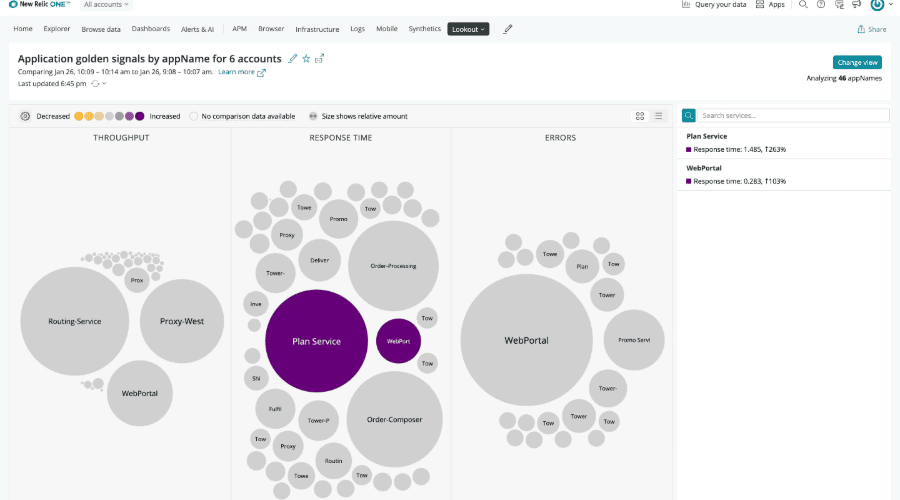
New Relic is an effective web monitoring solution for businesses that need in-depth analysis and diagnosis of applications, real-time performance tracking, and application insights. It assists developers in identifying slow-loading pages, optimizing server performance, and improving overall health of the website.
Features:
-
Full-stack monitoring for applications, servers, and browsers
-
Real-time user experience tracking with performance alerts
-
AI-powered anomaly detection for proactive issue resolution
-
Custom dashboards for advanced analytics
-
Integrations with DevOps and cloud-based tools
Pros:
✔️ Excellent real-time monitoring and diagnostics
✔️ AI-driven alerts for early issue detection
✔️ Wide range of third-party integrations
Cons:
❌ Steep learning curve for new users
❌ Expensive for small businesses
Pricing:
-
Free plan available; paid plans start at $99/month
2. Prometheus – Best for Open-Source Monitoring
Prometheus is an outstanding open-source monitoring solution tailored for alerting, tracking, and real-time performance monitoring. Its use is prevalent among DevOps teams dealing with server, application, and website monitoring.
Features:
-
Powerful time-series data collection for metrics tracking
-
Flexible query language for customized monitoring
-
Built-in alerting system for immediate issue detection
-
Integration with Grafana for visual analytics
-
Supports cloud and Kubernetes monitoring
Pros:
✔️ Completely free and open-source
✔️ Excellent for advanced custom monitoring setups
✔️ Highly scalable for large businesses
Cons:
❌ Complex configuration for beginners
❌ No out-of-the-box UI (requires Grafana for visualization)
Pricing:
-
Free (Open-Source Software)
3. Hotjar – Best for User Behavior Analysis
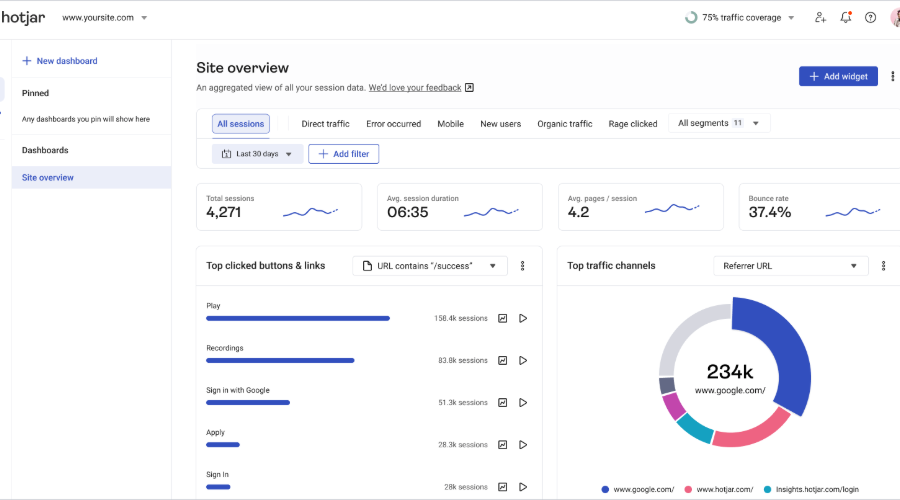
A business that requires behavioral and website analytics will find Hotjar useful as it tracks user interactions, heatmaps, and conversions. It is perfect for marketers, UX designers, and business owners looking to increase user engagement on the site.
Features:
-
Session recordings to analyze visitor interactions
-
Heatmaps to visualize website user behavior
-
Conversion funnel tracking to optimize performance
-
User surveys and feedback tools
-
AI-powered insights for improving website experience
Pros:
✔️ Great for UX optimization and A/B testing
✔️ Easy-to-use interface
✔️ Detailed heatmaps and session recordings
Cons:
❌ No real-time uptime monitoring
❌ Limited integrations with monitoring tools
Pricing:
-
Free plan available; paid plans start at $32/month
4. Pingdom – Best for Uptime and Page Speed Monitoring
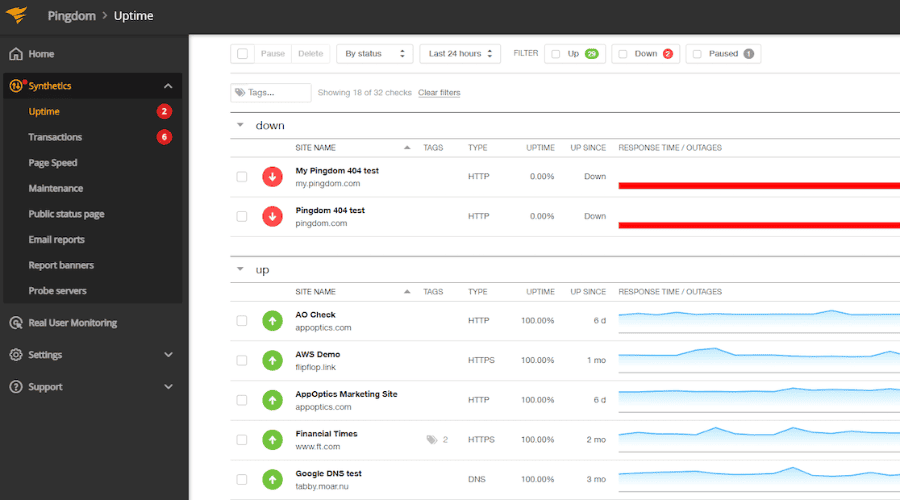
Pingdom is widely acknowledged for its website performance monitoring. The tool monitors uptime, page speed, and server response time in real-time. It's popular among web developers, businesses, and IT experts.
Features:
-
24/7 uptime monitoring with instant alerts
-
Website speed testing to optimize performance
-
Real user monitoring (RUM) for tracking visitor behavior
-
API monitoring for automated tracking
-
Customizable reporting dashboards
Pros:
✔️ Simple setup and easy-to-use interface
✔️ Comprehensive uptime and speed tracking
✔️ Reliable real-time alerts
Cons:
❌ Limited advanced analytics capabilities
❌ No in-depth security monitoring
Pricing:
-
Starts at $10/month
5. Datadog – Best for Cloud-Based Website Performance Monitoring
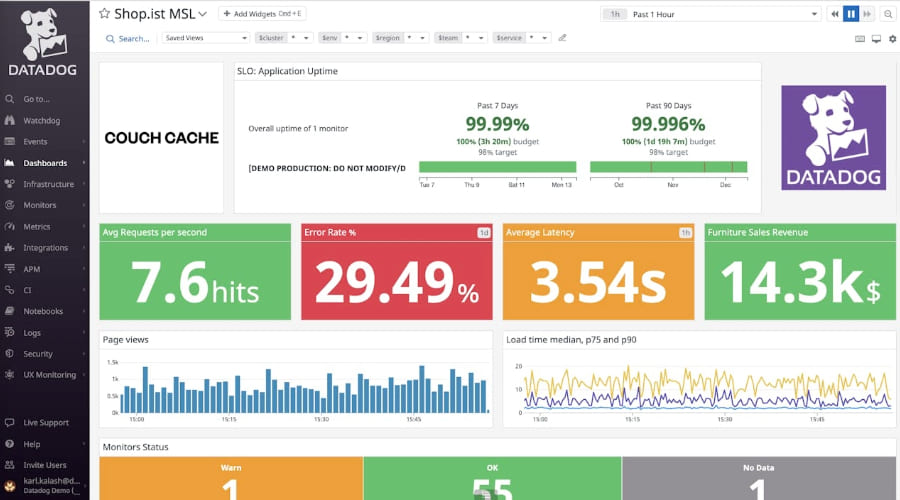
Datadog offers a comprehensive solution by combining cloud performance monitoring, security oversight, and real-time analytics into one platform. Its benefits are best realized by IT operations, DevOps teams, and large corporations.
Features:
-
Full-stack website monitoring with AI-powered insights
-
Cloud infrastructure monitoring for AWS, Azure, and Google Cloud
-
Log management and anomaly detection
-
Custom dashboards for performance visualization
-
Seamless integration with over 450+ applications
Pros:
✔️ Excellent cloud monitoring features
✔️ AI-powered analytics for proactive issue resolution
✔️ Highly customizable dashboards
Cons:
❌ Complex interface for first-time users
❌ Higher cost for premium features
Pricing:
-
Free trial available; paid plans start at $15/month
6. Benefits of Website Monitoring Software
1. Supports Smooth-Running Systems
Website monitoring software ensures seamless system operations by dealing with server issues, slow loading speed and downtimes in real time. By providing automated alerts, disruptions can be minimized which when resolved promptly helps businesses in maintaining smooth user experiences.
2. Maintains and Optimizes Website Performance
Performance tracking tools assist businesses with monitoring the utilization of resources such as website speed and server response time. With companies being able to locate, their bottlenecks, page load speeds, SEO rankings, and customer satisfaction can be improved thus improving the retention rate and conversion.
3. Control Bandwidth Usage
By using site monitoring software, monitoring of bandwidth consumption can guarantee that web resources are utilized efficiently. This prevents overuse, enhances server allocation, and ensures unusual traffic spikes are detected to prevent overload of the server and increased hosting expenses for the company. When combined with reliable web hosting software, it further strengthens performance and stability.
4. Increase Productivity on the Internet
Optimized website functionality also enhances visitor engagement, enabling businesses to maintain steady online operations and achieve better revenue generation. Undisrupted website performance along with the prevention of downtimes ensures employee efficiency aligned to business goals gets maximized. If you want to increase productivity, read our detailed guide on how employee engagement software transforms the workplace.
7. Challenges in Best Website Monitoring Software
1. An Ever-Expanding Ocean of Data
The performance monitoring tools available today have the capability of providing extensive functionality data, which when considered in its totality can lead to extracting high-level insights that are not simplistic. Furthermore, filtering out meaningless logs to single out major concerns demands sophisticated data processing abilities.
2. The APM Adoption Hurdle
Application Performance Monitoring (APM) is highly useful, but its deployment is not without difficulty due to complicated setups, lack of adequate skills, and the requisite APM integration with the existing IT infrastructure.
3. Limited Flexibility
Some monitoring software lacks customization options, reports, alerts, and performance thresholds set by the business itself. Inflexible tools may not grow according to the changing business requirements, monetarily impacting businesses.
4. Symptoms Everywhere, Root Cause Nowhere
Figure out the source of the problem that is causing the website issues. While monitoring the tools certainly figures out the issues for example response times or frequent crashing, it is vital to have advanced capabilities coupled with real-time analytics to retrieve the source of failure.
8. Criteria for Selecting the Right Website Monitoring Software
The top priorities of a business when selecting web page monitoring software are uptime, accuracy, and reporting. These tools should allow real-time monitoring with instant notifications sent through emails, SMS, or push alerts to enhance immediate action toward the website.
Another determinant of the software is monitoring coverage—this includes page speed analysis, security monitoring, and uptime tracking through integration with other platforms such as Google Analytics. The software must also be able to grant customizable dashboards that offer comprehensive performance reports and insights.
As we have discussed previously, we have come to the conclusion that choosing a business solution that matches a company's growth aims helps with scalability. Affordability, customer support, and the ease of setup should ensure that adequate value is provided for the investment made.
