
Best Machine Learning Software in
Are you looking for Machine Learning Software for your Business in ? SaaS Adviser brings you the best Machine Learning Software to ease your worries. In order to make your work smooth and swift, SaaS Adviser has compiled a list of the best software available. Compare the Best software features, pricing, free demo, and trial to select the best Machine Learning Software for your organization.
.jpg "Prachi Rana") Researched and Written by Prachi Rana
Researched and Written by Prachi Rana
Top 3 Featured Softwares


List of Top Machine Learning Software
Get Free Consultation


Deel is a cloud-based global payroll and compliance platform designed to help businesses hire, manage, and pay remote employees and contractors across 150+ countries. By provid...
View Profile

Kallidus Learn

Simplify compliance. Focus on potential.
Kallidus Learn is a modern learning platform designed to make learning simple, fast, and effective. It combines classroom, online, mobile, and social learning into one single scala...
View Profile

Absorb LMS is a cloud-based learning management system that enables organizations to efficiently deliver, manage, and track training programs. It offers a user-friendly platform fo...
View Profile

LearnWorlds is a powerful and intuitive cloud-based Learning Management System (LMS) designed for entrepreneurs, educators, and enterprises to create, manage, and monetize onli...
View Profile

Trainual is a cloud-based training and process documentation platform designed to help businesses organize their knowledge, standardize operations, and streamline employee onbo...
View Profile

AdCreative.ai
Ad & Social Creatives
AdCreative.ai is an AI-powered advertising platform that helps businesses, marketers, and agencies create high-converting ad creatives quickly and efficiently. It leverages machine...
View Profile

Amazon Personalize
By Amazon Personalize
Amazon Personalize is a machine learning platform that empowers developers to create individualized recommendations for customers using their apps. With tailored search results a...
View Profile

KNIME Analytics Platform
By KNIME Analytics Platform
The KNIME Analytics Platform is an open-source software that makes it easy for developers to understand data and design workflows. With the platform's native nodes, developers can ...
View Profile

RapidMiner
By RapidMiner
This software helps you to understand your customers better and provides options to improve your marketing strategies. The customer lifetime value feature lets you identify which c...
View Profile

Accord
By Accord
Accord software is a platform used to design contracts. The software offers templates to generate your legal document and edit documents with built-in rich-text editor. Sign your d...
View Profile

IBM Watson Studio
By IBM Watson Studio
IBM Watson Studio helps you build, run, and manage AI models. You can prepare data and build models anywhere using open source code or visual modeling. You can also predict and opt...
View Profile

Shogun Page Builder
By Shogun Page Builder
Choose from a library of pre-built page templates designed for conversions, then customize them to your liking. Convert more customers by uncovering what they love about your pages...
View Profile

Nyckel
By Nyckel
Nyckel's ML platform enables quick development and integration of ML functionality into applications.
View Profile
Google Cloud TPU
By Google Cloud TPU
The Tensor Processing Unit (TPU) is a custom-designed machine learning ASIC that enables anyone to achieve business and research breakthroughs in areas like network security and ...
View Profile

Amazon SageMaker
By Amazon SageMaker
What is Amazon SageMaker? Amazon SageMaker is a fully managed machine learning platform that enables developers and data scientists to build, train, and deploy models at scale. ...
View Profile

H2O Driverless AI
By H2O Driverless AI
H2O Driverless AI is a popular platform for automated machine learning that addresses a whole variety of use cases for every individual enterprise across several industries. It has...
View Profile

CoLab
By CoLab
CoLab is a web-based collaboration tool that lets the team share computer-aided design (CAD) files, provide feedback with full mechanical context, and capture the critical design d...
View Profile

BigML
By BigML
BigML's Machine Learning service is highly scalable, cloud-based, and easy to use. It integrates seamlessly and is instantly actionable. With a web interface and REST API, it's up ...
View Profile

UiPath RPA is a cloud-based robotic process automation software solution that is specifically designed for government organizations and businesses. It allows users to connect their...
View Profile

ArcGIS 3D Analyst
By ArcGIS 3D Analyst
ArcGIS 3D Analyst provides true 3D analysis tools to help you determine the contour, slope, or elevation of a region; the size of the shadow cast by a proposed building; or the geo...
View Profile

Table of Content
What is Machine Learning Software?
Machine learning software allows computers to process data and make decisions autonomously, without predefined instructions. These systems help users create, refine, and implement machine learning models capable of pattern recognition, predictive analysis, and self-improvement over time.
The application of machine learning in software development has emerged as a fundamental element of AI initiatives across numerous sectors. It helps organizations capitalize on extensive data sets and their intricate automated processes. Some applications are designed for non-technical end-users while others are tailored toward developers with programming skills.
From guiding business strategies through advanced analytics to enabling NLP or vision-based applications, machine learning software enhances innovation and propels better decision-making. If you’re working on a language model, we suggest you use machine translation software.
1. Conclusion
Both free and premium options of machine learning software continue to change and now offer advanced capabilities and tangible advantages for companies of every size. As a novice or an expert, you can check SaaS Adviser platforms that will provide you with the right machine learning based software that you need. Start exploring and comparing today, and advance further in your AI development journey.
2. Benefits of Machine Learning Software
-
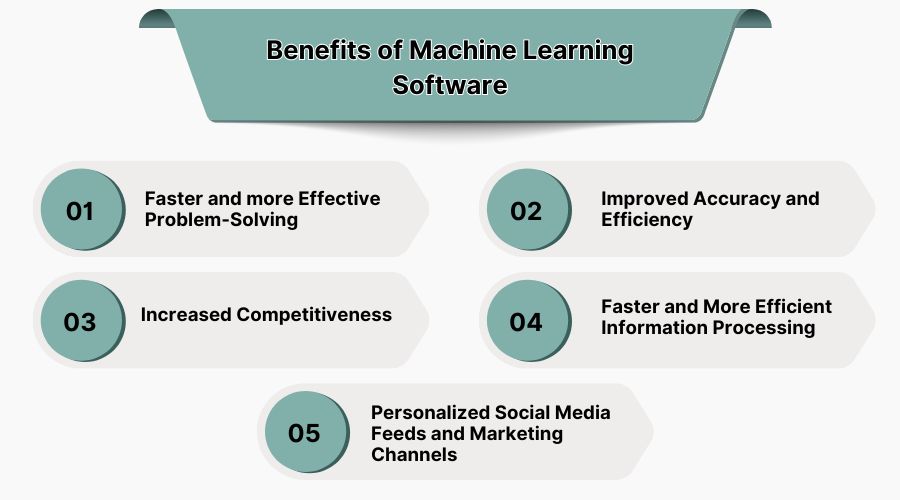
Faster and More Effective Problem-Solving
The rapid analysis of data by machine learning software aids in the quick identification of problems. It rescues teams from enduring lengthy and tedious processes while uncovering solutions to complex challenges that would take humans much longer to find.
-
Improved Accuracy and Efficiency
Machine learning tools enhance performance by increasing accuracy due to automation of repetitive tasks. As time progresses, models improve with added data, thus refining performance, decision-making accuracy, and averting human error in healthcare, finance, and marketing. If you’re focused on the healthcare sector more, we recommend you use healthcare software to ensure enhanced efficiency.
-
Increased Competitiveness
Adoption of machine learning software gives businesses a competitive edge since those who are first to leverage data insights get ahead. It helps businesses innovate in their processes and products or services to fit the rapidly evolving market.
-
Faster and More Efficient Information Processing
Machine learning processes massive amounts of data at high speeds. Fast processing leads to improvement in operating efficiency along with enabling real time decision making of data-heavy tasks.
-
Personalized Social Media Feeds and Marketing Channels
Advertising and marketing content have now become personalized as the AI tools helps in analyzing consumer interactions with brands. This advanced personalization improves user engagement and drives users tailored to their needs.
3. Challenges in Machine Learning Software
-
Poor Quality of Data
The performance of machine learning (ML) models is contingent upon having clean, consistently formatted, and accurately labeled data. Data quality issues, such as biases, noise, and missing values, can severely undermine trust and reliability in model outputs, which in turn impacts predictions, and decisions.
-
Underfitting of Training Data
Many machine learning models are underfitted due to oversimplifying basic data patterns, which results in an ineffective model yielding inaccurate predictions even on training data. With such poor performance, the deployed model is bound to fail in real-world applications.
-
Machine Learning is a Complex Process
From preparing the data to selecting and evaluating the model, the machine learning process requires a great deal of expertise. The learning curve is steep, and without proper resources, teams often struggle to execute ML initiatives successfully or at scale.
-
Slow Implementation
Building ML algorithms, models, and deploying them on systems can take a significant amount of time. Organizations can operate for weeks or months in system integration, model evaluation, as well as in model training and data preprocessing, all of which significantly extends time to value and delays ROI.
-
Scalability Issues
There are often problems that the ML systems encounter with scaling to meet demands from greater user numbers and larger datasets. Restrictions to performance caused by high computational costs, and inefficient models can disrupt delivery of real-time insights at enterprise scale, restricting their use.
-
Testing and Quality Assurance
As opposed to other systems, Machine Learning (ML) systems require ongoing validation to confirm that outputs are accurate. Because of data patterns that shift over time, testing ML models is intricate. This variation in specified boundaries presents a consistently challenging endeavor to achieve an enduring level of quality, performance, and fairness.
4. Features of Machine Learning Software in USA
-
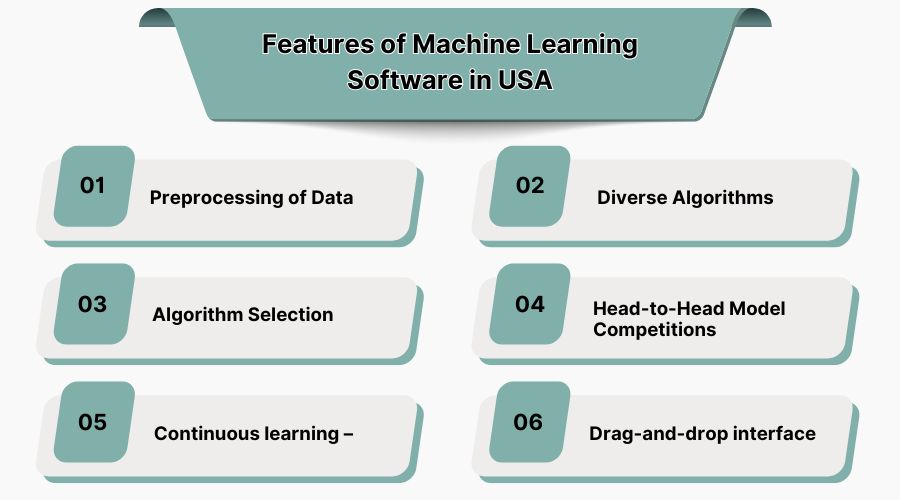
Preprocessing of Data
Unlike Europe, machine learning softwares in the USA are usually integrated with features for data cleansing, transformation, and normalization. Inclusion of these preprocessing features adds value to the services offered by the software, as users do not have to worry about the quality of data used for model training, and these efforts save time during the preparation stage.
-
Diverse Algorithms
Leading ML packages have an extensive algorithm library that contains simple decision trees and the most sophisticated deep learning algorithms. This enables the users to apply any algorithm that best fits their problem whether it be classification, regression, clustering, or even natural language processing.
-
Algorithm Selection
In modern frameworks, automatic selection of algorithms is one of the essential features. These tools use a number of models with defined performance metrics, evaluate them, and suggest the most useful model which expedites the workload of both novice and veteran users.
-
Head-to-Head Model Competitions
Some sophisticated frameworks have advanced model comparison features. They allow for the training of several models on one dataset to be benchmarked concurrently, thus enabling the user to easily see how different strategies perform so that they can select the best approach for their problem.
-
Continuous Learning
The latest development in machine learning software is the support of adaptive learning, which helps integrate new data without interrupting the flow of information. Continuously updating derived models improves predictive accuracy and relevancy, which is beneficial in constantly changing areas like finance, marketing, or cybersecurity.
-
Drag-and-Drop Interface
Drag-and-drop interfaces allow building of sophisticated models with ease and minimum knowledge. The add-your-code approach is low-barrier and provides economic flexibility for advanced ML tools, model creation for non-programmers, thereby enhancing customization and scalability across teams and sectors.
5. Five Best Machine Learning Software in USA
1. Microsoft Azure Machine Learning – Best for Scalable Enterprise ML Solutions
The Microsoft Azure Machine Learning management Software is a sophisticated cloud solution with a focus on enterprise-grade features which enables businesses to construct, train, and deploy machine learning models effortlessly.
It is beginner-friendly due to its low-code options, while still being powerful enough for professionals who prefer a code-first approach. As with many other Azure services, it integrates seamlessly with Microsoft products, extending services at the corporate level which strengthens AI applications to be used across the enterprise.
Features:
-
Automated ML for quick model building and deployment
-
Visual interface for no-code model development
-
Advanced tools for data prep, model training, and evaluation
-
Seamless integration with other Microsoft services like Power BI and Azure Data Lake
Pros:
-
Highly scalable and secure for enterprise use
-
Supports both code-first and low-code experiences
-
Offers end-to-end machine learning lifecycle support
Cons:
-
Can be complex for beginners without prior Azure experience
-
Pricing may increase rapidly with usage at enterprise scale
Price:
-
Pricing is usage-based. Basic plan starts at $0.004/hour for computer instances; advanced features require additional costs.
2. TensorFlow – Best Open-Source Platform for Developers
TensorFlow is widely accepted and used by developers and data scientists to create, train, and deploy deep learning models due to its exceptional flexibility, performance, and scalability. It also provides users with versatility in terms of languages and deployment environments, giving it an edge in both academic research and commercial solutions.
Features:
-
Extensive support for neural networks and deep learning
-
Compatible with Python, C++, and JavaScript
-
TensorBoard for model visualization and debugging
-
Scalable deployment via TensorFlow Serving and TensorFlow Lite
Pros:
-
Backed by Google with an active developer community
-
High flexibility for custom model development
-
Supports training on both CPUs and GPUs
Cons:
-
Steeper learning curve for beginners
-
Lacks a user-friendly interface for non-developers
Price:
-
Free and open-source under Apache 2.0 License.
3. OpenNN – Best for Advanced Neural Network Modeling
Open Source Neural Networks for C++ (OpenNN) is a powerful neural network library optimized for deep learning and advanced analytics. Its performance is unique as it provides fine control over model structure, training, and algorithms. OpenNN is lightweight and versatile; therefore, it is ideal for users who require access to core algorithms and processing layers, providing users with both agility and control.
Features:
-
Supports supervised learning and regression tasks
-
Advanced model customization and parameter tuning
-
High-speed training with multi-threading and CPU optimization
-
Integration capabilities with third-party analytics tools
Pros:
-
Extremely lightweight and efficient
-
Offers precise control over neural architecture and training
-
Ideal for research and advanced analytics
Cons:
-
Requires C++ programming knowledge
-
No graphical user interface or drag-and-drop support
Price:
-
Free and open-source for personal and commercial use.
4. PyTorch – Best for Flexibility and Research Applications
PyTorch has gained extensive popularity among the community due to its experimentation appeal and dynamic computation graphs. Easy navigation allows researchers and developers to take advantage of its usability. It is suitable for developing custom models in multiple domains, including but not limited to computer vision, natural language processing, and generative AI.
Features:
-
Dynamic graph computation for intuitive debugging
-
Strong support for computer vision and NLP
-
Integrates with Python libraries like NumPy and SciPy
-
TorchServe for scalable model deployment
Pros:
-
Flexible and easy to modify for research workflows
-
Strong community support with rich documentation
-
Excellent GPU acceleration
Cons:
-
Less suited for production environments compared to TensorFlow
-
Limited built-in tools for end-to-end ML lifecycle
Price:
-
Free and open-source under BSD license.
5. Amazon Web Services (AWS) SageMaker – Best for End-to-End ML Workflows
Amazon SageMaker is a comprehensive platform that advances machine learning (ML) model development lifecycle including data labeling and model deployment. It is ideal for businesses of every scale because SageMaker provides automation, guards sensitive information, and is scalable.
As part of the AWS ecosystem, SageMaker improves productivity and eases complex machine learning solutions, simplifying AI solution production with cloud infrastructure services.
Features:
-
AutoML, data preprocessing, training, and deployment in one place
-
Built-in Jupyter notebooks for experimentation
-
Model monitoring and versioning tools
-
Access to pre-built algorithms and frameworks
Pros:
-
Supports all phases of ML development
-
Highly scalable with integration across AWS ecosystem
-
Pay-as-you-go flexibility for different workloads
Cons:
-
May be overwhelming for small businesses or beginners
-
Can get expensive with large-scale projects and storage
Price:
-
Pricing varies by usage. On-demand notebook instances start at $0.07/hour, with additional fees for training and inference.
6. Latest Market Trends in free Machine Learning Software
-
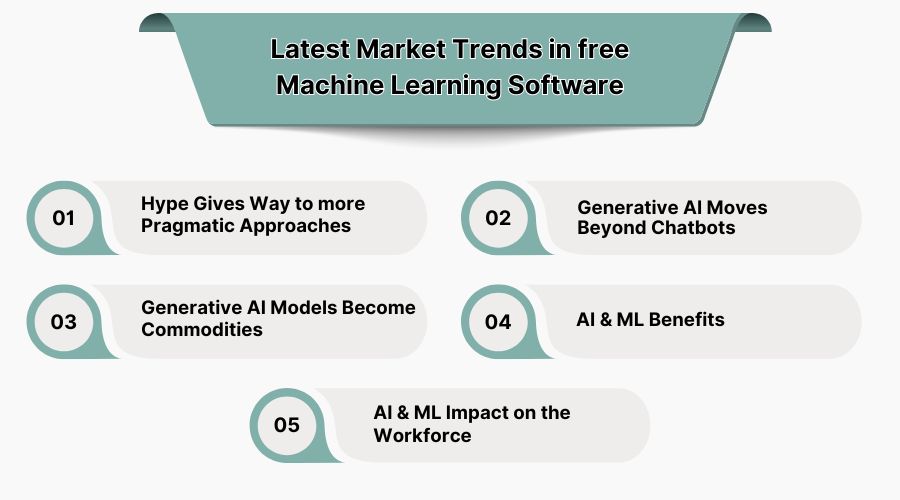
Hype Gives Way to More Pragmatic Approaches
Recent machine learning statistics shows that the global machine learning industry is worth more than $79 billion in 2024. The excitement AI induced seems to be representing a fad or outdated marketing tactic, as attention is now directed toward practical outcomes. Companies now choose free machine learning tools based on their practicality, accuracy, efficiency, and scalability—in comparison to claims made or expectations set about the system.
-
Generative AI Moves Beyond Chatbots
Simple chatbot functions are only the beginning of what generative AI has to offer. The creation of free tools permits the generation of images, content, and even data, increasing their use in numerous fields such as marketing, design, and even education.
-
Generative AI Models Become Commodities
Open-source repositories provide access to pretrained generative models, which enhances their availability. This change is fostering further innovation, as now even free software offers robust tools once reserved for elite tech corporations or paid enterprise solutions.
-
AI & ML Benefits
Advanced analytics, data-driven strategic decision-making, or even automation are accessible to firms for free due to self-learning machines. These systems enhance operational productivity and create more business value, all without heavy investments in proprietary hardware and systems.
-
AI & ML Impact on the Workforce
While AI is transforming how people work and for the most part, improving productivity, routine tasks are being automated. There are some roles that are being eliminated for good. However, other positions particularly in ML operations, data analysis, and training AI systems are proliferating. Also, you can use a dedicated workforce management software to ensure the workflow remains efficient.
7. Criteria for Selecting the Right Machine Learning Software
-
Provides convenient model training and deployment
-
Supports various methods of algorithms as well as differing data formats
-
Has user-friendly interface for novices and veterans
-
Facilitates integration with other systems
-
Includes detailed documentation and active community assistance
-
Gives sustainable solutions for business expansion and increased data usage
-
Allows on-premise and cloud deployment
-
Offers a premium model or trial version of the machine learning experience software
