
Best Integration Software in
Are you looking for Integration Software for your Business in ? SaaS Adviser brings you the best Integration Software to ease your worries. In order to make your work smooth and swift, SaaS Adviser has compiled a list of the best software available. Compare the Best software features, pricing, free demo, and trial to select the best Integration Software for your organization.
 Researched and Written by Akash Patel
Top 3 Featured Softwares


List of Top Integration Software
Get Free Consultation

Simplifier

By Simplifier
Simplifier helps companies sustainably digitalize their business processes. We're experts at configuring integrated business applications using modern and innovative technologies...
View Profile

Tray is an automation platform that lets users connect their cloud stack without any external support. They can quickly integrate their software applications using automated work...
View Profile
SyncSpider
By SyncSpider
SyncSpider automates the process of syncing data between different channels and platforms. This includes syncing all App Data, Inventory, Contact Leads, Tasks and everything else. ...
View Profile

You can use Cyclr’s embedded marketplace or launch capability to quickly set up integrations for end users, without having to implement your own UX. Cyclr is a low-code, user-f...
View Profile

APIANT
By APIANT
APIANT is a hybrid integration platform that reduces time by automatically connecting various software and automating processes. The software allows users to connect to the cloud...
View Profile
Locoia
By Locoia
Automate your processes by integrating your existing software and systems. Our intuitive drag & drop workflow editor makes it easy to create and automate processes. Modular integ...
View Profile

The Stackby software platform is used to create Project management apps to automate workflow. Collaborate with your team in real-time to create checklists, and recieve notification...
View Profile

LeadsBridge is a reliable platform that helps users integrate their CRM and optimize their digital advertising strategy to grow their ROAS. It connects over 370 tools with the mo...
View Profile
i2x
By i2x
I2x software is a great way to improve your team's performance by using data and sharing best practices. The contact center management system includes features like call recordin...
View Profile
Saphyte
By Saphyte
Saphyte is a CRM (Customer Relationship Management) that is integrated with useful sales and marketing tools to give your company a boost in efficiency and productivity. The syst...
View Profile
ArcGIS Online is a Geographical Information System (GIS) mapping software for individuals and companies that enables them to connect people, locations and data using interactive ma...
View Profile

Adobe Dimension
By Adobe Dimension
Adobe Dimension is a software that allows you to create 3D content quickly and easily. It offers you tools to create mockups, brand visualizations, product graphics, and other cr...
View Profile
Catalytic
By Catalytic
Catalytic is a no-code workflow automation platform that makes work faster and more efficient without friction or heavy development. It is the only cloud platform created for cit...
View Profile

What is Domo?Domo is a cloud-based business intelligence (BI) platform that helps organizations turn complex data into actionable insights. It connects seamlessly with various ...
View Profile

Lobster_data
By Lobster Data
Check How Lobster_data can help to automate Indian Business. SaaSAdviser provide their list of features, pricing, Free demo and Comparison with the best alternative
View Profile
Zed Axis
By Zed-SystemsCheck How Zed Axis can help to automate Indian Business. SaaSAdviser provide their list of features, pricing, Free demo and Comparison with the best alternative
View Profile

ElectroNeek Platform
By ElectroNeek RoboticsCheck How ElectroNeek Platform can help to automate Indian Business. SaaSAdviser provide their list of features, pricing, Free demo and Comparison with the best alternative
View Profile

Winautomation
By SoftomotiveCheck How Winautomation can help to automate Indian Business. SaaSAdviser provide their list of features, pricing, Free demo and Comparison with the best alternative
View Profile

KnowledgeLake
By KnowledgeLakeCheck How KnowledgeLake can help to automate Indian Business. SaaSAdviser provide their list of features, pricing, Free demo and Comparison with the best alternative
View Profile

UniRetail6
Fully Customizable Retail Software for Retail Chain Store
UniRetail6 Software is a comprehensive solution for retail businesses, designed to streamline operations such as inventory management, point-of-sale (POS) transactions, custome...
View Profile

Table of Content
What is Software Integration?
Software integration is the process of multiple software blocks or specialized subroutines plugging into general programming to be freely attached or discarded. Besides keeping track of multiple isolated tools, such a software system makes it certain that data is flowing well, which leads to speed up working time, and creates a uniform experience on various platforms. For instance, in companies, a comprehensive software integration strategy automates data flow, thus reducing the time needed for error correction and raising the overall efficiency. The best case scenario of the integration of ERP with CRM, payment gateways’ connection to e-commerce or cloud apps’ joining on-prem systems, the good structure of the Integration System in USA that makes it achievable for businesses to reach a high level of smoothness in operations.
Selecting the proper integration solution is not only about connectivity—it’s more of a matter of scalability, security, and compatibility with already installed technological systems. There’s a lot to consider before making a purchase, and this buyer’s guide will help you to decide the best solution for your business needs.
1. What is the Role of a Software Integration?
An Integration System connects various software applications that facilitate data exchange and workflow automation without the use of error-prone manual data entry. The software within the different departments is aggregated and the flow of information is such, that no errors are introduced. This method enhances productivity and clarifies decision-making.
Software integration, in addition to efficiency, also enables the scalability of the system, so that companies can incorporate new technologies without stopping their existing operations. Especially the right integration is the solution of agile automation. The process of establishing the integration keeps moving in the desired direction by operations of the right IT business systems and their operational processes.
To perform operations, businesses use a variety of apps, from CRM Software and accounting software to supply chain and analytics. There is a contradiction when the systems can't communicate. This is the case in software integration that plays an important role. For businesses that want to be competitive, the need for integration software is not just an option for growing, agility, and making operations more efficient, but it is a must.
2. List of Top Integration Software:
Here’s a detailed look at the top integration software solutions:
1. Informatica
Informatica is a powerful integration system that helps businesses connect and manage data across various platforms. It is widely used for integration testing software and data governance, making it a top choice for enterprises.
Features:
- AI-powered data integration for better accuracy
- Supports hybrid and multi-cloud environments
- Advanced data transformation and ETL capabilities
- Strong security features with role-based access
- Scalable architecture for large enterprises
Pros:
- High scalability for large datasets
- Comprehensive data governance features
Cons:
- Steep learning curve for beginners
- Pricing can be expensive for small businesses
Pricing: Custom pricing based on business needs. Contact Informatica for a quote.
2. MuleSoft Anypoint Platform
MuleSoft is an integration software that offers powerful API management capabilities and is the primary choice of companies that end up needing to connect their apps, devices, and data.
Features:
- Unified platform for API-led connectivity
- Suitable for cloud, on-premise, and hybrid integrations
- Built-in security and compliance features
- Drag-and-drop interface for easy workflow automation
- AI-driven insights for optimizing integrations
Pros:
- Strong API management and connectivity features
- Flexible deployment options available (cloud, on-prem, hybrid)
Cons:
- Higher cost compared to other platforms
- Requires technical expertise for advanced integrations
Pricing: Starts at $80,000 per year (approx.), with custom pricing for enterprises.
3. AWS Glue
AWS Glue is an ETL software integration service that helps businesses prepare and transform data for analytics. It is best suited for companies using AWS services.
Features:
- Fully managed ETL service
- Supports automatic schema discovery
- Serverless architecture for cost efficiency
- Integration with AWS ecosystem (S3, Redshift, Athena)
- Built-in job scheduling for automation
Pros:
- Serverless, reducing infrastructure management efforts
- Cost-effective for AWS users
Cons:
- Best suited for AWS environments, limited outside integration
- Requires technical knowledge for customization
Pricing: Pay-as-you-go model, starting at $0.44 per DPU-hour.
4. Zapier
Zapier is an easy-to-use integration system that hooks up more than 6,000 applications, thus making automation for companies of all sizes easily accessible. It's an ideal solution for non-technical users.
Features:
- No-code automation for workflows
- Supports over 6,000+ apps (Slack, Google Drive, HubSpot, etc.)
- Multi-step workflows for complex automation
- Real-time data syncing
- AI-powered automation suggestions
Pros:
- Easy-to-use, no coding required
- Supports a vast number of applications
Cons:
- Limited customization for complex integrations
- Higher pricing for advanced features
Pricing: Free plan available with basic features. Paid plans start at $19.99/month
5. Oracle Integration Cloud
Oracle Integration Cloud is a comprehensive integration testing software designed for enterprises that require seamless connectivity between Oracle and third-party applications.
Features:
- Pre-built adapters for Oracle and non-Oracle apps
- AI-driven process automation
- Supports API management and data transformation
- Advanced security and compliance features
- Real-time monitoring and analytics
Pros:
- Deep integration with Oracle applications
- Scalable for large enterprises
Cons:
- Complex setup process
- Higher pricing for small businesses
Pricing: Starts at $600 per OCPU per month. Custom pricing for enterprise needs.
3. Key Steps of Integration Software
Implementing an Integration System requires a detailed implementation of linking business applications to avoid any hiccups. There are the steps of top priority:
1. Feasibility Analysis
Before implementing integration software, businesses must analyze system compatibility, integration requirements, and potential challenges. This step helps estimate costs, resources, and the time needed for software integration.
2. Architecture Modeling
Once feasibility is confirmed, the next step is designing the Integration System's architecture. This involves the establishment of data flow, choosing Business Process Management Software, and making certain that security, scalability, and efficiency are addressed.
3. Implementation
Integration of the software, which is done in the final stage, includes the software integration process, the API configuration, and the use of the Integration Testing Software to ensure error-free data flow. The continuous monitoring helps to gather valuable insights and avoid any disruptions.
4. Different Ways to Connect Integration System
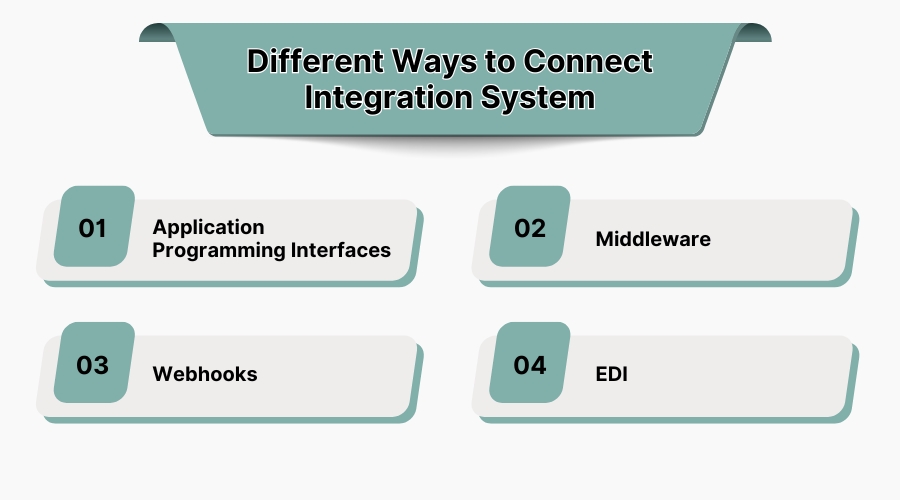
There are multiple ways to establish software integration, depending on business needs and system compatibility. Here are the most common methods:
1. Application Programming Interfaces (APIs)
APIs are undoubtedly among the most widely used and the most effective platforms to glue different apps together. They, so to speak, serve as the only link for software applications to pass data back and forth to each and every other so they can stay up-to-date. By API management software, companies can build, handle, and secure API links in order to ensure that software is seamlessly integrated. APIs offer modularity, scalability, and rapidity, so they thus outdo other methods when it comes to designing cloud-based systems and modern applications.
2. Middleware
Middle ware is a bridge that links different systems by ensuring trouble free data exchange without the need to modify existing applications directly. It streamlines the integration software implementing process by managing the communication, data transformation, and process automation. Companies frequently need middleware to merge older systems with modern business intelligence software, which in turn provides a seamless workflow with minimum disturbance to operations.
3. Webhooks
Webhooks are the building blocks of real-time logic as they serve to keep the data bounces to a minimum and minimize the response time. In contrast to APIs that require continuous fetching of data, webhooks push information at the very moment data is being created like this crawler case, thus cutting the load and increasing the efficiency. They are often used for Integration Testing Software, the update of Customer Relationship Management and for the processing of payments. They make sure the systems are synchronized in-time.
4. EDI
EDI a method used by companies to exchange business documents. The procedure is in use in various industries, such as logistics, retail, and healthcare. This method represents one way of automation by using kinds of transactions like purchase orders and invoices.
Relationship to APIs may be called a matter of EDI not being as flexible as APIs you might add a not and the text will be smooth but detailed at the same time. The most important thing to know is that EDI still remains a vital aspect of the software integration process, mainly for big businesses that regularly exchange structured data.
5. Cons of Integration Software in USA
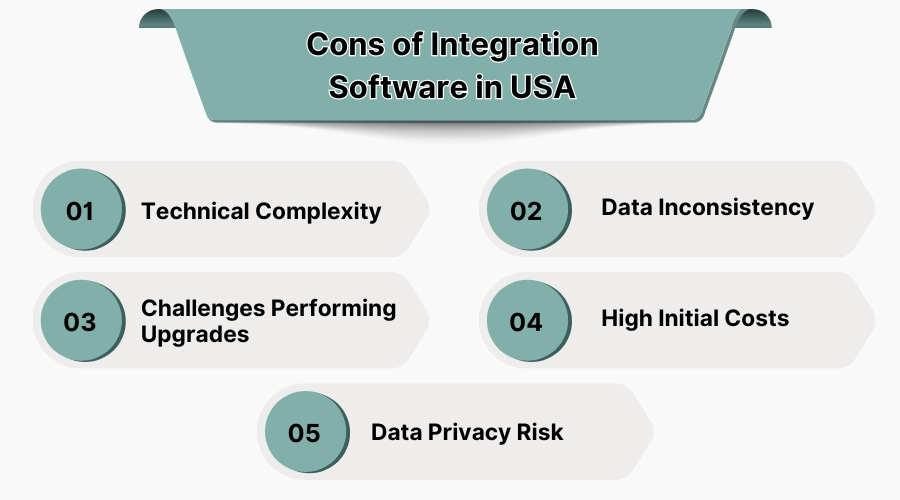
Even though integration software has a lot of pros, businesses should remember that there are possible problems they have to solve before implementing it. Here are some common drawbacks of software integration and how they may impact your operations:
1. Technical Complexity
Setting up an Integration System is a hard task and it requires a person with technical knowledge, as no two platforms are exactly the same and some of them may require one or the other further configurations, orchestration of APIs, or logical compatibility testing. Integration is challenging for a business that is not done with the proper attitude of implementation, which may lead to them experiencing disruptions, thus important to have IT professionals or even hiring experienced vendors from outside who will handle the process.
2. Data Inconsistency
Integrated data systems that are not managed properly can cause data mismatches, doubles, or inconsistent and obsolete records. Integration Testing Software, that is, which businesses may face such troubles as syncing errors, which in their turn may lead to incorrect data that in its turn impacts decision-making and operations.
3. Challenges Performing Upgrades
Software is updated and upgraded automatically; any changes released cannot be avoided. At the same time, the difficulty of updating separate systems without affecting the whole system may come from a sophisticated software integration configuration. Most importantly, companies should be sure that they have an integration system that is adaptable to the updates without ruining the whole setup.
4. High Initial Costs
Introducing a solid Integration System might cost a lot of money, but especially for small and medium-sized businesses. Costs include the upfront investment and therefore can range from the software licensing, the development, and the customization, to the daily maintenance. Nevertheless, the costs should be generally less than the long-term benefits, although the money coming at the beginning could be a hurdle for some organizations.
5. Data Privacy Risk
An integrated system handles enormous amounts of sensitive business and customer data. If there are no security features properly implemented, organizations may encounter issues related to data security, unauthorized access, or compliance challenges. For the sake of security, organizations need to focus on protocols, encryption, and access control within the software they use for the integration.
6. Criteria for Choosing Right Integration System
One of the most important factors in enhancing operational efficiency is the right choice of the right Integration System which allows for the movement of data from one system to another in a smooth and seamless way. Here's how you can make the right choice:
1. Know Your Needs and Take Demos
The first step is to identify your business requirements before investing in any software integration solution. Determine which of the systems need to be integrated, if the real-time data syncing is viable, and if the integration software can scale with your business growth. In case things become clear, ask to view demos from different suppliers. By gaining some practical experience, you will be able to assess not only the convenience, compatibility, and productivity of the Integration System, but also whether it suits your needs.
2. Analyze and Select the Best
Although integration solutions are critical in software development, not all of them are built the same, thus comparing the most critical aspects is of high importance, for example, ease of implementation, security compliance, and flexibility. Therefore, a high-quality solution would be Integration Testing Software that is capable of testing and troubleshooting integrations, which will automatically provide a smooth connection. Besides that, customization is a must to have features in your software for your business processes.
7. Pros of Integration Software in USA
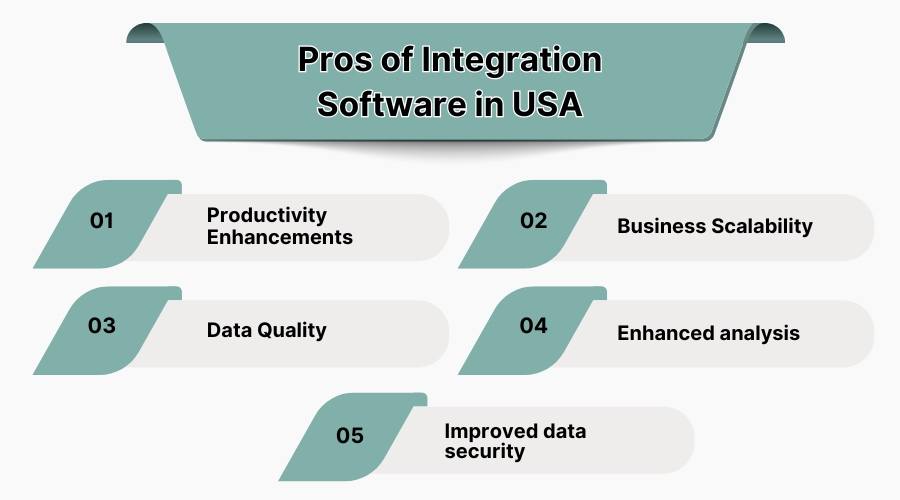
Software that integrates is an aid for companies to automate, streamline the working-s and thus performance, and be sure the data exchange is perfect. This is your way to profit with an Integration System for your company:
1. Productivity Enhancements
Professionally implemented software integration solutions result in specialists get rid of manual data entry to speed up and automate similar tasks. The workers can be more productive and efficient because they handle less platitude when it comes to using one platform and may focus on the most important activities that are vital for the business.
2. Business Scalability
The technological needs of businesses also grow as companies grow. An Integration System that is robust guarantees that new tools, applications, and platforms will get seamlessly connected while it also helps them to be much more compatible with the current software resources. It is this kind of flexibility that provides businesses with the ability to expand their operations while still having the peace of mind that the new systems are compatible or that the disruptions of the work are minimized.
3. Data Quality
Accurate and reliable data is very important in making informed decisions. To sum up, the data extraction software harnesses the power of real-time synchronization to keep the enterprise at high standards, thus avoiding errors which might result from outdated or even duplicate information.
4. Enhanced analysis
Integrated systems provide companies with a unified insight into their businesses, which makes it easy to look for trends and performance. Be it the customers' function, financial reports, or sales insights, Integration Testing Software is important in verifying that data-driven decisions are made based on accurate and fully connected information.
5. Improved data security
An effective Integration System must have a system of safety measures that are enabled by default, which allows for a secure transfer of data between platforms. When it comes to role-based access controls, encryption, and authentication mechanisms, businesses can inhibit unauthorized accessing and also ensure the safe custody of the most sensitive information of the organization.
8. Why do Businesses need Software Integration?
As companies these days use a number of tools, they use and the volume of applications to coordinate the activities and processes. If, however, this technology operates in isolation, it creates data silos, inefficiencies, and manual errors. This is the area where software integration is to be found. By means of the corresponding integration software, the businesses will be able to link their CRM, accounting tools, e-commerce platforms, and other applications to each other, what result in constant data continuity as well as a better collaborative work environment. The successful Implementation of an Integrated System has the following advantages: The solution eliminates repetitive tasks, reduces errors, and enhances the productivity of the organization in general.
Furthermore, establishments with large amounts of data who manage their data will gain from data management software, which will provide accurate, real-time data syncing to various platforms. To support a smooth flow of parts, Good Integration Testing Software is necessary to find bugs before the deployment and make all connections be without any errors. Besides helping with efficiency in operations, invoking decision-making with real-time reports can be a critical element in delivering the right software integration, and it is not merely an option but is a necessity.
9. Conclusion
Choosing the right Integration System is a crucial step toward streamlining your business operations and enhancing efficiency. With so many options available, Unfortunately, it's not an easy feat one will take and if things go wrong, the supply chain could get affected. Then what priorities should an executive choose to drive the business case first? That’s where SaaSAdviser comes in!
Our expert-curated Buyer’s Guide is a great help of the selection process that brings you in depth insights, and advice on the best integration software. No more experimenting with different things trying to find the right software—get the right solution from the get-go! Be it budgeting, improving productivity, or gaining valuable customer insights, proper software solutions can solve the business challenge at the core.
