
Best Healthcare Software in
Are you looking for Healthcare Software for your Business in ? SaaS Adviser brings you the best Healthcare Software to ease your worries. In order to make your work smooth and swift, SaaS Adviser has compiled a list of the best software available. Compare the Best software features, pricing, free demo, and trial to select the best Healthcare Software for your organization.
 Researched and Written by Akash Patel
Top 3 Featured Softwares


List of Top Healthcare Software
Get Free Consultation

InstaHMS is a comprehensive cloud-based Hospital and Clinic Management System designed to handle clinical, administrative, and financial workflows from a single platform. It is use...
View Profile

Electra HMS

By Electra HMS
Electra HIS software is an integrated Hospital Management System used to manage all aspects of the hospital administration, including the digital electronic health record, revenue ...
View Profile

Med2X HMIS
By Med2X HMIS
MED2X HMIS is a hospital management solution that offers smart tools and features to effectively control a clinic's several basic to advanced operations. It offers a comprehensive ...
View Profile

MDVision
By MDVision
MDVision is a medical practice management and electronic medical record (EMR) solution that helps organizations improve their operational capabilities. It offers a simple platform ...
View Profile

ProMed
By ProMed
ProMed hospital management software is a highly scalable tool that can introduce systemization and digitization into your hospital workflow. The software is very suitable for multi...
View Profile

MedEZ
By MedEZ
Check How MedEZ can help to automate Indian Business. SaaSAdviser provide their list of features, pricing, Free demo and Comparison with the best alternative
View Profile
Medstar HIS
By Medstar HIS
Medstar HIS is an HMS software that can fully digitalize the administrative workload of any medical establishment. It facilitates recording, storing, managing, accessing, and distr...
View Profile
DoctoSmart
By DoctoSmart
DoctoSmart is a comprehensive hospital management software that helps medical professionals to streamline their workflow and manage their appointments and reports easily. It featur...
View Profile

Medeil Plus
By Medeil Plus
MEDEIL PLUS is an effective Medical Practice, pharmacy, and Lab management system available at an affordable price. This is an award-winning product from Vanuston and is the only s...
View Profile

Dr in Cloud
By Dr in Cloud
Dr. Cloud's Practice Management solution is a Hospital Management Software that helps manage appointments, online bookings, and EMRs for patients. With e-signature capabilities, pa...
View Profile

DocEngage Clinic Management
By DocEngage Clinic Management
Reduce your workload with comprehensive clinic software that includes apps for IVR doc appointments, online billing, reporting, messaging, and more for one clinic or multiple clini...
View Profile

Doctolib
By Doctolib
Doctolib is a healthcare technology company that is dedicated to improving the daily lives of healthcare personnel and patients. They believe in building a team of entrepreneurs wi...
View Profile
Healthray Technologies
Healthray : Where, Care Meets Technologies
Healthray provides customized solutions for doctors; its suite includes EMR, RIS, LIMS, and HMIS, setting new benchmarks in user-friendly interfaces and seamless operational proces...
View Profile

Health.NET
Software BY Dharma Healthcare
Health.Net is fully featured and one of the most integrated software for medical practice and healthcare environment management. Health.Net offers end-to-end comprehensive software...
View Profile

SIMPLEX HIMES
By INTUIT Micro Technology
Check How SIMPLEX HIMES can help to automate Indian Business. SaaSAdviser provide their list of features, pricing, Free demo and Comparison with the best alternative
View Profile

Hypercare
By Hypercare
Check How Hypercare can help to automate Indian Business. SaaSAdviser provide their list of features, pricing, Free demo and Comparison with the best alternative
View Profile
NextGen Enterprise
By NextGen Enterprise
NextGen Enterprise is a top-rated EHR and EMR software for modern-day healthcare businesses. Simply, it is a highly integrated IT solution for health professionals as well as patie...
View Profile

CrelioHealth
Unlock Lab Of The Future With AI-Powered Lab
CrelioHealth provides Patient Engagement, LIMS, PACS, & Inventory management platform
View Profile
blueBriX
Building Blocks for Digital HealthblueBriX’s Care Management Solutions offer a comprehensive platform designed to empower healthcare organizations with tools to improve care coordination, enhance patient engageme...
View Profile

GoodTime Hire
By GoodTime
Recruiting top talent is a competitive process that requires efficiency, speed, and seamless coordination. GoodTime Hire is an innovative interview scheduling platform that opt...
View Profile

Table of Content
Healthcare software enables medical practitioners to take control of patient documentation, with their overall productivity being boosted. It minimizes the amount of completed documents, guarantees proper charge capturing, and improves the level of care offered.
This technology is adopted by numerous hospitals, clinics, and private practices in order to automate daily activities. The proper software facilitates not only inter-provider communications but also intra-provider communication. In the United States, the use of healthcare software is common among institutions as a form of compliance with laws and for service enhancement.
It is often the case that selecting healthcare software is challenging due to the competing requirements, such as security and current system integration. This publication aims to define healthcare software and its applications within the field.
1. Market Trend in Healthcare Software
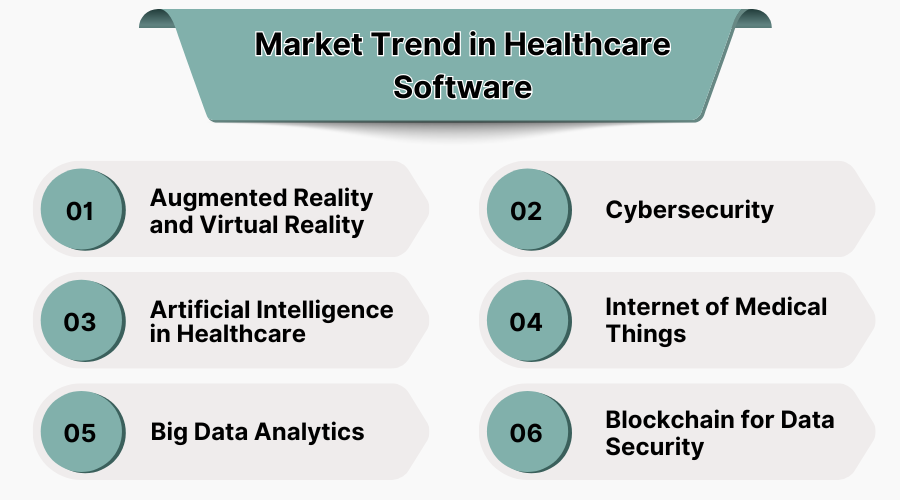
1. Augmented Reality and Virtual Reality
Augmented Reality (AR) and Virtual Reality (VR) technologies improve medical training, patient therapy, and surgical simulations. These technologies enable practitioners to perform complex steps, and even offer therapy to anxious or painful patients in a relaxing environment.
2. Cybersecurity
There is a noticeable increase in cyber attacks on healthcare systems; therefore, maintaining data security is one of the main challenges. This cross-cutting problem is tackled using advanced encryption, multi-factor credentials, and Artificial Intelligence based threat identification to ensure compliance with HIPAA regulations while maintaining access control to sensitive records to avoid breaches and misuse of information. Also, you can use a dedicated cybersecurity software if you want to focus on securing your business against cyber attacks the most.
3. Artificial Intelligence in Healthcare
AI has proven beneficial in improving the accuracy of diagnostics and in administrative work automation, as well as in patient care. The assistance of machine learning algorithms in analyzing images and predicting disease outcomes, as well as streamlining operations, allows faster and more effective treatment to be administered while decreasing human errors and inefficiencies.
4. Internet of Medical Things
The Internet of Medical Things (IoMT) is the integration of medical devices and software for real-time observation and monitoring. Smart wearables monitor vital signs, while smart equipment in hospitals enhances patient care through automation.
This results in improved remote monitoring of patients, especially those in critical cases, increases accuracy in treatment, and improves efficiency within the healthcare system.
5. Big Data Analytics
The application of big data analytics allows for processing tremendous amounts of healthcare data for trend identification, treatment improvement, and hospital operations optimization.
In addition, predictive analytics allow doctors to identify disease in its earliest stages, while data analytics promote resourceful management through personalized medicine.
6. Blockchain for Data Security
Blockchain technology is beneficial for increased data security due to its provision of decentralized, immutable records. It protects patient records from fraudulent activities, ensures transparency in healthcare transactions, and permits secure sharing of information among healthcare providers without breaching regulatory compliance.
2. Different Types of Healthcare Software
1. EHR Software
An electronic health record EHR software allows for the secure storage and easy retrieval of patient data, medical histories and patient treatment plans. Further, it facilitates patient record retrieval by healthcare providers, thus improving intra-professional communication.
2. Medical Database Software
Medical professionals can easily organize findings from clinical research, information from drugs, and studies of diseases, thanks to medical database software. Such software enables healthcare providers to acquire necessary data for accurate diagnoses, effective treatment plans, and continuous medical research.
3. Medical Research Software
This software allows researchers to collect, analyze, and manage various clinical trial data sets. It enables drug development, disease tracking, or other medical innovations, providing secure data storage along with collaborative capabilities.
4. Medical Diagnosis Software
Medical diagnosis software makes use of artificial intelligence and a myriad of symptom analyses to assist medical practitioners in accurate diagnosis. It enhances the accuracy of the medical diagnosis, speeds up decision making processes, and supports overall patient care.
5. Medical Imaging Software
The software aids in the processing and enhancement of medical scans such as X-rays, MRIs, and CT scans. With this software, doctors can analyze images for accurate diagnosis and treatment.
6. E-prescribing Software
Doctors can send prescriptions to pharmacies with e-prescribing software. This improves tracking prescriptions and reduces prescription error rates, and allows patients to receive their medications much faster.
7. Telemedicine Software
With the use of telemedicine software, physicians can consult with their patients over video calls, chats, or through online portals. It also improves healthcare access in remote regions and enhances convenience for patients.
8. Medical Billing Software
Medical billing software facilitates automation of invoice creation, insurance claims processing, and payment tracking. It also helps increase efficiency in billing processes, lowers the administrative burden, and eliminates errors in financial procedures.
3. Best Healthcare Software in USA
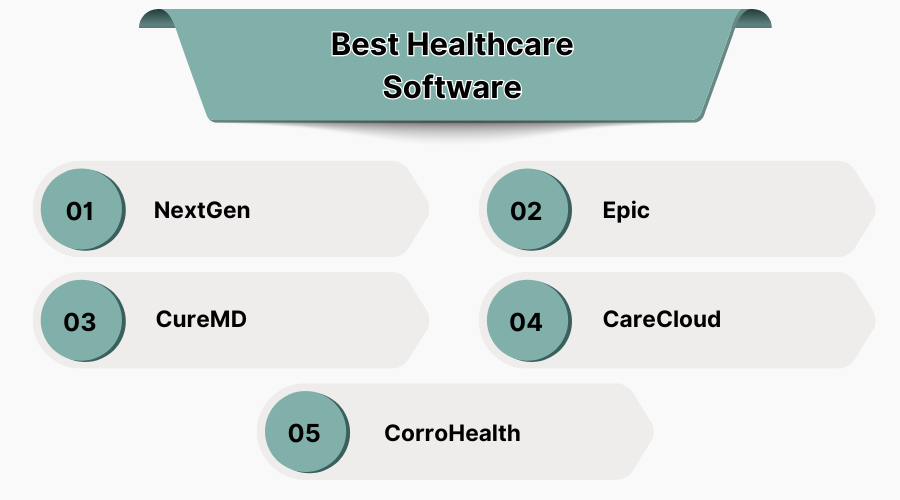
1. NextGen – Best for Small and Mid-Sized Practices
NextGen offers integrated practice management and record keeping software relative to the health industry. In addition, it incorporates features like patient satisfaction, and revenue cycle processing.
The software also accommodates telemedicine and integrates with other medical systems. It targets small to mid-sized practices looking for a single healthcare solution.
Pros:
- User-friendly interface with customizable templates
- Strong integration with labs and pharmacies
- Robust reporting and analytics for better decision-making
- Mobile access for on-the-go healthcare management
- Excellent customer support
Cons:
- Initial setup can be time consuming
- Some users report slow system performance
- Pricing is higher than some competitors
- Advanced features require additional training
- Customization options may require IT support
Pricing: Contact NextGen for a custom quote.
2. Epic – Best for Large Hospitals and Health Systems
Epic is a prominent provider of healthcare information systems and electronic health record (EHR) software for larger hospitals and health systems. It allows keeping track of patient records alongside billing, and population health services.
Epic’s interoperability is one of its major strengths as it allows sharing of information across multiple institutions and remains compliant with regulatory requirements.
Pros:
- Comprehensive EHR with strong customization options
- Advanced data security and HIPAA compliance
- Strong integration with third-party healthcare applications
- Scalable for large healthcare organizations
- Extensive reporting and analytics features
Cons:
- Expensive compared to other healthcare software
- Requires extensive training for full utilization
- Implementation can take several months
- High system complexity may be overwhelming for small practices
- Limited mobile accessibility compared to competitors
3. CureMD – Best for Cloud-Based Healthcare Management
CureMD is a web-based platform focused on holistic cloud care solutions tailored to small to mid-sized practices. It combines EHR, practice management, medical billing, patient engagement functionalities, etc.
The system's combination of user friendliness and protected cloud storage makes it a great choice for health practitioners intending to scale.
Pros:
- Cloud-based, allowing remote access to medical records
- Cost-effective compared to other EHR solutions
- Customizable templates for different medical specialties
- Integrated billing and revenue cycle management
- Simple and easy-to-use interface
Cons:
- Customer support response times can be slow
- Limited third-party integrations compared to larger providers
- Customization options are somewhat limited
- May not be suitable for large hospital systems
- Some users experience occasional system lag
Pricing: Contact CureMD for a custom quote.
4. CareCloud – Best for Medical Billing and Revenue Cycle Management
CareCloud is a leader in healthcare software with an EHR, practice management as well as a medical billing application. CareCloud is famous for its outstanding revenue cycle management (RCM) tools, thus, it is most effective for healthcare providers who need assistance with financial operations and billing processes.
Pros:
- Strong RCM tools for efficient billing and claims management
- Cloud-based system with remote accessibility
- User-friendly interface and modern design
- Integrates well with third-party medical applications
- Scalable for growing healthcare organizations
Cons:
- Higher learning curve for beginners
- Limited customization for specific medical specialties
- Occasional system performance issues
- Customer service response times can vary
- Pricing may be high for smaller practices
Pricing:
- CareCloud Central: $349 per provider per month.
- CareCloud Complete: $629 per provider per month.
- CareCloud Concierge: 3-7% of practice collections.
5. CorroHealth – Best for Healthcare Compliance and Auditing
CorroHealth focuses on healthcare compliance, and revenue cycle services. It has AI-powered analytics to enhance documentation, optimize revenue cycles, maintain compliance, etc. For hospitals or healthcare providers needing assistance with billing compliance and accuracy, this is best suited.
Pros:
- Strong compliance and auditing tools for regulatory adherence
- AI-powered analytics for billing accuracy and fraud detection
- Helps optimize revenue cycle management
- Scalable for hospitals and large healthcare organizations
- Expert consulting services included
Cons:
- Not a full EHR system, mainly focuses on compliance and billing
- Implementation can take time for new users
- Requires integration with existing healthcare software
- Limited features outside compliance and revenue cycle management
- Pricing may be high for smaller practices
Pricing: Contact CorroHealth for a custom quote.
4. What is Healthcare Software?
Healthcare software serves as a remedy for hospitals and practices. It assists the providers in organizing the patient's information, accounting, timetable management, and treatment prescription.
A variety of systems offer remote care with analyzing features. The software serves to enhance precision, lowers the quantity of documents required, and guarantees that the patient information is safeguarded. In the United States, healthcare organizations subscribe to these services for compliance purposes, for example, HIPAA. While some focus on hospital administration, others deal with client interaction or scientific issues.
The ideal healthcare software is capable of being interconnected with tools for electronic health records (EHR) as well as other basic instruments necessary for the efficient workflow of physicians and administrative personnel.
5. How Software is Used in Healthcare?
Healthcare systems use software for patient management, medical billing, and storing medical records. Nurses and doctors utilize these systems for capturing patient history and for medication prescriptions.
Healthcare facilities employ sophisticated systems for scheduling, inventory control and regulation compliance. Some software helps doctors consult with patients remotely, thereby improving access to care.
Other features include artificial intelligence for disease diagnosis and treatment outcome forecasting. In the US, healthcare has specialized secure software to ensure confidentiality of patient data and compliance with laws. The right choice of healthcare software accelerates processes, enhances accuracy, and enables better care for patients.
6. Top Features of Healthcare Software
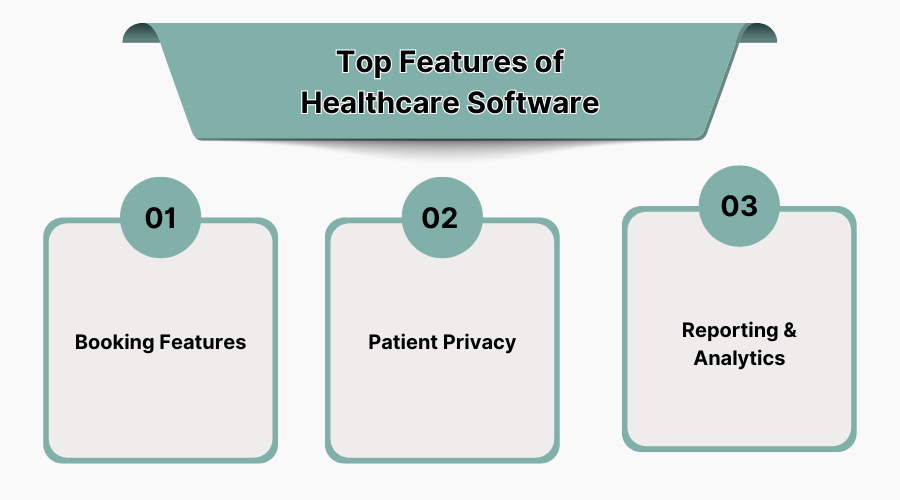
1. Booking Features
Health software incorporates online appointment booking capabilities, facilitating quick visit reservations. Automated reminders enhance organization and minimize no-shows.
Certain systems provide patient portals software where patients can view available slots, select doctors and confirm appointments. Medical personnel receive updates automatically with the integration of electronic health records.
2. Patient Privacy
Safeguarding patient information is a key aspect of healthcare software. Such systems protect from unauthorized information access through encryption, multi-factor authentication, and access controls.
Sensitive health records are securely stored and shared with HIPAA compliant solutions. Patients can communicate with doctors without fear of cyber-attacks compromising their data privacy.
3. Reporting & Analytics
Modern health software allows practitioners to track patient outcomes, billing, and operational performance in real time. Reports enable treatment plan improvements, clinic resource management, and trend identification.
Predictive analytics assist in diagnosing diseases and optimizing work processes. Key insights are available through user-friendly customizable dashboards making it easier for administrators to make data-informed decisions. Also, you can implement a healthcare CRM software if you have a lot of clients to manage.
7. Conclusion
healthcare software plays a crucial role in modernizing the medical industry, improving patient care, streamlining administrative tasks, and enhancing data security. From electronic health records (EHR) to telemedicine and AI-driven diagnostics, technology continues to revolutionize healthcare. As advancements progress, the focus should remain on user-friendly, secure, and interoperable solutions that benefit both healthcare providers and patients.
