
Best Banking System Software in
Are you looking for Banking System Software for your Business in ? SaaS Adviser brings you the best Banking System Software to ease your worries. In order to make your work smooth and swift, SaaS Adviser has compiled a list of the best software available. Compare the Best software features, pricing, free demo, and trial to select the best Banking System Software for your organization.
 Researched and Written by Akash Patel
Top 3 Featured Softwares


List of Top Banking System Software

Get Free Consultation


Cardtr

Cards that impress
Create compelling experiences with solutions your customers will love and continuously choose to use.
View Profile

kutadguenerji
Kutadgu Energy Defense Information Technology Trade Joint Stock Company
Founded in 2013, Kutadgu Energy Defense Information Technology Trade Joint Stock Company is an engineering firm dedicated to delivering top-quality corporate solutions.
View Profile

Pickcel
Your Ideas, Our Canvas: Simplifying Digital Signage!
A single digital signage software to make your screens smart.
View Profile

WireSpring
Virtual Queuing with FireCast SmartFlow ,Eliminate long lines. Keep visitors informed.
WireSpring's software helps companies manage networks of connected devices, including queuing systems and digital signs.
View Profile

Bluevine
Business checking built for you.
Bluevine is a financial technology company that offers a suite of banking solutions tailored for small businesses. Established in 2013, Bluevine's mission is to simplify financ...
View Profile

Relay Bank
Your cash flow can be clearer
Relay Bank is a modern digital banking platform designed specifically for small businesses, providing seamless financial management tools and enhanced cash flow visibility....
View Profile

Counting up
We make it easier to run businesses
Countingup is a UK-based financial technology company that offers an innovative solution combining a business current account with integrated accounting software. This all-...
View Profile

CreditSnap
Lending & Account Opening Re-imaginedCreditSnap is a fintech platform designed to provide end-to-end digital solutions for banks and credit unions, specializing in lending and deposit account opening.
View Profile

NETinfo
Digital Banking Platform Banking beyond branches
NETinfo is a leading provider of digital banking solutions, offering a comprehensive suite of products designed to support banks and financial institutions of all sizes acro...
View Profile

FIS Core Banking
Innovation. Flexibility. Performance.
FIS offers a suite of core banking solutions designed to meet the diverse needs of financial institutions, enabling them to navigate the complexities of the modern banking l...
View Profile
.jpg "Videocx.io")
Videocx.io
The world’s most feature-rich enterprise-grade Video Banking PlatformVideoCX.io is a secure, browser-based video engagement platform designed for banks, NBFCs, and insurers. It enables customer onboarding, policy servicing, claims processing, loan d...
View Profile

Holvi
By Holvi
Check How Holvi can help to automate Indian Business. SaaSAdviser provide their list of features, pricing, Free demo and Comparison with the best alternative
View Profile

Solución Neurona
By Neurona
Check How Solución Neurona can help to automate Indian Business. SaaSAdviser provide their list of features, pricing, Free demo and Comparison with the best alternative
View Profile

Banksoft
By Processware Systems
Check How Banksoft can help to automate Indian Business. SaaSAdviser provide their list of features, pricing, Free demo and Comparison with the best alternative
View Profile

BankTrade
By Complex Systems
Check How BankTrade can help to automate Indian Business. SaaSAdviser provide their list of features, pricing, Free demo and Comparison with the best alternative
View Profile

Omnichannel Digital Banking Platform
By ModeFinServer
Check How Omnichannel Digital Banking Platform can help to automate Indian Business. SaaSAdviser provide their list of features, pricing, Free demo and Comparison with the best alt...
View Profile

North One
Connect every part of your business to one bank account
North One transform the bank account from a basic utility to a financial platform that gives our customers a greater shot at success.
View Profile

Online Check Writer
Check Printing SoftwareWhat is Online Check Writer? Online Check Writer (powered by Zil Money) is a comprehensive, cloud-based financial technology platform that revolutionizes how businesses handle a...
View Profile

Credit Cooperative Society Software
Best Accounting Management Software
Contact now for FREE DEMO & DOWNLOAD, thrift and credit cooperative society software in all over India. Our thrift and credit cooperative society software is completely user-fr...
View Profile

RISK IDENT
By RISK IDENT
RISK IDENT is a software development company that specializes in anti-fraud solutions for the e-commerce, telecommunication, and financial services industries. FRIDA is RISK IDENTâ...
View Profile

Table of Content
What is Banking System Software?
The software for the banking industry allows financial institutions to deal with banking transactions, customer accounts, loans, and even compliance, working for them. This type of software automates the basic functions of the bank, enhances security, and improves customer satisfaction.
AI mobile banking, fraud detection, and analytics improve banking processes and make them more sophisticated. SaaS solutions facilitate cloud-enabled banking infrastructure that is secure, ultra-reliable, highly scalable, and flexible. Such solutions are adopted for use by businesses, banks, and fintech firms to make digital payments, conduct online transactions, and manage finances efficiently.
Meticulous decision-making concerning the selection of banking software for an institution enables the elimination of errors, maximization of security, and improvement of the banking experience. With the appropriate software, large and small banks can guarantee adequate operational processes, proper compliance, and improved digital banking services for customers.
1. List of Top 5 Banking Software Providers in the USA:
Listed below are the top 5 banking software providers in the USA. Let’s have a look at each of these by understanding the pros, cons, and pricing.
1. Temenos – Best Core Banking Software for Digital Transformation
Temenos is one of the leading core banking providers for large financial institutions and fintech companies. Cloud-based banking, digital payments, and AI-driven analytics guarantee seamless operations and improved customer experiences. The platform facilitates open banking integrations and encompasses compliance management and supervision functionalities.
Features:
- Core banking automation with cloud scalability.
- AI-powered fraud detection and risk management.
- Open banking API for seamless third-party integrations.
Pros:
✔️ Highly customizable for banks of all sizes.
✔️ Scalable cloud infrastructure for digital banking.
✔️ Advanced data analytics for better decision-making.
Cons:
❌ High implementation cost for small banks.
❌ Requires extensive staff training for customization.
Pricing:
-
Custom pricing based on business needs.
2. Mambu – Best SaaS Banking Platform for Fintechs & Digital Banks
Mambu operates as a cloud-based SaaS banking software for digital banks and other providers in the fintech industry. Mambu helps organizations offer banking solutions within a short period of time while providing real-time services. Mambu also aids with easy API integration, which is crucial for contemporary financial institutions looking for expansion and flexibility.
Features:
- Cloud-native core banking infrastructure.
- Microservices architecture for flexibility.
- Open APIs for seamless integration with third-party apps.
Pros:
✔️ Quick deployment with minimal infrastructure costs.
✔️ Ideal for fintech startups and challenger banks.
✔️ High flexibility with modular banking services.
Cons:
❌ Limited customization options for traditional banks.
❌ Requires additional third-party integrations for advanced features.
Pricing:
-
Custom pricing based on business needs.
3. Oracle FLEXCUBE – Best for Large-Scale Banking Operations
For large multinational banks and other financial conglomerates, Oracle FLEXCUBE is their sophisticated software of choice. The platform aids in digital banking and cash management while providing comprehensive services for retail and corporate banking and AI fraud detection. Services offered are billing and sensitive complaints management.
Features:
- AI-powered customer analytics and fraud detection.
- Automated risk assessment and compliance tracking.
- Multi-currency and cross-border transaction support.
Pros:
✔️ High scalability for large financial institutions.
✔️ Strong security and compliance management.
✔️ Advanced automation for seamless banking operations.
Cons:
❌ Complex setup requiring dedicated IT teams.
❌ High initial and maintenance costs.
Pricing:
-
Custom pricing based on bank size and needs.
4. Fiserv – Best for Retail Banking and Payment Processing
Fiserv delivers robust banking software for financial institutions, credit unions, and payment processors. It provides a system of open digital banking, anti-fraud measures, and transaction monitoring to ensure safe financial activities.
Features:
- Digital banking and omnichannel customer engagement.
- Real-time transaction monitoring and fraud detection.
- Seamless integration with third-party financial applications.
Pros:
✔️ Comprehensive banking and payment solutions.
✔️ Strong security features for fraud prevention.
✔️ Scalable for banks and financial institutions of all sizes.
Cons:
❌ Implementation may require extensive IT support.
❌ Some advanced features require additional licensing.
Pricing:
-
Custom pricing based on bank size and needs.
5. Finacle – Best Core Banking Solution for Enterprise Banks
Infosys banking software platform Finacle offers technology solutions for numerous sectors, including Core Banking, Digital Banking, Wealth Management, and Corporate Banking. It is integrated with advanced AI automation of global banking and supports multi-currency operations.
Features:
- Cloud-based core banking with AI-driven insights.
- Integrated lending, payments, and treasury management.
- Multi-currency and multi-language support for global banking.
Pros:
✔️ Highly scalable for large banking institutions.
✔️ AI-powered automation for enhanced efficiency.
✔️ Strong regulatory compliance and security features.
Cons:
❌ Expensive for smaller banks and credit unions.
❌ Requires extensive customization for non-standard banking models.
Pricing:
-
Custom pricing based on business requirements.
2. Features of Banking Software:
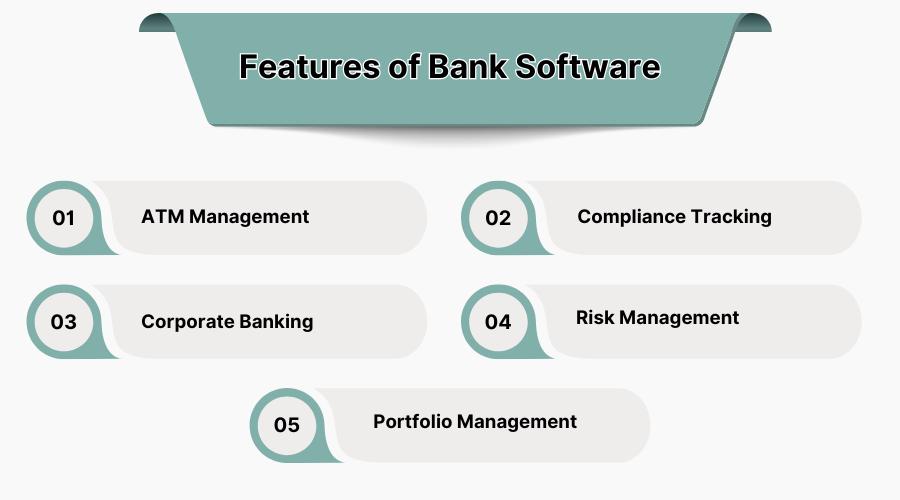
1. ATM Management
Advanced banking software effectively monitors and controls automated teller machine networks. It checks cash availability, transaction security, and machine functionality, ensuring that machines are appropriately used and updated to meet the requirements of banking databases for customer transactions.
2. Compliance Tracking
Automated compliance tracking ensures that an institution observes banking laws and financial regulations based on the particular rules of the target country. It facilitates the real-time monitoring and reporting of financial transactions, along with comprehensive fraud prevention, which saves financial institutions from legal fines and regulatory violations.
3. Corporate Banking
These features of corporate banking are tailored to meet a business's financial needs, including investments, payroll, processing imports and exports, and managing company funds. The business banking tools enable timely action while minimizing risk and maintaining security in financial transactions.
4. Risk Management
Comprehensive risk management systems employ sophisticated tools that examine financial records and look for anomalies indicative of fraud, credit risks, or regulatory violations. AI and machine learning automatically assist banks in meeting basic security objectives by anticipating various forms of risks and proactively implementing effective ways to minimize them.
5. Portfolio Management
Portfolio management is one of the features of banking software, which facilitates investment and disinvestment by individuals and institutions, monitors the performance of funds, and manages the composition of different financial portfolios and sets of stocks. These features provide data analytics, risk analysis, and report generation for reporting intelligent investment decisions.
3. Pros of Banking Software:
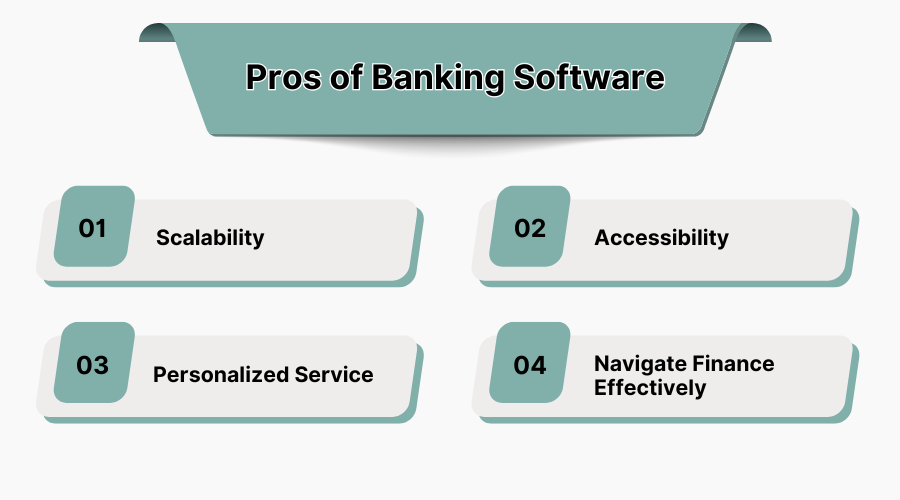
1. Scalability
Banking software solutions are integrated to cope with the business at hand. When necessary, downgrading adjustments are made to make the necessary changes for a certain number of financial institutions. The software handles increases in account volumes without degradation in response time or security as the number of issued services, jurisdictional compliances, and customers increase rapidly due to new business expansions.
2. Accessibility
Banking software operates mainly on cloud services, meaning that a customer or even bank staff can manage their accounts from outside their normal working environment. This guarantees remote banking at any time, promotes the use of online and mobile banking, and increases customer satisfaction with the provision of streamlined digital financial services.
3. Personalized Service
AI-driven banking software uses data mining techniques to analyze customers' information and provide unique financial services worthy of their attention. Personalized marketing of loans, investments, and even account or service management can be incorporated to promote customer retention and the boost services offered by the financial institution.
4. Navigate Finance Effectively
Banking software offers key features such as real-time financial insights, transaction processing, and automated risk management. These elements allow banks and financial institutions to effectively manage intricate financial processes while assuring security, compliance, and optimized strategies to enhance decision-making and, thus, business expansion.
4. Cons of Banking Software:
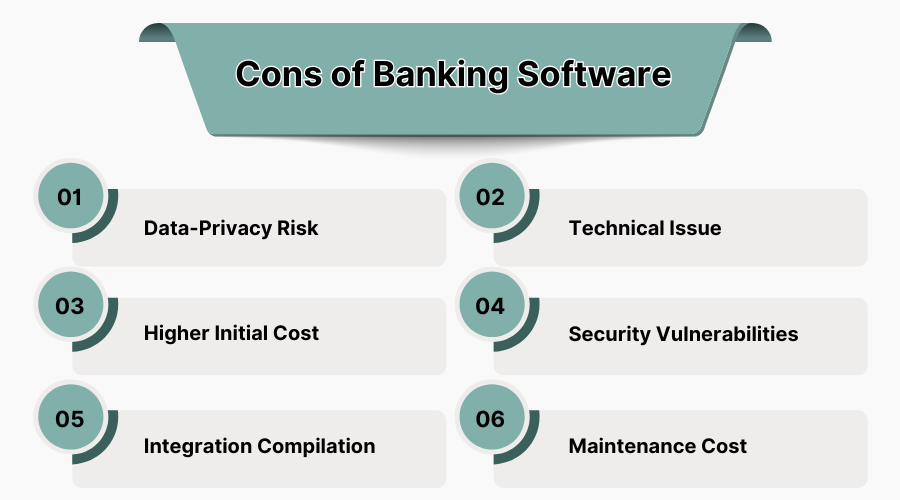
1. Data-Privacy Risk
Cyber threats are prevalent, and sensitive information processed through the software is at risk. Inadequate security measures may lead to unauthorized access or data breaches, which results in identity theft or non-compliance. These can result in a loss of trust from customers and potentially fines from regulators.
2. Technical Issues
Frequent updates to software, server downtimes, and other technical bugs could disrupt banking operations. Customers may suffer from transaction failures, sluggish processing, and system outages, which decrease the quality of service, leaving account holders more angry than satisfied.
3. Higher Initial Cost
Implementing new banking software involves a large upfront payment for infrastructure and employee training. These costs can be quite expensive for small banks, severely damaging their finances if careful planning is not done.
4. Security Vulnerabilities
Even with security measures in place, banks and other financial institutions are still subject to cyberattacks and fraudulent transactions. To mitigate the chances of financial fraud and data leaks, banks must continuously change and improve their security measures and regularly check their systems and procedures for weaknesses.
5. Integration Complications
Existing systems, payment gateways, and even external applications pose a challenge to integrating banking software. There may be compatibility problems that lead to additional expenses due to delays in system implementation and disruption of normal banking activities.
6. Maintenance Cost
Banking software requires regular system modification updates, security patch installation, and compliance procedure oversight, which all increase the cost of maintaining it. Therefore, adequate resources need to be set aside for sufficient IT support, system maintenance, and any other problems that may arise so that financial institutions can ensure the efficient functioning of the bank.
5. Criteria for Choosing the Right Software for Banking Industry:
- Regulatory Compliance – As with all software, ensure that it complies with PCI DSS, GDPR, and local laws so that it does not pose a legal threat to the institution.
- Security Features – Encryption, multi-factor authentication, and fraud detection as standard features.
- Scalability – Choose a level that can accommodate the growth of the institution in terms of more transactions and increased customers.
- Integration Capabilities – The software needs to be compatible with various payment gateways and accounting tools to facilitate seamless banking for customers.
- User-Friendly Interface – A clearly organized and simple-to-use interface enhances the experience of interaction for both clients and employees, thereby boosting productivity.
- Customer Support and Maintenance – The support helpdesk open around the clock ensures quick problem resolution and timely transaction handling.
- Cost and ROI – Estimate costs and expected returns from different pricing structures to guarantee that the value received matches expenses incurred while maximizing business objectives and monetary resources.
- Mobile and Online Banking Support – Provides modern-day value by allowing customers to utilize available services, whichever place they are at, whichever time.
6. Why Do I Need Bank Software?
Financial institutions must have banking software to fully automate banking operations, increase security, and improve customer satisfaction. It offers the possibility of digital banking by combining mobile and internet banking, thus minimizing manual work. AI helps in fraud detection, risk assessment, and the generation of various financial reports.
Real-time data access through cloud banking solutions enhances operations at different branches, making seamless integration with all parts of the bank possible. Additionally, banks can avoid penalties and minimize operational errors through automated compliance tracking.
All types of banks, be they traditional, digital, or even fintech firms, benefit from banking software, which optimizes financial processes, customer management, and overall banking performance. Proper investment in software guarantees secure, smooth, and ever-ready banking services.
7. What is Banking Software?
Banking software refers to an application, or set of applications, that automate and control the main workings of the bank – account management, transactions, loan management, and security control systems within the bank. It offers features such as financial reports, fraud detection, and regulatory compliance in real-time to ensure effective, smooth banking activities.
Recently modernized banking software includes mobile banking, internet banking, and financial analytic software to address the needs of the customers. Such solutions are beneficial for banks and various financial organizations in handling risks and preventing fraud, in addition to managing digital banking services.
Utilizing cloud and SaaS solutions allows banks to grow their operations while ensuring data security and adherence to regulations, which leads to enhanced financial oversight.
The banking software market size in the USA was valued at $5.30 billion in 2024.
8. Why You Need Banking System Software?
- Banking system software is a cornerstone in today's financial sector, offering streamlined operations, bolstered security, and an enhanced customer experience. It facilitates real-time processing of transactions, ensures compliance with complex regulatory requirements, and employs robust cybersecurity measures to protect sensitive data. By utilizing advanced analytics, such software provides valuable insights into customer behaviour, enabling banks to tailor their services and anticipate market trends, thus maintaining a competitive edge in the fast-moving world of finance.
- Banking software also plays a crucial role in promoting financial inclusion. With the rise of digital banking, individuals and businesses can now access financial services without having to physically visit a branch. This is especially beneficial for those living in remote areas or with limited mobility, as they can easily conduct transactions through their mobile devices. Moreover, banking software has greatly simplified operations for financial institutions. Tasks that previously required manual processing, such as Accounting software opening and loan approvals, can now be done through automated systems, saving time and reducing errors.
- This also allows banks to allocate their resources more efficiently and focus on providing quality customer service. Apart from enhancing efficiency, system software also enhances security. With stringent authentication protocols and data encryption methods in place, customers' financial information is better protected from cyber threats. This not only safeguards customer trust but also minimizes the risk of financial fraud.
9. Conclusion:
Banking software improves operational efficiency, security, and customer service in financial institutions. These solutions support everything from core banking to digital payments. Businesses can use the guidance of SaaSAdviser to pick the optimal banking software as this company specializes in such software. Enhance the transformation of the bank into a digital organization for achieving long-term financial goals by streamlining the provision of banking services, meeting regulatory requirements, and complying with the necessary guidelines.
