
What we'll cover
Share with your community!


Get Free Consultation


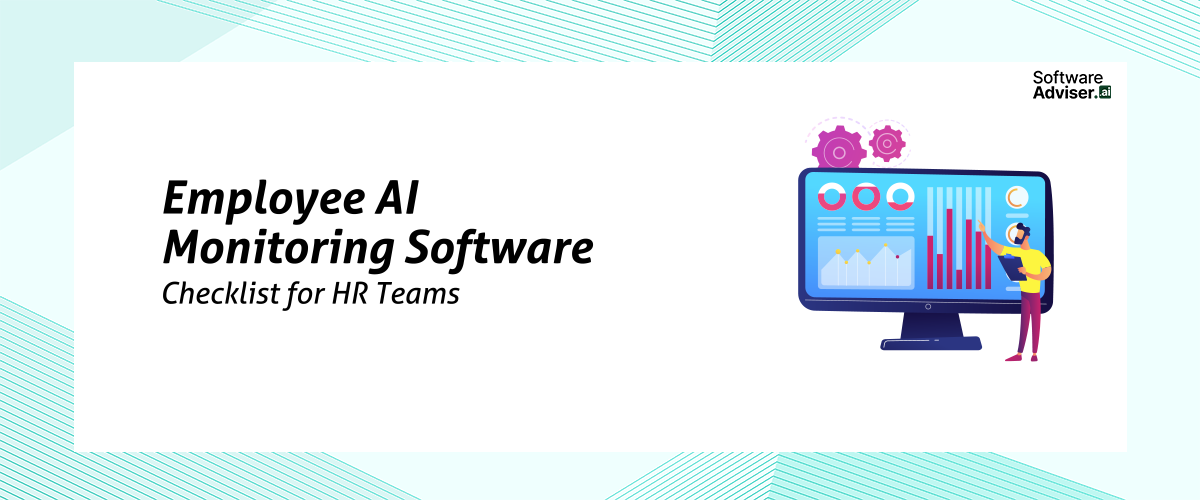
Employee AI Monitoring Software Checklist for HR Teams
 Dokas mile
Using AI employee monitoring software tools in the U.S. presents a challenge of finding the right balance between ensuring that employees remain productive and abiding by a constantly changing and very complicated set of laws. With states such as California, New York, and Connecticut introducing laws that impose strict regulations on what employers need to tell employees, and federal agencies such as the FTC and the NLRB going after companies that employ bossware technologies that violate the privacy and legal rights of employees, HR department heads do not have room to experiment. This checklist is intended for U.S. HR professionals to review their upcoming plan to implement AI tools, comply with state and federal laws, and communicate with employees openly and honestly.
What is AI Employee Monitoring Software, and why should every US-based HR team know about it?
AI employee monitoring software, also known as Bossware, refers to an array of digital technologies that employ artificial intelligence to monitor and analyze employee performance and activity. Unlike traditional time trackers that record the time of arrival, these sophisticated tools assess keystrokes, track screen usage, watch eye movements through webcams, analyze email tone, and evaluate an employee’s focus or efficiency during work hours. Identifying and knowing about this technology is an absolute necessity for organizations in the USA to carry out their operations.
With remote and hybrid work practices on the rise in the US, companies are increasingly interested in implementing this kind of technology. Human resources professionals in the U.S. must be mindful of not only new technology that promises more efficient workflows but also the serious legal and ethical risks these tools create. The rules governing the operations of different bodies have changed. Indeed, federal institutions such as the National Labor Relations Board (NLRB) and the Federal Trade Commission (FTC) have started monitoring some companies that use invasive methods and violate workers’ rights.
Some states (e.g. Californian, New York, and Delaware legislatures) have passed stringent laws aimed at the necessity to inform workers about any electronic monitoring in advance. Thus, for human resource professionals, being aware of artificial intelligence means knowing how to check such tools for bias, using them in consonance with the current requirements of different legislations, and making sure that these tools are applied in a transparent manner in order not to ruin employees’ motivation and loyalty completely.
Why do HR teams across the US need AI Employee Monitoring Software to manage today's workforce effectively?
Modern-day management of the American workforce has turned into an extremely fragmented challenge due to the fact that employees have started working remotely and using hybrid models. For American AI HR software departments, AI employee monitoring tools bridge the gap that has been created with the disappearance of traditional offices. The lack of physical monitoring often makes it difficult for executives to measure employees’ engagement levels as well as to differentiate between motivated workers and disengaged ones. AI tools help HR teams gain objective information about employees’ daily operations, find roadblocks in work processes, and get information about the digital presence of people, which helps managers lead their teams much better.
As well as their own duties, these platforms are crucial for securing the most important assets – both people and data. The U.S.A. has to deal with problems of corporate espionage, theft of intellectual property, and unintentional breaches of various information. AI monitoring software is a source of information about problems. This software gathers behavioral data. It detects unusual activities, such as an employee who is downloading something big or accessing secret client data outside working hours. When the changes are identified immediately, companies can do something and avoid a problem that costs money
The use of AI employee monitoring technologies with empathy can be an essential solution to the problem of employee burnout. There are many cases in the US where an employee was feeling bad at work without informing anyone about that. Employees end up quitting suddenly, which causes high costs due to the growing turnover rates. AI systems can detect patterns, such as too much email activity during the night, changes in typing rhythm, and excessive screen time. With the help of this information, the software notifies the Human Resources department about the employees in need of assistance prior to getting into trouble.
How does AI Employee Monitoring Software help HR teams stay compliant with federal and state regulations?
AI employee monitoring software facilitates compliance of HR teams in the US by allowing for the automation of data guardrails, auditing processes, and putting legal protections in place on a day-to-day basis.
- Automated delivery of Notices: This allows state legislation (in states like New York and Connecticut) to be followed by sending notices that must be sent to employees before the electronic monitoring begins.
- Retention of Consent Logs: This keeps the logs in digital format intact so that they can stand the scrutiny of inspectors from the state labor department.
- Recording of Overtime Hours: This ensures that the number of hours worked in the remote format is recorded accurately, thus giving the HR department assurance of adhering to the FLSA.
- Avoiding Algorithmic Bias: The high-end systems ensure that while conducting evaluations, no demographic information is used.
- Data Privacy Regulations: This technology facilitates automatic removal of sensitive personal data and health information from images, thereby adhering to state privacy rules and HIPAA.
- NLRB Safe Zone Mapping: This helps human resources to geo-fence and block certain online addresses, protecting the organization from breaking the provisions of the National Labor Relations Act.
What Core Features should HR teams look for when evaluating AI Employee Monitoring Software?
When looking for AI employee monitoring tools, HR specialists must search for features that combine operational aspects, ensuring legal compliance and the trust of employees.
- Granular Data Redaction: This function automatically removes sensitive financial details, passwords, and health records from screen logs. This ensures that the organization doesn’t breach the CCPA/CPRA and HIPAA.
- Configurable Notification Banners: The built-in feature uses transparent pop-ups to fulfill state requirements on electronic monitoring impact before it starts.
- Independent Human-in-the-loop Overrides: The settings are designed to ensure that AI cannot perform any disciplinary actions without the necessary approval of Human Resources staff in compliance with laws and regulations of the state, such as California’s SB 947.
- Exclusion of Protected Activity from the Mapping of Activities: Strengthening the geofencing and app-blocking specifications to form complete isolation of users' personal communication channels from any illegal surveillance of protected concerted activities under the National Labor Relations Act (NLRA).
- Demographic-Blind Analytics of Performance: Ensuring the protection of the protected-class data (such as age, race, gender) in the performance-searching platforms to protect the business from claims considered to be a violation of Title VII.
- Tracking FLSA-Compliant Hours: Ensuring the effective performance logging of both idle and active hours through the integration of the tracking system with the pay system to offer reliable data in case of any wage-and-hour disputes.
- Exporting an Unalterable Audit Trail: A central compliance database to store all the information about employee consent records and their access history for easy submission during the labor audits.
How does AI Employee Monitoring Software protect employee privacy while still giving HR teams the visibility they need?
An AI employee monitoring application balances the benefits and dangers by utilizing behavioral analytics instead of invasive monitoring. Current solutions use automatic information redaction instead of passing straight streams of video from the employee’s screen or webcam. It means that the monitoring systems are programmed in such a way that they can identify and instantly conceal information that should remain private. The monitoring software does not show anything unnecessary and does not intrude into private life.
Such tools give insights that are more about trends at the macro-scale than individual events. AI does not evaluate every single keystroke a person makes with his/her device but rather aggregates the anonymized performance and working data, for example, the hours spent within a particular client account or the time lost due to system lag. It helps HR departments to identify issues within organizations, including burnout and bottlenecks in the work processes, without accessing the private workspaces of any employee.
An effective privacy protection mechanism is created by means of well-defined access rules and stringent compliance with all US regulations. The system minimizes the chance for unauthorized personnel to peek into operations by allowing only the users needing privileged information access to the system. It is important that AI is only allowed to detect non-standard situations or falls in employee engagement, leaving the interpretation and decision-making processes solely to the HR staff with their required humane approach.
How can HR Teams Choose the right AI Employee Monitoring Software for their Organization's Size and Structure?
- Examine Scale and Infrastructure Limits: While smaller enterprises require lightweight, web extensions with minimal IT support, larger companies need specialized desktop applications that work with complicated, multi-tenant HRIS and Identity Access Management (IAM) technologies.
- Connect Tracking Applications to Workplace Modes: Pilots of hybrid companies, which operate from different regions, require cloud-first means of geo-fenced local AI applicant tracking system, while relentlessly centralized in-office workforces can rely on the wide-area-level supervision that shows bottlenecks by departments.
- Consider Multi-State Legal Compliance Capabilities: Businesses operating in several states should choose software with flexible and geo-specific settings that will update the tracking parameters automatically, ensuring consent delivery in New York and biometric data compliance in Illinois.
- Align Operations Information with Departmental Workflows: While the fluidity of creative and software development teams requires data that allows measuring the general progress of the team in task completion, high-risk financial departments or customer service departments would need information that will allow monitoring the activities online on an ongoing basis.
- Emphasize non-technical Analytics Reporting: HR teams should not go for platforms that feed them raw data without any organization, but select those that would convert their clicks and analytics into visual charts representing work distribution and burnout risk.
- Ensure enterprise-grade Security Certifications: To protect employee information and avoid possible federal penalties due to failure to comply with the law, organizations should work with vendors that provide guaranteed data residency in the USA, SOC 2 Type II certifications, and strict data processing agreements.
Is AI Employee Monitoring Software the right investment for your HR team's long-term workforce strategy?
Deciding whether AI employee monitoring software fits your organization's long-term strategy requires weighing cultural alignment against operational and legal realities in the U.S. market:
- Make Sure You Are Culturally Aligned: Determine if the deliberate data monitoring is in line with your company’s core values, since intense employee monitoring could result in a 55% increase in the potential for employee pressure.
- Assess Return on Investment by Looking at More Than Just Data Collection Exercises: Enable the financial return on investment through high-level operational enhancements and streamlining of workflows instead of just logging what employees do and tracking keystrokes on their computers.
- Check Your Compliance Status: Verify that your internal compliance team can manage the complexity of local state notifications and the strict requirements of privacy legislation in their work.
- Specify Your Data Security Requirements: Make sure to determine the data security requirements for your company and invest accordingly based on whether your main concern is the protection of trade secrets or preventing the costly loss of intellectual property.
- Avoid Legal Risks for Algorithmic Bias: Ensure that employees in your company are able to audit the software to prevent bias and unlawful monitoring of employees’ protected concerted activities.
- Make Sure to Disclose How You Track People: Make sure the management of your organization agrees to disclose all the activities related to employee monitoring
Conclusion
The deployment of artificial intelligence employee monitoring programs necessitates a careful approach to boost productivity yet preserve workers’ trust in the workplace. The irresponsible use of these products may cause dissatisfaction among workers, but a clear and comprehensive framework can both protect the company’s information and help employees. When you are ready to get down to business, go to Softwareadivser, where you will get most of the available software programs. Using the knowledge of experts, you can choose the most suitable software for your HR department and meet the requirements of the company.
FAQ's
It is a digital platform that uses machine learning and behavioral analytics to track, measure, and analyze employee productivity, workflows, and security compliance.
Yes, monitoring remote workers on company-owned devices is legal federally, but several states like New York and California require advance written notice or explicitly limit surveillance on personal devices.
The software tracks precise active hours and login timestamps, which provides HR teams with bulletproof documentation to verify hours worked and prevent unpaid overtime lawsuits.
Yes, it can violate the NLRA if the tool is used to monitor, target, or intercept employee communications regarding labor unionizing or protected concerted activities like discussing wages.
HR must choose platforms with demographic-blind analytics and conduct routine independent audits to ensure the AI's metrics do not create a disparate impact on protected classes.
The U.S. event management software business is undergoing a seismic upheaval, driven by a post-pandemic explosion in live events and a desire for oper [...]

David N. Wilks
The use of AI sales management software has evolved from a forward-thinking competitive advantage to a must-have operational baseline for B2B business [...]
David N. Wilks
Insurance has in no way been an industry recognised for velocity. Forms, again-and-forth telephone calls, weeks of waiting on a claim choice- that was [...]