
What we'll cover
Share with your community!


Get Free Consultation


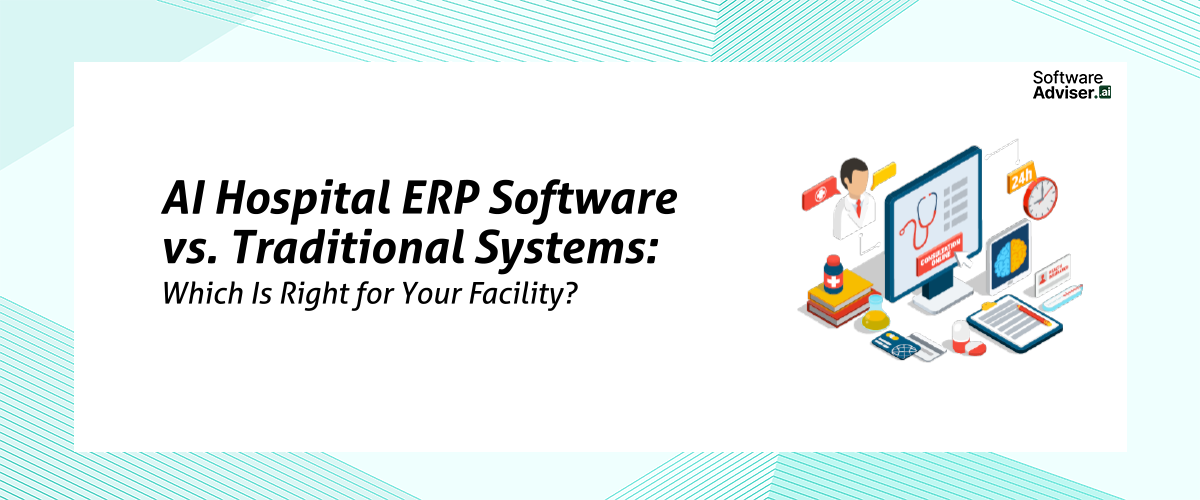
AI Hospital ERP Software vs. Traditional Systems: Which Is Right for Your Facility?
 Dokas mile
US healthcare systems are currently faced with difficult operating environments characterized by dwindling operating margins, which are severely affected by extreme shortages in healthcare staffing, all in the context of stringent HIPAA and CMS regulatory requirements. This situation makes it imperative to choose between setting up AI-enabled ERP hospital software or going for traditional legacy systems. Traditional ERP systems actually do serve as stable transaction-based infrastructures, doing tasks like regulating payables, payroll, and slow-paced inventory control.
These systems are based on manual data input and work with historical reports. Whereas AI-supported ERP systems present the opportunity of incorporating predictive data into the functioning of ERP systems, thus optimizing the schedule of nurses, predicting shortages of supplies in advance, and automating such complex processes as revenue cycle management (RCM) that allows for eliminating delays with authorization and denying claims. Thus, when deciding where to invest in the US, facilities should remember that traditional systems can provide proven financial control, while AI-driven ERPs are able to deliver required operational capabilities.
What is AI Hospital ERP Software?
AI Hospital ERP software is a current, centralized management platform that aims at automating and streamline back-office operations of the healthcare facility and includes accounting, supply chain, human resources, and revenue management (RCM). Traditional hospital ERPs rely on the static storage of databases and manual entry of the data, while AI ERPs integrate technologies such as AI and machine learning into the administrative operations. With data interfaced from various clinical and administrative systems, the AI ERP acts as a brain coordinating various operations associated with compliance with the regulations imposed on the healthcare sector, e.g., HIPAA and CMS regulations.
The uniqueness of AI Hospital ERP software lies in how it has transitioned away from traditional record-keeping to one that provides predictive intelligence. Instead of merely recording inventory after it has run out, it has a built-in predictive analytics function that helps to know if supplies will run low based on the volume of surgeries occurring and patient census trends. Financially, AI algorithms execute an automatic auditing of clinical documentation to recover revenue from charges that were missed, predict insurance claims that might be rejected, and speed authorization procedures. This translates to better hospital operations, as the hospital would have less time spent on administrative duties and lower operating costs compared to the past, as more resources can be allocated to the provision of quality services.
What makes AI Hospital ERP Software different from traditional systems?
The significance of the AI Hospital ERP software in the United States AI employee mental health sector can be explained especially by comparing it with the old legacy system. The key concept in determining the difference between these two systems is predictive insight instead of only keeping records. Indeed, traditional hospital ERPs can be viewed as digital files that keep information about general ledger accounts, monitor the amount of inventory based on scanned items, and send out reports about what happened in the past by using static data. The traditional system mostly relies on data entry conducted manually and on reactive choices. On the other hand, the introduction of AI ERP Hospitals changes the picture by introducing machine learning, language processing, and predictive analysis directly into daily operations.
Instead of simply recording information about what happened, AI ERP makes predictions regarding operational, clinical, and financial aspects of the hospital activity, thus allowing it to prepare in advance for future needs and losses. This intelligence effectively changes the way US establishments are operating. The traditional ERP systems are more about the time spent by the staff and other resources. In contrast to this, the AI-powered system is able to predict the demand for beds in advance. Also, it enables staff scheduling in advance, taking into account the preferences and limits. As for the supply chain, the traditional systems only notify the end user once there’s nothing on the shelf. The modern AI ERP systems not only provide alerts but also predict seasonal illness, weather patterns, and surgical schedules, allowing hospitals to place orders in due time.
AI-enabled ERPs address the specific challenges of the US healthcare reimbursement model with its high rates of claims denial and complicated prior authorization rules that put a strain on operating margins. Old-style billing systems process claims as simple transactions: putting together a claim, submitting it, and waiting for a response. In contrast, the AI-enabled ERP checks all clinical documentation against the constantly changing CMS and private payer regulations to identify coding issues and missing data before doing the submission. The AI ERPs eliminated the manual effort needed in revenue cycle management (RCM) that allowed reducing the reimbursement time and lowering the costs of collecting.
How does AI Hospital ERP Software improve patient care in the US?
AI Hospital ERP systems are designed to enhance healthcare delivery in the United States by eliminating inefficiencies in their operations and ensuring that necessary resources are not depleted. Conventional hospital management systems are known to overlook the supply chain, resulting in costly occurrences of desperately needed surgical instruments or drugs running out just when they are required. With AI ERP software, hospitals can assess the use of their health resources on a daily basis and infer future demand based on clinical calendars, rooms available for patients to be treated, and seasonal health trends.
Also important is the influence of software on staffing and burnout in the health sector. The health industry is facing shortages of nurses. AI ERPs support the management of shifts by evaluating real patient flow, the level of urgency, and other rules regarding the ratio of nurses to patients. Static scheduling leads to shortages. Thus, AI can create sufficient planning on the part of managers so as to avoid burnout. This leads to better outcomes, as fresh nurses can pay more attention to the care of patients rather than spend the shift in a rush.
Using AI ERPs to simplify the burden of back-office processes such as automated clinical coding, prior authorizations with insurance companies, and patient intake processes leads to reduced red tape and challenges for doctors and nurses. Because the physicians and nurses can spend less time writing up their documentation or doing administrative tasks, patients can experience reduced wait times, better discharges from hospitals, and overall better quality of care.
What are the Cost differences between AI Hospital ERP Software and Traditional Systems?
1. Implementation and Licensing Costs in Advance
- Legacy systems are usually characterized by a high level of initial capital expenses. These systems also usually require buying a licensed program, establishing on-site servers, and paying for the costly infrastructure and a lengthy installation period (often from 1 to 1.5 years).
- Most AI solutions are cloud-based SaaS platforms, meaning that they transform capital expenses into operational costs. While there is still a specialist involved in establishing the data pipeline during installation, initial hardware expenses are generally lower than in the previous case.
2. Continuous Maintenance and Subscription Payments
- Organizations incur consistent but recurring expenses in the form of yearly software support contracts, on-site technical staffing, periodic manual updates, and on-site server upkeep.
- Institutions incur a regular monthly or annual subscription cost that covers ongoing cloud hosting, security updates, and frequent algorithm upgrades. Though subscription costs may add up over time, they do away with the big cost of upgrade surprises and eliminate the necessity of extensive in-house server systems teams.
Expenses Associated with Integration and Customization
- The process of linking legacy ERPs with contemporary EHR systems such as those belonging to Epic or Cerner usually involves the use of costly custom middleware, API creation, and thousands of dollars in consulting fees to accomplish overcoming separate databases.
- The built-in APIs and medical data guidelines (for example, HL7 and FHIR) of AI-based solutions help in decreasing overall integration costs. However, in case of considerable efforts in employing custom machine learning models, the costs may increase considerably.
How secure is AI Hospital ERP Software compared to traditional systems?
1. Anomaly Detection in Real-Time vs. Perimeter Defense
Bases itself on the principle of perimeter security (firewalls and VPNs). When users are authorized to enter the network, traditional ERPs take it for granted and assume their honesty, thus preventing detection of breaches until a manual audit is carried out.
Uses the Zero Trust model based on machine learning algorithms. The system carries out real-time analysis of the users’ behaviors and immediately identifies suspicious actions of a different nature (for example, one of the administrators downloading thousands of patient files at 2 am) and cuts access automatically.
2. Threat Intelligence over Time vs. Manual Auditing
Registers the users’ attempts to get access and perform an operation and keeps it in the passive logs. Security specialists have to conduct manual compliance reviews regularly and look for intrusion cases.
Applies predictive analytics to detect attempts of cyber-attacks and fraud activities even before the attack takes place. The system correlates the suspicious activities happening in the networks, the software updates, and the international cyber threat databases.
3. Automated HIPAA/CMS Compliance Monitoring
Keeps electronic protected health information (ePHI) in static databases protected by Role-Based Access Control (RBAC). However, compliance teams at hospitals are required to constantly monitor whether data sharing complies with changing HIPAA Privacy and Security Rules.
Automates compliance with regulations by always keeping a record of how data flows across modules of financial, clinical, and supply chain. The AI process makes sure that patient data is scrubbed and de-identified according to Safe Harbor requirements before data analytics starts, thus allowing it to significantly reduce the chances of violating regulations during audits carried out by CMS or OCR.
4. Continuous Identity & Access Governance
Applies static access rules that are defined once when the system is deployed. If an employee changes his/her department or experiences an intra-department shift during his/her work activities, his/her access permissions have to be changed manually, which leads to the fact that such an employee has too many privileges.
Uses Context-Aware Access Control (CAAC) technology. AI is capable of assessing many factors such as location, health of devices used, time of access, and role context to decide on permissions in real time.
Which US facilities benefit most from AI Hospital ERP Software?
While AI Hospital ERP software offers major advantages, certain facility models realize a far higher return on investment due to their specific operational, financial, and clinical pain points.
1. Huge Multi-Hospital Health Systems
Healthcare systems operating in multiple regions have to deal with serious data issues in their regions. Nevertheless, utilizing AI ERP technology can align supply chain and financial estimates across hospitals and help shift resources, staff, and inventory depending on demand rate.
2. Hospitals with Emergency Aid and High-Medicaid Concept
Working at the edge or even below zero profit rate, these hospitals should use AI billing and invoicing; AI ERP technology helps automate the entire revenue collection process in order to effectively reduce the cost of collection and increase the volume of revenues of the entity specified by CMS.
3. Rural Hospitals
However, rural hospitals can have shortages of medical staff and a lack of proper funds to process complex bills. Hence, AI ERP systems should generate inventory restocking and scheduling, thus allowing functioning efficiently with the smallest administrative costs possible.
4. Big Academic Medical Centers
Academic health facilities deal with multiple surgeries, high patient care, and high costs of supplies. AI-enabled ERPs utilize predictive demand techniques to get required surgical equipment and drugs in time.
5. Outpatient Surgical Centers and Specialty Clinics
Outpatient surgery centers depend on speedy supply turnover and scheduling to stay profitable. AI-enabled ERPs arrange for timely supply arrival and cancellation.
6. Post-acute care and Skilled Nursing Facilities
Nursing facilities must comply with CMS nurse-patient ratio and thus incur higher costs of employee turnover. AI ERP systems plan workforce staffing weeks.
How easy is it to implement AI Hospital ERP Software?
Implementing AI Hospital ERP software is generally more agile than deploying traditional legacy systems due to cloud-native architectures, but it remains a complex enterprise project that requires careful planning, data preparation, and change management.
1. Comparison of Modern API Integration with Legacy Data Silos
Latest cloud-enabled AI ERP solutions leverage modern, API-first architecture that can facilitate rapid connectivity with existing Electronic Health Record (EHR) installations such as Epic or Cerner. However, implementation is slow for a facility using outdated, legacy software that requires custom middleware for data sharing.
2. Cleaning Historical Data and Establishing Pipeline
For accurate predictive scheduling or supply forecasting, AI algorithms require clean historical data. The cleaning process can be the most time-consuming step in the implementation of AI because of the years of unorganized and unstructured administrative and financial records.
3. Speedier Deployment of Cloud
Unlike traditional ERP systems, where the physical installation of servers and setting up of on-premise hardware can take months, cloud-native AI ERPs can be rolled out quickly. In this case, the time-consuming task of establishing the infrastructure is replaced by that of configuring software and mapping out workflow.
4. Calibration of any Algorithm used and training
When using an AI machine learning model in your facility, it must be calibrated first to match your particular operating patterns, trends in the number of patients, and clinical specializations. This process requires testing in a sandbox mode to make sure all output predictions work properly.
5. Training of staff and building trust
Even though a modern AI-based program appears to be easy to use because of its intuitive and conversation-oriented interface, making the staff rely on machine suggestions takes time and effort from the management department. Both nurses and administration personnel must be trained not only on how to use the system, but also on how to read AI’s decisions.
Conclusion
The choice between conventional ERP systems and AI-enabled ones primarily depends on the objectives and strategy of expansion. While traditional ERP systems can fit small healthcare providers needing basic setup and reporting capabilities, the new AI systems are designed for modern facilities striving to optimize supply chains and combat burnout issues. Are you ready to choose the best solution for your facility? If yes, go to softwareadviser.ai to search for and buy the best tools for enterprise systems.
FAQ's
Traditional ERPs rely on static rules to process historical data, whereas AI hospital ERPs analyze real-time data to predict trends, automate complex workflows, and optimize clinical scheduling.
It uses predictive analytics to monitor stock levels, forecast demand based on seasonal patient volume, and automatically reorder medical supplies before shortages occur.
Yes, enterprise AI ERPs are built with strict compliance frameworks, utilizing local or secure cloud encryption, role-based access controls, and automated audit logs to safeguard patient data.
Yes, modern AI ERP platforms are designed with open API frameworks to seamlessly sync administrative and financial data directly with established EHR/EMR systems.
While traditional or standard cloud ERPs fit smaller budgets, scalable cloud-based AI ERPs offer modular plans that allow growing clinics to adopt predictive features as needed.

Video has become the language of modern business. Organizations now need to produce an increasing number of videos, including product launches, custom [...]

David N. Wilks
Quick Comparison Table Tool Best For AI Features Starting Price Free Plan [...]
David N. Wilks
If you've ever gone into a Target, scrolled through Sephora's app, or waited for a delivery from Amazon, then you have noticed an under-the-radar majo [...]