.jpg)
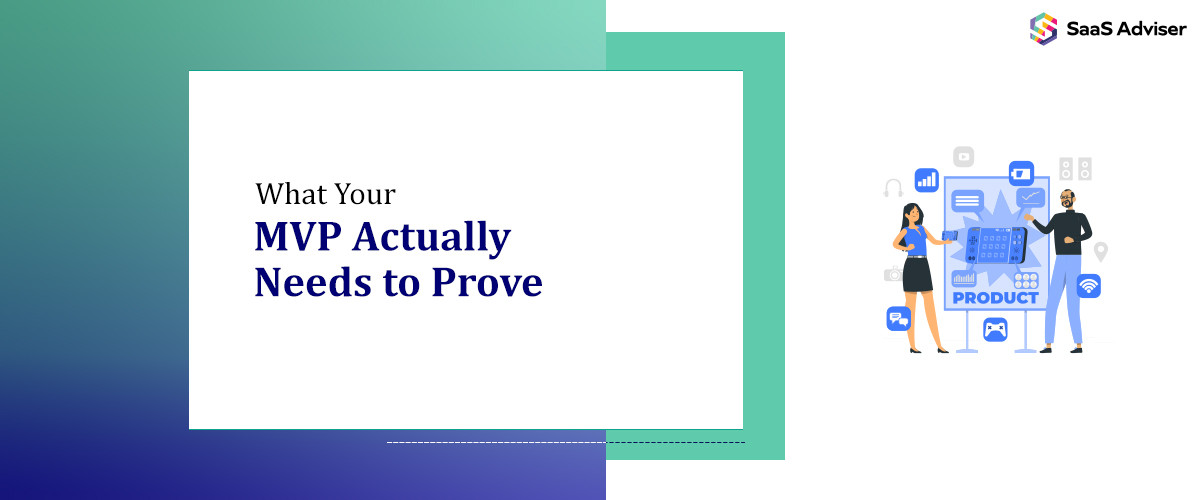
Hundreds of companies set out every year to “validate” their business ideas with a minimum viable product (MVP). The concept is well known among startups and corporate innovation teams: Build a simple initial version of your product fast and take it to market to learn what works—and what absolutely doesn’t. But ask founders what their MVP proved, and you’ll often hear a muddled mix of anecdotes, angry early users, half-baked pivots, and wasted development budgets.
This isn’t surprising. As a software developer and adviser involved in dozens of MVP launches, I see confusion not just about how to build an MVP, but about why you’re building it. The answer isn’t “to see if people will use our product”, or “to get into Techstars”, or “because a lean startup told us to.” It’s much sharper, more disciplined, and results in a fundamentally stronger business.
Let’s break down, with precision, what an MVP truly needs to prove—plus how you, as a product leader or technical team, can ensure that your MVP delivers meaningful evidence.
Forget Feature Checklists: How MVPs Get Misunderstood
The phrase “minimum viable product” has been stretched to cover everything from wireframes to sophisticated launch-ready platforms. I’ve seen teams equate their first demo, a set of static screens, or even a Notion doc with an MVP. While these might be useful for some kinds of validation, only a fraction of MVPs answer the hard questions your business model raises.
Here’s what an MVP is not:
-
It’s not a way to postpone real development investment.
-
It’s not a pitch deck for investors.
-
It’s definitely not a halfhearted prototype you never intend to deploy.
Instead, the only meaningful test for an MVP is whether it answers the single existential question at the heart of your business:
Is there a scalable, repeatable, and profitable opportunity here, and what exactly does our product need to do to capture it?
If this seems obvious, that’s great. But many MVPs only touch on usability or offer soft, indirect signals. Real validation takes much more discipline.
The Core Proof Points Your MVP Needs
Every software project tackles a unique set of risks. Founders often talk about “de-risking”, but few identify, up front, the fundamental uncertainties to resolve. Most promising ideas rest on one or more of the following assumptions:
-
Users will engage with the product in the way you intend
-
People are willing to pay (or otherwise create value)
-
You can deliver your core promise better or cheaper than alternatives
-
The solution can be built, scaled, and supported reliably enough
-
Acquisition channels exist and are affordable
Let’s walk through each of these pillars, outlining how a minimum viable product can (and should) tackle the riskiest one first.
1. Proving User Behaviour Patterns
At the heart of every digital product is a bet on how users will interact with it. Sometimes the real challenge is about motivation: Will people take extra steps for the outcome you promise? Do they drop off? Are you solving a pain point real enough for them to switch from a status quo or from a patchwork of other tools?
Consider a health tech team building an app for medication adherence. They might prove, with minimal engineering, that a daily reminder notification genuinely leads to users taking their medications. This could involve:
-
Simple mobile web notifications
-
Manual reminders via SMS before automating
-
Collecting qualitative feedback on friction points
If nobody changes their behaviour after a month, the entire opportunity could vanish, regardless of any fancy features on the roadmap.
Common user behaviours to validate:
-
Sign-up and onboarding friction
-
Activation rates from (first use to repeated use)
-
Willingness to share data or perform “work” in the app
-
Churn rates: How many stick around after week one or two?
2. Testing the Value Hypothesis
You aren’t just checking if people use your MVP—you’re aiming to prove that it creates value that users are willing to trade something for. That could be direct payment, attention (in ad-supported models), or some measurable action such as user-generated content.
A direct way to do this is to test for payment, even if you don’t have a polished payment flow. The act of putting a price on the product and testing for purchase tells you much more than free signups.
Structure your MVP to test value rapidly by:
-
Charging for early access or a waitlist spot
-
Running a fake purchase flow (e.g., collect intent to pay, even if you won’t process it)
-
Pre-selling to targeted customers
-
Offering a free trial, but tracking conversion seriously
Monetization is often the hardest proof point. Many teams skip it until after launch, but doing so puts the business at risk. If you’re not validating willingness to pay, you’re only collecting vanity metrics.
3. Can You Do This Better or Cheaper?
Every business faces existing alternatives. Your MVP needs to demonstrate not just that a problem exists, but that your solution can solve it more efficiently, with less friction, or at a more attractive price.
Early test versions don’t need a full backend. Sometimes the best proof comes from behind-the-scenes manual labour (concierge MVPs) or spreadsheets. Airbnb famously launched with a simple web page and found their core proof by manually matching renters and hosts.
If you’re promising speed as your differentiator, measure how fast you truly deliver in practice, even if you’re faking some steps behind the scenes.
In many cases, the “manual” version yields richer feedback and validates differentiation more clearly.
4. Ensuring Feasibility and Stability
This risk is technical, not just business-focused. Are you trying to build a recommendation engine with off-the-shelf components, or do you need a new AI breakthrough to make it work? Some MVPs stop at the first UX demo, only to later realise the core tech isn’t possible, or is orders of magnitude more expensive to deliver than anticipated.
Early proof often involves “Wizard of Oz” tricks: appearing automated while humans do the work behind the curtain. But at some point, your MVP must address technical feasibility:
-
Can we achieve the required performance with current tools?
-
Are there infrastructure, privacy, or data issues?
-
Does the third-party API deliver accurate enough data for a usable product?
If your business room depends on a technical leap, your first MVP must prove that leap, whether through benchmarks, a slimmed-down POC, or targeted experiments.
5. Validating Acquisition and Channels
Building a product people want doesn’t matter if you can’t reach them affordably and at scale. Many MVPs are tested among friends, family, or specially-invited pilot customers, but stall out post-launch when real acquisition costs bite.
Some teams neglect this, leading to disillusionment later. Instead, build channel tests directly into your MVP:
-
Set up live acquisition campaigns on AdWords or Facebook — even if your product isn’t ready for full launch
-
Offer a landing page to gauge click-throughs and signups
-
Measure drop-off at every funnel point and estimate cost per acquisition
Too many excellent MVPs fail because their target buyer costs too much to reach, or requires a long consultative sell that the product can’t support.
Calibrating the Scope: The “Minimum” Standard
There’s a temptation to build too much, too soon. While under-building is dangerous, over-building kills startups just as easily—especially for teams without the guidance of a startup-focused app development company that understands how to prioritize features for fast learning.
So, what’s the sweet spot? Your MVP lives at the intersection of “needed to answer the core risk” and “fast/cheap enough to get real-world learning.” Anything you add that doesn’t test your riskiest assumption is feature creep.
Signs your MVP is bloated:
-
More than one user role unless absolutely required
-
Complex onboarding, integrations, or dashboards before basic flows are tested
-
Custom design when off-the-shelf frameworks work
-
Polished, scalable backend architecture before real traffic
Contrast that with a focused MVP:
-
One or two core flows that mirror the promised value
-
Ability to collect evidence of real user engagement or purchase intent
-
Lightweight data collection to measure key metrics
Often, your MVP should be embarrassingly simple.
“Minimum Lovable Product”: Myth or Milestone?
When MVP’s bare-bones approach meets criticism, you’ll sometimes hear teams talk about an “MLP” or Minimum Lovable Product. The idea: Don’t just build something viable — build something users actually adore from day one.
This sounds inspiring, but in practice, the best MVPs are rarely lovable. They might even feel broken or silly. The trick is to differentiate between delight and necessity. If your core users require delight to even try your product (think consumer social apps or hardware), raising the bar to “lovable” makes sense. But in fintech, SaaS, or dev tools, users forgive a lot if you solve their pain.
Focus your first MVP on “must-have” moments:
-
Does a user get immediate, undeniable value?
-
Is the product useful (if not beautiful)?
-
Are users requesting to pay, despite friction?
Lovability has its place, but not at the expense of learning quickly.
Picking Your MVP Stack: Build or Hack?
If your goal is learning, your choice of tech stack and process matters. A good MVP development services team knows how to cheat — using third-party components, low-code/no-code tools, and even manual steps to speed up validation.
Should you build with React Native or just use Webflow? Invest in a serverless backend or a Google Sheet behind the scenes? Hire a dev shop, or do it yourself? There are no universal answers, but here’s a common-sense checklist:
-
Use off-the-shelf UI kits for aesthetics
-
Prefer low-code tools for workflows and logic
-
Leverage Stripe, Zapier, Airtable for basic backend/ops
-
Only custom-build once you’ve validated market need
A great MVP is less about technical elegance and more about honest signal extraction.
How to Measure MVP Success (Beyond Vanity Metrics)
Your MVP is only useful if it gives you contradictory evidence — data or feedback that can falsify your hypothesis. Many teams celebrate launch day or early usage, but gloss over metrics that matter.
Here’s what strong MVP teams measure:
-
Activation: Of total signups, how many complete the core action?
-
Retention: What % return after 7, 14, 30 days?
-
Conversion: What % are willing to pay, or at least indicate purchase intent?
-
Referral/word of mouth: Are early users bringing in others?
But numbers only tell part of the story. The best signals come from unfiltered feedback:
-
Do users hack around friction, signalling pain worth solving?
-
Are they requesting changes or new features?
-
Are you being begged for access, or does usage stop without nudging?
If your MVP flops, that’s precious feedback, not defeat. Adjust, or admit the risk you tried to prove can’t be overcome—then move forward.
The Developer and Advisor's Role: Holding Fast to Proof
As a dev team member, your job isn’t just to ship code, but to ensure the team’s most pressing risk is being tested. This means asking clarifying questions at every sprint:
-
What’s the hypothesis we’re validating with this release?
-
How will we measure success or failure against it?
-
Can we deliver less and still learn more?
-
Is anyone actually changing their behaviour?
Invite friction. Push on assumptions and evidence. Resist gold-plating and endless iteration without learning.
If you’re advising, your counsel is even more critical. Help founders crystallise the biggest risk. Help articulate what, precisely, “proof” will look like: Is it five paying customers? Ten per cent improvement in process speed? A 20 per cent lower churn rate? Define these criteria before a line of code is written.
Embrace Proof Over Perfection
Building products is an exercise in humility, not bravado. Every feature, every workflow, every bug fix should map back to proving you understand the true risk in your business. When constructing your MVP, ignore the hype around “just shipping it” or over-optimising for scale.
A useful mantra: Don’t try to answer everything. Answer the hardest, most specific risk right now.
That tension — the discipline to ask the right questions, build just enough, and be ruthless about what counts as proof — is what turns a minimum viable product into a maximum learning product. That, in the end, is the real win.