
What we'll cover
Share with your community!


Get Free Consultation
What Is Token-Based Pricing? AI Software Costs Explained
 David N. Wilks
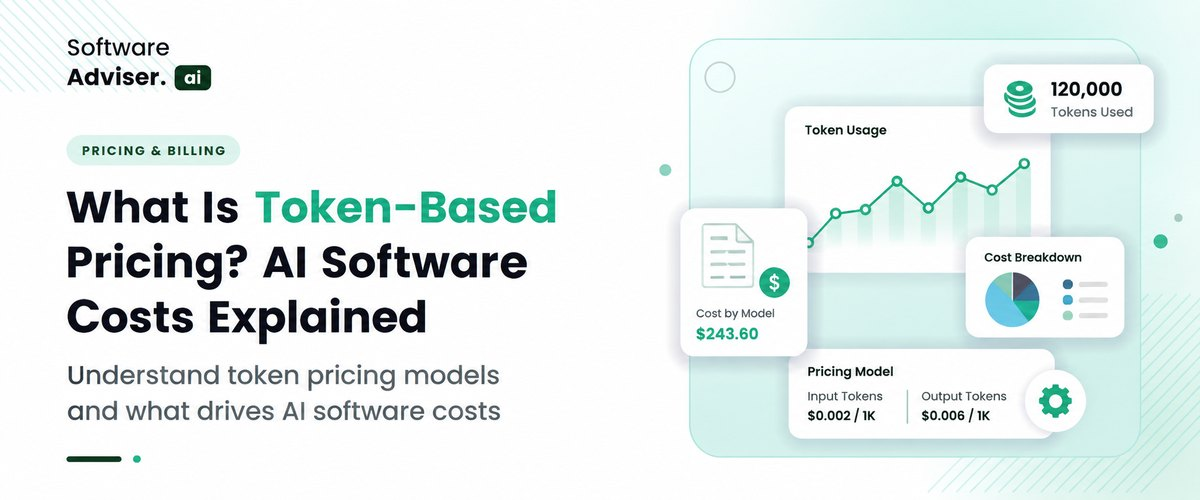
Token-based pricing charges you for the amount of text an AI tool processes, measured in tokens. A token runs to roughly four characters, or about three-quarters of an English word. Most AI software in 2026 bills input tokens and output tokens at separate rates. What you send costs one price. What the model writes back costs considerably more.
This catches finance teams out constantly. Zylo's 2026 SaaS Management Index found 78% of IT leaders had faced unexpected charges tied to AI consumption, with 60% lacking full visibility into how their organization uses generative AI. AI Accounting Software can help finance teams track, categorize, and monitor these changing expenses more effectively. The problem is not that usage-based pricing is complicated. It is that the bill behaves like cloud infrastructure while everyone budgets for it like a subscription.
Why AI Software Pricing Confuses Buyers
Why AI Tools Do Not Use Flat Subscriptions
Traditional software costs the vendor almost nothing per additional use. Once the code exists, one more login is free.
AI does not work that way. Every request burns compute, so the vendor's cost rises with your usage. Flat pricing would mean absorbing that, which nobody does for long.
The Shift From Seats to Usage in 2026
Seat licences assume steady, predictable consumption. AI workloads are neither.
One person running an agent that chains twenty model calls can cost more than forty colleagues asking occasional questions. That mismatch is why usage based pricing displaced per-seat billing across most of the AI category.
What Is Token-Based Pricing?
Token-Based Pricing Definition
Token based pricing charges according to how much data the model handles. Send a longer prompt, pay more. Get a longer answer, pay more again.
Rates are quoted per million tokens rather than per token, because a single token costs somewhere between a few millionths and a few hundred-thousandths of a dollar.
What Are Tokens in AI Software?
Anyone asking what are tokens in ai is asking about how models read text.
Models do not process words. They break text into chunks, and those chunks are tokens. Roughly 1,000 tokens equals 750 English words.
Some concrete examples help. The word "hello" is typically one token. "Tokenization" splits into two, as "token" and "ization". Punctuation and spaces count as well.
Anyone still wondering what are tokens in ai should remember one thing: they are units of processing rather than units of meaning.
How Tokens Are Counted and Charged
Your total is simple arithmetic. Input tokens multiplied by the input rate, plus output tokens multiplied by the output rate.
Take a task sending 2,000 tokens of prompt and receiving 500 tokens back, on a model charging $3 per million input and $15 per million output. That comes to $0.0135, or roughly one and a third cents.
Trivial for one request. Multiply by 10,000 daily and it is $135 a day.
What Is Credit-Based Pricing?
How Credits Differ From Tokens
Credit based pricing sells you a pool of prepaid units and charges actions against it. One image generation might cost 5 credits, a document summary 2.
The difference from tokens is abstraction. Tokens map directly to processing volume, while credits are a vendor-defined currency sitting on top of it.
How Credits Are Consumed
Vendors set the conversion rate, and they can change it. A feature costing 3 credits this quarter might cost 5 next quarter without your contract changing.
Credit based pricing is easier to understand and harder to audit. You cannot verify a credit charge against underlying compute the way you can check a token count.
What Is Consumption-Based Pricing?
Consumption Pricing Definition
Consumption based pricing is the broader family that token billing belongs to. You pay for resources actually used, whether that is tokens, API calls, storage, or compute hours.
Cloud infrastructure pioneered the model. AI simply adopted it. As businesses manage increasingly complex infrastructure and AI workloads, an AI cloud management platform can provide better visibility into cloud resources, compute usage, and the costs associated with consumption-based services.
How Usage Is Metered and Billed
Metering happens per event and aggregates across a billing period. That gap matters more than most buyers of usage-based pricing expect.
Most billing systems settle usage at cycle end, which breaks the feedback loop. A single agent task can generate $40 in inference cost before anything registers it, leaving no opportunity to intervene mid-run.
Token vs Credit vs Consumption Pricing
All three are forms of usage based pricing, differing only in what gets measured.
Tokens measure text processed. Credits measure actions taken. Consumption measures resources used, which may include all of the above.
Token pricing is the most transparent, since you can verify the count. Credit pricing is the most opaque because the vendor controls the exchange rate. Consumption sits between, depending on what is being metered.
Comparison Table: AI Pricing Models
The six ai pricing models you will encounter, ranked by how predictable the bill turns out to be:
|
Pricing Model |
How You Pay |
Best For |
Cost Predictability |
|
Flat-rate |
Fixed monthly fee |
Steady, heavy users |
Very predictable |
|
Per-user |
Price times user count |
Growing teams |
Predictable |
|
Token-based |
Per token processed |
Variable AI workloads |
Varies with usage |
|
Credit-based |
Prepaid credits per action |
Occasional users |
Depends on usage |
|
Consumption |
Metered resource usage |
Infrastructure and APIs |
Least predictable |
|
Hybrid |
Base fee plus overage |
Mixed usage patterns |
Moderately predictable |
How AI Software Pricing Actually Works
Understanding how ai pricing works comes down to four factors, and most ai pricing models share all four regardless of what the vendor calls the product.
Input vs Output Token Costs
Output almost always costs more, typically three to eight times the input rate.
The reason is computational. Reading your prompt is cheap. Generating each new token requires a full pass through the model.
Practically, this means capping response length saves more money than trimming prompts. Most teams optimise the wrong side of the bill.
How Model Choice Affects Your Bill
The spread between models is enormous. Budget models run under $0.50 per million input tokens while frontier models reach $50 or higher.
Ramp's data puts the average business token cost at roughly $0.72 per million in April 2026, though that average hides a range spanning more than 100x. What $1,000 buys varies by a factor of twenty depending on which model you route to.
Why Heavy Usage Costs More
Agents changed the maths. A single query costs one call, while an agent completing a task might make ten, and the agent decides how many steps to take. Businesses using AI workflow automation software should pay particular attention to this, since automated workflows can trigger multiple AI requests and increase token consumption without requiring constant manual interaction.
Ramp found token usage among businesses with connected AI grew 1,001% between January 2025 and April 2026, with total spend up 497% across the same window. Per-token prices fell throughout, and bills still rose.
Hidden Costs in Usage-Based AI Pricing
Context windows are the trap nobody warns you about. The API bills the entire conversation history on every call, so a twenty-message session re-sends everything each turn.
Model proliferation compounds it. The median business ran nine models in April 2026 while the average ran 16.5, and companies using 26 or more posted median monthly AI spend of $26,562.
SaaS Pricing Models Compared
The main saas pricing models in 2026:
- Flat-rate, one fixed price for unlimited access
- Per-user, price multiplied by headcount
- Token-based, paying per token processed
- Credit-based, buying credits and spending them on actions
- Consumption-based, paying for metered resource usage
- Hybrid, a base fee plus usage overages
Flat-Rate Subscription Pricing
One price, unlimited use. Wonderfully predictable and increasingly rare in AI, since the vendor absorbs all consumption risk.
Per-User / Per-Seat Pricing
Cost scales with headcount rather than usage. The dominant model in traditional SaaS and a poor fit for AI, where one user's consumption can dwarf another's by orders of magnitude.
Usage-Based Pricing
Pay for what you process. Usage based pricing is fair in principle, unpredictable in practice, and now the default across AI infrastructure.
Hybrid Pricing Models
A base tier with an included allowance, then overage charges beyond it. Most AI products land here eventually, since it gives customers a predictable floor while protecting vendor margin.
Pay as you go pricing is the purest version, with no commitment and no base fee. Good for experimentation, expensive at scale, since committed-use discounts are unavailable.
Why AI Software Often Costs More Than Traditional SaaS
Compute and Infrastructure Costs
Every AI request consumes GPU time somebody pays for. Traditional software has no equivalent marginal cost.
This is why AI vendors target 50 to 70% gross margins rather than the 80% that traditional SaaS assumes.
Scaling Costs With Usage
Your bill grows with adoption, which inverts the usual software economics. Normally getting more value from a tool costs nothing extra. Here it costs proportionally more. AI Business Management Software can help organizations monitor technology usage, operational costs, and resource consumption as AI adoption expands across different teams.
Unpredictable Monthly Bills
CloudZero's 2026 survey of 260 finance leaders found 42% had approved AI spending without reliable cost projections.
That is the real problem with ai software pricing. Not that it is expensive, but that it resists forecasting.
How to Estimate and Control Your AI Software Costs
Estimate Your Expected Token/Credit Usage
Count tokens per typical task, multiply by expected monthly volume, then multiply by the rate. Run it twice, once for median usage and once for heavy usage, because the gap between those two numbers is where usage based pricing budgets break.
Set Usage Limits and Budget Alerts
Hard caps beat alerts. An alert tells you money was spent, while a cap prevents it.
Ask specifically whether limits enforce mid-request or only at cycle end, since only the first actually stops anything.
Choose the Right Model for Your Workload
Routing simple tasks to cheaper models is the single largest saving available. Not every query needs a frontier model, and most do not.
Prompt caching helps too. Cached input typically bills at 10 to 25% of standard rates, which matters enormously for repeated context.
Questions to Ask AI Vendors About Pricing
What counts as a billable token. Are input and output priced separately. Is caching available and at what discount. Can we cap spend, and does the cap enforce in real time. What happens when we exceed our allowance.
Get the answers in writing before signing.
Which Pricing Model Is Right for Your Business?
Choose Flat-Rate If
Usage is steady and heavy, and predictability matters more to you than paying strictly for consumption. Flat pricing beats usage-based pricing whenever your volume barely moves.
Finance needs a number they can forecast, and your workload does not swing month to month.
Choose Usage-Based If
Consumption varies, you are still experimenting, or usage is genuinely light.
Just build the guardrails first. Usage-based pricing without spend caps is how a $200 monthly budget becomes a $4,000 invoice, and that conversation is easier to prevent than explain.
Conclusion
Token pricing is not unfair. It reflects real cost, which flat SaaS pricing never had to. What makes it hard is the loss of predictability. You are buying something metered, and metered things surprise people who budget for them as subscriptions. Model your expected usage before you commit, cap what you can, and check whether your vendor's limits enforce in real time or after the fact. Those three steps prevent most of the unpleasant invoices. Also useful: best AI software for your budget covers platform options, and other SaaS pricing models explained walks through how seat-based billing compares.
FAQ's
It's a billing model that charges based on how much text an AI model processes, measured in tokens, with input and output priced separately.
Tokens are chunks of text a model processes, roughly four characters or three-quarters of a word each.
Generating each new token requires a full pass through the model, so output rates typically run three to eight times higher than input rates.
Tokens measure text processed, credits measure vendor-defined actions, and consumption measures broader resource use like API calls or compute.
Set hard usage caps that enforce in real time, route simple tasks to cheaper models, and use prompt caching for repeated context.
Choosing the right SEO software in 2026 requires shifting focus from traditional keyword tracking to comprehensive brand [...]
David N. Wilks
Enterprises are dealing with a quiet crisis of margins. Running a enterprise has in reality grow to be too steeply-priced, and traditional cost-reduci [...]

Dokas mile
To build a resilient and secure cloud setup, modern tech businesses need a smart approach to cloud architecture management. When running complex code [...]