
.jpg)
In the digital-first era, it has become a mandatory part of individuals, entrepreneurs, and organizations of any scale to have an online presence. Probably the most frequently asked question by beginners is: What is a Website Builder? In fact, a website builder is a platform that allows any person to create, develop, and deploy a site in the shortest time possible and without any knowledge of code. When you know what a website builder is, you will see how it can help people in the business and amateurs alike to create a website easily.

Looking for Website Builder Software? Check out SaaS Advisor’s List of the Best Website Builder Software for your business.
A website builder has simple tools, templates, and features that allow you to create a webpage with ease, as opposed to the traditional methods, where you needed to hire developers to create a webpage. As a small business owner or as a freelancer, you can save time, spend less, and build your presence online with the best offline site builder tools with the help of a business website builder
How Do Website Builders Help You Create a Site?
Website creators simplify web-building to an easy task. You do not need to know how to write complicated programming languages, and you can make web page design features in minutes through drag-and-drop functionality. These websites usually have pre-built templates, design capabilities, and e-commerce, search engine optimization, and analytics tools.
Consider a web builder as your own web maker software—it does the coding in the background, and you get to customize layouts, images, and text. This simplifies the page creation even by persons with no technical skills.
List of Best Website Builder Software: Ultahost, JouwWeb, WebHostingHubWhy Should You Choose a Website Builder for Your Site?
Selecting a website builder is one of the most intelligent business and individual decisions to create an online presence without the need to code. These services are simple, fast, and professional in their outcome, and that is why they are the favorite among the millions of users across the world. Here's why.
-
Cost-effectiveness
Professional developers or agencies are costly to hire, particularly when it comes to startups or small companies. Conversely, the majority of web builders are priced with cheap subscription packages and tier pricing options, so you never pay more than what you require.
-
Time-saving
An old web development can be done in weeks, months, but a new web maker program allows you to make a webpage within hours. This pace allows businesses the agility to move fast in disputed markets.
-
Accessibility
Website builders are easy to use and were created to be used by the non-technical community of entrepreneurs, freelancers, and small teams. By providing friendly interfaces and in-built page creation software, first-time user can create professional websites.
-
Flexibility
Blogs, portfolios, e-commerce stores, and corporate sites, among others, give web builders the power to grow and change. Regardless of whether you are building a business site using a web builder, or are trying out the best web builder using personal uses, these websites expand with your demands.
Experts suggest that platforms like Wix, DudaMobile, and SquareSpace make setup easy, while solutions like ChowNow or FoodKonnekt handle the heavy lifting of online orders.
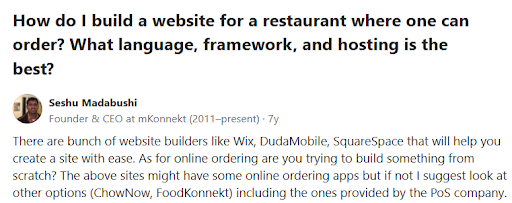
Reference Link: https://qr.ae/pC1ANI
This shows one thing clearly: with the right tools, any restaurant can turn its website into a powerful ordering and revenue channel.
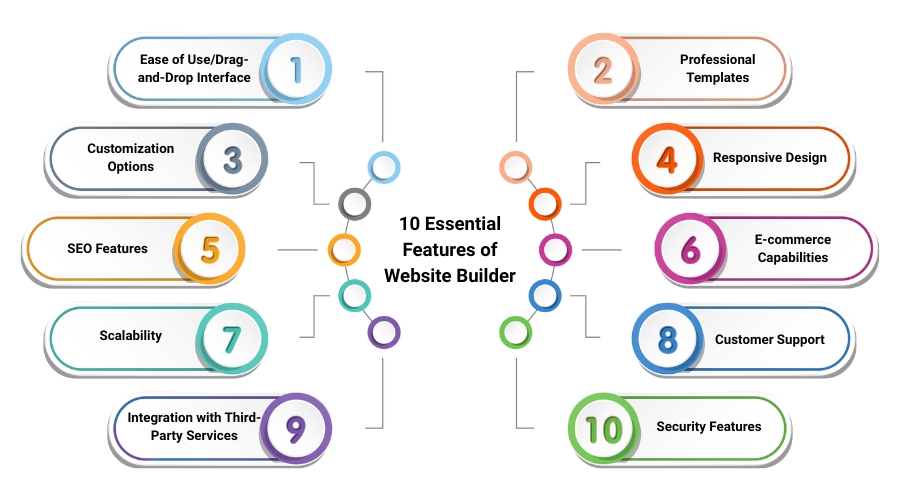
Here are 10 Essential Features to Consider When Choosing a Website Builder
Choosing the most favorable web builder to suit your requirements, it is necessary to be aware of the main characteristics of its design that will guarantee the functionality, expansion and scale. DIY website builders are the ones used to create more than 18 million websites on the internet. Below are the top 10.

Did You Know?
Small business owners should consider using a platform that comes with the necessary features of website design such as search engine optimization features, mobile operation, and the ability to integrate with marketing applications. This means that your site will not only look good, but it will also do well online.
1. Ease of Use / Drag-and-Drop Interface
Drag-and-drop features on elements such as images, text boxes, and forms make it quick and easy to build a site. This is because this feature does not require you to have any coding skills to make a useful web page or create design features, making it a great starting point for beginners who may later explore coding career options.
2. Professional Templates
The finest web developers also offer plenty of industry-specific templates through which you can create a professional-looking site in a matter of minutes. Small businesses, in particular, will find templates that will help them have a nice design without the expense of employing developers.
3. Customization Options
Although templates give you a base, customization means that your site will still be your brand. The business website builder of your choice must allow you to modify fonts, colors, layout, and widgets, and change the background easily.
4. Responsive Design
Current travelers read on computers, tablets, and phones. Responsive website design features have the advantage that it automatically adapt the layout of your webpage to the size of any screen, so it looks the same on all machines. Understanding the psychology of web design also plays a key role here, as colors, layouts, and visual hierarchy influence how users feel and interact with your responsive website. As projects become more complex, many organizations eventually turn to professional web development services to handle custom features, integrations, and security requirements that basic do-it-yourself tools struggle to support.
5. SEO Features
In order to be visible on the internet, your builder must add SEO-friendly features like meta tags, unique URLs, alt-text of images, and sitemap generation. In order to be visible on the internet, your builder must add SEO-friendly features including seo meta tags, unique URLs, alt-text of images, and sitemap generation. These are important characteristics of a site that contribute highly to ranking your site higher up in search engines.
6. E-commerce Capabilities
When you intend to sell goods or services, the site builder will allow you to use a shopping cart, secure payment gateways, product lists, and inventory control. This will make your site a complete online store.
7. Scalability
Start small, but think big. The most efficient web builder systems enable your website to expand with your business without slowing down as it supports more traffic, pages, and integrations.
8. Customer Support
Customer service should provide care 24 hours a day and particularly to novices. Search through other builders that offer live chat, tutorials, forums, and extensive FAQs to help you navigate the difficulties along the way.
9. Integration with Third-Party Services
Your builder must also be integrative with other tools such as CRM software, email marketing software, and social media. These integrations are often made possible through a website builder API, which allows developers to extend platform functionality, automate workflows, and connect third-party tools seamlessly for a more customized website experience.
10. Security Features
Both your data and your visitor depend on security. SSL certificates, frequent backups, malware protection, and data encryption are essential features of a website design. A safe site increases trust and prevents the loss of confidential data.
Pro Tip
If your business is small and you have a builder, you might want to combine your builder with the best time tracking software for small business to simplify operations and enhance productivity.
How to Choose the Right Business Website Builder?
There is more to business website building than design; there is matching the tool to your business objectives, financial considerations, and long-range vision. There are so many website makers that you should consider carefully. The following are the factors of a website builder to consider.
-
Ease of Use
When you are a novice or own a small business, ease of use is essential. The most useful platforms are drag-and-drop with easy-to-use dashboards, and creating a webpage does not require any coding knowledge.
-
Design Flexibility
Your brand ought to be on your website. Select a builder with quality templates and a wide range of customizing features, including fonts, layouts, colors, and widgets. This will ensure your site does not appear generic but is reflective of your business.
-
Industry Relevance
Not every business uses the same templates. The best business website builder will have customized designs like niches, say restaurant layouts, e-commerce stores, or business templates of services. This helps to make page creation quick and has your site appearing to the right people.
-
Pricing Plans
There is always a decision point on the budget. There are free versions of some website creators, though more sophisticated web designing functions, such as e-commerce, search engine optimization services, and integrations, can be purchased on a paid basis. Compare plans to make sure you are getting the appropriate cost-to-feature mix
-
Scalability and Support
Choose a builder that is scalable, be it the amount of traffic it can support, the additional e-commerce functionality, or the inclusion of sophisticated systems such as CRMs. Good customer support will be provided to customers via reliable live chat, tutorials, and forums.
Quick InsightsA variety of sites are providing small businesses with annual subscriptions at discounts as much as 30% as opposed to a monthly plan.
Conclusion
Website builders have changed how people and companies create their presence online. With their user interfaces and sophisticated website design capabilities, these sites enable professional, responsive and secure websites to be built without technical skills. With the right web builder, you will save time, save money, and be able to scale up as your online presence expands. Although not a tool, in a word, website builders are facilitators of online success.
Related Reads:
Yes. Analytics features help you track visitor behavior, traffic sources, and overall performance.
Templates provide ready-made designs, making it quick and easy to create a professional-looking website.
Depending on your needs, the best alternative is available. An example is that some are more e-commerce, and others are more blog or portfolio.
Scalability ensures your website builder can grow with your business, supporting new features, pages, and traffic demands.
Security features like SSL certificates and regular updates keep your website safe from threats.

.jpg "Biometric Authentication Through Facial Recognition Software")

 (1).jpg "What Are the Top Benefits of Network Monitoring Software for USA Enterprises?")