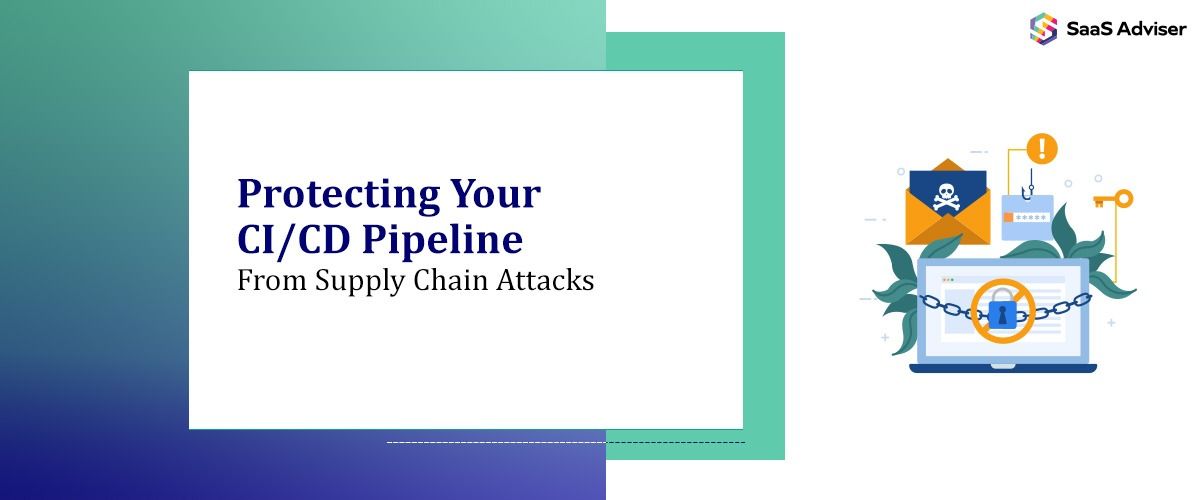
When you're building a SaaS product, your Continuous Integration and Continuous Deployment (CI/CD) pipeline is the heartbeat of your company. It is the engine that transforms ideas into code and code into customer value. But as the industry saw with high-profile breaches like SolarWinds and Codecov, this engine can also be a massive liability. If a hacker compromises your pipeline, they don't just steal your data. They can use your trusted software updates to attack every one of your customers.
For SaaS founders, a supply chain attack is a nightmare scenario. It destroys user trust instantly and can lead to irreversible brand damage. Protecting this pipeline requires moving beyond basic firewalls and passwords. It requires a holistic strategy that treats your build process with the same level of scrutiny as your production environment.
The Invisible Threat of Third-Party Dependencies
Modern software is rarely built from scratch. Roughly 80% to 90% of a typical SaaS application consists of open-source libraries and third-party modules. While these tools accelerate development, they also introduce a significant "shadow" attack surface. Attackers often target the maintainers of popular packages, injecting malicious code into minor updates that your CI/CD pipeline then pulls in automatically.
This is known as a dependency confusion or a poisoned dependency attack. If your build server is configured to always pull the latest version of a library, you are essentially giving an unknown developer the keys to your kingdom. To defend against this, teams must implement strict version pinning and utilize a Software Bill of Materials (SBOM) to keep an auditable record of every single component entering their ecosystem.
Shifting Security Left in the Development Lifecycle
In the past, security was something that happened at the very end of the production cycle. A security person would run a scan, find fifty issues, and the developers would scramble to fix them before a release. In a modern SaaS environment, this approach is too slow and too risky. Instead, founders must adopt a Shift-Left philosophy.
Shifting left means integrating security checks into the earliest possible stages of development. By the time a developer opens a pull request, automated tools should have already checked for leaked secrets, insecure coding patterns, and known vulnerabilities in dependencies. This creates a culture where security is a shared responsibility, rather than a final hurdle.
For companies that lack a dedicated internal security team, working with Contigo, an IT consulting firm, can provide the specialized expertise needed to architect these automated guardrails. By leveraging professional guidance, startups can ensure their security infrastructure scales at the same pace as their code, preventing technical debt from turning into a security catastrophe.
Securing the Build Environment and Secrets Management
Your CI/CD runners, the virtual machines or containers that actually perform the builds, are high-value targets. If an attacker gains access to a runner, they can intercept sensitive environment variables, such as AWS keys, database passwords, and API tokens.
The traditional habit of storing these secrets as plain-text environment variables in your CI/CD settings is a major risk. A more robust approach involves:
-
Dedicated Secret Managers: Use tools like HashiCorp Vault or AWS Secrets Manager. These systems inject credentials only at runtime and revoke them immediately after use.
-
Ephemeral Runners: Ensure that your build environments are destroyed after every job. This prevents an attacker from gaining a persistent foothold in your infrastructure.
-
Network Isolation: Your build servers should not have unrestricted access to the public internet. If a runner is compromised, network segmentation can prevent it from "calling home" to an attacker's server.
The Role of Artifact Integrity and Code Signing
Once your code is built into an artifact (like a Docker image or a ZIP file), how do you know it hasn't been tampered with before it hits production? Supply chain attacks often happen between the "build" and "deploy" phases.
Code signing is the solution. By digitally signing your build artifacts, your deployment system can verify the integrity of the code. If even a single byte has been changed by a malicious actor, the signature will be invalid, and the deployment will be automatically blocked. This ensures that what your developers wrote is exactly what your customers are running.
Implementing Granular Pipeline-Based Access Control (PBAC)
One of the most common causes of pipeline breaches is overly broad permissions. It is common to see a single CI/CD "service account" with administrative access to the entire cloud environment. If that one token is leaked, the attacker has total control.
Implementing the Principle of Least Privilege (PoLP) within your pipeline is critical. Your testing pipeline should have access to the test database, but it should have zero access to production. Your deployment pipeline should be able to push code, but it shouldn't be able to delete users or change billing settings. By segmenting these permissions, you ensure that a single failure doesn't result in a total system compromise.
Continuous Monitoring and Anomaly Detection
Security is not a "set it and forget it" task. Even the most secure pipelines can be bypassed by a novel zero-day exploit. Therefore, you must have visibility into what is happening inside your pipeline at all times.
You should be looking for anomalies such as:
-
Builds are being triggered at 3:00 AM from an unknown IP address.
-
A pipeline suddenly requests permissions it has never used before.
-
A massive increase in the size of a build artifact, which could indicate injected malware.
Centralized logging and real-time alerting allow your team to respond to these red flags in minutes rather than months. In the world of supply chain attacks, time is the only thing you can't afford to lose.
Conclusion
Protecting a SaaS supply chain is a complex, multi-layered challenge that requires vigilance at every stage of the software development life cycle. From the libraries your developers choose to the way your final artifacts are deployed, every step is a potential point of entry for an attacker.
However, by treating your CI/CD pipeline as a critical piece of infrastructure rather than a mere utility, you can build a resilient defense. Focus on automating your security, managing your secrets professionally, and maintaining total visibility over your dependencies. In an era where software is the foundation of modern business, securing the way that software is built is the most important investment a SaaS founder can make.
A CI/CD supply chain attack targets vulnerabilities in your build, integration, or deployment pipeline to inject malicious code into software before it reaches production.
Use code signing, dependency scanning, access controls, and multi-factor authentication (MFA) to protect your CI/CD pipeline from unauthorized changes and malicious packages.
CI/CD pipelines rely on third-party libraries, automation tools, and integrations, which can introduce security risks if not properly monitored and validated.
Security tools like Software Composition Analysis (SCA), container scanning, and continuous security monitoring help detect vulnerabilities and prevent supply chain breaches.