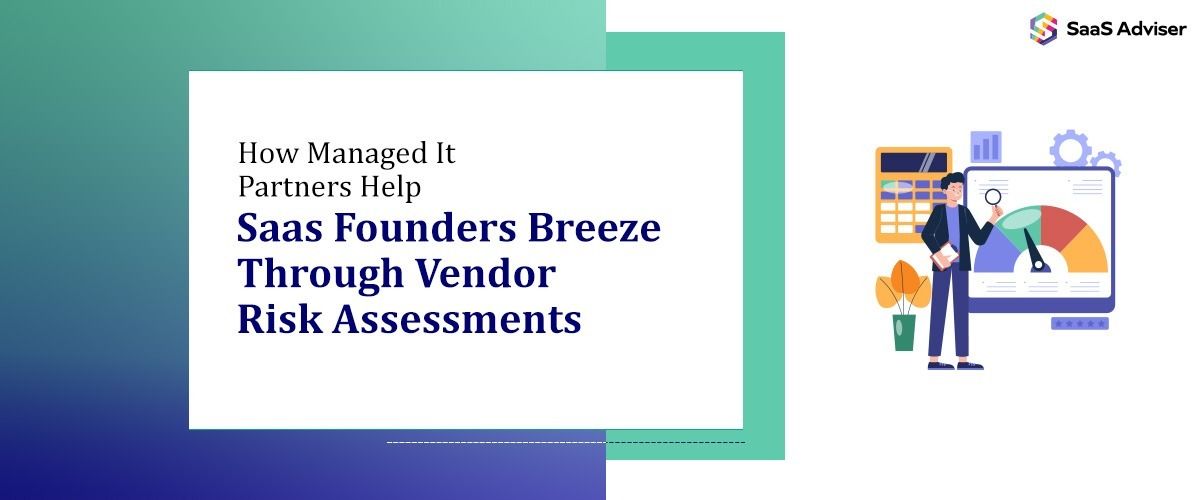
When you are a SaaS founder, the growth path often feels like a sprint until you hit the "Wall of Enterprise." To scale your software, you need big clients, but big clients come with one of the most grueling hurdles in the tech industry: the vendor risk assessment.
These assessments aren't just simple forms. They are deep, invasive deep-dives into your infrastructure, data handling, and security protocols. For a small or mid-sized SaaS team, this can bring operations to a grinding halt. However, savvy founders have discovered a secret weapon. By partnering with a Managed IT Service Provider (MSP), you don't just survive these audits; you breeze through them.
The High Stakes of SaaS Vendor Risk Assessments
In the SaaS world, trust is the only currency that truly matters. When a potential enterprise client hands you a 200-question security questionnaire, they aren’t just being difficult. They are protecting themselves from supply chain attacks, data breaches, and regulatory fines.
For the founder, these assessments represent a massive gatekeeper. If you can’t prove that your data is encrypted, your access is controlled, and your disaster recovery plan is airtight, the deal dies. Most founders try to DIY this process, pulling developers away from the roadmap to answer questions about firewall configurations and patch management. This is where a Managed IT partner changes the game by providing the technical "proof" of your security posture before the questions are even asked.
Why Technical Due Diligence is a Founder’s Biggest Headache
The complexity of modern compliance frameworks, like SOC 2, HIPAA, or ISO 27001, requires more than just a "secure" product. It requires a secure company. This means every laptop your employees use, every cloud server you spin up, and every third-party tool you integrate must be accounted for and hardened.
When an auditor asks for "evidence of quarterly access reviews" or "proof of encrypted backups," many founders realize they have the systems in place but no documentation to prove it. A Managed IT partner acts as your technical architect and librarian, building the systems and maintaining the records that auditors crave.
By leveraging tech services from AhelioTech, SaaS founders can offload the burden of infrastructure management to experts who specialize in audit-ready environments. Instead of scrambling to find logs, you simply point the auditor toward a pre-configured, monitored, and documented environment.
How Managed IT Partners Simplify Evidence Collection
The most time-consuming part of any risk assessment is evidence collection. An auditor doesn't want you to say you have a firewall; they want to see the configuration file. They don't want to hear that you "update your software"; they want to see the patch logs from the last six months.
Managed IT partners use sophisticated Remote Monitoring and Management (RMM) tools that track every change in your environment. This creates a continuous "paper trail" of security. When the vendor assessment asks about your endpoint security, your partner can instantly generate a report showing that 100% of your team's devices are encrypted, updated, and monitored for threats.
4 Ways an MSP Accelerates Your Compliance Journey
If you want to move from "startup" to "enterprise-grade," you need to address four specific areas that Managed IT partners handle best:
1. Proactive Infrastructure Hardening
Most SaaS vulnerabilities don't exist in the code itself, but in the environment where the code lives. Managed IT partners ensure that your cloud instances are configured with "Least Privilege" access, your databases are encrypted at rest, and your network is segmented to prevent lateral movement during a breach.
2. Automated Patch and Vulnerability Management
Security is a moving target. Yesterday's secure server is today's vulnerability. An MSP provides automated patching for all systems, ensuring that you are never "caught out" by an outdated piece of software during a risk assessment.
3. Business Continuity and Disaster Recovery (BCDR)
"What happens if your primary server goes down?" This is a standard question in every assessment. A Managed IT partner doesn't just back up your data; they build a recovery plan with a defined Recovery Time Objective (RTO). They test these backups regularly, providing the "Proof of Test" documents that enterprise clients require.
4. 24/7 Monitoring and Incident Response
Enterprise clients want to know that someone is watching the store. Having a 24/7 Security Operations Center (SOC) is often a requirement for high-tier contracts. A Managed IT partner provides this level of oversight at a fraction of the cost of hiring a full-time in-house security team.
Bridging the Gap Between Code and Compliance
Many founders make the mistake of thinking that because their app is built on AWS or Azure, they are automatically compliant. This is the "Shared Responsibility" trap. While the cloud provider secures the physical hardware, you are responsible for everything inside your virtual environment.
A Managed IT partner bridges this gap. They understand the nuances of the cloud and can implement the administrative controls, like Multi-Factor Authentication (MFA) and Single Sign-On (SSO), that are essential for passing a vendor risk assessment. They ensure that your internal operations are as polished as your product's user interface.
Scaling Your Security Posture as You Grow
The beauty of a Managed IT partnership is scalability. In the early days, you might only need basic device management and backups. But as you move toward a Series A or start eyeing Fortune 500 clients, your needs will evolve.
Your IT partner evolves with you, upgrading your security stack and helping you map your controls to more rigorous frameworks. This "compliance-first" approach to IT ensures that you never have to "rip and replace" your infrastructure when a big client asks for a higher level of security.
Conclusion
SaaS founders are visionaries, builders, and leaders. They shouldn't have to be full-time compliance officers. The vendor risk assessment is a necessary part of doing business in the enterprise world, but it doesn't have to be a source of stress.
By partnering with a Managed IT expert, you gain more than just technical support; you gain a competitive advantage. You can confidently walk into sales meetings knowing that your infrastructure is as robust as your software. When you have the right systems, the right documentation, and the right partner, you don't just pass the assessment, you breeze through it, leaving your competitors stuck in the paperwork.