-min.jpg)
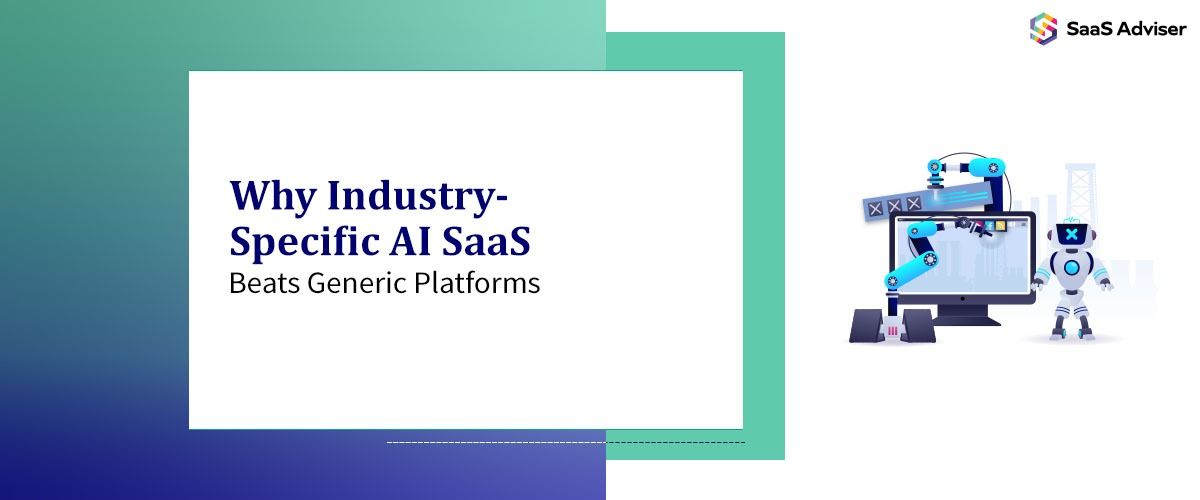
Many SaaS teams start in the same place with AI. They roll out a well-known AI platform, run a few promising pilots, and then hit a wall just a few weeks after implementation, which forces people to double-check everything anyway.
Horizontal AI platforms do handle general tasks well enough, but they treat every industry like the same problem with the same vocabulary. So, organizations in highly specialized fields keep discovering that what looked like a shortcut ends up creating more work.
That’s why vertical AI SaaS is getting real attention. Instead of adapting a generic system, vertical vendors build these tools from the ground up for a specific industry.
This piece looks at why that approach is gaining ground and where it delivers the most value. Plus, learn how to evaluate these tools without letting surface-level features distract you.
What Is Vertical AI SaaS and Why Does It Matter?
Vertical AI SaaS focuses on a single industry and wraps around its realities: workflows, language, and compliance demands. Instead of trying to serve everyone, these platforms go deep into a single domain, such as legal, healthcare, or finance, and pair artificial intelligence with genuine domain expertise.
This isn't a knock on horizontal AI, but horizontal tools cast a wide net. If your industry has its own regulatory framework, its own jargon, and its own risk profile, a tool built for everyone isn't really built for you.
Choose based on how much adaptation your teams must do because a general-purpose AI tool often requires configuration, training, and workarounds before it fits. But a vertical tool starts closer to “ready out of the box” because it already understands the environment it’s entering.
Why Generic AI Platforms Fall Short in Specialized Industries
Most teams abandon general AI tools because the friction slows their adoption and creates inconsistencies in their work. Those limitations tend to show up in the same three places, regardless of the industry.
Domain Knowledge Gaps That Increase Error Rates
Generic AI models lack the context needed to interpret industry-specific language. In legal settings, for example, a clause might look standard but carry subtle implications that change its meaning entirely. Without domain awareness, the model produces outputs that sound right but miss critical details.
Compliance and Regulatory Blind Spots
Many industries operate under strict regulatory frameworks. Generic tools don’t reliably flag compliance risks because they weren’t designed with those frameworks in mind. That leaves teams double-checking outputs manually, which cancels out much of the time savings.
Workflow Misalignment and Integration Friction
If your legal team lives in Microsoft Word and the AI requires a separate browser tab with copy-paste workflows, the adoption will drop. People revert to old habits fast, especially when the new tool creates more steps.
Industries Where Vertical AI SaaS Delivers the Highest Impact
Some sectors feel the generic-versus-vertical gap more acutely than others.
Legal Services and Contract Management
Generic AI tools routinely miss jurisdictional nuances, fail to flag non-standard clauses, and can't benchmark contract terms against industry norms.
Firms increasingly adopt AI software built for law firm workflows to handle contract review, clause generation, and redlining in ways generic platforms can’t match. These legal-specific tools understand legal structure, reference established standards, and integrate directly with tools like Microsoft Word, keeping lawyers within their existing workflow.
Healthcare and Clinical Operations
A generic summarizer that misinterprets a medication dosage note or overlooks a contraindication creates real patient risk. Vertical tools, by contrast, reduce administrative burden with far greater reliability. They align with medical coding systems, patient record formats, and regulatory requirements.
Financial Services and Compliance
Generic AI might assist with analysis, but it rarely accounts for evolving compliance rules or audit requirements. Vertical solutions embed those considerations directly into the product. Teams can generate reports, monitor risk, and stay aligned with regulatory expectations.
Construction and Real Estate
Project timelines, contracts, and site data all intersect in complex ways. Generic tools lack the context to manage these moving parts effectively. Vertical AI platforms that specialize in this space pull from industry-specific datasets and understand the relationships between project phases, regulatory checkpoints, and cost structures.
How to Evaluate Vertical AI SaaS Before You Buy
Not every tool that calls itself "industry-specific" has earned the label. Buyers need to understand how deeply the product aligns with their industry.
Depth of Industry Expertise Built into the Product
Ask how the model was trained. Was it fine-tuned on real industry data, or did the vendor just add a few templates to a general-purpose engine?
Integration with Existing Industry-Standard Tools
A vertical AI tool that doesn't connect to the platforms your team already uses will collect dust. If your lawyers work in Word, your clinicians work in Epic, or your engineers work in Procore, the AI needs to meet them there. Not the other way around.
Data Security and Compliance Certifications
Look for SOC 2 Type II, HIPAA compliance, or GDPR adherence. Verify how the vendor manages data, whether it retains inputs, and which certifications it holds. If the answer is vague, walk away.
Scalability and Vendor Stability
You want a partner who will still exist and continue improving in three years. A vertical AI startup with a great product, but twelve months of runway is a risk. Make sure to also evaluate the vendor's funding, customer base, and product roadmap.
What to Watch in the Vertical AI SaaS Market
The vertical AI space is moving fast, and some of the shifts underway will reshape how buyers evaluate these tools within the next year or two.
Consolidation as Horizontal Vendors Acquire Vertical Specialists
Big platforms are buying vertical players to fill capability gaps. That can be good (more resources) or bad (product gets absorbed and deprioritized). Keep an eye on acquisition announcements in your sector and assess whether the product roadmap survives the merger.
AI Model Customization Lowering Barriers to Vertical Specialization
Fine-tuning and retrieval-augmented generation have made it cheaper to build domain-specific AI. Expect more niche entrants targeting underserved industries. But this is good news because more competition generally means better products and pricing for buyers.
Increasing Buyer Demand for Embedded Compliance and Auditability
Procurement teams now ask tougher questions about how AI handles regulated data and whether outputs leave an auditable trail. Vendors that can provide transparent outputs and audit trails will stand out as this expectation becomes standard.
Final Thoughts
The choice between generic and vertical isn't just a product decision. It's a strategic one that directly affects productivity, risk exposure, and long-term ROI.
Take a hard look at your current AI stack. Where are the tools underperforming because no one designed them for your reality? Those are your replacement candidates.
Organizations that invest in vertical AI SaaS set themselves up for steady efficiency gains as these platforms evolve as the platforms mature around their exact needs.