
What we'll cover
Share with your community!


Get Free Consultation

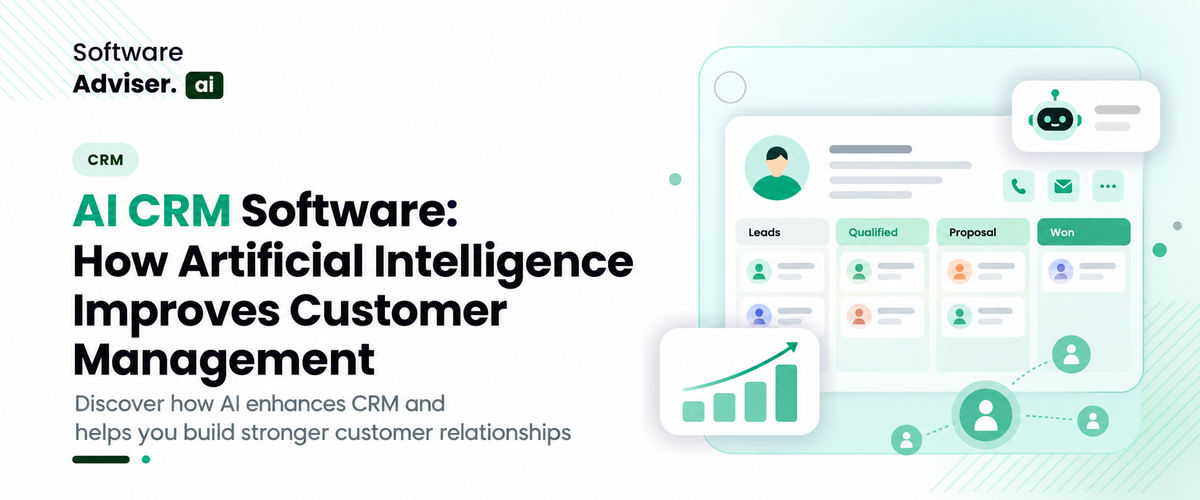
AI CRM Software: How Artificial Intelligence Improves Customer Management
 Dokas mile
Managing customer relationships has grown increasingly complex. Modern businesses collect massive streams of data from emails, social media, live chat, support tickets, and purchase histories. Yet, despite having more data than ever, many organizations struggle to turn this information into meaningful action. Disconnected systems, rising customer expectations, and repetitive manual workflows often bog down sales and support teams, leaving opportunities slipping through the cracks.
This is where AI CRM software enters the picture, turning static customer databases into dynamic, intelligent engines that anticipate needs and drive business growth. Artificial intelligence changes how companies approach customer management by shifting the focus from manual data entry and reactive problem-solving to automated workflows, predictive analytics, and deeply personalized engagement. Rather than forcing employees to dig through endless spreadsheets, modern AI-enabled platforms surface the right insights at the exact moment they matter most.
Throughout this article, we will explore how AI-powered customer relationship management works, the tangible business benefits it delivers across different departments, real-world use cases, and how organizations can successfully implement or integrate these advanced tools.
What Is AI CRM Software?
AI CRM software is an advanced evolution of traditional customer relationship management technology that embeds artificial intelligence, machine learning, and automation capabilities directly into the core platform. By intelligently analyzing historical and real-time customer information, an AI CRM system automates routine administrative workflows, predicts future customer behaviors, and assists employees with real-time decision-making and personalized communication.
How Does an AI CRM System Work?
At its core, an AI CRM combines several technological components to mimic and enhance human intelligence:
- Machine Learning (ML): Algorithms scan historical customer data, interaction patterns, and transaction histories to recognize trends and continuously refine their predictive outputs over time.
- Natural Language Processing (NLP): Enables the CRM to parse, understand, and generate human language, powering intelligent chatbots, sentiment analysis of customer feedback, and automated email summarization.
- Generative AI: Assists sales and marketing teams by instantly drafting personalized outreach messages, proposal outlines, and campaign content based on contextual CRM data.
- Predictive Analytics: Evaluates historical data to forecast future outcomes, such as which leads are most likely to convert or which clients show early warning signs of churn.
- Workflow Automation: Automatically triggers tasks, updates records, and routes support tickets without requiring manual intervention from staff.
Unlike a conventional database which simply stores records and relies on manual reporting an AI-enabled CRM actively interprets data, provides prescriptive recommendations, and executes routine actions autonomously.
How AI CRM Software Improvements Shape Customer Management
Intelligent Customer Data Analysis
Traditional CRMs often suffer from data silos and duplicate entries, making it difficult to get a unified view of the customer. AI algorithms continuously clean, deduplicate, and enrich customer records by pulling in external signals and cross-referencing interaction histories. This creates a single, reliable source of truth that empowers teams with accurate insights.
Personalized Customer Communication
Generic email blasts and one-size-fits-all scripts no longer resonate with modern buyers. AI CRM tools analyze individual user behavior, purchase preferences, and browsing habits to dynamically tailor communication. Whether recommending a complementary product or adjusting the tone of an email, AI ensures that every customer touchpoint feels relevant and bespoke.
Automated Sales and Support Workflows
Administrative tasks like logging call notes, scheduling follow-ups, and routing support tickets consume hours of productive time each week. AI automation handles these repetitive chores seamlessly. Sales representatives can focus on relationship-building and closing deals, while customer support agents receive instant ticket categorization and AI-suggested responses to resolve issues faster.
Predictive Insights and Next-Best Actions
By analyzing historical success patterns, AI predicts what a customer or prospect is likely to do next. It suggests the optimal time to reach out, the best channel to use, and the specific offer or piece of content most likely to resonate. This guidance eliminates guesswork and aligns sales, marketing, and support around a unified strategy.
Key Benefits of AI-Powered CRM
Adopting an intelligent CRM platform yields measurable improvements across operational efficiency, revenue growth, and customer satisfaction. The primary benefits of AI-powered CRM include:
1. Better Lead Scoring and Conversion Opportunities
Sales teams frequently waste valuable hours pursuing unqualified leads. AI-driven lead scoring evaluates dozens of implicit and explicit variables such as website visits, email engagement, company size, and budget indicators to rank leads by their actual likelihood to buy. Sales representatives can immediately focus their energy on high-potential prospects, directly improving conversion rates and sales velocity.
2. Improved Customer Retention and Churn Prediction
Acquiring a new customer is significantly more expensive than retaining an existing one. AI algorithms monitor engagement frequency, support ticket sentiment, and product usage drops to identify accounts at risk of leaving. Armed with this early warning system, account managers can proactively intervene with retention offers, check-ins, or dedicated support.
3. Greater Sales Productivity Through Automation
Administrative friction is a primary productivity killer in sales organizations. AI-powered CRM tools automate data entry, generate meeting summaries from call recordings, and suggest automated email follow-ups. By removing these manual bottlenecks, organizations see a dramatic increase in daily customer-facing activities per representative.
4. Personalized Customer Experiences at Scale
Delivering individualized attention used to require an army of account managers. With AI, businesses can personalize interactions for thousands of customers simultaneously. Recommendations, marketing offers, and support journeys adapt in real-time to each user's unique profile and past behavior.
5. More Accurate Forecasting and Decision-Making
Sales forecasting has historically relied on subjective manager estimates and gut feelings. AI transforms forecasting into a data-driven science by analyzing historical pipeline velocity, seasonal trends, and current win/loss rates. Executive leadership gains accurate, real-time revenue projections to guide budgeting and strategic planning.
6. Faster Customer Service and Issue Resolution
Customer support teams benefit immensely from AI routing and intelligent assistants. AI analyzes incoming requests, determines urgency and sentiment, and routes the ticket to the most qualified agent or resolves it instantly via advanced conversational bots. This dramatically reduces first-response times and overall resolution durations.
AI CRM Use Cases Across Business Functions
To understand the practical impact of AI CRM use cases, let's examine how different departments leverage these capabilities in daily operations:
- AI for Sales Lead Qualification and Follow-Ups: Automatically scores inbound leads from web forms, assigns them to the appropriate sales rep based on territory or expertise, and drafts context-aware follow-up sequences.
- AI for Marketing Segmentation and Campaign Personalization: Dynamically groups audiences based on behavioral shifts and predicts the exact channel and time of day to deliver targeted marketing campaigns.
- AI for Customer Support and Chatbots: Resolves routine customer inquiries 24/7 through natural language understanding, escalating complex technical issues to human agents along with a concise summary of the customer's problem.
- AI for Sentiment Analysis and Customer Feedback: Evaluates customer emails, chat transcripts, and survey responses to gauge overall brand sentiment, flagging frustrated customers for immediate management review.
- AI for Customer Lifetime Value and Churn Prediction: Projects long-term customer value to help marketing allocate acquisition budgets effectively while predicting churn risks before they materialize.
A Typical Customer Journey Example
Consider a mid-market software buyer, Sarah, who visits a vendor's pricing page and downloads a whitepaper. An AI CRM tool instantly logs these actions, updates her lead score, and triggers an automated email containing a relevant case study. When Sarah replies asking about enterprise security features, the CRM routes her email to a senior account executive, attaching an AI-generated summary of her company's profile and predicted pain points. The sales rep enters the call fully prepared, closing the deal in half the usual time.
AI CRM vs. Traditional CRM: What Is the Difference?
|
Capability |
Traditional CRM |
AI-Powered CRM |
|
Data Analysis |
Reports and manual interpretation |
AI-assisted pattern detection and enrichment |
|
Lead Management |
Rules and manual qualification |
Predictive lead scoring and automated prioritization |
|
Communication |
Templates and predefined workflows |
Context-aware assistance and generative personalization |
|
Forecasting |
Historical reports and manual estimates |
Predictive forecasts based on real-time pipeline data |
|
Customer Support |
Manual handling and rule-based routing |
AI-assisted responses and intelligent ticket routing |
While traditional CRMs serve as reliable data repositories, they place a heavy burden on users to input, organize, and interpret information. An AI-powered CRM takes over the heavy lifting, actively uncovering insights and executing routine tasks.
Organizations with simple sales cycles and minimal data volume may find traditional CRMs sufficient for basic contact management. However, businesses dealing with high data velocity, complex sales pipelines, or multi-channel customer interactions quickly outgrow traditional systems and benefit immensely from the predictive power of AI.
AI CRM Integration Services: How to Implement AI in Your CRM
Implementing artificial intelligence within customer management requires careful planning. Businesses can either adopt an all-in-one AI-native CRM platform or leverage specialized AI CRM integration services to infuse AI capabilities into their existing legacy infrastructure.
1. Assess Your Existing CRM and Business Goals
Begin by auditing your current tech stack, data quality, and operational bottlenecks. Identify specific pain points such as low lead conversion rates, slow support response times, or inaccurate sales forecasts that AI is uniquely positioned to solve.
2. Connect Customer Data and Business Applications
Successful AI relies on clean, unified data. Integrate your CRM with marketing automation platforms, ERP systems, customer support helpdesks, and communication channels to ensure the AI engine has a comprehensive view of the customer lifecycle.
3. Select Relevant AI Models and Automation Workflows
Avoid turning on every available feature at once. Start with high-impact, low-complexity use cases, such as automated lead scoring, email drafting assistance, or intelligent chatbot routing, before expanding into advanced predictive modeling.
4. Test, Monitor, and Optimize Performance
Establish clear performance metrics (such as response time reduction, conversion rate improvements, or forecast accuracy) and continuously monitor AI model outputs to ensure predictions remain accurate and unbiased.
How to Choose the Right AI CRM Tools for Your Business
Evaluating potential solutions requires looking beyond flashy marketing claims to find tools that genuinely align with your operational needs. Use this evaluation checklist when selecting AI CRM tools:
- Business Objective Alignment: Ensure the AI features address your specific pain points rather than offering generic capabilities you won't use.
- Integration Compatibility: Check for robust APIs and pre-built connectors with your existing marketing, billing, and support software.
- Data Security and Governance: Verify that the platform complies with industry regulations (such as GDPR and CCPA) and safely protects sensitive customer data.
- Ease of Use and Customization: Look for intuitive interfaces, minimal learning curves, and customizable workflows that fit your team's existing processes.
- Pricing and Expected ROI: Evaluate total cost of ownership against projected productivity gains, time savings, and revenue growth.
- Human-in-the-Loop Controls: Ensure the system allows human review and overrides for automated customer communications and critical decisions.
Challenges and Best Practices for AI CRM Adoption
While artificial intelligence offers transformative advantages, organizations must navigate several common adoption hurdles:
- Data Silos and Inaccurate Records: Garbage in equals garbage out. If underlying customer records are outdated or fragmented, AI predictions will be unreliable. Cleanse your database before deploying AI models.
- Privacy Risks and Compliance: Handling customer data responsibly is paramount. Ensure strict access controls and transparent data usage policies.
- Employee Resistance and Adoption Friction: Staff members may fear automation or struggle with new interfaces. Invest in comprehensive training and demonstrate how AI relieves them from tedious administrative chores.
- Overreliance on Automation: While AI excels at pattern recognition and routine tasks, human empathy and strategic judgment remain essential for complex relationship building.
Best Practices: Start with pilot projects, maintain rigorous data hygiene, enforce human oversight on automated communications, and regularly review performance metrics to ensure continuous optimization.
Conclusion: Make Customer Management Smarter With AI
Artificial intelligence has permanently transformed customer relationship management. By replacing manual data entry and guesswork with intelligent automation, predictive analytics, and deeply personalized engagement, organizations can build stronger, more profitable relationships with their customers. Whether you are looking to optimize sales pipelines, accelerate support response times, or forecast future revenue with confidence, an intelligent CRM platform provides the clarity and efficiency needed to stay competitive.
Ready to elevate your customer management strategy? Contact our team today to discuss how our tailored AI CRM integration, development, and customization services can help your business unlock its full potential
FAQ's
AI CRM software is customer relationship management technology enhanced with artificial intelligence, machine learning, and automation. It works by analyzing large volumes of customer data, recognizing interaction patterns, predicting future behaviors, and automatically executing routine tasks like lead scoring, data entry, and workflow routing.
The primary benefits include higher lead conversion rates through predictive scoring, reduced customer churn via proactive risk analysis, increased sales productivity through workflow automation, hyper-personalized customer experiences at scale, and more accurate revenue forecasting based on real-time data.
While traditional CRMs function primarily as passive databases that require manual data entry and reporting, AI-powered CRMs actively analyze data, surface predictive insights, automate administrative chores, and offer contextual recommendations to help employees make smarter decisions faster.
The ideal tool depends on specific business needs, budget, and existing infrastructure. Popular options include solutions offering scalable, out-of-the-box AI features such as automated email drafting, basic lead scoring, and conversational chatbots designed for growing teams without dedicated data science departments.
For enterprises in the U.S. that want to gain operational independence, selecting the right AI-based Enterprise Resource Planning (ERP) platform has b [...]

David N. Wilks
Let’s be honest about what happens when a customer runs into an issue today. Nobody wants to sit around on a muted phone line for twenty minutes jus [...]
David N. Wilks
Managing US payroll is difficult, with a web of federal, state, and local tax compliance obligations that go beyond basic automation. For American bus [...]