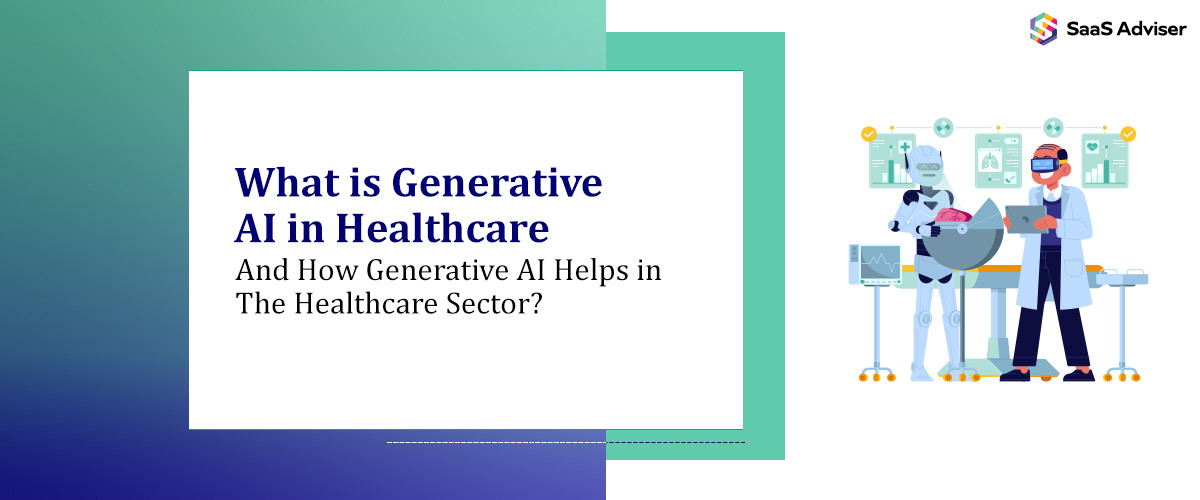
The incorporation of Generative AI in Healthcare is transforming the way we go about delivering patient care, diagnosing, and treatment. From enhancing medical documentation to assisting in drug discovery, generative models are revolutionizing one of the world's most essential industries. With ai application healthcare sector, professionals are seeing changes come into place on how data gets analyzed, decisions get made, and customized treatment plans get created.

Looking for Healthcare Software? Check out SaaS Advisor’s List of the Best Healthcare Software for Your Business.
Generative AI in healthcare examples is different from the conventional tools in the sense that it can possibly mimic biological systems, create synthetic data for research, and interpret medical images. The most effective applications of AI in healthcare are already being utilized in hospitals, research institutions, and pharma corporations.
What is Generative AI in Healthcare?
Generative AI healthcare is different from typical tools because it is able to simulate biological systems, create synthetic data for studies, and even read medical images. The most effective applications of ai use cases in healthcare are already being used in hospitals, research facilities, and generative AI in pharmaceutical companies.Teleradiology locum tenens staffing is also seeing the impact of AI, as it supports diagnostic imaging workflows and helps bridge staffing gaps in remote settings.
In healthcare, generative AI extends beyond automation. It makes it possible to develop solutions that conventional research methods would take years to develop. For example, AI is able to develop virtual copies of molecular structures (pharmaceutical discovery) or patient treatment pathways to accelerate target research processes.
How Generative AI Transforms the Healthcare Sector
Generative AI is more than just a tool—it's a transformational force. The introduction of intelligent processing within health care systems permits the acquisition of a new depth of precision, personalization, and efficiency.
-
Faster diagnosis. A.I. can analyze a wide array of complicated datasets and recommend faster and more accurate diagnostic options for clinicians, based on patient history, lab results, and interval and latest imaging scan outputs.
-
Cost Reduction by automating repetitive tasks such as documentation and record-keeping, hospitals save resources and focus more on patient care.
-
Better training outcomes are made possible for medical professionals by AI simulations for surgery, case option evaluation, diagnosis, and treatment planning, for instance, minimizing risks to actual patients.
-
AI used in healthcare allows for customized treatment and much more proactive monitoring, which results in more effective and/or efficient interventions (if possible) or in proper longer-term care strategies.
Applications of Generative AI in Healthcare
AI application in healthcare sector are transforming patient care and treatment. These are a few of the most significant uses of generative AI in healthcare that are currently underway.
Looking for Healthcare App Monetize? Check out SaaS Advisor’s How to Monetize a Healthcare App
1. Personalized Medicine
Generative AI contributes to the management of treatment plans based on an individual patient. By examining genetic material, lifestyle factors, and previous medical history, it is able to tailor treatments that will not only better facilitate treatment outcome but also improve tolerability through reduction of side effects.
2. Medical Education and Training
AI simulations enable medical students or physicians to simulate surgery and clinic procedures without endangering patients. With the creation of synthetic patients and scenarios, the platform provides unlimited learning opportunities.
3. Patient Education
Generative AI and healthcare are able to generate personalized educational materials for patients to comprehend their health problems. From charts and diagrams to chatbots and interactions, it increases access to medical knowledge.
4. Medical Diagnosis
The use of AI in conjunction with patient medical records and imaging is allowing AI to help the physician spot a disease earlier and with better accuracy. It is reducing the chances of being done incorrectly and limiting miscommunication in the decision process.
5. Radiology Impressions
AI systems that pull the structured radiology impressions straight from the original imaging scans. It saves radiologists time and makes reports more uniform and free of errors. This implies that new generative AI in medicine can be delivered to patients sooner, and new drugs are created even for uncommon diseases.
6. Treatment Plans
AI supports physicians in structuring treatment plans that adapt with the patient's status. It also reduces the chance of side effects, since nurses would understand what to do in an emergency. Generative AI is changing this by being a quiet aide while patients are seen.

Do You Know?
Mckinsey states that generative AI can save the U.S. and save the healthcare sector up to $360 billion every year through 2030.
AI Use Cases in the Healthcare Sector: From Diagnosis to Drug Discovery
1. Drug Development
Generative models simulate molecular structures and test their viability virtually, reducing drug development cycles from years to months. This accelerates the availability of new therapies.
2. Healthcare and AI
The data management created by clinical systems within hospitals is using AI to create better ways of recording data and processing clinical workflows and ultimately guiding the clinical decision process. This will ensure that clinicians are focusing more of their time on patients and less time on paperwork.
3. Robotic Surgery
Generative AI directs surgical robots towards planning. Doing the operation ahead of time makes the actual procedure on a patient's body safe and accurate. This results in better-trained and more confident future physicians.
4. Electronic Health Records (EHR)
AI automates the extraction and summarization of EHRs, turning unstructured data into actionable insights. This saves clinicians hours of manual work. Gen AI in healthcare can generate synthetic yet realistic data that mirrors real patient data, unlocking new possibilities for medical research.
5. Virtual Health Assistants
Artificial intelligence-enabled assistants aid patients by responding to health-related questions, monitoring signs, and organizing appointments. Experts can work without any restriction in innovating, and patient data security and privacy are not affected at all.
6. Remote Patient Monitoring
Wearable devices and generative artificial intelligence in healthcare models assist in monitoring patient vital signs in real-time and notifying physicians of possible health hazards for instant intervention. This allows for the experimentation of new medical interventions in a test environment to be quicker and more effective.
Looking for Artificial Intelligence Software? Check out SaaS Advisor’s List of the Best Artificial Intelligence Software for Your Business.
Real-World Examples of Generative AI in Healthcare
Ensora Health is an examples of ai in healthcare that utilizes generative AI to enhance patient engagement and care management. Their platform harnesses AI to provide patient insights, enhance communication, and assist in clinical decision-making.
1. Developing Drugs
The search for new medications is lengthy, expensive, and frequently unproductive. Generative AI is like having an army of super-smart, tireless scientists working in a virtual laboratory 24/7. Instead of spending years on trial and error, AI analyzes billions of data points to foresee how a molecule will behave when targeting a specific part of the human body.
2. Clinical Documentation
All physicians are aware that time spent typing out notes, refreshing records, or completing forms is time stolen from patients. It hears the doctor-patient discussion and knows the medical background to create clinical notes physicians can quickly glance through and approve. It also lowers the administrative work for doctors considerably, fights doctor burnout, and enables them to concentrate on what matters most—the patient.
3. Clinical Trials
Clinical trials are costly, and it is good luck to find a representative and diverse patient group. Generative AI healthcare enables scientists to create virtual groups of patients that reflect the variety and evolution of diseases within real-world environments. AI predicts outcomes and reduces the trial durations and costs while guaranteeing the drugs are effective for diverse populations.
4. Medical Imaging
Medical research and development are dependent upon massive imaging data sets, but using real patient images poses serious privacy issues. Generative AI addresses this issue by generating full synthetic, high-fidelity imaging data, like simulated X-rays and CT scans. This allows the AI models to be trained for future task uses (e.g., abnormality detection) without ever using the original patients' health data.
Pro Tip: While executing generative AI solutions in healthcare, it is very important to always guarantee that they are conforming to data privacy laws like HIPAA and GDPR for long-term success.
Benefits of generative AI in healthcare
The global healthcare market size for generative AI was worth USD 1.95 billion in the year 2024 and reached USD 2.64 billion in the year 2025 and is anticipated to be roughly USD 39.70 billion by 2034. 17% from 2024 to 2034.
1. Medical Education and Training:
Imagine a medical student studying for exams or a surgeon planning the steps in a complex procedure. Generative AI makes it possible to generate virtual patients and 3D models of internal organs for training. Students can train and hone their diagnostic and procedural abilities by working on cases that are rare or difficult to obtain in their training environments.
2. Synthetic Data Generation
Researchers then struggle with the problem of accessing enough data, specifically for uncommon conditions. This enables researchers to subject hypotheses, model disease development, and model clinical trials at a scale and pace that is impossible using real data alone. It protects patient confidentiality, which is to say that scientists in the field can collaborate more freely and get quicker answers.
3. Automating Administrative Tasks
The volume of paperwork and other administrative work that the generative ai for healthcare staff has to do is another cause of burnout. Generative AI does monotonous and repetitive work, such as billing and appointment scheduling. It leaves the doctors', nurses' and other staff's time free to interact with patients. The result is a more efficient healthcare system and a more human-centered experience for both providers and patients.
4. Personalized Treatment Plans
The traditional approach to medicine is on the way out. Generative AI can examine a patient's genetics, way of life, and other medical conditions in an effort to formulate closely customized treatment regimens. It decides what a person would react to a certain drug and can predict the optimal drug dosages and treatments.
5. Patient Empowerment
It is not simple attempting to chart something as complicated as your own health. It makes the patient better educated about their health and more empowered. By giving educational aids and support specific to the individual, it positions the patient at the center of their health experience. This improves the treatment efficacy with minimal side effects, i.e., improved patient outcomes.
6. Medical Research
From hypothesis to breakthroughs and discovery, medical research often has a tough road ahead. With more advanced experiments and testing, healthcare generative AI is able to drive product development much quicker than current practices. It can also direct human researchers to novel findings by identifying hidden patterns and connections that are not immediately evident.
Conclusion
A more intelligent, effective, and individualized medical future is being ushered in by the combination of generative AI use cases in healthcare. The options are endless, ranging from patient care to drug development. Better results and empowerment are what it means for patients. This results in less work and more efficiency for providers. Adoption of it will redefine medical practice in addition to improving diagnosis and treatment. Early adopters of these innovations will establish new benchmarks for healthcare around the world.
Yes. Pharma uses it to design drugs, run clinical trials, test efficacy, save costs, and reduce time to market.
When it comes to trends, here are some to note:Drug discovery driven by AI, synthetic data for research, smarter EHR and care, and patient-facing chatbot management solutions.
It enables person-centered care, earlier diagnosis, fewer errors, and real-time monitoring to influence patient outcomes.
All of the areas of drug development, clinical trials, drug imaging, and patient management systems are where Ensora Health has emerged as one of the leaders in this space.

.jpg "Benefits of Employee Scheduling Software for Modern Business in 2024")