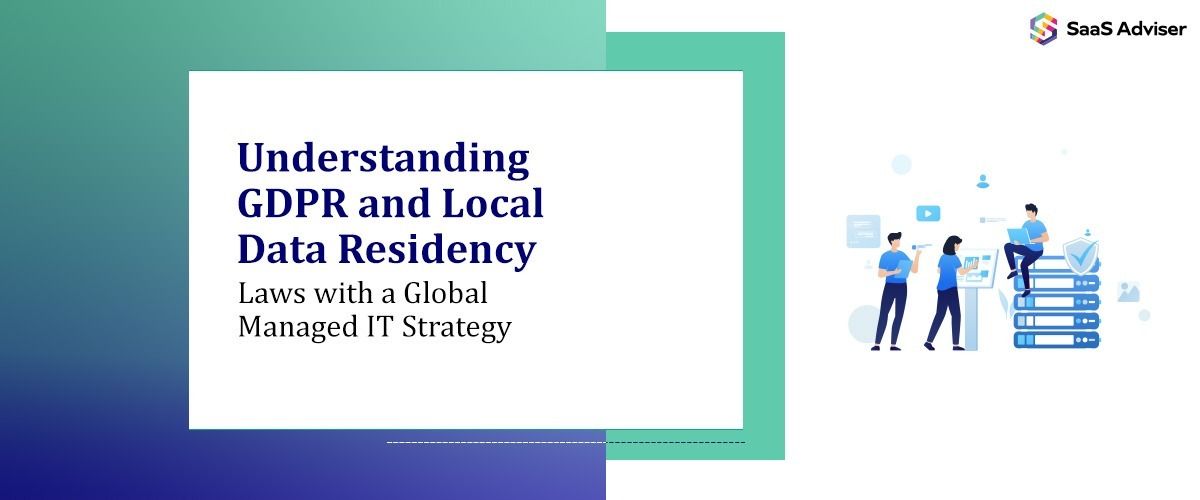
When a SaaS company begins to scale beyond its local borders, the complexity of its infrastructure doesn't just grow. It fractures. For founders, the promise of a global customer base is often tempered by the reality of the General Data Protection Regulation (GDPR) and the increasingly fragmented landscape of local data residency laws.
Navigating these waters requires more than just a legal consultant; it requires a robust technical strategy. A global Managed IT strategy ensures that your data isn't just secure, but also geographically compliant. This approach allows SaaS platforms to remain agile, avoiding the "compliance debt" that often sinks international expansion efforts.
Understanding the Trio: Residency, Sovereignty, and Localization
To build a global strategy, one must first distinguish between three often-confused concepts. Data Residency is the physical location where your data is stored. Data Sovereignty refers to the fact that data is subject to the laws of the country in which it is located. Finally, Data Localization is the most restrictive, requiring that data about a country’s citizens be processed and stored entirely within its borders.
The GDPR, while not strictly a localization law, imposes heavy requirements on "cross-border transfers." If you are a Virginia-based SaaS company and you're pulling data from a user in Berlin to a server in Ashburn without the proper safeguards (like Standard Contractual Clauses or the Data Privacy Framework), you are technically in violation. A Managed IT partner helps you architect "regional silos" or "sovereign clouds" to ensure that data stays where it legally belongs.
The Role of Architecture in Regulatory Compliance
Architecture is the silent partner of compliance. You cannot "policy" your way out of a data residency violation if your database is hard-wired to a single global region. A modern Managed IT strategy utilizes "Privacy by Design," where the infrastructure is built to detect the origin of a user and route their data to a compliant regional cluster automatically.
Managing this level of complexity, from geofencing to regional encryption key management, is a massive undertaking for an internal team. By having your IT support handled by Nortec, you gain access to engineers who understand the nuances of multi-region cloud deployments. This expertise allows you to implement "follow-the-sun" support models while maintaining strict logical and physical separation of sensitive data sets.
Why Multi-Region Infrastructure is No Longer Optional
In the early days of SaaS, a single AWS or Azure region was enough. Today, enterprise clients in regions like the EU, India, or Canada often won't even sign a Letter of Intent (LOI) unless you can guarantee that their data will never leave their jurisdiction. This has turned data residency into a competitive advantage.
Solving the "Latency vs. Law" Conflict
A global Managed IT strategy balances the need for speed with the requirements of the law. While you want your application to be fast, you cannot cache sensitive personal data in an "insecure" third-party country just to shave off 50 milliseconds of latency. Managed IT partners help you configure Content Delivery Networks (CDNs) and "Edge" computing to process non-sensitive data locally while keeping regulated personal information locked in compliant regional hubs.
Automated Data Mapping and Discovery
You cannot protect what you cannot find. Global compliance requires knowing exactly where every byte of EU resident data lives, whether it's in your primary production database, a backup snapshot, or a developer’s local environment. A Managed IT partner uses Data Security Posture Management (DSPM) tools to crawl your environment, identifying and tagging regulated data so it can be moved or secured before an auditor finds it. Hiring a privacy policy lawyer can ensure you have robust policies for your digital business to help protect its future.
The Shift from "Data Processor" to "Data Guardian"
Under GDPR, SaaS companies are typically viewed as "Data Processors," while their clients are the "Data Controllers." However, the burden of security and residency proof almost always falls on the processor. If a client faces an audit, they will turn to you for the documentation.
A Managed IT strategy centralizes this documentation. It provides a "Single Pane of Glass" where you can see the compliance status of your servers in London, Virginia, and Singapore simultaneously. This level of visibility is crucial for answering the "Security Questionnaires" that now dominate the enterprise sales cycle. It transforms your IT department from a cost center into a "Trust Center" that actively helps the sales team close deals.
Managing the Human Element: Access Control Across Borders
Compliance isn't just about where the servers are; it's about who can see the data. A major trap for global SaaS companies is "Administrative Access." If your support team in the U.S. can access the raw database of your EU clients, you may be performing a "virtual data transfer" under GDPR.
Managed IT partners implement "Zero Trust" architectures and Just-In-Time (JIT) access. This ensures that even your own employees only see the data they need to see, for a limited time, and from a verified, compliant device. They also manage the logging and auditing of this access, which is a mandatory requirement for nearly all global privacy frameworks.
Building Resilience with Compliant Backup Strategies
One of the most overlooked areas of data residency is the backup and disaster recovery (DR) plan. Many SaaS founders assume that if their production data is in Ireland, they are compliant. But if their backup service automatically replicates that data to a vault in the United States, they have inadvertently violated residency rules.
A global Managed IT strategy ensures that your DR plan is "region-aware." This means:
-
Regional Redundancy: Backups for EU users are stored in a secondary EU region (e.g., Frankfurt to Dublin) rather than crossing the Atlantic.
-
Encrypted Transmissions: All data moving between regions for administrative purposes is encrypted using keys that are managed within the home jurisdiction.
-
Tested Recovery: Regular "War Games" to ensure that if a region goes down, the recovery process doesn't accidentally trigger a non-compliant data migration.
Conclusion
The era of "one-size-fits-all" global IT is over. For a SaaS company to thrive in 2026, it must embrace the reality of a "Bordered Internet." Navigating GDPR and local residency laws isn't just about avoiding fines. It's about building a foundation of trust that allows you to sell to the world's most demanding clients.
By shifting to a global Managed IT strategy, founders can stop worrying about the "where" of their data and focus on the "what" of their product. When your infrastructure is built with compliance as a core feature rather than an afterthought, international expansion becomes a simple matter of turning on a new regional cluster. With the right architecture and the right partner, the complexities of global law become a ladder to your company's next stage of growth.