
What we'll cover
Share with your community!


Get Free Consultation


The Future of AI in Global Payroll Software: What Businesses Need to Know
 David N. Wilks
There’s a major change happening in the US payroll situation. Traditional methods are not sufficient as firms cope with complicated compliance standards, managing a cross-border workforce, and altering tax legislation. AI is no longer a future idea; it is actively transforming global payroll software. AI automates tiresome computations, predicts compliance issues, and provides real-time data insights to help American firms minimize costly human errors and grow abroad with confidence. Here’s what forward-thinking firms need to know to navigate this automated, compliance-first future of global worker remuneration.
What is AI Global Payroll Software, and why is it Useful in 2026?
It automatically calculates, manages, and distributes pay for your network of dispersed, global employees according to full legal requirements. These new solutions are not like the earlier batch processing and human spreadsheet systems; they are autonomous compliance co-pilots. They bring together time monitoring, multi-state tax reciprocity, local currency exchanges, and cross-border data limits into a single dashboard.
The program uses machine learning and predictive error detection to constantly check payroll inputs for data abnormalities and misclassifications, flagging errors before a single dollar is sent. For US companies growing abroad or managing remote personnel at home, this software has become an actual operational need, not just a competitive advantage. Manual “best efforts” are no longer accepted since regulators and tax authorities are now using sophisticated computerized screening techniques to discover real-time reporting problems.
The AI software updates programmatically to keep pace with evolving regulations to protect American businesses from expensive FLSA overtime penalties, complicated IRS categorization AI audit, and multi-state tax penalties. It also provides real-time workforce analytics that provide leadership teams the ability to estimate headcount expenses and anticipate cross-border spending, making payroll a major strategic control engine.
How is AI Global Payroll Software Transforming Payroll Management for Global Businesses?
1. Propelling Unprecedented Efficiency via Intelligent Automation
As autonomous payroll agents enter the global corporate landscape, they are fundamentally transforming how multinational corporations think about remuneration. Organizations may now move from strict legacy databases to a cloud-first payroll architecture, allowing cross-border labor management to be orchestrated from one place with a unified view. The new way of working means that instead of monthly payrolls with a delay, the payroll is run in real time, and the gross-to-net computation may be done instantly across countries and organizations. This means HR and finance are no longer bogged down with manual, repetitive data input and can focus on strategic growth and worldwide expansion.
2. Proactive Detection of Errors to Minimize Risks
For US-based companies venturing into worldwide expansion, compliance breaches can lead to significant financial and legal ramifications. AI-enabled solutions provide an always-on security layer, applying automated compliance intelligence to constantly watch-altering labor rules and tax legislation throughout the world. Using powerful predictive error detection, the system automatically reviews payroll runs to identify any data abnormalities and misclassifications ahead of cash disbursement. And it’s proactive, ensuring compliance with complicated requirements like changing FLSA overtime standards and multi-state tax reciprocity agreements, protecting firms from costly audits and fines.
3. Advancing Strategic Decision-Making and Analytics
Today’s payroll software is more than just a means to track operations; it’s a complex engine for corporate strategy. Business executives, by aggregating international data sources, may tap into holistic, real-time workforce analytics that give an instant view of overall global labor expenses. Decision-makers may rapidly evaluate the financial effect of expanding into new locations, compare country-specific benefit loads, and optimize departmental budgets. This transition changes payroll from a typically reactive back-office administrative expenditure to a forward-looking asset for business intelligence and data-driven growth.
What are the key Benefits of using AI Global Payroll Software?
1. Integrated Cross-Border Workforce Management
Traditionally, managing a dispersed multinational workforce means handling several local vendors, distinct financial systems, and varying pay intervals. These components are integrated into a unified cloud-first payroll architecture by AI-enabled systems, making cross-border labor management easier for US organizations. The solution deploys autonomous payroll agents that provide AI HR software teams one view of their worldwide operations, automatically calculating localized deductions, currency conversions, and foreign payments via a single interface.
2. Predictive Detection for Removal of Human Error
Manual spreadsheet reviews are infamous for overlooking tiny differences that lead to expensive fixes. AI software is a solution for this problem that regularly audits payroll inputs before any cash leaves business accounts through predictive mistake detection. The technology promptly highlights data abnormalities and misclassifications (such as irregular hours, multiple payments, or improper tax brackets) to ensure payroll is processed the first time correctly.
3. Ultra Precise Multi-State & Global Compliance
US companies are struggling with a tangle of local and foreign rules that shift without notice. AI global payroll software solutions include automatic compliance intelligence into the process that quickly adjusts to local labor regulations and FLSA overtime requirements. And for domestic remote workforces, the software easily handles the complexity of multi-state tax reciprocity, withholding the right state and local taxes depending just on where the person is working.
4. Continuous, Real-Time Payroll Processing
The old, high-stress “payroll week” is giving way to ongoing, real-time payroll processing. Rather than big batches at the conclusion of a pay cycle, AI infrastructure continually syncs time-tracking, cost, and bonus data. This always-on computation capability means finance teams can conduct off-cycle payments on the go, manage terminations seamlessly, and dramatically cut down the administrative bottleneck usually involved with closing out a pay period.
What trends are shaping the Future of AI Global Payroll Software in the US market?
1. Change to Continuous, On-Demand Processing
The conventional inflexible pay cycle is breaking down with a cloud-first payroll architecture, enabling real-time AI payroll processing across several geographies. It enables US companies to do continuous calculations and make quick, on-demand payments to international teams with zero admin hassle.
2. Active Prevention of Fraud & Risk Reduction
Top platforms are focusing on security using predictive error detection to check huge data sets in real time before the money leaves corporate accounts. This automatic supervision proactively identifies data irregularities and misclassifications that are frequently missed by standard manual audits.
3. Dynamic and hyper-local tax compliance
Automated compliance intelligence is moving to fully automate the navigation of complicated local and international tax webs. The program automatically adjusts to changing multi-state tax reciprocity agreements and tough FLSA overtime requirements throughout the US and internationally.
4. Decentralized Operations using AI Agents
Autonomous payroll agents are forcing organizations to reconsider how they manage complicated cross-border workforces. The intelligent agents can autonomously deal with local currency changes, banking rules, and variances in contracts.
5. Compensation Strategy Based on Data
Payroll is transitioning from a back-office cost to a primary company asset by providing comprehensive, real-time labor statistics. US leaders are harnessing these real-time data streams to anticipate the cost of foreign labor, plan their hiring budgets, and strategically grow their worldwide footprint.
What Challenges does AI Global Payroll Software solve for Multinational Companies?
1. Getting rid of international Compliance Nightmares
Multinational organizations sometimes have to deal with disparate local labor rules. But automated compliance intelligence takes care of these modifications automatically and smoothly. The program safeguards US enterprises from harsh legal fines by ensuring compliant usage of complicated standards such as the domestic FLSA overtime laws.
2. Eliminating Cross-Border Processing Delays
Traditional banking methods hold up foreign payments, but a cloud-first payroll architecture allows for real-time, continuous, and immediate payroll processing. This removes the traditional administrative barrier so autonomous payroll agents may simultaneously push localized cash to global teams.
3. Avoid Costly Human Mistakes and Audits
Manually crunching numbers can sometimes lead to data abnormalities and misclassifications that cause costly IRS or foreign audits. The program sidesteps this by conducting predictive error detection all the time, reporting differences in hours or tax brackets before any money is ever transferred.
How does AI Global Payroll Software enhance the Employee Experience in Payroll Management?
With a contemporary, cloud-first payroll infrastructure replacing inflexible legacy networks, US-based multinationals can now offer a smooth, frictionless compensation experience for their whole staff. Autonomous payroll agents make it possible to handle payroll in real time, taking the stress out of delayed foreign wire transfers or cut-off dates. The program continually calculates wages, deductions, and incentives in the background, giving employees on-demand access to extremely accurate pay stubs, clear localized currency translations, and fast off-cycle payments.
This kind of response establishes a deep organizational trust and does a lot to improve the overall job satisfaction over the whole gamut of cross-border workforce management.
Moreover, AI software is a direct safeguard for workers from the stress of tax and compensation issues sometimes caused by human error. Advanced predictive error detection allows the system to actively discover data irregularities and misclassifications before they ever hit a worker’s paycheck.
The platform seamlessly handles complicated multi-state tax reciprocity agreements and assures consistency with FLSA overtime standards and automated compliance intelligence for remote and mobile personnel traveling across many jurisdictions. Employees can be certain that there will be no retroactive tax adjustments or unpaid overtime. And management can leverage real-time AI workforce planning analytics to guarantee fair, accurate, and timely compensation throughout the global enterprise.
What should Businesses consider when adopting AI Global Payroll Software?
1. Resilience of Automated Compliance Intelligence
US companies need a platform with dynamic, automatic compliance information that changes at the speed of business. The program must react automatically to changing international labor regulations and domestic FLSA overtime standards to save your organization from harsh regulatory fines.
2. Cloud-First Integration with Payroll Infrastructure
Evaluate how easy the solution can connect with your existing tech stacks numerous times before adopting it. A real cloud-first payroll infrastructure must be easily integrated with your existing HRIS and time-tracking solutions to offer unified, seamless cross-border workforce management.
3. Real-time Payroll Processing Capability
Check if the platform allows continuous calculation versus standard batch runs. With a system that supports real-time payroll processing, foreign wire transfers, off-cycle payments, final paychecks are processed immediately and without processing delays.
4. Accuracy of Detection of Prediction Error
Look for AI and machine learning algorithms that provide proactive security. The platform has to leverage predictive error detection to constantly scan datasets, discovering data abnormalities and misclassifications in hours, rates, or tax brackets before funds leave business accounts.
5. Multi-State Tax Reciprocity Process
For organizations with remote workers across the United States, the software must be very skilled in domestic tax subtleties. Make sure the system can automatically sort out multi-state tax reciprocity agreements so withholding taxes are properly matched to exactly where each employee logs in.
6. Workforce Analytics Depth in Real-Time
How the tool turns raw pay data into actionable corporate strategy. In addition, the platform must offer complete real-time workforce analytics and deploy autonomous payroll agents, so executives have quick access to full global labor responsibilities and forecasting models.
Conclusion
The future of global payroll is undoubtedly autonomous, and US companies must change to remain competitive. By adopting AI-driven solutions, organizations may easily shift to a borderless operating model where regulatory penalties, computation delays, and cross-border payment frictions are a thing of the past. It’s about finding the correct, specialized tools for your unique organizational footprint in a quickly expanding technological ecosystem.” In today’s era, platforms such as softwareadviser.ai prove to be an essential tool for the leadership team. Such platforms provide a one-stop SaaS marketplace for enterprises to find, compare, and purchase the best AI-powered payroll software to ensure the future readiness of multinational labor management.
FAQ's
AI shifts payroll from manual data entry to an autonomous system, instantly adapting to real-time international tax changes and detecting cross-border compliance anomalies before they happen.
No, AI will act as a co-pilot that eliminates repetitive processing, allowing human teams to focus on strategic workforce planning and high-level problem solving.
It continuously monitors global labor laws and tax regulations, automatically updating local payroll calculations to prevent costly compliance penalties.
Yes, machine learning algorithms analyze historical patterns to flag unusual transactions, preventing data entry mistakes and detecting potential internal fraud in real time.
Companies should prioritize platforms with robust data privacy certifications, seamless integration with existing HR systems, and proven predictive analytics for global labor costs.
Sales teams across the US are under more pressure than ever, and the tools most of them rely on were simply not designed for what the market demands t [...]
David N. Wilks
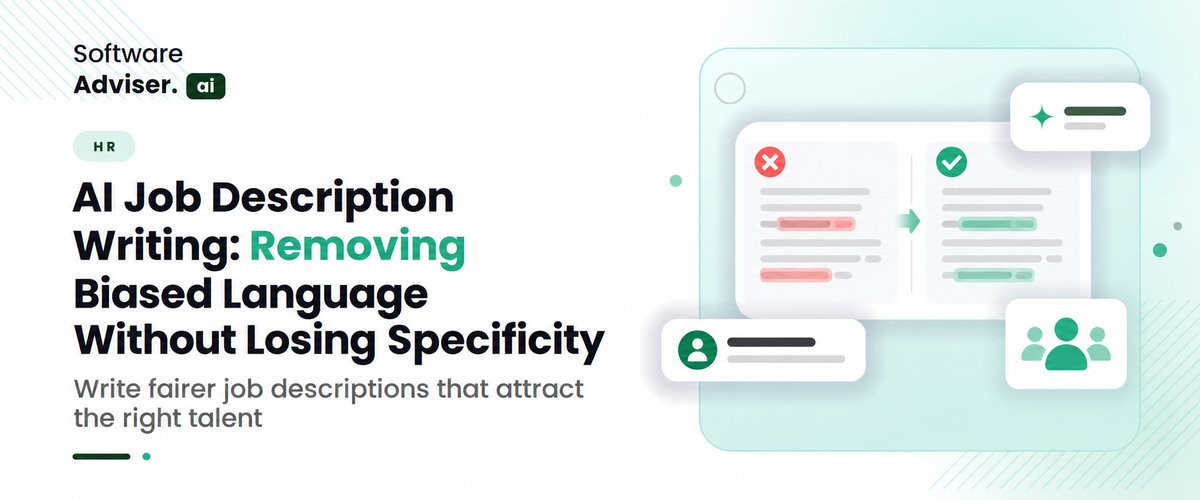
Creating job descriptions in the US labor market is a process that tries to match the stringent technical requirements with non-discriminatory terms. [...]

Dokas mile
In the current rapidly developing digital world, it is not sufficient for traditional file cabinets and cluttered cloud folders to provide what busine [...]