
What we'll cover
Share with your community!


Get Free Consultation
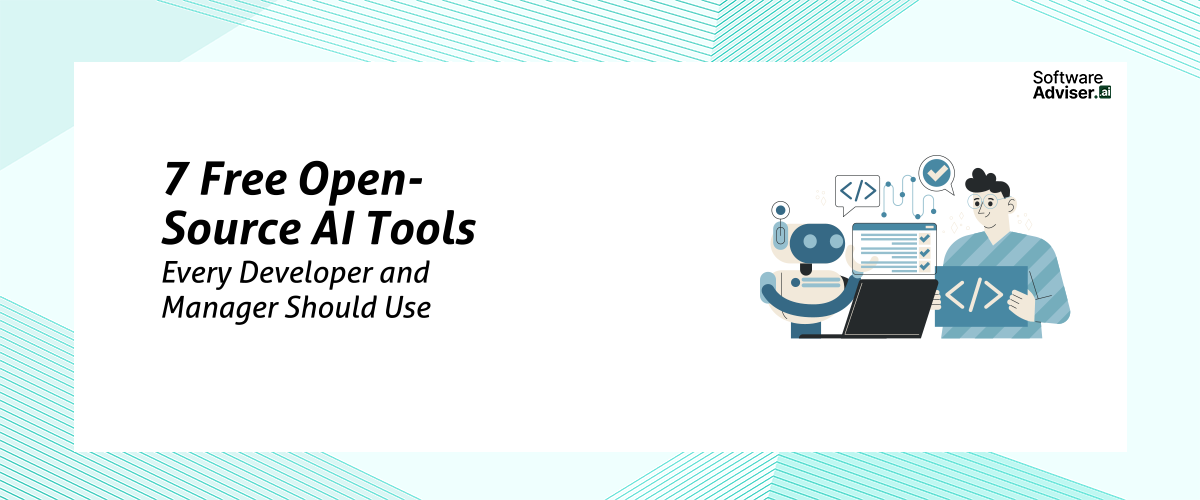
7 Free Open-Source AI Tools Every Developer and Manager Should Use
 Dokas mile
Modern business environments demand fast automation, smart data processing, and highly secure digital structures. Relying entirely on costly public cloud systems can drain tech budgets and introduce massive data recovery and security liabilities. Implementing reliable AI Tools locally or on private cloud servers has become a necessity for technical leads and product managers. These flexible software packages help software teams write scripts, handle massive documents, and design custom workflows without paying expensive recurring subscription fees.
 Looking for AI Open Source Tool? Check out SaaS Advisor’s List of the Best AI Open Source Tools in USA for Your Business
 By shifting toward local and community-maintained code, organizations maintain strict ownership over their customer records and technical architectures. This detailed guide explores how using open frameworks streamlines corporate production while cutting down software upkeep costs significantly. The following analysis breaks down seven prominent choices available for technical teams and operations managers.
Why Businesses Are Adopting Open-Source AI
Organizations worldwide are transitioning away from proprietary software systems toward community-governed alternatives. The pressure to innovate rapidly requires frameworks that provide immediate utility without restrictive commercial terms or unexpected API price shifts. The choice to deploy community-driven solutions rests on four fundamental corporate advantages that protect intellectual property and lower administrative friction.
1. Lower costs
Running proprietary model APIs creates unpredictable monthly expenses that scale rapidly with user volume. When a development team tests complex scripts or processes large data batches, the token costs accumulate fast. Deploying cost-free alternative software cuts out user-based licensing fees completely. This financial crm relief lets companies scale their internal experimentation pipelines and roll out automated customer bots across different departments without inflating the corporate technology budget.
2. Data privacy
Pasting sensitive client documents, internal financial spreadsheets, or proprietary source code into external cloud-hosted portals creates an immediate data leakage vulnerability. Security teams must ensure that business records do not leave local hardware boundaries. Utilizing self-hosted model engines guarantees that every single text string remains contained within private company walls. This strict containment helps corporations meet tough global compliance guidelines and protects corporate trade secrets from external processing platforms.
3. Full customization
Proprietary models function as sealed black boxes, leaving engineers with no power to tweak the underlying model parameters, edit system weights, or adjust internal logic structures. Open-source frameworks grant developers full access to the underlying code environment. The technical teams were then able to re-adjust specific models using internal company knowledge sources, redefine the responses of the API (application programming interface), and delete default format margins to bring out outputs that were as close to their corporate design as it could get.
4. Self-hosting
Your stack is hostage to your external vendors If they suffer unexpected network downtime and you go offline with them, you can also do that to your company if their TOS contract has them doing things differently, or network configuration has you up depending on what they do. If you host it on your on-site (private) infra, then it’s up to people.
Organizations can host their systems on internal office workstations, dedicated regional servers, or private virtual clouds, ensuring that critical automated business services remain available around the clock regardless of external network issues.
Best Free Open-Source AI Tools
The test, then, involves the best practice – evaluate how seamlessly a tool plugs into a development process you already use and a team that’s able to effectively leverage its features. Your platform of choice should find the delicate sweet spot between quick setup by a software engineer and ease-of-use by a product manager. The following seven platforms represent highly capable, cost-free packages tailored for modern software engineering and business workflow optimization.
1.Ollama
Ollama is a lightweight, efficient engine designed to package, deploy, and run large language models locally on your private computer. It wraps complex model operations into clean, Docker-like terminal commands, eliminating the need to set up complex runtime dependencies or manage individual model weights manually.
- Key Features
- One-command installation for major operating systems.
- Native GPU acceleration across different hardware configurations.
- Local REST API endpoints that match standard industry web pathways.
- Automatic memory management that unloads files from VRAM after use.
- Pros
- Highly accessible for terminal-based setups and scripting.
- Wide selection of pre-compiled model weights available instantly.
- Cons
- Lacks a built-in graphical user interface for non-technical users.
- Consumes high amounts of local RAM and processing power during heavy tasks.
- Best Use Cases
- Running offline coding assistants directly on developer laptops.
2. Open WebUI
Open WebUI is a feature-rich, user-friendly frontend dashboard designed to act as an offline alternative to popular cloud chat interfaces. It connects natively with local engines like Ollama, giving corporate teams a unified graphical portal to interact with different models, manage chat histories, and parse large documents smoothly.
- Key Features
- Sleek visual chat layout with comprehensive multi-user login support.
- Direct integration with multiple local and cloud model engines.
- Built-in retrieval mechanics that extract information from uploaded PDFs.
- Custom prompt engineering dashboards to share templates across teams.
- Pros
- Extremely simple for non-technical office staff to navigate.
- Supports secure, multi-tenant instances on corporate networks.
- Cons
- Requires a separate background engine to process model queries.
- Can be resource-heavy when processing extensive document folders.
- Best Use Cases
- Deploying a secure, internal company chat hub for research tasks.
3. Flowise AI
Flowise AI is a visual, low-code interface designed to build complex multi-agent reasoning paths and retrieval-augmented generation pipelines. Users drag and drop visual blocks onto a central canvas to link vector databases, prompt memory chains, and chat engines together without writing long Python scripts.
- Key Features
- Drag-and-drop canvas for structural node wiring.
- Direct connectors for major enterprise applications and memory stores.
- Built-in tools to embed chat interfaces onto live company websites.
- Visual debugging tool to trace exactly where a text flow fails.
- Pros
- Shortens the time required to prototype complex automated agents.
- Large library of pre-built operational templates ready for deployment.
- Cons
- Managing massive enterprise graphs can become visually cluttered.
- Certain deep customizations still require an understanding of JavaScript nodes.
- Best Use Cases
- Automating client email triage and drafting responses using internal guides.
4.Langflow
Langflow is a robust, canvas-based developer framework built specifically for prototyping and testing agentic software setups. It focuses heavily on deep Python compatibility, giving engineering groups granular control over prompt behaviors, vector indexing mechanisms, and sequential automation tasks.
- Key Features
- Interactive drag-and-drop development canvas with clean component grouping.
- Native parsing mechanics for structured file uploads and data feeds.
- Real-time testing console to verify component responses instantly.
- Simple export options to save workflows as raw configuration files.
- Pros
- Excellent for developers who want to bridge visual prototyping with Python code.
- High structural clarity for complicated data parsing routines.
- Cons
- Steeper learning curve for teams without basic programming knowledge.
- Documentation can sometimes lag behind the rapid pace of open source updates.
- Best Use Cases
- Building advanced database search pipelines for internal software.
5. LiteLLM
LiteLLM is a highly practical, code-focused proxy server that unifies multiple cloud and local API endpoints into one standardized interface. Instead of writing distinct connection logic for every model provider, software engineers route all requests through LiteLLM using a single, uniform layout.
- Key Features
- Standardizes multiple third-party API outputs into one predictable format.
- Built-in user authentication keys and precise token usage tracking.
- Automatic fallbacks to ensure alternative models activate if a server drops.
- Detailed spending monitors to keep track of computing costs.
- Pros
- Cuts down hundreds of lines of messy connection code in software projects.
- Simplifies the process of swapping underlying model backends.
- Cons
- Contains no visual interface, operating strictly as a background service.
- Requires continuous maintenance to stay aligned with external API updates.
- Best Use Cases
- Managing application model access across large engineering departments.
6. AnythingLLM
AnythingLLM is an all-in-one desktop application designed to turn raw documents, folders, and website links into private, secure knowledge bases. It includes its own internal vector database and text embedding layers, letting corporate teams search across internal company assets with complete offline security.
- Key Features
- Desktop application with simple workspace organization tools.
- Built-in file parsing layers that digest text documents and spreadsheets.
- Flexible user settings to pick between local, private, or cloud models.
- High-speed vector storage built straight into the main application.
- Pros
- Eliminates the complex chore of configuring separate database tools.
- Strong workspace barriers to separate different company projects safely.
- Cons
- Desktop installation limits central sharing options unless self-hosted on a server.
- Processing heavy data batches can temporarily lock up standard office laptops.
- Best Use Cases
- Creating a secure, private document search engine for company policies.
7. n8n AI
n8n AI is an advanced, fair-code workflow automation tool that lets corporations link their business tools together through node-based logic. By adding smart nodes into standard automation paths, users can design intelligent sequences that extract data, sort records, and update company tools dynamically.
- Key Features
- Visual node constructor with hundreds of pre-built business app connectors.
- Advanced logic paths, loop mechanisms, and data structure adjusters.
- Native webhooks to trigger automation sequences based on real-time events.
- Specialized agent nodes to insert decision-making steps inside paths.
- Pros
- Connects standard company tools like spreadsheets directly to smart models.
- Highly stable environment suitable for complex, daily production lines.
- Cons
- Advanced multi-step structures require an understanding of JSON Web Objects.
- Hosting the platform independently requires basic database management knowledge.
- Best Use Cases
- Automating daily business pipelines like lead scoring and CRM updates.
Open-Source vs Paid AI Tools
Choosing between community-maintained software and paid commercial software-as-a-service models involves weighing long-term maintenance duties against upfront subscription fees. Paid enterprise options provide immediate convenience, offering hosted setups, customer help desks, and polished user systems on day one. However, these systems lock a firm into fixed operational boundaries, where user fees escalate quickly, and data privacy remains tethered to third-party corporate privacy compliance statements.
Community-led AI Tools eliminate upfront seat licensing fees, giving organizations the freedom to test expansive automation lines without checking usage bills. More importantly, the ability to view the exact codebase means internal security heads can run thorough security audits before deploying software into production pipelines. The trade-off shifts from financial costs to internal human resource needs. Running free open software successfully requires internal tech teams to handle basic server configurations, process data updates, and keep up with regular security patches.
Deployment Best Practices
Successfully integrating open-source frameworks into an enterprise technology environment requires following systematic data safety rules. A major blunder is connecting live customer databases directly to a newly launched visual dashboard without setting up strict user walls first. Technical leads must isolate testing platforms inside secure staging networks, verify performance using synthetic or public files, and log model outcomes carefully before expanding access to wider corporate departments.
Another critical step involves managing API keys and system credentials safely. Rather than hard-coding sensitive access keys directly inside application files, teams should leverage secure environment variables or central password lockers. Furthermore, when deploying multi-agent logic chains, supervisors must set narrow reading boundaries and limit what files an automated tool can alter, preventing recursive loops or unintentional record modifications across your business infrastructure.
Conclusion
Transitioning to open-source AI Tools allows modern corporations to scale their automated systems while protecting core data assets and technical budgets. Prioritizing flexible frameworks like Ollama, Flowise AI, and n8n AI helps business leaders establish a resilient software ecosystem that drives long-term operational speed. Selecting the correct combination of visual builders and backend proxies removes traditional development bottlenecks, giving teams the freedom to iterate on complex pipelines without worrying about expensive commercial software fees.
FAQ's
Open-source AI tools are AI software with publicly available source code that users can modify and self-host.
They help reduce costs, improve data privacy, and offer greater customization.
Most open-source AI tools are free, though hosting and maintenance may require resources.
Ollama is one of the most popular tools for running large language models locally.
Yes, tools like Open WebUI and Flowise AI provide user-friendly visual interfaces.
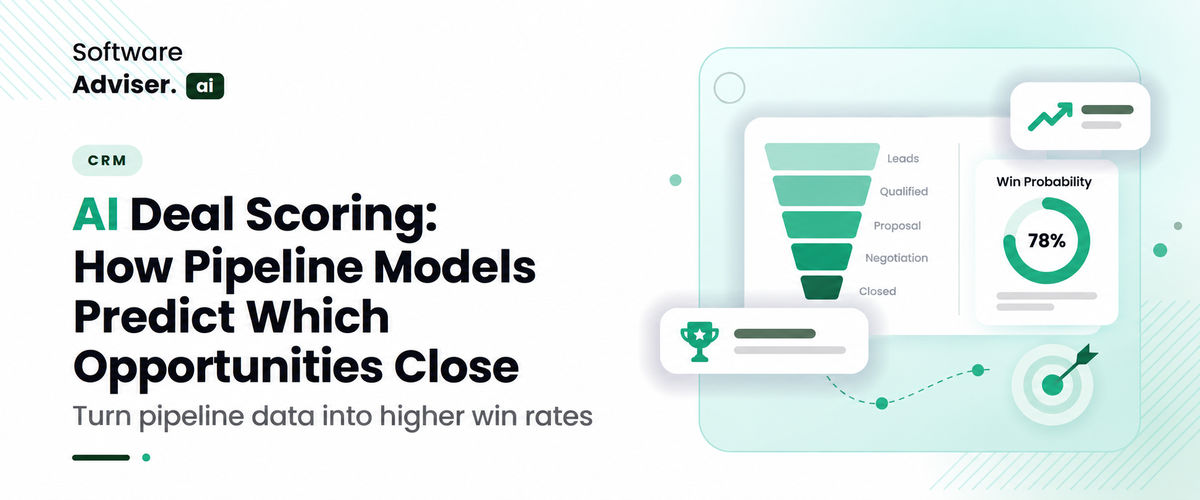
In an environment fraught with uncertainty like the US B2B market, the practice of relying on subjective estimates made by reps and the impossibly lar [...]
Dokas mile
Employee referrals are sort of seen as the holy grail of recruitment, because they always bring in strong quality candidates who stick around longer a [...]
Dokas mile

AI-driven email marketing software has disrupted the conventional approach of repeating messaging by making it much more personal through smart predic [...]