
What we'll cover
Share with your community!


Get Free Consultation

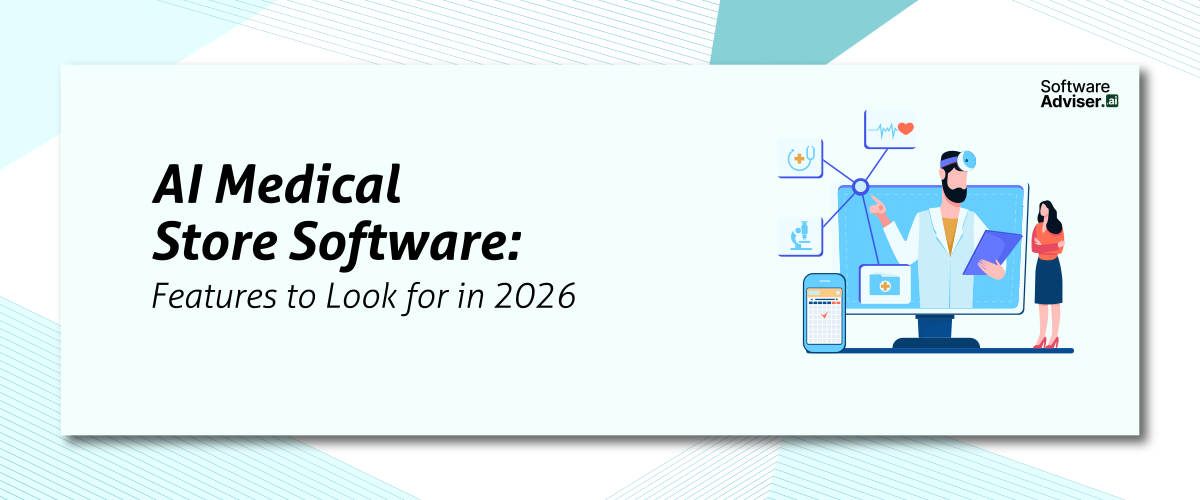
AI Medical Store Software: Features to Look for in 2026
 David N. Wilks
The U.S. healthcare market is fiercely competitive nowadays for the owners of a pharmacy or a medical supply business. Independent businesses are caught up in shifting insurance reimbursement schemes, tight DEA tracking requirements, and increasing patient demands for home delivery. Those days of modern software being used only to scan barcodes are long gone; it’s now your principal weapon against operational exhaustion. The correct platform uses secure AI in 2026 to detect supply shortages, automate complicated medical billing, and improve compliance. Here are the non-negotiable characteristics required to maintain your shop lucrative and compliant.
What is AI Medical Store Software and why does it matter in 2026?
AI medical store software is a medical shop and pharmacy management software that employs artificial intelligence to handle everyday operations. For independent pharmacists and durable medical equipment (DME) suppliers across the United States, this software is the primary nervous system of the firm. These are far more than old-school point-of-sale systems that bring together predictive inventory control, automated medical billing, real-time insurance verification, and tight regulatory compliance tracking (think DEA requirements for controlled substances or Drug Supply Chain Security Act (DSCSA) tracing) in a single dashboard.
By 2026, technology by 2026 is not a luxury; it will be a matter of life and death. Today’s US pharmacies are operating with razor-thin margins amid uncertain insurance reimbursement fluctuations, rigorous Pharmacy Benefit Manager (PBM) audits, and acute labor shortages. AI software can ease these demands by AI workflow automation monotonous, error-prone operations. It can detect medicine shortages before they occur, identify billing problems that might lead to insurance denials, and handle regular patient communication for prescription refills. This ultimately sustains the profitability of independent medical businesses and enables personnel to focus on direct patient care.
How does AI Medical Store Software Actually Work behind the scenes?
AI medical store software works as a highly secure, smart engine that continuously pulls together and analyses data from numerous healthcare touchpoints. It links directly to electronic health record (EHR) systems, e-prescribing networks, insurance clearinghouses, and the largest drug wholesalers. When a prescription or medical supply order hits the system, the AI instantly scans the data using natural language processing (NLP) to verify proper dosages, drug interactions, and patient history, all while simultaneously checking the patient's insurance formulary in the background for potential real-time coverage or prior authorization roadblocks.
On the inventory and supply chain side, the program goes from reactive ordering to predictive forecasting. Instead of waiting for a shelf to become empty, the AI looks at past sales trends, seasonal disease spikes (such as local flu or allergy surges), and macroeconomic medicine shortage data. It then automatically determines the ideal stock levels and creates purchase orders for the wholesalers. The program automatically scans and logs the 2D data matrix barcodes on incoming shipments, verifying the product’s complete chain of custody without manual data entry as required by US rules requiring stringent tracking under the Drug Supply Chain Security Act (DSCSA).
On the financial and administrative side, the AI also serves as an automated AI billing and invoicing software expert. When a claim is ready for submission, the software employs machine learning algorithms to audit the claim against hundreds of ever-changing payer criteria and ICD-10/HCPCS coding requirements. It greatly eliminates expensive insurance rejections and Pharmacy Benefit Manager (PBM) audit risks by identifying typos, missing modifiers, or inaccurate National Drug Codes (NDCs) before submission. Basically, it’s a very smart invisible helper who keeps the shop on the right side of the law, well stocked, and making money.
What are the Top Features of AI Medical Store Software to look for?
1. Demand Forecast
AI algorithms may accurately forecast when to resupply based on prior sales trends and local health epidemics. And it means high-demand pharmaceuticals may be made available without locking up funds in dead inventories.
2. Automated Pre-Authorization & Billing
The technology automatically collects clinical data and pre-verifies claims based on ever-changing insurance requirements. This identifies coding errors as they happen, reducing audit risks and costly payment denials.
3. DSCSA & DEA Compliance Automation
The technology tracks the chain of custody for each drug to the individual serial number through automated scanning. This means you can create audit-ready compliance records fully hands-free, keeping your shop protected.
4. AI-Powered Clinical Safety Audits
An integrated AI cross-checks patient records in real-time when medications are filled and flags harmful drug-to-drug interactions or improper doses. This lowers human mistakes tremendously before a bottle even reaches the counter.
5. Tools for Patient Compliance – Conversational
Smart virtual assistants SMS or contact patients instantly with individualized reminders to refill and schedule pickup. This promotes prescription adherence and shop income, without putting your frontline personnel out of pocket.
What benefits does AI Medical Store Software bring to your Pharmacy?
Using AI medical store software will take your firm from a defensive stance to an attacking one, safeguarding your bottom line from the structural stresses of current US healthcare. There are a few different financial and operational benefits for an independent pharmacy to implement this technology:
1. Immediate Overhead Reduction & Time Saving
It handles the boring, repetitive chores for you, such as manual purchase order entry, invoice tracking via automatic OCR (Optical Character Recognition) scanning, and routine refill outreach, saving your employees about two hours a day. This directly reduces personnel expenses and enables a lean staff to handle large prescription volumes without burnout.
Less Cash Tied Up in Inventory
The software’s predictive analytics uses local historical demand and real-time public health data to align your shelves, not guessing. Pharmacies also see up to 30% less loss from expired medicine and far fewer emergency stockouts of fast-moving, high-margin maintenance meds.
2. Audit-proof your Revenue Streams
The AI serves as a silent compliance officer, continually cross-checking National Drug Codes (NDCs) and validating digital 2D barcodes to meet stringent DSCSA tracking requirements. It prevents costly invoice rejections at the source by pre-auditing claims against evolving PBM (Pharmacy Benefit Manager) standards before submission, mitigating damaging clawbacks.
3. Clinical Error Rates Greatly Reduced
Immediate boost to patient safety. The program delivers dynamic, real-time clinical decision assistance by doing background safety evaluations on each e-prescription. It analyzes doses against patient health histories and complicated drug-to-drug interactions, intercepting high-risk supervision mistakes before a prescription is ever delivered.
How can AI Medical Store Software help with Inventory and Prescription Tracking?
1. Smart Inventory: No stockouts, no dead capital
Traditional inventory is based on hard minimum/maximum reorder points. AI substitutes this with predictive demand forecasting that includes prior dispensing patterns, localized seasonal health trends (e.g., a rise in respiratory diseases), and macroeconomic medication shortage data.
- Automated Procurement: Rather than a technician spending hours checking inventories, the AI determines ideal order amounts and automatically places buy orders to your principal and secondary wholesalers.
- Waste and Expiry Prevention: The system records drug expiry dates to the batch level. Proactively identifies slow-moving products months before expiry so you can start returning or transferring them to high-demand areas. Reduces dead stock by 17-30%.
- DSCSA Chain of Custody: Comply with rigorous Drug Supply Chain Security Act (DSCSA) standards by having the AI read 2D data matrix barcodes on receipt, quickly confirming the serial number and storing the whole transaction history, no human spreadsheet entry.
2. Prescription Tracking: Streamlining the Dispensing Workflow
It’s not simply a matter of locating a bottle on a counter. Tracking prescriptions is about monitoring the full lifespan of a script, from the doctor’s e-prescription to the patient’s hands.
- Instant Clinical Safety Audits: When an electronic prescription comes into your queue, the AI becomes a secondary clinical reviewer. It rapidly cross-checks the patient’s longitudinal electronic health record (EHR) to find harmful drug-to-drug interactions, improper dosage frequencies, or concealed duplicate treatments.
- Proactive PBM & Prior Authorization Guardrails: The program examines live insurance formulary regulations and Pharmacy Benefit Manager (PBM) rules. This means that the AI may instantly begin the paperwork process if the prescription requires noticing champions prior permission, rather than waiting for a denial at the checkout counter.
- Smart Lifecycle Logging: Localized barcode scanning or RFID tracks every touchpoint, whether filling, labeling, pharmacist verification, or staging. If a patient calls asking for their medicine, staff may quickly see its exact position in the workflow.
Who are the Top US Companies Providing AI Medical Store Software?
1. Rx30 (Results)
Rx30 is the heritage US pharmacy management system created from the ground up for independent, specialty, and multi-location community pharmacies that have to manage the intricacies of American healthcare.
- Pros: Deep native connectivity with the US Surescripts e-prescribing network, real-time claims adjudication with major PBMs, and a powerful Virtual Pharmacist workflow that automates refills and billing to insurance hands-free.
- Cons: It’s built on a legacy code base that sometimes seems archaic, customer support wait times are a common pain point for busy shops, and complicated add-on modules quickly add to the monthly bill.
2. Alternative to Gofrugal on the Market: PioneerRx
Gofrugal is a worldwide retail software vendor with good pharmacy solutions, independent US pharmacies wanting a hefty dose of clinical AI often go to PioneerRx as their gold standard.
- Pros: Best-in-class clinical AI integration with quick alerts for complicated drug-drug interactions, highly flexible workflow built for current healthcare services (immunizations, MTM, etc), and an immensely active peer-to-peer user community.
- Cons: The learning curve for new technicians is quite steep, hardware requirements are inflexible, and the data migration procedure from outdated systems can be rocky initially.
3. BestRx (Alternative to Visual Chemist)
Visual Chemist is a specialized niche product, but for independent pharmacies that need a full-featured, highly responsive US solution, BestRx leads the small-to-medium pharmacy industry.
- Pros: Most praised in the market for the fastest and most accessible US-based customer assistance, a very easy and clean interface, and perfectly built-in DSCSA barcode compliance tracking capabilities.
- Cons: Not as robust as rivals in terms of trying to expand 10+ multi-state locations. Custom report construction can be difficult. Doesn’t have some of the hyper-advanced compounding features.
4. Ecogreen (by C-Square/Reliance)
Ecogreen is a huge enterprise-level retail pharmacy chain ERP developed internationally. It is widely used for big multi-outlet networks, especially in foreign markets and major medical distribution centers.
- Pros: Great powerhouse for centralized master data control, multi-warehouse administration, sophisticated inter-branch stock transfers, and automated tender/proposal monitoring for major medical accounts.
- Cons: Not natively constructed out of the box for US insurance processes, no direct built-in Medicare/PBM adjudication modules, and can feel unnecessarily complex for a typical American neighborhood pharmacy.
Is AI Medical Store Software worth the investment for small pharmacies?
CVS and Walgreens have large business infrastructures to absorb financial shocks. And neither do small independent pharmacies. A negative Pharmacy Benefit Manager (PBM) audit or a few thousand dollars in expired specialty drugs may really hurt a small store’s monthly cash flow.
AI software is a great equaliser. It provides a single-location store with the same data analytics capacity, buying optimization, and automatic compliance tracking (such as complete DSCSA serial number tracing) as a huge national chain, without the necessity of a corporate IT staff.
If you are suffering from administrative fatigue, uncertain DIR costs (Direct and Indirect Remuneration), or cash caught up in dusty inventory, the software is not an expense – it is a financial shield. Most independent pharmacies make back the cost of their software investment within 4 to 6 months of implementation.
How do you choose the Right AI Medical Store Software for your Store?
Choosing the appropriate AI medical store software isn’t just about selecting a platform packed with the latest technological buzzwords; it’s about finding a system that integrates smoothly into your unique workflow and secures your pharmacy’s financial health.
If you're considering your alternatives for your store, consider these five important criteria:
- The Definitive Software Selection Checklist: PBM & Insurance Guardrail Accuracy Confirm that the program has a proven, real-time AI engine that pre-audits claims against changing Pharmacy Benefit Manager (PBM) guidelines. The system should flag missing modifiers, inaccurate National Drug Codes (NDCs), and spelling mistakes before submission to avoid costly audit clawbacks.
- Deep Wholesaler and EHR Integration: Your software shouldn’t be an island. It has to integrate with the major electronic health record (EHR) networks, e-prescribing systems (such as Surescripts), and your primary and secondary drug wholesalers. Now you can have automatic, hands-free computerized buying and inventory synchronization.
- Seamless Legacy Data Migration: Moving from an outdated POS or pharmacy management system may be a headache if done incorrectly. Select a provider who offers focused, hands-on help to securely clean and move your previous patient profiles, prescription histories, and existing stock numbers without operational disruption.
- Turnkey DEA & DSCSA Compliance: With the Drug Supply Chain Security Act (DSCSA) electronic tracking rules in full force, human data entry represents a huge compliance risk. The technology has 2D data matrix barcode scanning, which automatically records the whole chain of custody for a drug and creates audit-ready logs.
- User-Friendly Interface for Your Team: The world's most powerful AI is useless if your technicians and pharmacists find it too complex to navigate in a hurry. Focus on software that is intuitive, clean, mobile-friendly, with few clicks per transaction, and low learning curves for new employees.
Conclusion
To secure your pharmacy against razor-thin margins and the tight US compliance rules, there's no other choice except to embrace AI medical store software in 2026. Upgrading your IT stack saves your firm, reduces worker fatigue, and smoothens everyday operations. Ready to transform your business into a highly efficient, automated healthcare hub? softwareadviser.ai Being a leading SaaS marketplace makes it easy to compare best-in-class solutions. Browse your selections smoothly, weigh up the matching characteristics of vendors, and safely close your transaction to find the best fit for your pharmacy.
FAQ's
Unlike basic point-of-sale systems that simply scan barcodes, 2026 software uses proactive AI to predict drug shortages, automate insurance claims, and track federal compliance completely hands-free.
The built-in AI acts as a pre-submission editor, instantly checking prescriptions for coding errors, missing modifiers, or incorrect data before they are sent to Pharmacy Benefit Managers (PBMs).
Yes, the platform automatically scans 2D data matrix barcodes on incoming shipments to authenticate and log a medication's entire chain of custody without manual data entry.
No, top-tier vendors provide dedicated migration support that cleans, formats, and transfers your historical patient profiles and stock numbers safely in the background.
Absolutely, because it lowers overhead costs, cuts expired inventory waste, and eliminates claim rejections, allowing small stores to see a total return on investment within four to six months.
The restaurant point-of-sale (POS) system is no longer merely a digital cash register; as of 2026, it has become the main controlling system for moder [...]

Dokas mile
We have passed over the threshold into AI driven IT project management changing the way technical teams ship software and manage infrastructure, movin [...]
David N. Wilks
Remote checks usually follow a set schedule, like one call per hour. For IT teams and outside vendors, those repeated status pings can end up looking [...]