(1) (1).jpg)
SaaS services are here to stay. They are just too convenient and flexible to let go of. Today, SaaS platforms empower businesses to deliver enhanced services and products.
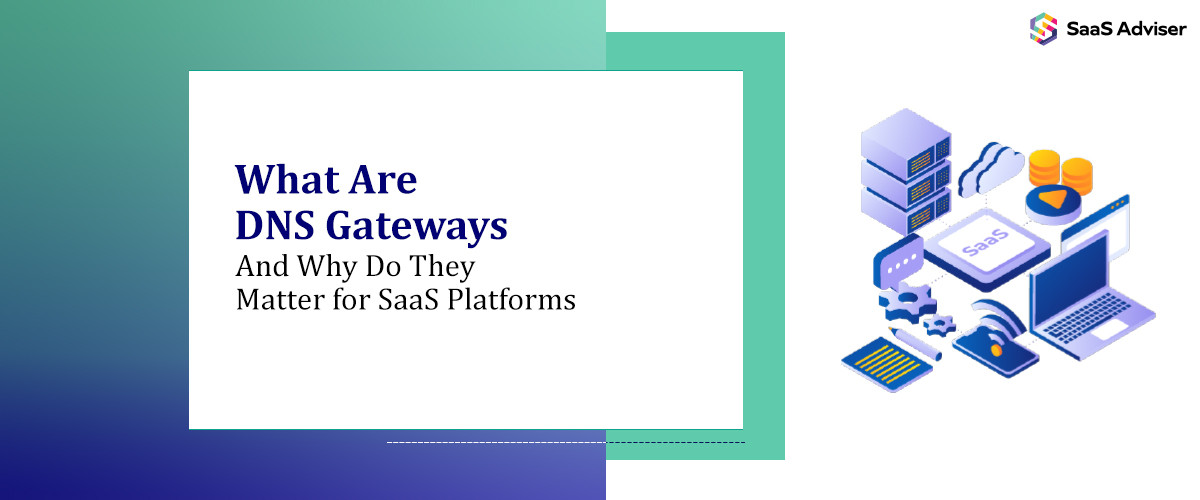
However, many factors have to come together for SaaS to work. One of the quiet enablers in the background is DNS and DNS gateways. DNS is the phonebook/address book of the Internet. It enables devices to find servers and websites. Without it, the Internet would be unusable.
However, the topic of our discussion today is not DNS, but DNS gateways. In this article, we’ll break down what DNS gateways are, why they matter, and how they benefit companies that rely on SaaS platforms to operate.
What Is a DNS Gateway?
In networking, a gateway is a device that connects two different networks together. Gateways are capable of NAT, and they are the primary reason your local or office network can connect to the internet.
DNS gateways are kind of similar to standard network gateways. They intercept DNS queries from a small network and forward them to DNS resolvers on the greater internet.
They also apply security policies and filtering rules to this traffic. In your local network, your router is your DNS gateway. So all the policies and filters have to be set up on it. In larger or managed environments, these policies are often enforced through a DNS filtering service, allowing organizations to centrally block malicious domains, control web access, and apply consistent security rules across all users and devices.
DNS gateways are necessary in managed IT environments, such as those found in an office. They are heavily used by:
-
Businesses with remote teams or branch offices
-
Enterprises using SaaS applications across departments
-
Organizations with security compliance requirements
They are not typically used in household setups; however, tech-savvy users can use setup DNS gateways with the help of services like OpenDNS or NextDNS.
These gateways improve website browsing speed and enforce DNS-level security measures.
Let’s check out how they affect SaaS services.
Why DNS Gateways Matter for SaaS Users
SaaS services are accessed over the internet using domain names. Every login, API call, or data sync starts with a DNS lookup. If that lookup is slow, blocked, or compromised, the SaaS experience breaks down.
It can even lead to situations where the SaaS service becomes completely inaccessible for your organization. DNS gateways help prevent that. In addition, they offer a range of other benefits that enhance your company's SaaS experiences. Let’s check them out.
1. Ensures Fast, Reliable Access to SaaS Tools
DNS gateways can do lots of things, for example:
-
Gateways can cache DNS responses, reducing lookup times.
-
They route DNS traffic to optimal resolvers and support failover if a resolver is down.’
Failover refers to a process where, if one of the DNS resolvers or nameservers is down, the gateway automatically forwards the request to a clone or backup server. This minimizes disruptions when users access cloud apps.
Additionally, companies can benefit from gateways in other ways as well. As an example, take an office of 100 workers who are all connecting to various SaaS solutions. In the absence of a DNS gateway, all DNS lookups reach directly to the resolver of the ISP and may result in non-consistent performance or loss of control. This can directly impact productivity tools, Business Management Software, and other SaaS platforms that rely on seamless connectivity.
With a DNS gateway, the IT team has a single point of enforcement to apply security rules and caching for all employees simultaneously.
Why does this work? It's because all API calls rely on DNS resolution. Since DNS gateways make resolution faster, any SaaS applications naturally feel snappier too. Without DNS gateways, the API call can fail if any of the required nameservers are down or if the ISP resolver doesn’t respond.
2. Enhances Security for DNS-Based Attacks
Security is very important in a business. Rogue hackers or even corporate spies can try to infiltrate your systems through your network to steal data. This data is very valuable and can be sold for millions of dollars or even held for ransom.
If sold, it can damage your company’s reputation and result in a federal inquiry as well as massive fines. That’s enough to bankrupt all but the biggest corporations.
Some common approaches to data theft include using fake websites or emails for phishing. The attackers use deceptively similar domain names (e.g., Amãzon, instead of Amazon) to phish for passwords and credentials. This is a very popular method of attack. Studies show that 35% of ransomware attacks are done through phishing emails.
However, security measures installed in the DNS gateway can prevent such attempts. For example:
-
Gateways can block scammy websites and prevent redirects to them.
-
They can prevent cyberattacks like DNS tunneling.
-
They can authorize connections to only whitelisted domains and deny connections to everything else. This effectively blocks fake domains.
-
Prevent infected machines from “calling home” to a command and control server.
Numerous ransomware groups depend on obfuscated DNS queries to communicate with their operators. With this blocking of these suspicious lookups at the gateway level, companies are able to prevent malware prior to it encrypting files or propagating itself through the network.
As a result, you can protect your company network from being compromised. This is vital when you use SaaS tools to handle sensitive or regulated data within the company network.
A DNS lookup tool can help in the implementation of these whitelists. A network admin can do a DNS lookup for the SaaS domain to find out all of its genuine domain names and IP addresses. Then the network admin in your company can add those to a whitelist. As such, only the original domains will be accessed while fake domains will be blocked.
3. Controls and Restricts SaaS Access
As we mentioned before, if your SaaS solution handles regulated data, then it is a lucrative target for hackers. Bad actors can use social engineering and exploit poor security practices to gain unauthorized access to your network and your SaaS application.
Social engineering is a method of using various socializing techniques to get information that would be otherwise not available to you. For example, an attacker may bump into a help desk employee online and get information about their workplace through a nonchalant conversation. They may be able to use the information to infiltrate the company premises later on.
DNS gateways can prevent that in several ways.
-
DNs gateways allow companies to implement access policies. As a case in point, they may be permissive of Office 365, SaaS Management Software, or other SaaS-based services, but restrictive of personal Gmail or unapproved file-sharing applications.”
-
Block VPNs and other methods to bypass restrictions.
-
Block social media access from company premises. Shuts down avenues for social engineering.
This helps reduce shadow IT and improve control over SaaS usage. Shadow IT, if you don’t know, is the use of unsanctioned software inside a company. Many employees who don’t have training pertaining to social engineering and hacking install personal apps on their work devices. Hackers can use flaws in these apps to infiltrate the company networks.
4. Provides Visibility and Logging
DNS gateways make logging easier. Every DNS query can be logged and analyzed.
This is useful for IT teams as they can gain insight into what services are being accessed and by whom, especially when managing IT Service Management Software and other mission-critical SaaS tools across departments.”
For example, in regulated industries such as healthcare or finance, having a full DNS query log is critical for compliance audits. Regulators often require proof that sensitive SaaS applications are only accessed by authorized users. DNS gateway logs provide that evidence and make reporting far easier for IT departments.
DNS gateway logs are also very helpful in cracking down on shadow IT, as well, because the activity would show up on DNS logs, and admins can trace which device it originated from. Then they can direct the user to uninstall their unsanctioned apps.
This doesn’t directly affect SaaS services; however, in an environment where multiple SaaS are in play, this knowledge, when paired with other network statistics, can help companies identify if they need certain services or not (depending on how much they are used). It can also show if network resources need to be increased to prevent throttling of SaaS services.
What About SaaS Providers? Do They Use DNS Gateways?
DNS gateways can only improve the experience for SaaS clients, not SaaS providers. That’s because gateways are a client-side tool, not a server-side one.
There is nothing that a SaaS provider can do with a DNS gateway that somehow improves their service.
That’s because DNS gateways control outbound DNS traffic, which is something that happens on the client side, not the provider side.
SaaS providers instead focus on:
-
Hosting globally distributed DNS records using Anycast
-
Signing zones with DNSSEC for security
-
Providing unfettered uptime by using extra servers.
In short, DNS gateways enable your company to access SaaS platforms in a better way. However, the opposite is not true because SaaS platforms cannot use or set them up in a way that benefits the user.
Conclusion
DNS gateways are just one of the many things that clients can implement to improve their SaaS experience. They are not the final bastion of security, but they provide substantial benefits.
They let you block bad websites, log DNS activity for auditing, and improve SaaS performance via local caching and routing optimization. This leads to increased performance, ease of auditing and increased security.
DNS gateways are components of a layered defense strategy together with other network protection systems such as firewalls and endpoint protection. In the case of SaaS-intensive business, they make performance and security hand in hand.
Lastly, remember that DNS gateways are implemented client-side, not server-side. So, a SaaS service itself cannot set them up; only their clients can.
A DNS Gateway is a tool that manages and secures domain name resolution between users and SaaS platforms.
They ensure uptime, speed, and protection against DNS-related attacks.
Yes, they distribute traffic across servers, helping SaaS apps grow smoothly.
They block threats like spoofing, hijacking, and DDoS attacks.