Are you standing at the crossroad of your marketing journey, unsure which direction leads to success? Does it feel like every campaign misses the mark, no matter how hard you try? Perhaps, you’re burning enough cash to earn a decent visibility in the ocean of search engines, but to your dismay “SERP” is a luxury you are never able to afford.
The problem isn’t your lack of motivation, but a solid marketing plan. You know what happens in the absence of it:
- Inconsistent Messaging: Your brand voice shows a disconnect because of its uncertain pitching, confusing potential customers.
- Wasted Resources: Your resources; be it in the form of time, money, or human, are wasted because of a lack of clear direction.
- Missed Opportunities: You tend to lose many opportunities that may come your way because of the undefined target audience.
Marketing plan is not something that will solely streamline your tasks. But it is “the only” way to sail the ocean of market.
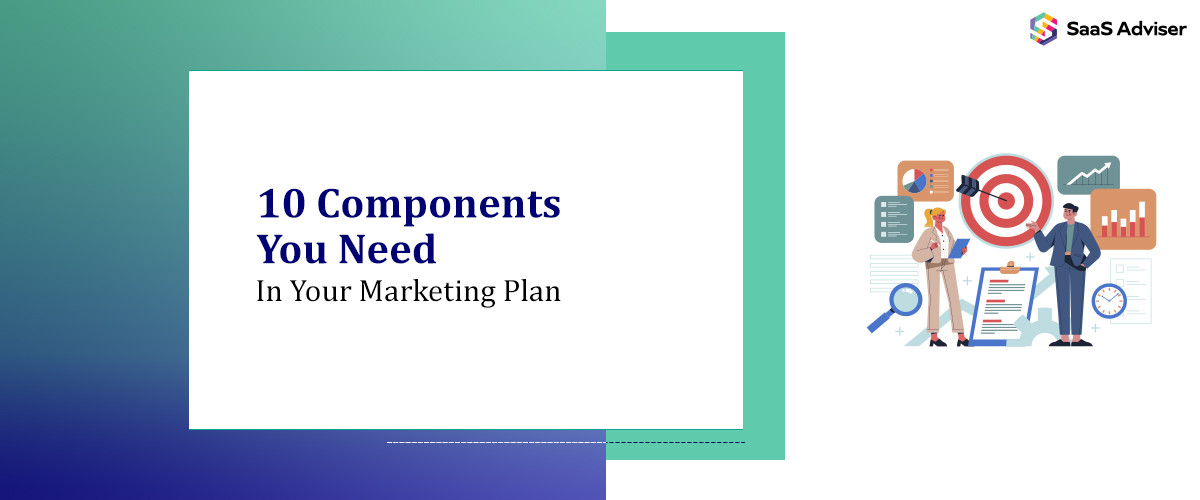
In this guide, you’ll learn 10 components that are important in building an empirical plan and how you can utilize a marketing plan template to streamline your process. Let’s discuss them, one by one!
What is a marketing plan?
A marketing plan is a document that clearly mentions how a brand will sound, act in the system, react to the trends, reach out to the target group, and promote its products.
In simple terms, it's a Google Map that will help work as a beacon in your marketing journey.
Role in Business Success
The role of a marketing plan is pivotal to achieve business success in an optimized way. Here’s how it helps:
- Goal Clarity: When you’ve your target goal documented, you are more likely to remain focused and not entertain any distraction, that eventually unifies your team.
- Enhanced Focus: When the goal is determined, the team is able to focus unanimously while aligning all the marketing efforts.
- Resource Optimization: A plan forecasts not only the “goal,” but all the driving factors in it. Hence, the budget is properly allocated for every resource, ensuring minimal loss.
- Improved Communication: There is little to no chaos in the team when your goal is determined and written on a sheet of paper. This streamlines communication and fosters better collaborations.
10 Components of a Successful Marketing Plan
Marketing plans are drawn up based on strategic thinking that can foresight the trends as well as their impact. The following 10 components act as a foundational pillar of an effective marketing plan:
1. Executive Summary
The first pillar of a successful marketing plan is to have an executive summary in hand. It is basically a document that has all the ins and outs of your process and goals in a concise way.
However, being concise or brief doesn’t mean you can skip the important points such as primary goals, strategies and expected outcomes. You can design your executive summary keeping in mind the following points:
- Marketing goals and objectives should be outlined in simple terms that can be understood by people across the departments.
- Give a crisp overview of all the strategies you’re going to employ to achieve your goal.
- Highlight the long term as well as short term milestones you’re anticipating.
2. Market Research
Having a clearly outlined executive summary facilitates proper market research. The success of a marketing plan is highly impacted by the quality of research done prior to it. Market research primarily focuses on understanding your industry, identifying the target group, and decoding the behavior of potential customers. Furthermore, it also ascertains external factors such as internal relations, politics, inflation, etc.
You can start your research process by following the below mentioned guideline:
- Collect the data from primary sources such as direct feedback from the customers, surveys, and interviews.
- Use analytics software such as GA4, Google Search Console, SEMrush, Ahref, Search Atlas, etc., to fetch the data and understand the user behavior.
- Conduct competitor analysis through SWOT and find the gap in the market that can be filled by you.
3. Buyer’s Persona
Market research enables you to determine your target group and build personas around them. A buyer’s persona is basically a fictional chart of your potential customers that includes their age, place, preferences, income, interests, pain points, and some other metrics.
Below is the process that can help you build a successful buyer’s persona:
- Segment your audience based on various metrics such as buying behavior, demographics and purchase history.
- Understand the patterns of your customers behavior, for e.g.; when they buy, how they buy, and where they buy.
- Choose proper channels for outreach and make strategies to ensure accuracy.
- Make use of CRM software to unify customer data and create an omnichannel communication approach.
4. Goal Setting
Goal setting is one of the most important pillars in the process of marketing plan designing. It includes both long term and short term goals. Without proper goal setting, it is almost impossible to streamline other tasks and consolidate the whole team. Therefore, it is recommended to set SMART (Specific, measurable, achievable, relevant, and time-bound) goals so that all the marketing efforts are trackable. You can go through the following guideline:
- Goals should be defined clearly without any vagueness, such as 1 million app store downloads, or 100% increase in the website traffic.
- Marketing goals should be aligned properly with the revenue growth of the company otherwise resources are burned for no good use.
- Keep reviewing your goals to make sure their relevancy does not fade with time.
5. Unique Selling Proposition (USP)
Without any USP, your product, brand or service cannot stand for a long time in the market. There is a large number of buyers and sellers in the market. Hence, a successful marketing plan also recommends building a USP that differentiates brands from your competitors. Some of the guidelines are shared below:
- The value addition is the most important thing in today’s market. The information is accessible to all. Therefore, differentiation can only be made on the value you add to your existing product or service.
- You need to ensure consistency in your brand voice so that your USP is recognized by customers on all the marketing channels.
- Do the A/B testing of your USP.
6. Marketing Strategies
You need to select the right marketing strategies to reach your target audience. The strategies vary from place, age group, product type, and market trends. Based on that, below are a few of the well-acclaimed marketing strategies used in this era:
- Holistic digital marketing strategies can be used to reach a wider range of audiences. This includes content marketing, SEO, and social media engagement.
- Outbound marketing strategies like paid ads, sales outreach, and email marketing campaigns can also be employed to covert customers fasters.
- Offline events can also be done such as sponsorships, podcasts, and other networking activities, to expand the reach.
7. Budget Allocation
Here comes the most important point – the budget. Without proper budget allocation no marketing plan can be successful. It ensures the marketing strategies have enough resources to survive and also helps in minimizing the unnecessary cash burn. Some of the important points to note are:
- The budget allocation should be done centering on the ROI. When there is no return, marketing plans tend to fail.
- There should also be a separate fund to address the unforeseen circumstances.
- Budget should be reassessed time to time in order to make sure it is sufficient as per the market standards.
8. Marketing Channels and Tactics
Selecting the right channels to sell your products or services comes as a vital part of the marketing plan. No matter how hard you try, if your channel is wrong, your product and service won’t be sold. It should be aligned with the target audience availability. Some of the important marketing channels are:
- Digital channels – social media, SEO, email campaigns, etc.
- Offline channels – print advertising, billboards, trade shows, etc.
Various other channels like podcast which is very prevalent these days can also be used to promote your product or service.
9. Implementation Plan
After having researched the market, designed the strategies, and determined the goal, comes the phase of implementation. This requires proper planning again so that tasks are assigned to the right person and resources are used efficiently. Some of the important guidelines for this are:
- There should be a timeline set for each campaign alongside the expected days for the return on investment.
- The roles and responsibilities assigned to the team members must be clearly documented so that confusion doesn’t breed in the system.
- Various CRMs or project management tools can be used to ensure every task is well documented.
10. Performance Tracking
Now, the last pillar of a successful marketing plan is the performance tracking. When you have the metrics and KPIs in the form of data, you know what’s working for you and what’s not. Based on that you can refine your marketing strategies. Some important points to be noted are:
- Track website traffic through GA4 and GSC and also learn your consumer behavior.
- Use other analytics tools for understanding the pattern of your consumers. The data collected on social media is very crucial. That data must be properly used to optimize your plans.
- Compare your plans with your competitors and find the gap again to fill that faster.
Conclusion
Every successful business circle around a successful marketing plan. By focusing on the 10 components, you can ensure you’ve an error free roadmap to success. Those components can be well optimized by following a marketing plan template.
The question is, why do you need a marketing plan template?
- It gives you a readymade structure to streamline your planning process.
- It makes sure all the elements are included.
- Makes it viable for you to adapt to the market trends.
So, what’s stopping you from building your marketing plan? Get in touch now!