Boards will not wait. In Gartner’s 2025 Board of Directors Survey, 93 percent of directors say cyber-risk threatens shareholder value, and two-thirds admit their oversight processes are still inadequate. Analysts warn that any risk platform failing to produce real-time answers “rarely survives the next budget review,” according to a U.S. Securities and Exchange Commission (SEC) statement.
Regulators have shortened the fuse. Since December 18, 2023, U.S. companies must file an 8-K within four business days of deciding a cyber incident is material, per new SEC rules. The SEC’s March 6, 2024 climate-disclosure rule, though paused in court, signals the same expectation of rapid, data-rich reporting. Similar fast-cycle mandates are rolling out under Europe’s CSRD and across Asia-Pacific.
Threats keep multiplying. A 2024 Ponemon study found that 59 percent of organizations were hit by a software supply-chain attack, and half of those took more than a month to respond. Add AI misuse, ESG metrics, and operational-resilience demands, and single-purpose tools quickly inflate budgets.
This is where ROI gets real. Modern ERM suites auto-ingest logs, push vendor questionnaires, and draft audit narratives. That shift replaces admin overhead with analysis your CFO can measure.
Consolidation compounds the payoff. Replacing three niche tools with one cloud platform can reduce duplicate licenses, compress rollout from months to weeks, and cut training to a single session. You lower total cost of ownership while the first-quarter ROI clock is still ticking.
This guide compares five cloud-based ERM and GRC platforms: Vanta, AuditBoard, LogicGate Risk Cloud, Diligent, and ServiceNow GRC. The goal is simple. Pick the platform that gives your board real-time answers before the next quarterly meeting, and you win the budget conversation.
How We Evaluated Fast-ROI ERM Platforms
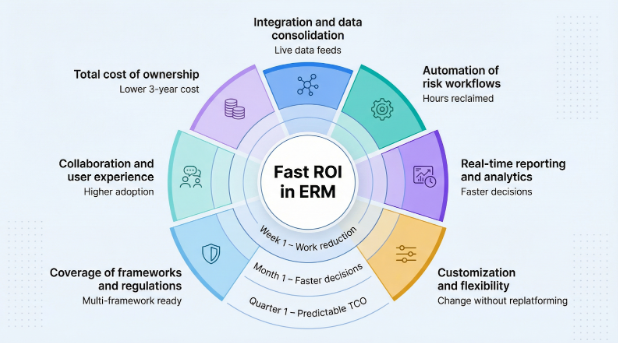
Copy-pasting data is still the biggest time sink in risk work. PwC estimates that automation and technology could handle between 30% and 40% of internal audit tasks within the next three to five years, and industry breakdowns of the best GRC software emphasize the need for “wide-ranging and deep pre-built integrations” to make that shift stick.
Here are the criteria that matter most when you are buying with a CFO and board timeline in mind.
Integration and data consolidation
Copy-pasting data is still the biggest time sink in risk work. PwC estimates that 45 percent of internal-audit tasks, primarily data transfers between systems, could be automated with today’s technology. When your ERM platform connects directly to cloud accounts, HR directories, ticket queues, and finance ledgers, your risk register can refresh every few minutes instead of every quarter.
Real-time feeds create two concrete ROI drivers:
-
Hours reclaimed. A Forrester 2025 TEI study on MuleSoft found a 70 percent drop in ongoing integration management effort after connecting core systems.
-
Instant credibility. Dashboards pull live evidence, so what you show leadership matches what auditors see tomorrow.
Teams notice the difference quickly. One G2 reviewer for Scrut Automation wrote that the tool “centralizes policies, evidence collection, and audit workflows in one place, saving us a significant amount of time.”
From an ROI perspective, integration is the multiplier. The sooner you connect your systems, the sooner the platform starts paying you back.
Automation of risk workflows
Manual checklists turn audits into marathons. After PetSmart moved its SOX and audit work to AuditBoard, the team reclaimed more than 1,400 hours a year by automating document requests and evidence collection.
That lift usually comes from a few repeatable automation wins:
-
Always-on control testing. The platform checks cloud logs and ticket queues every few hours, flagging exceptions before the quarter-end rush.
-
Self-driving questionnaires. Vendor surveys can launch, score, and escalate without email chasing, cutting follow-up time by more than 30 percent in customer case studies.
-
Auto-drafted reports. Generative AI stitches test results into board-ready narratives, turning days of slide building into minutes of review.
If you want “first-year payback” to be more than a promise, this is where you should pressure-test vendors. Ask what gets automated out of the box, what still requires humans, and what requires services work.
Real-time reporting and analytics
When numbers update in seconds, decisions follow faster. Insurance provider ELCO Mutual cut board-book prep from two days to under two hours and trimmed executive meetings from 150 minutes to 30 minutes after adopting Diligent’s live dashboards and AI summaries.
Real-time ERM portals stream updated heat maps, trend lines, and dollar-based loss scenarios as soon as control status changes. That immediacy creates two ROI levers:
-
Faster action. Finance teams at UnitingCare shaved 80 percent of control-testing time once dashboards highlighted exceptions instantly, freeing analysts for remediation instead of slide building.
-
Credible cost math. Continuous Monte Carlo analysis recalculates exposure with every refresh, letting you show the board how a five-million-dollar cyber risk can drop to two-hundred-thousand dollars after mitigation.
The practical test is simple. If a tool cannot produce an exec-ready dashboard from your own data during a short pilot, it is unlikely to deliver “fast ROI” after rollout.
Customization and flexibility
Risk programs pivot fast, so your software has to keep up. In LogicGate’s 2024 customer survey, 78 percent of users said they reconfigured a workflow without vendor help in less than a day, avoiding change-order fees.
Low-code builders make that speed possible. You can add an approval step, adjust a risk matrix from 3×3 to 5×5, and publish without waiting for a release cycle. A Forrester TEI study on low-code platforms found this agility cut development time by up to 50 percent compared with traditional coding.
Flexibility protects ROI in two ways:
-
Consulting dollars stay in your pocket. Self-service workflow changes replace paid statements of work.
-
No replatform tax. When your company doubles or a new regulation lands, you expand the model instead of buying a new tool.
Coverage of frameworks and regulations
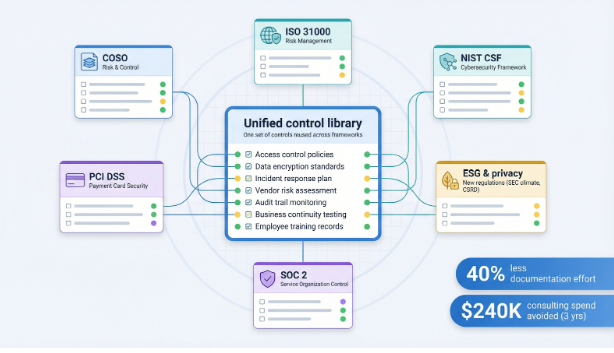
Compliance demands keep growing. Eighty-five percent of companies say requirements became tougher during the past three years, according to PwC. Platforms that ship with pre-mapped libraries, such as COSO, ISO 31000, NIST CSF, PCI DSS, SOC 2, and newer ESG and privacy mandates, reduce the amount of control mapping you have to do by hand.
The payoff can be direct. LogicGate’s 2024 Forrester TEI report found that automating multi-framework mapping cut control-documentation effort by 40 percent and eliminated about 240,000 dollars in consultant fees over three years. When a new rule appears, such as the SEC climate-risk disclosure or California’s Delete Act, updated content can show gaps before your inbox fills with emergency requests.
Collaboration and user experience
Your risk program works only when people use it. A 2023 G2 industry study found that average user adoption for GRC platforms is 57 percent. Nearly half of potential users stay on the sidelines. Tools that feel intuitive change the economics because more updates happen in the system, not in side channels.
Look for practical adoption drivers:
-
Role-based views. Control owners see only what they need, not a full GRC universe.
-
In-context prompts. Tasks appear inside Slack or Teams so people can act without hunting for logins.
-
Mobile first. Field managers capture evidence and close issues in real time.
Higher engagement is ROI. When updates happen continuously, fewer blind spots reach leadership, and remediation starts earlier.
Total cost of ownership
Sticker price is only the opening number. Gartner’s 2024 TCO model shows that a multi-tenant SaaS GRC platform costs 37 percent less over five years than an on-premise deployment once you add hardware, upgrades, and admin labor.
The savings usually surface in three places:
-
Implementation. Forrester’s 2025 TEI on AuditBoard found that a six-week rollout saved 345,000 dollars in internal labor compared with a traditional six-month project.
-
Upkeep. SaaS vendors deliver automatic updates. PwC estimates organizations spend 20 percent of total GRC cost just patching on-prem systems.
-
People time. Automation that pulls evidence and removes duplicate data entry frees analysts for higher-value work. AuditBoard users regained 1,400 hours each year in a published case study.
The fastest-ROI platform is rarely the one with the lowest line-item price. It is the one that reduces implementation drag, eliminates manual work, and stays adaptable without a steady stream of services bills.
Top Cloud-Based ERM Platforms for Fast ROI
Vanta: compliance automation that delivers payback fast
Vanta is a trust management platform built to automate compliance work end to end, especially the evidence collection and control monitoring that usually slow teams down. It started as the go-to option for SOC 2 and ISO 27001 in fast-growing startups, and it has expanded upmarket with broader framework coverage, vendor risk workflows, and customer-facing trust tooling.
The ROI case is unusually well quantified. An IDC Business Value study (January 2025) found 526 percent three-year ROI with a three-month payback period and 535,000 dollars in average annual benefits per organization. IDC also reports two times faster ROI than other GRC tools, and three-year discounted benefits of 1,280,900 dollars versus 204,700 dollars in investment.
Vanta is ideal for:
-
Growing mid-market and enterprise companies (roughly 50 to 5,000+ employees) that need to get compliant quickly, then stay continuously audit-ready
-
Cloud-native teams that want deep integrations with tools like AWS, GCP, Azure, Okta, GitHub, Jira, and similar systems
-
Organizations that treat compliance as both a security requirement and a go-to-market lever
Why Vanta tends to show ROI early
Time-to-value is a strength when your goal is “first framework, fast.” Fern went from zero program to SOC 2 Type II in eight weeks. Other customer stories cited include readiness in three weeks (Dust) and self-onboarding in one week (AudioStack). The practical point is that Vanta is designed to get you to an audit-ready baseline in weeks, then reduce ongoing compliance labor month after month.
That speed is driven by automation depth. Vanta supports 400+ integrations and 1,200+ automated tests that run hourly. On AWS alone, Vanta runs 130+ automated tests per connected environment, so teams spend less time chasing screenshots and more time fixing what actually failed.
Capabilities that matter for fast ROI
-
Framework coverage at scale: Vanta supports 35+ pre-built frameworks (including SOC 2, ISO 27001, HIPAA, PCI DSS, HITRUST, CMMC, ISO 42001, and FedRAMP) with cross-framework mapping to reuse evidence where controls overlap.
-
AI that reduces back-and-forth: Vanta’s AI Agent is reported to save teams four hours per week on average. Questionnaire Automation (QAuto) shows roughly a 95 percent first-pass acceptance rate, and Trust Center visitors can self-serve answers via an AI chatbot.
-
Audit deliverables without reinventing the wheel: Vanta can auto-generate key audit artifacts like a SOC 2 System Description and an ISO 27001 Statement of Applicability, and it provides remediation guidance with code snippets (Terraform, AWS CLI, CloudFormation) to accelerate fixes.
Reporting, pricing, and support considerations
Vanta includes built-in reporting and dashboards with executive-friendly views, and it is actively strengthening reporting for upmarket needs. One limitation is that it does not currently integrate with external BI tools like Tableau or Power BI.
On cost and rollout, Vanta publishes pricing on its website and uses package-based tiers that scale by headcount and feature needs. The expert research also notes free implementation services and no-cost customer support, which can materially reduce first-year total cost of ownership.
Limitations to be aware of
Vanta is compliance-first, and that focus is a trade-off:
-
It is not a traditional ERM platform and does not provide deep internal audit management, SOX business process audit workflows, ESG, or operational resilience capabilities.
-
Board-level reporting is improving, but it is not positioned as a replacement for dedicated board portals.
-
If your program requires heavy BI-driven analytics, the lack of BI integrations can be a constraint.
Best fit scenario: Choose Vanta when the fastest ROI path is continuous compliance automation, rapid time to first certification, and customer trust acceleration (Trust Center plus questionnaire automation), especially for cloud-native teams that want deep, integration-driven evidence and testing with minimal manual effort.
AuditBoard: audit-first rigor for SOX and internal audit teams
AuditBoard is a connected risk platform that was built for internal auditors first, then expanded into a broader GRC suite. If your ROI is tied to reducing SOX effort, tightening internal audit cycles, and connecting issues, risks, and controls across teams, AuditBoard is one of the most proven options in this group. The company also operates at true enterprise scale, with 2,000+ customers, including 50 percent of the Fortune 500, and it was acquired by Hg and TA Associates for 3 billion dollars in May 2024.
AuditBoard is ideal for:
-
Large enterprises with mature internal audit functions
-
Organizations where SOX is the primary buying driver, and ERM/IT risk are adjacent needs
-
Teams that want audit workflows and reporting to be the “system of record,” not a side module
Time to value and ROI proof
AuditBoard’s strongest ROI stories come from audit-centric outcomes:
-
National Storage Affiliates cut SOX hours by 20 percent year over year after moving to AuditBoard’s connected platform.
-
Gulfport Energy reduced external-audit consulting fees by 20 to 25 percent and saved at least one administrative FTE by centralizing evidence and role-based access.
-
Lennar Homes reported a 206 percent return on a three-year investment.
Where you should be cautious is time to value. Compared with compliance-automation-first tools, AuditBoard typically requires more configuration and admin effort. Implementation services are paid, and the expert research cites one documented example of an 87-thousand-dollar implementation fee for an organization with roughly 1,000 employees. In other words, AuditBoard can still deliver ROI, but it tends to show up fastest when SOX and internal audit efficiency are the headline outcomes.
What AuditBoard does well (and what it does not)
AuditBoard’s differentiator is depth in audit management. SOXHUB is purpose-built for SOX, including the structure audit teams need for financial accounts, controls, and business process audits. OpsAudit supports the full internal audit lifecycle. That “audit-first loop” is the core value proposition: work done for control testing and audit can flow forward into risk and compliance records without rebuilding everything from scratch.
On automation, AuditBoard is less aggressive than platforms designed around continuous compliance. The expert research notes 10 out-of-the-box automated test templates, with additional testing requiring configuration. Evidence collection also leans heavily on manual uploads and attestation workflows rather than always-on, integration-driven testing.
For AI, AuditBoard launched AuditBoard Assistant in November 2025. The described capabilities include generating risk/control/issue descriptions, identifying duplicative issues, recommending control-to-requirement mappings, flagging framework changes, summarizing audit findings, and supporting vendor assessment questionnaire responses.
Reporting, pricing, and total cost of ownership
Reporting is a strength, especially for audit leaders. AuditBoard offers dashboards and analytics across audit, risk, and compliance, with reporting powered by Sigma (previously Power BI). That said, cost can vary widely based on modules and user counts. The expert research includes the following pricing signals:
-
Growth segment pricing often lands around 30 to 50 thousand dollars, with a cited median platform price of 42,775 dollars (and a broader 20 to 88 thousand-dollar range).
-
One cited example pegs the TPRM module at 69 thousand dollars per year.
-
Longer-term contracts can become substantial, including a documented 1.7-million-dollar total example over five years for an organization of about 1,000 employees.
-
Renewal increases were noted in one set of pricing intelligence (3 percent, then 6 percent, then 19 percent across successive years).
The takeaway for ROI math is straightforward: AuditBoard can pay for itself, but you want pricing clarity early and you want to baseline current SOX and audit labor so savings show up cleanly in finance reviews.
Limitations to factor into a “fast ROI” decision
AuditBoard is not trying to be a Trust Center and questionnaire automation platform, and it does not offer those customer-facing trust tools. It also has a meaningful automation gap versus compliance-automation-first products, given the limited out-of-the-box automated test library and the heavier reliance on manual evidence workflows. The expert research also flags recurring G2 themes around admin overhead, a steep learning curve, and pricing concerns.
Best fit scenario: Choose AuditBoard when your fastest path to ROI is SOX and internal audit efficiency in a large enterprise environment, and you want a platform built around auditor workflows. If your definition of “fast ROI” is continuous compliance automation with minimal configuration and customer-facing trust acceleration, AuditBoard is usually not the quickest payback option.
LogicGate Risk Cloud: no-code flexibility with CFO-friendly risk quantification
LogicGate Risk Cloud is a modern risk management platform built around a no-code visual workflow builder, often described as an “application canvas.” The promise is straightforward. Instead of waiting on IT tickets or vendor services for every adjustment, risk teams can design and modify workflows themselves.
LogicGate positions for enterprise breadth. In addition to ERM, it supports use cases like compliance, third-party risk management (TPRM), internal audit, AI governance, regulatory compliance management, ESG, data privacy, and operational resilience.
LogicGate is ideal for:
-
Enterprise organizations with complex programs that change often and cannot afford constant replatforming
-
Risk leaders who need to translate heat maps into dollars for CFO and board conversations
-
Teams that want maximum workflow control without relying on engineering resources
Time to value and ROI, with an important caveat
LogicGate claims a typical mid-market team can stand up an MVP ERM program within one quarter. The no-code approach can make that realistic for workflow design and rollout.
For ROI, LogicGate publishes results from its 2025 Value Realization Tool, including:
-
2.6x average ROI (resource efficiency alone)
-
7.35x ROI for the Controls Compliance use case
-
1,170+ hours saved annually
-
A mid-year 2025 claim that the average customer reduced risk by 7.3 million dollars
The caveat is that these figures are self-reported through LogicGate’s own tool, not independently validated by a third party like IDC or Forrester. They can still be useful for benchmarking, but you should treat them as directional until you replicate the measurement in your own environment.
Where LogicGate can drive fast ROI
LogicGate’s biggest ROI lever is flexibility. When the business changes, you can change the system quickly. That protects ROI in two practical ways:
-
You avoid change orders for routine workflow updates.
-
You can expand into adjacent programs, such as AI governance or operational resilience, without buying a separate point solution.
LogicGate also differentiates on financial quantification. Built-in Monte Carlo simulations and Open FAIR methodology help teams express risk in dollar terms, not just red-yellow-green scoring. For many finance stakeholders, that is the difference between a risk discussion and an investment decision.
Automation and integrations, where the trade-offs show up
LogicGate is not a compliance-automation-first platform, and the automation model reflects that.
The expert research highlights:
-
40+ pre-built integrations, which can be a constraint if your ROI model depends on broad, deep out-of-the-box connectivity.
-
No automated tests comparable to platforms built around continuous control monitoring.
-
Automated evidence collection exists, but it is limited to higher-tier packages and can be more schedule-based (for example, pulling a quarterly user list from AWS) rather than always-on.
-
Integrations may use Merge.dev for basic pulls. More complex needs can require Workato-based “Risk Cloud Connectors” managed by LogicGate’s integrations team, which can introduce services dependency.
If your definition of “fast ROI” is “connect everything, start testing immediately, and reduce evidence work this month,” you will want to validate exactly what comes out of the box versus what requires build effort.
Framework coverage, reporting, and cost considerations
LogicGate supports 30+ frameworks, but the expert research notes it lacks out-of-the-box coverage for several regional and international frameworks, including Cyber Essentials, Essential Eight, TISAX, CJIS, AWS FTR, and Microsoft SSPA.
On reporting, LogicGate is stronger than many compliance-first tools in one key way. It supports more advanced analytics workflows and is friendly to external BI, with reporting capabilities leveraging tools like Power BI. For teams that already run executive reporting in BI, that can accelerate adoption.
Pricing is not published and is described as highly customized. Third-party pricing data cited in the research ranges from 11 to 126 thousand dollars per year, with a median of 52 thousand. Premium support and a Technical Account Manager are paid add-ons, and implementation and custom integrations are typically delivered through professional services.
Limitations to factor into a “fast ROI” decision
LogicGate’s flexibility is real, but it comes with clear gaps for ROI models that depend on turnkey automation:
-
Fewer integrations than integration-heavy compliance automation platforms.
-
No Trust Center and no questionnaire automation in the expert research, which limits customer-facing trust workflows.
-
Automated evidence collection and deeper automation are more tier and services dependent.
-
Pricing is opaque, and implementation is an investment you need to plan for.
Best fit scenario: Choose LogicGate when your fastest ROI comes from building and evolving a tailored, enterprise-wide risk program in one platform, especially when you need strong workflow control and dollar-based risk quantification. If your primary goal is rapid compliance certification with deep, out-of-the-box evidence automation, it is less likely to be the quickest payback option.
Diligent: board-grade governance and reporting, with GRC as the extension
Diligent is best known for board management. For many organizations, it is the default portal where directors actually log in, review materials, vote, and sign. Diligent One extends that governance footprint into GRC, including ERM, audit and controls, compliance, ESG, and third-party risk, with the goal of giving executives and the board a consolidated view of risk and oversight activity.
Diligent is ideal for:
-
Large and very large enterprises with formal board and committee workflows
-
Governance teams that need faster, more secure board reporting and approvals
-
Organizations that want board visibility connected to risk and assurance programs, rather than bolted on
Time to value and ROI, scoped correctly
Diligent has strong quantified ROI evidence for its board portal, specifically. A Forrester Total Economic Impact study for Diligent Boards and Leadership Collaboration found organizations reduced board-pack creation time by 50 to 60 percent and saved more than 1,600 hours over three years in material creation and distribution. The study also cites 167-thousand dollars saved from retiring alternate board portal software, plus smaller line items for risk reduction benefits and IT support savings.
That said, those numbers apply to the Boards product, not to the full Diligent One GRC platform. For broader GRC and ERM rollouts, deployments can take longer given the number of modules and Diligent’s multi-year platform unification work after acquiring Galvanize.
The TEI composite organization deployed Diligent Boards in four months, overlapping with the previous solution. That is a reasonable expectation-setting anchor for board operations. It is not a promise of full-platform ERM implementation speed.
What Diligent does best
Diligent’s differentiator is not automated evidence collection. It is governance visibility, at board scale.
-
Board-ready reporting: Directors can view risk rankings, overdue actions, and governance materials in one secure place.
-
Fast approvals between meetings: Secure mobile access supports reviews, signatures, and voting without waiting for the next board session.
-
Governance workflows people actually use: Agenda, minutes, and committee processes live in a familiar system for directors, which reduces the friction that often kills “board reporting” in GRC tools.
-
Market and peer context: Diligent Market Intelligence adds external data for governance, shareholder activity, and ESG context.
If your ROI definition is “fewer days lost to board books and last-minute reporting,” Diligent can be a direct unlock.
Automation, frameworks, and AI, where the trade-offs matter
Diligent One is positioned as an AI-powered, cross-organizational GRC platform. It includes AI capabilities across risk analysis and audit acceleration. However, the expert research also notes that Diligent’s compliance automation is limited compared with compliance-automation-first tools. Evidence workflows can be more manual, and it does not follow the integration-driven automated testing model that platforms like Vanta use.
Framework coverage is positioned around a central repository of regulations, laws, and governance content, including regulatory change tracking through third-party providers. Diligent is comparatively weaker for programs centered on SOC 2 or ISO 27001 continuous compliance management.
Scale, pricing, and implementation expectations
Diligent operates at a significant enterprise scale, with 25,000+ organizations, 700,000+ board members, and adoption across 75 percent of the Fortune 500 and 85 percent of the FTSE100 and ASX200. Pricing is not publicly disclosed, and based on the target market and breadth of modules, deployments are typically enterprise-grade investments.
On support, Diligent is known for strong training and concierge-style support for Boards, supported by the Diligent Institute.
Limitations to factor into a “fast ROI” decision
Diligent is not the fastest ROI path if your ROI model depends on continuous, integration-driven compliance evidence and testing. The expert research flags:
-
Limited automated compliance testing and evidence collection compared with compliance automation platforms
-
No Trust Center and no questionnaire automation
-
A complexity risk, with IDC MarketScape noting the need to avoid introducing too much complexity such that only some features are utilized
Best fit scenario: Choose Diligent when “fast ROI” means faster board operations and board-grade visibility into governance and risk oversight, especially in large enterprises. If your priority is rapid, turnkey compliance automation for SOC 2 or ISO 27001, Diligent is typically better as a complementary governance layer than as your primary automation engine.
ServiceNow GRC (IRM): the fastest path if you already live on the Now Platform
ServiceNow GRC, often sold as Integrated Risk Management (IRM), is not a standalone ERM tool in the traditional sense. It is a GRC module that runs natively on the ServiceNow Now Platform alongside IT service management (ITSM), security operations, HR, and more. For the right organization, that architecture can be the ROI story.
ServiceNow GRC is ideal for:
-
Very large enterprises that already run core workflows in ServiceNow
-
Teams that want GRC to share the same system of record as incidents, changes, assets, and service delivery
-
Organizations prioritizing platform consolidation over turnkey compliance automation
Why it can deliver ROI quickly (in the right environment)
ServiceNow’s unfair advantage is its shared data model, especially the Configuration Management Database (CMDB). If your assets, owners, tickets, and changes already live in ServiceNow, IRM can pull that context directly into risk and control workflows. You avoid duplicate records, brittle sync jobs, and “two versions of the truth.”
ServiceNow also benefits from an easier procurement path for existing customers. In many cases, you are buying an add-on module rather than introducing a new vendor and new identity stack.
Time to value and ROI proof, what is solid vs. what is not
The draft referenced a case study claim (FMG rollout in 12 weeks and a 35 percent reduction in manual evidence collection). The expert research could not independently verify those specifics in ServiceNow’s published materials, so treat that as directional unless you can validate it directly with ServiceNow references.
More broadly, the expert research did not identify an independently published ROI study specific to ServiceNow GRC/IRM that you can use the way you might use an IDC Business Value or Forrester TEI for a dedicated GRC product. The value case is usually consolidation-driven, not “out-of-the-box compliance automation savings.”
Automation, frameworks, and AI, with the trade-offs spelled out
ServiceNow automates workflow exceptionally well. It is a workflow engine at enterprise scale. However, for compliance automation specifically, the expert research highlights major gaps compared with compliance-automation-first platforms:
-
Automated tests: There are no out-of-the-box automated tests comparable to tools that run continuous control checks. Evidence collection is often driven by user surveys and manually configured indicators.
-
Framework readiness: ServiceNow does not ship “pre-built frameworks” in the same turnkey way. It relies on Unified Compliance Framework (UCF) content and content packs/accelerators, and organizations still do extensive configuration and mapping to make the system useful for their specific frameworks.
-
Audit deliverables: No out-of-the-box compliance roadmap, and no auto-generated deliverables like a SOC 2 System Description or ISO Statement of Applicability in the way compliance automation tools provide.
On AI, ServiceNow brings Now Assist into the platform for capabilities like smart assessments, natural language search, content summarization, and guidance. That can reduce friction, but it does not replace the underlying build effort required to make IRM “audit-ready” for your specific program.
Reporting, cost, and implementation expectations
Reporting and dashboards are generally robust, and the advantage is that IRM can pull from the same platform data used by IT and security teams.
Where ROI can get complicated is cost and services. Pricing is not publicly disclosed and is known to be complex. Implementation is typically delivered through specialized ServiceNow expertise and often certified partners. The expert research cautions that for large enterprises, these efforts can become multi-million-dollar projects once you include implementation, ongoing customization, administration, and license governance (true-ups and audits).
Limitations to consider if “fast ROI” means compliance automation
ServiceNow GRC is powerful, but it is not designed as a turnkey compliance automation platform. The expert research notes that it lacks several capabilities that directly shorten time-to-audit and reduce evidence work:
-
No Trust Center
-
No AI-powered questionnaire automation
-
No out-of-the-box automated tests or continuous evidence model
-
No native compliance roadmap or auto-generated audit deliverables
Best fit scenario: Choose ServiceNow GRC when your organization already runs ServiceNow broadly and you want GRC to ride the same CMDB and workflow backbone. That is where “fast ROI” is most realistic. If you are looking for the fastest path to continuous compliance automation with minimal configuration, ServiceNow is usually not the quickest payback option.
Conclusion: Make “Fastest ROI” Your Buying Filter
If you are buying ERM or GRC software in 2026, speed is not a nice-to-have. It is the constraint. Boards and regulators expect answers on demand, and finance expects proof that software spend reduces labor, shortens cycles, or lowers measurable exposure.
A simple rule holds across every platform in this comparison. Fast ROI comes from three things: live integrations, workflow automation, and executive-ready reporting. If you do not see those working with your data quickly, you will not “get it later” from more meetings and more modules.
A practical rollout plan that forces ROI early
-
Run a 30-day pilot on one high-pain workflow. Good candidates are third-party risk management (questionnaires) or SOX evidence. Require working integrations and one automated workflow end to end.
-
By day 60, expand to one adjacent process. If you start with third-party risk, add controls testing or policy management. If you start with SOX evidence, add ERM visibility. Publish one live dashboard for execs.
-
By day 90, quantify impact and lock in adoption. If you cannot show time saved, cycle time reduced, or spend avoided, the tool will struggle to survive the next budget review.
One additional lens that often gets overlooked in “ROI” conversations is revenue velocity. If security reviews slow deals, prioritize platforms with customer-facing trust workflows such as Trust Centers and questionnaire automation. Not every GRC suite is built for that.
Track these ROI metrics (and report them monthly)
-
Hours saved vs. baseline: evidence collection, control testing, reporting, and board-pack prep
-
Cycle times: vendor questionnaire to approval; control failure to remediation
-
Audit outcomes: findings reduced; external-audit or consulting spend reduced
-
Risk exposure: expected loss reduced using quant models; incident count or severity reduced
Avoidable pitfalls (and fixes)
-
Pilot too broad: Start with one process and one business unit. Expand only after the workflow runs cleanly.
-
Low adoption: Embed tasks in Slack or Teams, assign champions, and run a weekly burndown.
-
No CFO proof: Baseline time studies before go-live, then convert time saved into fully loaded cost and report it on a consistent cadence.
Decision rule
If a vendor cannot demonstrate live integrations, automated evidence or workflow execution, and exec-ready dashboards in a 30-day pilot, and cannot commit to first-quarter value, it is not your fastest-ROI choice.
With a focused pilot (e.g., third-party risk or SOX evidence), most teams surface measurable wins in 30–60 days—think hours saved on evidence collection and faster vendor cycles. Aim for first-quarter value by phasing modules (audit/compliance first, then ERM dashboards) and using out-of-the-box templates to avoid long configs.
Track four buckets: (a) Hours saved on evidence/testing/reporting (convert to fully loaded cost), (b) Cycle-time cuts (questionnaire → approval; control failure → remediation), (c) Audit outcomes (findings and external-audit spend down), **(d) Dollarized risk (expected loss before vs. after controls). Roll these into one quarterly snapshot so finance sees time and money back.
Usually, yes. Compliance automation keeps you audit-ready; ERM connects risks across IT, ops, and finance, prioritizes them by impact, and gives the board a unified, real-time view. If your pain is audit prep, start with compliance features; if decisions stall due to blind spots, add ERM for cross-functional visibility and prioritization.
Require three proofs: live integrations (SSO/cloud/ticketing/HRIS feeding a working risk register), automated workflows (control tests running, vendor questionnaires auto-scoring and escalating), and exec-ready reporting (live heat map plus a one-pager that dollarizes exposure). If those are working with your data in 30 days, you’re on track for first-quarter value.