
What we'll cover
Share with your community!


Get Free Consultation
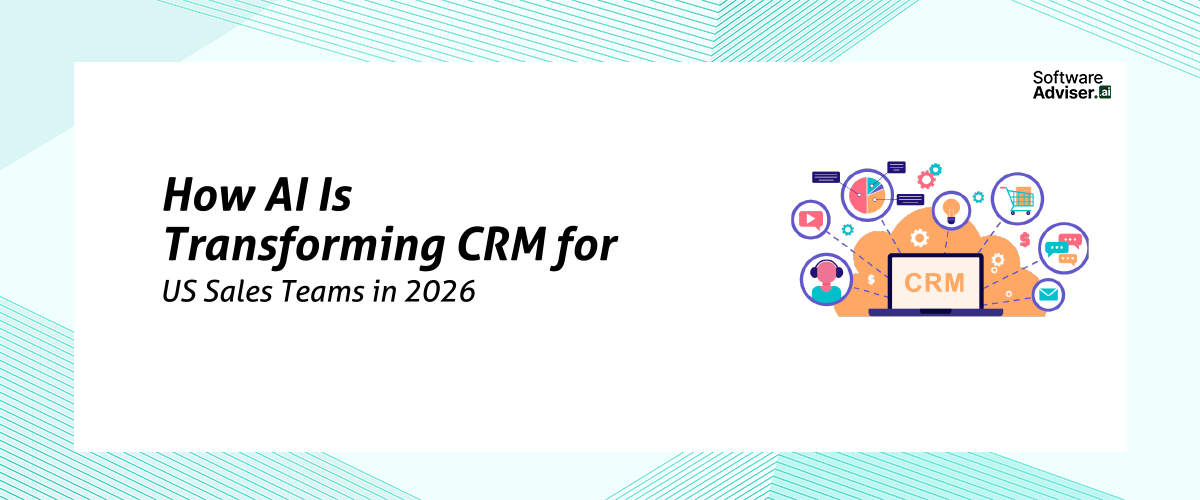
How AI Is Transforming CRM for US Sales Teams in 2026
 David N. Wilks
For years, sales teams were stuck using CRMs they grumbled about daily. Meant to simplify tasks, these tools too often piled on chores, typing endless notes, chasing down contact info, and filling out boxes few people ever checked. That grind sparked what managers today call the CRM adoption problem: more paperwork, less help. By 2026, things shifted sharply. AI is transforming CRM from an old-style customer record into something smarter, watching every move and predicting wins before they happen. It nudges sellers with names, timing, and even the words to use. The pressure never lifts for American sales teams chasing targets, and this change hits harder than most shifts seen lately.

Looking for AI CRM Software? Check out Software Adviser’s List of the Best AI CRM Software in USA for your business.
This guide breaks down how AI is transforming CRM in 2026, using everyday language. Real cases show the changes, while numbers back them up, so sales leaders get clear proof of where the gains actually happen. It is not magic, just shifts you can measure.
How AI CRM Turns Customer Data into Revenue
One shift stands out. Old-style CRMs hold records of events gone by, but an AI version looks ahead, hinting at where things might go. Calls get saved without human input here, and each conversation slips into place on its own. Forecasting is no longer a gut feeling, since the numbers stack up across years of similar deals, with patterns emerging quietly behind the scenes.
This is not just another update. It is a rethink of what a CRM is for, and it shows clearly how AI is transforming CRM in practice. The proof sits in the data: in Salesforce's 2026 State of Sales study, nearly nine out of ten salespeople find AI sharpens their customer insight. Across sectors, those same tools cut weekly admin work by nearly half a day. Speed matters here, and what comes next moves quickly. Gartner expects most seller research to lean on AI within two years, and by then, conversational systems driven by AI will handle more than half of business-to-business selling steps.
The Main Ways AI Is Transforming CRM
Change appears everywhere in how deals move forward. It is not just a single tweak here or there; instead, it weaves through every step people take when selling. Across offices big and small, reps notice certain turns more than others, and these are the moments that now feel different.
1. Automatic Data Capture Replaces Manual Entry
Right away, the busywork fades. With AI CRM tools, contact details get built and filled in automatically, pulled directly from emails and meeting schedules. Notes appear without someone having to type them after a call. Salespeople once lost twenty minutes per conversation just on data entry, and now those hours add up to roughly eight to twelve each week, freed entirely. The old issue of low CRM usage melts away, simply because there is no longer a trade-off between talking to clients and updating logs.
2. Predictive Lead Scoring That Adapts Over Time
Old lead scores relied on rigid point systems, ten points if the title matched, five for company scale. Instead of guessing, modern AI CRM digs into actual deal results, win or loss, updating its understanding nonstop. Hidden signals emerge when the software scans countless data threads from earlier campaigns, things people overlook every time. Suddenly, outreach focuses on those truly ready to buy, not just someone who fits an outdated mold.
3. Live Purchase Indicators with Intelligent Next Steps
Most of the time, today's CRM tools catch what people really want. When the system spots a download of price details, it reads that act as serious interest and bumps up the buyer's priority score on its own. Then, without anyone typing a thing, a custom message path kicks off right away, while the person handling that account receives a heads-up showing exactly which step the buyer took. Everything happens behind the scenes. Missed chances drop sharply, and messages arrive just when attention peaks.
4. AI-Generated Emails, Summaries, and What Comes Next
Messages take shape on their own, emails, pitches, and quick notes, all shaped around who they are meant to be for using AI email marketing software. Calls turn into text automatically, while the key points from talks appear in summaries complete with next steps. Instead of facing an empty screen, sellers get a starting point that already has substance. This way, personal touches spread wide, reaching more people than any group could handle by hand.
5. Sentiment Analysis Detects Early Warning Signs
Emotions hide between the words, yet AI spots them instantly inside every message. When excitement shows through eager phrases or questions about setup steps, it flags those moments just as sharply as irritation or price-checking hints. This awareness lets support teams act earlier, stopping deals from fading out unnoticed or customers leaving without warning. Real-time insight turns quiet concerns into clear signs that someone might walk away.
6. Better Forecasting and Territory Choices for Managers
Most of the benefit flows to managers, though sellers gain too. Rather than relying on hunches from the field, AI measures deal progress through actual activity patterns, showing supervisors which opportunities are likely to close and when they might land. It reveals how regions perform at any moment, spotting if someone is overloaded while a teammate sits underutilized, which lets adjustments happen using facts rather than gut feelings.
7. AI Agents Managing Complex Tasks
Something is different now: AI agents are stepping in, not just replying but taking steps on their own. These tools dig into company details, sort potential clients, write messages, and adjust records in the system, then circle back later, all while needing only small nudges from people. Gartner expects roughly four out of ten business programs to include focused AI agents by late 2026, compared to fewer than one in twenty before, and customer management software stands right at the front of this change.
How This Affects a US Sales Representative's Workday
One thing leads to another, and now the daily grind feels different, which is where AI is transforming CRM in the most visible way. Less clicking through updates means more room for real conversations, since background tools handle summaries, data entry, and drafts without nudging anyone. When someone picks up the phone, smart search has already dug out prior pushbacks from old messages and chats, so there is clarity before the first hello. Teams notice extra hours stacking up weekly, close to seven or eight, slipping back into what they came here to do: talking with customers.
Real Results and Real Examples
One real estate firm saw a 35 percent jump in leads after switching to an agentic CRM, with conversions rising half again as much thanks to sharper automation and audience focus. Results like these are not guesses; they are what businesses actually see when AI is transforming CRM and stepping into customer relationship management. Productivity climbs between 25 and 47 percent on routine tasks where agents take hold, which makes old processes look slow by comparison. Firms using up-to-date AI CRMs often notice both faster rollouts and replies that land sooner. At Salesforce, tools named Einstein and Agentforce team up to rank prospects and manage actions from start to finish. Meanwhile, HubSpot weaves Breeze AI throughout its Smart CRM, shaping messages, condensing conversations, and spotting which opportunities deserve first attention.
How US Sales Teams Should Get Started
Most failures come from turning on too much all at once. Winners begin small and show real results early. One clear problem worth solving could be ranking leads by likelihood to convert or letting AI draft replies after initial contact, so try just that first. Run it like a test, not a launch. Show staff more than the clicks; teach them how to see what the system sees, then decide better because of it. Results appear only when people lean in, trust it, and actually work with it. Track the truth first, hours saved, speed of replies, and gains in conversions before growing elsewhere. What else holds weight? Intelligence depends on information, and without complete records, insight falters. Stitching disjointed details into one clear view turns ordinary tools into something sharper, since a full story feeds real understanding while gaps leave guesses in its place.
Conclusion
What once felt like paperwork now feels like progress. Inside today's workflow, data flows without typing. Predictions improve because they study what actually happened. Alerts pop when buyers show interest, not weeks later. Drafts appear fast, shaped by context rather than copied from a template. Emotions in messages get spotted before problems grow. Forecasts land closer to reality, helping leaders adjust sooner. Machines take on chained actions, reducing the mental load. Hours add up, eight and sometimes twelve each week, freed from drudgery, and deals close more often, with some rising by 50 percent. Winners are not chasing every feature. They focus. They fix the inputs first, teach teams new rhythms, then expand only what proves useful. Done right, AI is transforming CRM into more than software; it tilts the field, even for small teams.
FAQ's
AI is transforming CRM by automating data entry, improving lead scoring, personalizing outreach, and providing predictive sales insights.
Look for predictive lead scoring, workflow automation, AI-generated content, sales forecasting, CRM integrations, and real-time analytics.
Yes, AI CRM software helps sales teams close more deals by identifying high-value leads, automating tasks, and improving customer engagement.
Businesses of all sizes, from startups to enterprises, can benefit from AI CRM software by increasing productivity and improving customer relationships.
Start by identifying a key sales challenge, implementing AI features for that workflow, training your team, and measuring performance improvements.
Choosing the right AI accounting tool starts with these two platforms for most businesses. QuickBooks holds roughly 62% of the small business accounti [...]
David N. Wilks
AI Employee Branding Software provides an automated digital solution that supports businesses by distributing and growing their employer branding mate [...]

Dokas mile
Small business owners in America often have only one way to manage their cash flow - by sending invoices out the door. As their businesses grow, howev [...]