
What we'll cover
Share with your community!


Get Free Consultation
Top 25 AI Tools of 2026: The Ultimate Editor's Picks by SoftwareAdviser.ai
 David N. Wilks
Somewhere between your third Slack ping and your second coffee, another AI tool launched. That is roughly the pace of this market now. New products appear weekly, established platforms bolt on AI features every quarter, and buyers are left squinting at feature lists that all sound the same.
Our editorial team at SoftwareAdviser.ai spends most of the year inside these products. We review them, compare them, and track which ones actually stick in real business workflows. This list is what survived that filter.
These are the 25 AI tools we believe deserve your shortlist in 2026. Not the loudest launches. The ones teams keep paying for after the trial ends.
How We Picked These 25 AI Tools
Our Selection Process
Every tool here had to clear four checks before it earned a spot. It needed strong verified user reviews across major review platforms. It needed real adoption, meaning active user bases and revenue growth rather than launch-week hype.
We also looked at how deeply AI is built into the product. A chatbot stapled onto a legacy interface did not qualify. The AI had to change how the work gets done.
The last check was valuable. Freemium tiers, transparent pricing, and honest free trials all counted in a tool's favor.
AI Tool Pricing
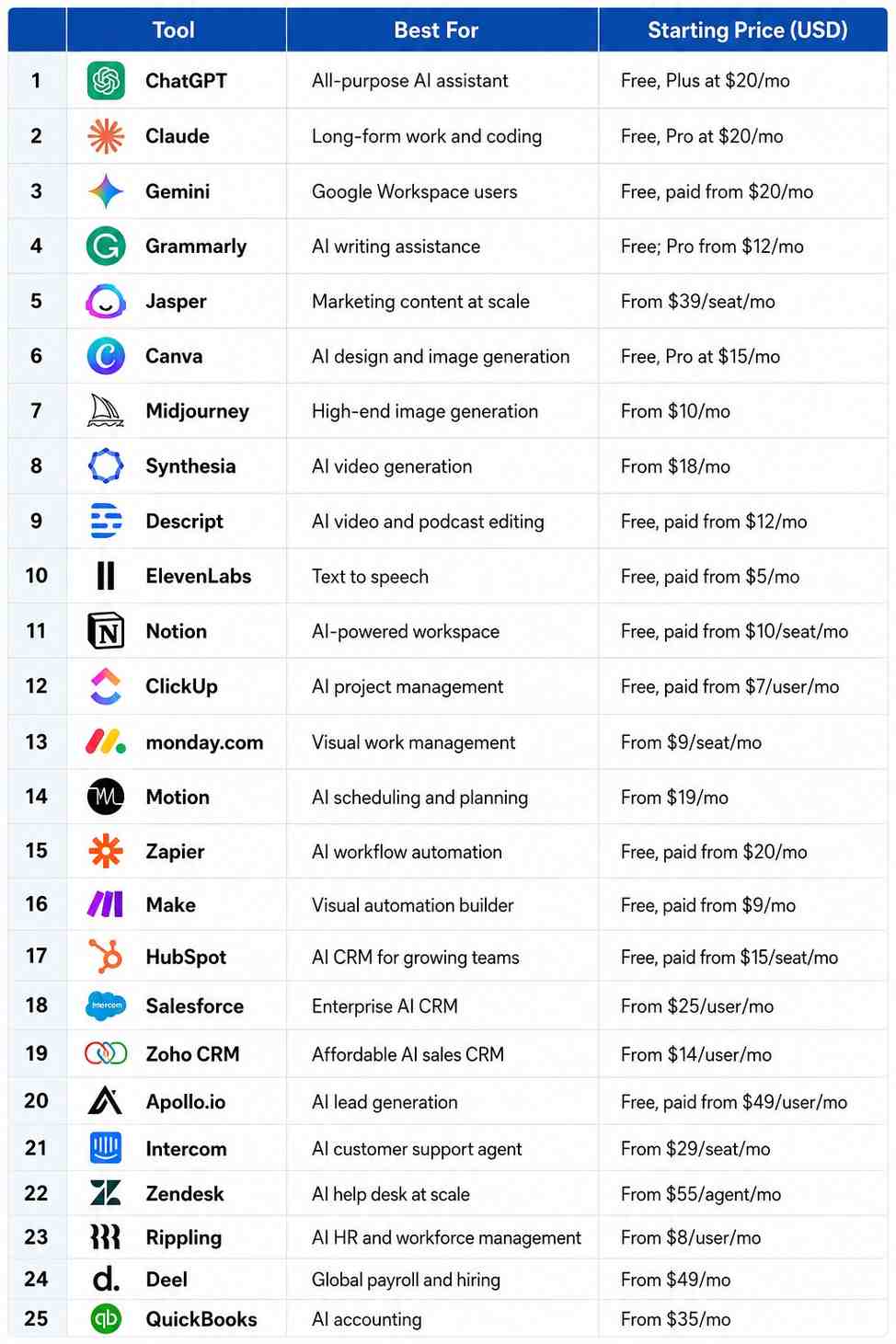
All pricing below is in USD and reflects publicly listed rates at the time of writing. Vendors change plans often, sometimes without much notice. Treat these figures as a starting point and confirm on the vendor's site before you commit.
Top 25 AI Tools Comparison Table
Best AI Chatbots and AI Assistants
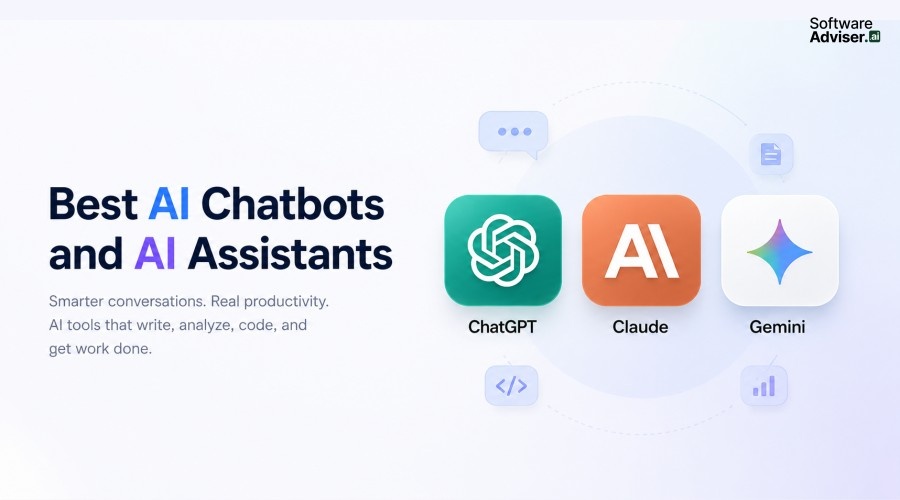
1. ChatGPT
The tool that started the modern AI wave still sits at the top of most usage charts. ChatGPT handles writing, research, analysis, coding, and voice conversations inside one interface, and its custom GPTs let businesses build assistants trained on their own material.
What keeps it here is versatility. A sales rep drafts follow-up emails in the morning, a developer debugs a script after lunch, and both are using the same product.
The free tier covers casual use. Plus runs $20 per month, and team plans start at $25 per user monthly for shared workspaces and admin controls.
2. Claude
Anthropic's assistant has quietly become the favorite of people who work with long documents and serious codebases. Claude can hold enormous amounts of context in a single conversation, which makes it unusually good at reviewing contracts, analyzing reports, or refactoring an entire project.
Writers tend to prefer its prose too. The output reads less mechanical than most competitors, which matters when the draft is going in front of clients.
Pro access costs $20 per month. Team plans land around $25 to $30 per user monthly depending on billing.
3. Gemini
Google took a different route and wove its AI directly into the tools people already open every day. Gemini drafts inside Gmail, summarizes in Docs, builds formulas in Sheets, and pulls context from your Drive when you ask it a question.
For companies already paying for Google Workspace, that integration is the whole pitch. There is no new tab to remember.
A capable free tier exists. Paid individual plans start near $20 per month, and Workspace business tiers now bundle Gemini features into standard per-seat pricing.
Best AI Tools for Writing, Design, and Creativity
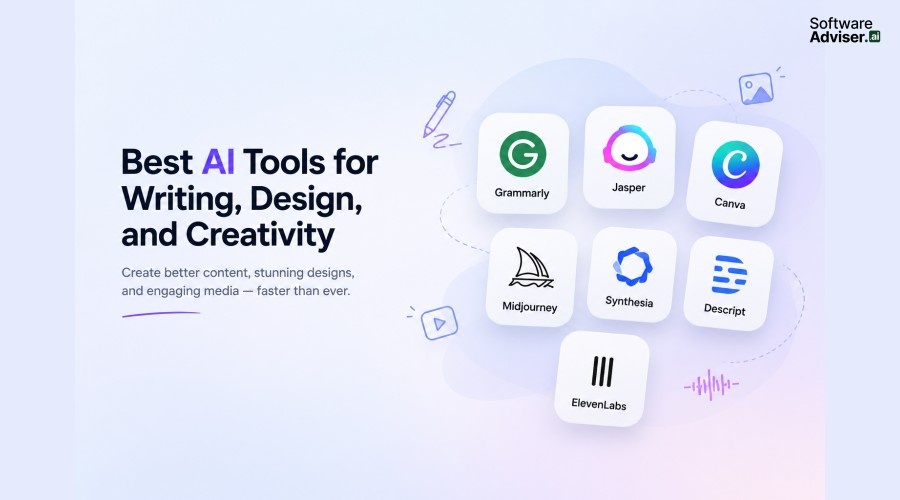
4. Grammarly
Long before AI was a headline, Grammarly was fixing typos in browser tabs. The 2026 version does far more. It rewrites full paragraphs, adjusts tone for a specific audience, and generates first drafts directly inside Gmail, Docs, Slack, and most places you type.
Teams like it because it enforces consistency. Brand tone guides can be applied across every writer in the company without anyone opening a style manual.
A generous free plan handles the basics. Pro starts around $12 per month billed annually.
5. Jasper
Marketing teams with heavy content calendars gravitate here. Jasper is built specifically for brand-controlled content production, with campaign workflows, a brand voice engine, and templates for everything from product descriptions to full funnel copy.
Its real strength shows at volume. When ten writers need to sound like one brand across fifty assets a month, generic chatbot tools start to buckle and Jasper does not.
Plans start at $39 per seat monthly on annual billing. There is a seven-day free trial rather than a free tier.
6. Canva
Design stopped being a bottleneck for most small teams the day Canva shipped Magic Studio. The platform now generates images from text prompts, resizes one design into twenty formats, removes backgrounds, and writes accompanying copy, all inside the same editor.
Non-designers get professional output fast. Actual designers get a speed boost on the repetitive parts of their job.
The free plan is genuinely usable. Pro costs about $15 per month, and Teams pricing scales per user.
7. Midjourney
When image quality is the entire point, Midjourney remains the benchmark. Its outputs consistently lead in realism, lighting, and artistic range, which is why agencies and product teams use it for concept art, ad visuals, and brand imagery.
The workflow moved to the web long ago, so the old Discord-only barrier is gone. An editor panel now lets you vary, upscale, and retexture images in place.
Subscriptions start at $10 per month. Commercial usage rights come with paid plans, which matters for client work.
8. Synthesia
Training videos used to mean cameras, studios, and reshoots. Synthesia replaced all of that with a script box and a library of realistic AI avatars speaking more than 140 languages.
Enterprise learning teams are the core audience. One compliance script becomes localized video for twelve regional offices in an afternoon, with no travel budget touched.
Personal plans start at $18 per month billed annually. Business tiers add custom avatars and brand controls at higher rates.
9. Descript
Editing video by editing text sounds like a gimmick until you try it. Descript transcribes your recording, then lets you cut the video by deleting words from the transcript. Filler words disappear with one click, and its Overdub feature can fix a flubbed line in your own cloned voice.
Podcasters and course creators treat it as their entire production suite. Screen recording, multitrack editing, and publishing all live in one app.
A free tier includes limited transcription. Paid plans start at $12 per month.
10. ElevenLabs
Voice generation crossed the uncanny valley, and ElevenLabs is the company most responsible. Its text to speech output carries natural pacing, emotion, and emphasis across dozens of languages, and voice cloning takes only a short audio sample.
Product teams use it for in-app voice features. Media companies use it for audiobooks and dubbing at a fraction of studio cost.
A free tier covers experimentation. Paid plans begin at $5 per month and scale with character volume.
Best AI Tools for Productivity and Project Management
11. Notion
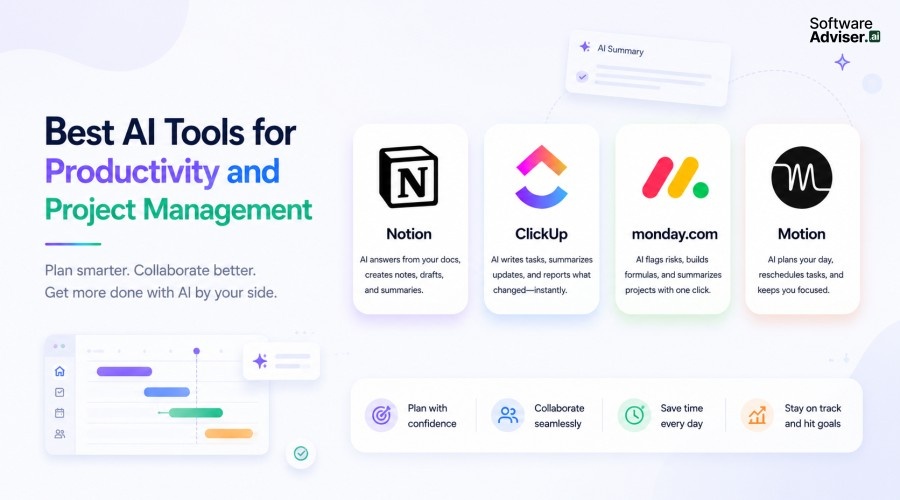
Notion turned its all-in-one workspace into an AI operating layer. Its assistant answers questions using your own wikis, docs, and databases, which means new hires can ask "how do we handle refunds?" and get the actual company answer.
Meeting notes, project summaries, and first drafts are generated in place. The AI project management also connects to Slack and Drive, so answers pull from beyond Notion itself.
Free plans work well for individuals. Paid tiers start around $10 per seat monthly, with AI features bundled into business plans.
12. ClickUp
Few platforms ship features as aggressively as ClickUp, and its Brain assistant is the current centerpiece. It writes task descriptions, summarizes long comment threads, generates standup reports automatically, and answers questions across every project in your workspace.
Teams drowning in status meetings feel the difference first. The AI simply tells you what changed since yesterday.
The free plan is one of the deepest in the category. Paid plans start at $7 per user monthly, with the AI add-on priced separately at about $7 more.
13. monday.com
Visual thinkers tend to pick monday.com, and its AI now handles the tedious parts of keeping boards accurate. Automated risk flags, formula generation in plain English, and one-click project summaries sit on top of its familiar colorful interface.
The platform stretches across use cases too. Marketing calendars, CRM pipelines, and dev sprints all run on the same underlying boards.
Basic plans start at $9 per seat monthly with a three-seat minimum. AI actions are included in a monthly allowance on paid tiers.
14. Motion
Rather than helping you manage a calendar, Motion manages it for you. The tool takes your task list, deadlines, and meeting schedule, then automatically builds and rebuilds your daily plan as things change.
Miss a task because a call ran long? Motion reschedules it before you even notice. For overloaded founders and consultants, that alone justifies the cost.
Individual plans start at $19 per month billed annually. Team pricing runs slightly higher per user.
Best AI Automation Tools
15. Zapier
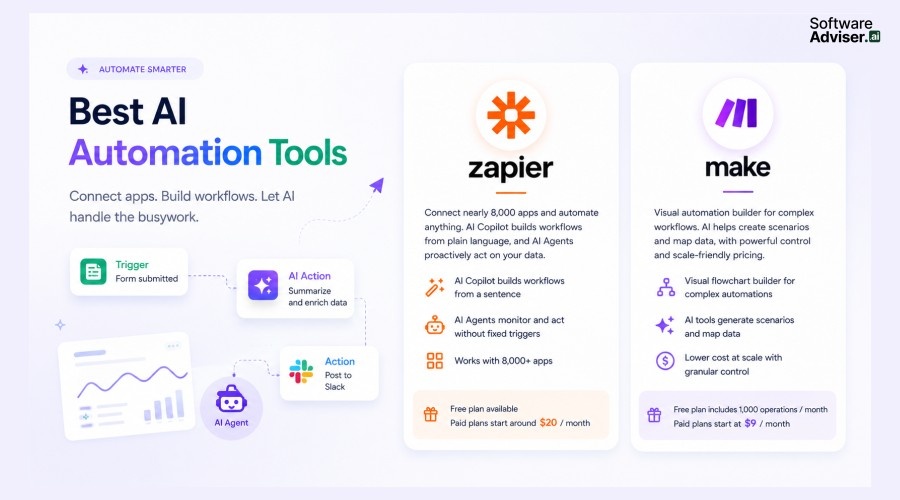
Nearly 8,000 apps connect through Zapier, which makes it the default glue of the software world. Its AI Copilot now builds entire workflow automation from a plain sentence like "When a form is submitted, summarize it and post to Slack."
Zapier Agents push further. These are small AI workers that monitor your data and act on it without a fixed trigger, handling things like lead enrichment on their own.
A free plan covers simple automations. Paid plans start around $20 per month.
16. Make
Power users who find Zapier limiting usually end up here. Make offers a visual canvas where complex, branching automations are drawn like flowcharts, with granular control over every step and far cheaper per-operation pricing at scale.
Its AI tools help generate scenarios and map data between apps. The learning curve is steeper, but the ceiling is much higher.
Free plans include 1,000 operations monthly. Paid tiers start at $9 per month.
Best AI CRM and Sales Tools
17. HubSpot
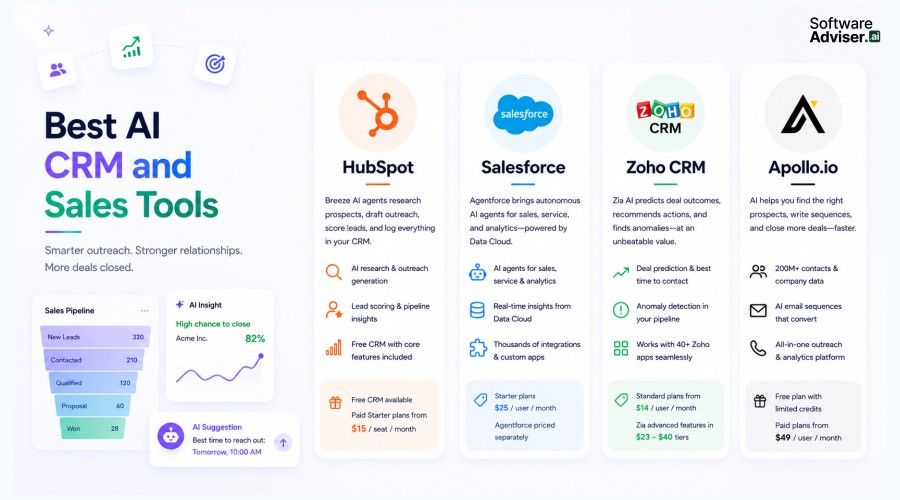
HubSpot rebuilt its entire platform around an AI layer called Breeze, and the result feels less like CRM software and more like a sales assistant with a database attached. Breeze agents research prospects, draft outreach, and score leads while the CRM quietly logs everything.
Small and mid-sized teams get the most value. The free CRM remains a genuinely functional starting point rather than a demo.
Paid Starter plans begin at $15 per seat monthly. Professional tiers climb steeply from there, so map your needs first.
18. Salesforce
Enterprise sales still runs on Salesforce, and Agentforce is its answer to the AI era. Autonomous agents handle lead qualification, customer service triage, and pipeline analysis directly inside the platform, drawing on the company's Data Cloud for context.
The ecosystem is the moat. Thousands of integrations, an army of certified admins, and industry-specific clouds mean it bends to almost any process.
Starter plans cost $25 per user monthly. Full Agentforce deployments are priced separately, often per conversation or per action.
19. Zoho CRM
Value hunters keep landing on Zoho, and for good reason. Its Zia assistant predicts deal closures, suggests the best time to contact a lead, and detects anomalies in your pipeline, all at a price point most competitors cannot touch.
The wider Zoho suite sweetens the deal. Books, Desk, Campaigns, and forty-odd other apps share the same login and data layer.
Standard plans start at $14 per user monthly on annual billing. Zia's deeper features unlock in the $23 to $40 tiers.
20. Apollo.io
Prospecting teams treat Apollo as their outbound engine. The platform combines a contact database of more than 200 million profiles with AI that writes personalized sequences, scores accounts, and recommends who to contact next.
The all-in-one angle is the draw. Data, email sequencing, dialer, and analytics live in one subscription instead of four.
A free tier includes limited credits. Paid plans start around $49 per user monthly.
Best AI Customer Support Tools
21. Intercom
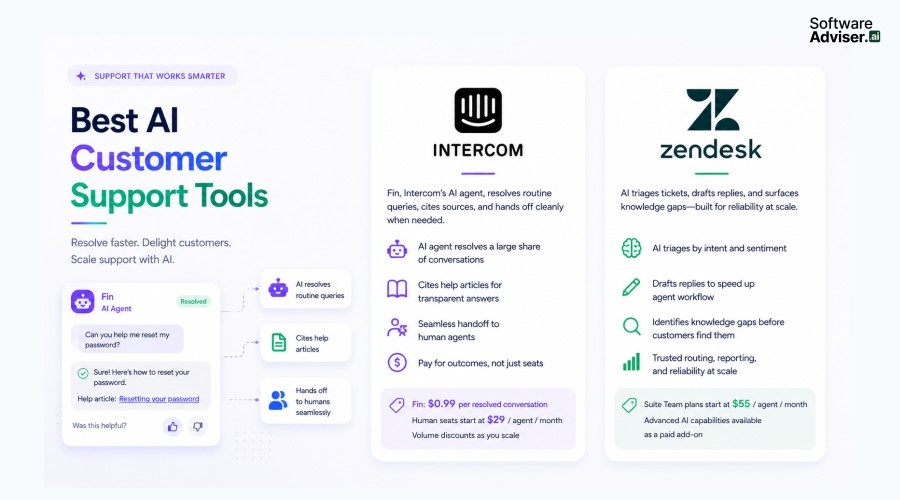
Fin, Intercom's AI agent, changed what buyers expect from support software. It resolves a large share of routine customer queries on its own, cites the help articles it drew from, and hands off cleanly to humans when it hits a wall.
The pricing model turned heads too. Fin charges $0.99 per resolved conversation, so you pay for outcomes rather than seats alone.
Human seat plans start at $29 per agent monthly. Volume discounts apply as resolution counts grow.
22. Zendesk
Large support operations still standardize on Zendesk. Its AI now triages tickets by intent and sentiment, drafts agent replies, and surfaces knowledge gaps in your help center before customers find them.
Reliability is the selling point at scale. When a team handles thousands of tickets daily, mature routing and reporting beat novel features.
SuiteTeam plans start at $55 per agent monthly. Advanced AI capabilities are a paid add-on on higher tiers.
Best AI HR and Payroll Tools
23. Rippling
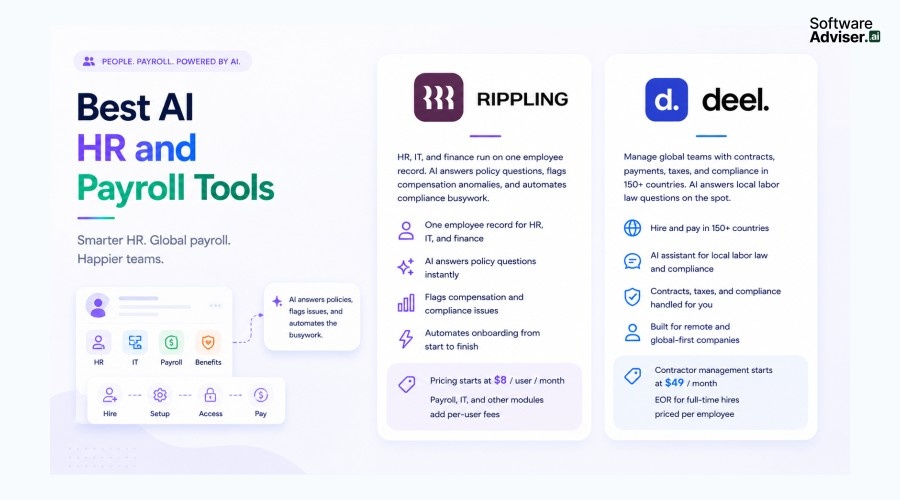
Rippling's pitch is simple and ambitious. HR software, IT, and finance run on one employee record, so hiring someone triggers payroll setup, device shipment, and app access in a single flow. Its AI answers policy questions, flags compensation anomalies, and automates compliance busywork.
Growing companies feel the payoff at every new hire. Onboarding that took days compresses into minutes.
Pricing starts at $8 per user monthly for the core platform. Modules like payroll tools and IT management add per-user fees.
24. Deel
Hiring across borders used to require a lawyer in every country. Deel handles contracts, payments, taxes, and compliance for workers in more than 150 countries, and its AI assistant answers thorny questions about local labor law on the spot.
Remote-first companies are the obvious fit. So is any business testing a new market before opening an entity there.
Contractor management starts at $49 per month. Employer of record services for full-time hires run considerably higher per employee.
Best AI Accounting Software
25. QuickBooks
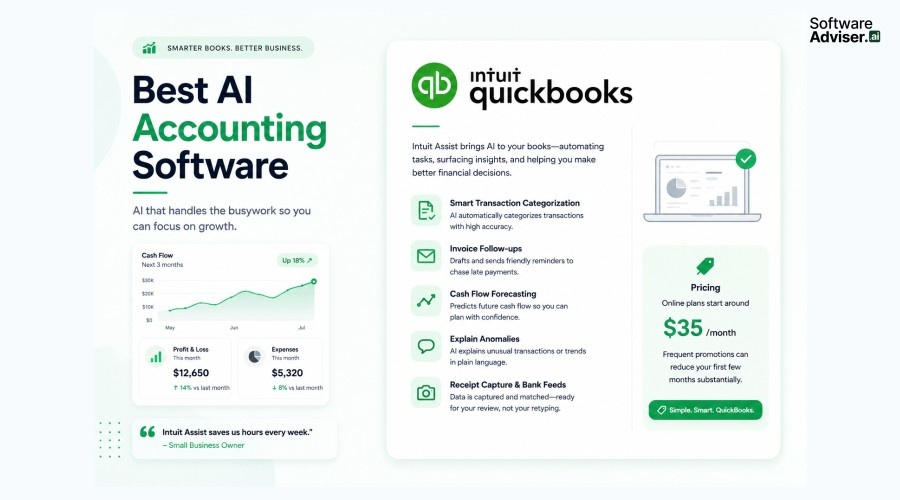
Small business accounting tools still begin with QuickBooks, and Intuit Assist has modernized the experience. The AI categorizes transactions, chases late invoices with drafted reminders, forecasts cash flow, and explains anomalies in plain language.
Accountants remain in the loop, just with less manual entry. Receipt capture and bank feeds now need review rather than data entry.
Online plans start around $35 per month. Frequent promotional pricing cuts the first few months substantially.
How to Choose the Right AI Tool for Your Business
Know What You Need First
The fastest way to waste money on AI software is to buy the tool first and hunt for a use case later. Identify the task that eats the most hours in your week, then shortlist only the tools built for that exact job.
A three-person agency drowning in client reporting needs ClickUp or Notion, not an enterprise CRM. Match the tool to the pain.
Check Integrations and Pricing
Every tool on this list claims to integrate with everything. Verify it. Run your actual data through the free trial, connect your real Slack workspace, and watch where the seams show.
Pay attention to pricing traps too. Per-seat costs look small until your whole team needs access, and AI features are increasingly sold as add-ons on top of base plans.
Conclusion
The AI tools that matter in 2026 share one trait. They removed a specific, measurable chunk of work from someone's week and kept doing it reliably after the novelty wore off. Start with one tool from this list that maps to your biggest bottleneck. Run a real trial with real work, not demo data. The right pick will prove itself inside two weeks, and you can build your stack from there. For deeper side-by-side comparisons across all of these categories, explore the full software directories on SoftwareAdviser.ai.
Marketing automation used to have one component: cause an email when someone fills out a shape. Send a follow-up after a webinar. Assign a lead while [...]
David N. Wilks
The software tools for finding email addresses are revolutionizing the process of identifying prospects and enabling teams to concentrate on finalizin [...]
David N. Wilks
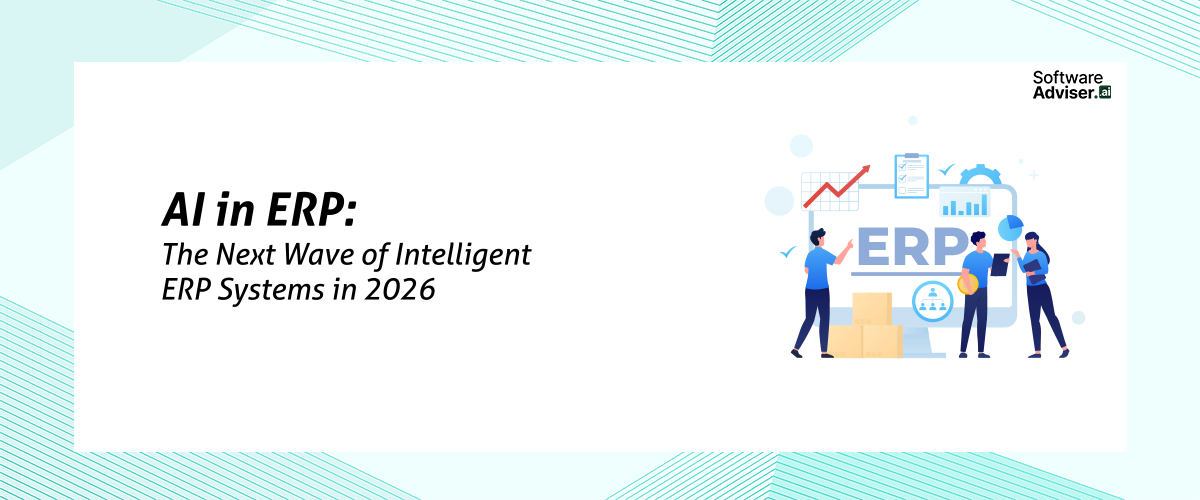
Artificial intelligence is transforming Enterprise Resource Planning (ERP) systems from traditional record-keeping platforms into intelligent decision [...]