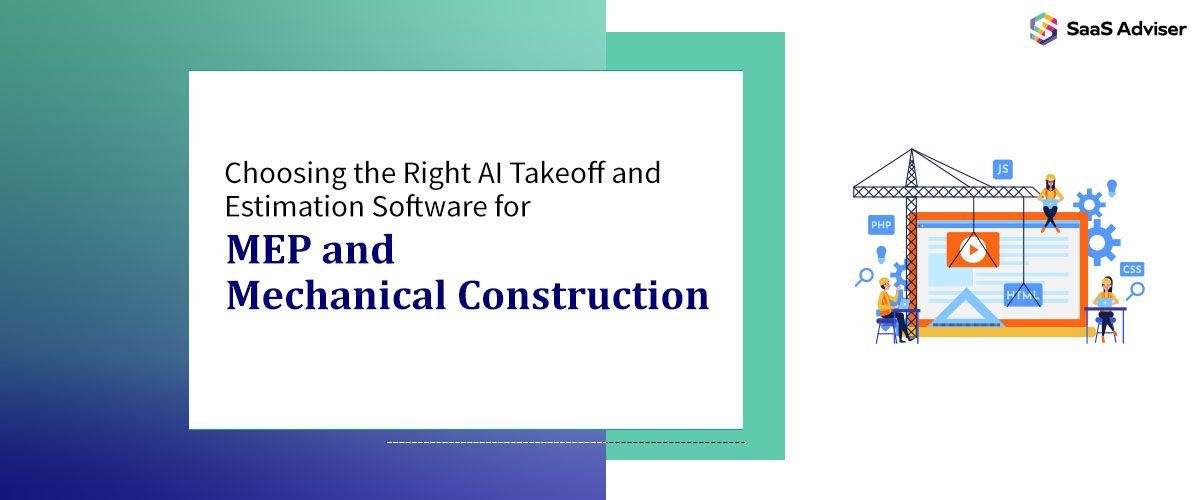
Mechanical, electrical, and plumbing (MEP) estimating has always demanded a higher level of precision than most other construction trades. Mechanical estimators are expected to interpret dense, symbol-heavy drawings, quantify thousands of components, and produce defensible numbers under aggressive bid timelines. Small takeoff errors in pipe runs, fittings, or ductwork rarely stay small once pricing is applied.
As bid volumes increase and experienced estimators become harder to replace, many mechanical contractors are turning to AI-powered takeoff and estimation software. The appeal is obvious: faster quantity generation, more consistency across bids, and relief from the most repetitive parts of estimating work. This mirrors broader SaaS adoption patterns discussed in SaaSAdviser’s analysis of SaaS fundamentals for modern businesses.
Still, adopting AI in MEP estimating is not a simple plug-and-play decision. The value of these platforms depends far more on how they fit real estimating workflows than on how impressive their feature lists look in a demo.
Why MEP Takeoffs Are Different From General Construction
MEP takeoffs introduce challenges that don’t exist in most general construction scopes. Mechanical drawings are dense, revisions are frequent, and quantities depend on precise linear measurements rather than simple counts. Pipe and duct systems involve layers of fittings, transitions, and connections that compound quickly when plans change late in the bid cycle.
Traditional takeoff tools lean heavily on manual tracing and estimator experience. That approach can work well on smaller projects, but it becomes increasingly fragile as project size and revision frequency grow. At scale, manual takeoffs create bottlenecks, fatigue, and inconsistent results between estimators.
AI-powered takeoff software is most effective when it takes pressure off these weak points. By automating repetitive measurement tasks, it allows estimators to focus on review, validation, and pricing logic rather than spending hours tracing the same systems repeatedly.
AI and the Reality of Estimator Capacity
One of the strongest drivers behind AI adoption in MEP estimating isn’t technology, it’s labor. Many mechanical contractors are dealing with a shrinking pool of senior estimators while bid demands continue to rise. Training new estimators to confidently interpret mechanical drawings and understand system intent takes years, not months.
AI does not solve that skills gap. What it does do is change how teams absorb workload. By standardizing how quantities are captured and documented, AI makes it easier for junior estimators to contribute meaningfully while senior staff focus on validation, scope interpretation, and pricing strategy.
This structured, review-first approach aligns closely with guidance from the U.S. Government Accountability Office, whose Cost Estimating and Assessment Guide emphasizes documentation, traceability, and repeatable processes as core requirements for credible estimates. Those principles apply just as strongly to private-sector mechanical bids as they do to public projects.
What AI Takeoff Software Actually Does Well
The good news is, AI takeoff and estimation software uses computer vision and machine learning to analyze construction drawings and extract quantities automatically. For MEP trades, this typically includes identifying pipes, ductwork, fittings, and linear runs directly from plans.
Where these platforms add value is not in replacing estimators, but in acting as a productivity layer. In that sense, an AI assistance tool functions as decision support, helping estimators process drawings faster while retaining full control over assumptions and validation A capable system should reliably detect common mechanical components, measure linear runs accurately, flag quantities for review, and update results efficiently when drawings change.
The difference between a helpful tool and a frustrating one often comes down to how transparent the outputs are. Estimators need to see what the AI identified, understand how quantities were generated, and adjust assumptions without fighting the software.
Accuracy Still Depends on Human Review
Accuracy is the deciding factor for most mechanical contractors evaluating AI takeoff tools. While modern systems can process drawings quickly, they are not infallible, especially on complex or poorly coordinated plans.
Successful platforms are designed around estimator review rather than full automation. They make quantities visible, editable, and easy to validate. This mirrors formal estimating standards used on government construction projects, where independent verification is required.
For example, Federal Acquisition Regulation 36.203 requires an independent government estimate for many construction projects. The intent is clear: estimates must be structured, supportable, and prepared with accountability. AI tools that obscure how quantities are generated run counter to that expectation.
In practice, many early AI adopters run into trouble when review processes are poorly defined. Treating AI outputs as “close enough” often leads to scope gaps that surface during revisions, when there is little time left to correct them.
How to Evaluate AI Takeoff Software for MEP Trades
When comparing AI takeoff platforms, feature lists matter less than outcomes. Trade-specific accuracy should be the first filter. Tools must recognize the symbols, fittings, and conventions commonly used in mechanical drawings, not just generic construction elements.
Workflow fit is equally important. If estimators have to rework AI outputs extensively or adjust their entire process to accommodate the software, adoption will stall. Speed matters, but only when it’s paired with precision teams can trust.
Revision handling is another critical factor. Mechanical bids often involve multiple late-stage plan updates. AI tools should clearly show what changed between versions and update quantities without forcing estimators to start from scratch.
Finally, quantity data must be exported cleanly into spreadsheets or estimating systems. If AI-generated takeoffs create friction downstream, the efficiency gains disappear quickly.
Integration With Pricing and Preconstruction Systems
AI takeoff software delivers the most value when it connects smoothly with downstream estimating workflows. Mechanical contractors rely on consistent quantity data that flows into pricing models without rework or manual reconciliation.
This principle is reinforced by the U.S. Department of Defense guidance, including UFC 3-740-05: Construction Cost Estimating, which outlines how quantity takeoffs should feed directly into structured cost estimates as part of a broader preconstruction process.
For contractors, this means export flexibility and system compatibility should be treated as core requirements, not optional add-ons.
Measuring ROI Beyond Speed
Speed is the most visible benefit of AI takeoff software, but it’s rarely the most important one. Long-term ROI is driven by consistency, documentation quality, and reduced rework during revisions.
The Federal Highway Administration emphasizes this broader view in its Major Project Program Cost Estimating Guidance, noting that reliable estimates support better decision-making, risk management, and cost control across the project lifecycle.
For mechanical contractors, this translates into more predictable bids, faster response to revisions, and the ability to pursue additional work without increasing headcount, while maintaining tighter control over scope changes and estimate defensibility under deadline pressure.
Common Mistakes in AI Estimating Adoption
Despite clear benefits, many contractors struggle to realize full value from AI estimating tools. One common mistake is treating AI output as final. Automation accelerates takeoffs, but estimator review remains essential.
Another frequent issue is choosing generic AI platforms that are not purpose-built for MEP trades. These tools often fail to recognize mechanical drawing conventions, leading to inconsistent results.
Workflow misalignment can also derail adoption. If the software does not match how estimators actually work, usage drops quickly. Underinvesting in onboarding compounds the problem, leaving teams without clear standards for reviewing AI-generated quantities or managing revisions.
Data Security, Ownership, and SaaS Considerations
Because AI takeoff platforms are delivered as SaaS solutions, data governance matters. Mechanical drawings often contain sensitive project information, and contractors need clarity around storage, access, and ownership.
Federal estimating frameworks assume controlled access and auditability of estimating inputs. When evaluating AI tools, user permissions, data retention policies, and ownership terms deserve the same scrutiny as accuracy and workflow fit.
Best Practices for Implementing AI Takeoff Software
Mechanical contractors should adopt AI takeoff tools gradually. Starting with pilot bids helps validate accuracy and time savings before scaling across the estimating team. Clear review processes should be established so estimators understand how AI outputs are checked and approved.
Industry guidance from organizations such as the National Institute of Building Sciences reinforces the importance of accuracy and standardization in mechanical estimating workflows, particularly as digital tools become more widely adopted.
Final Checklist for Selecting MEP AI Takeoff Software
Before committing to a platform, contractors should evaluate performance on real project drawings, not just demonstrations. At a minimum, the software should accurately detect pipes, ductwork, and fittings across different drawing styles and maintain reliability at scale.
Support for estimator review is non-negotiable. Quantities should be transparent, editable, and easy to verify. Revision handling should be efficient, with clear visibility into changes between drawing versions.
Downstream compatibility matters as well. Clean exports and flexible formats help preserve efficiency gains. Finally, usability and onboarding determine long-term adoption. Tools that are intuitive, well documented, and supported by meaningful training are far more likely to deliver sustained value.
The Future of AI in Mechanical Estimating
As AI technology matures, its role in mechanical estimating will expand to include deeper analytics, improved revision tracking, and stronger links between quantities, pricing, and historical performance data.
Still, one principle remains constant. Tools support decisions, but accountability stays human. Whether in public or private construction, accuracy, documentation, and review will continue to define credible estimates. AI-powered takeoff software that respects these realities allows mechanical contractors to modernize their workflows without compromising rigor.