
What we'll cover
Share with your community!


Get Free Consultation
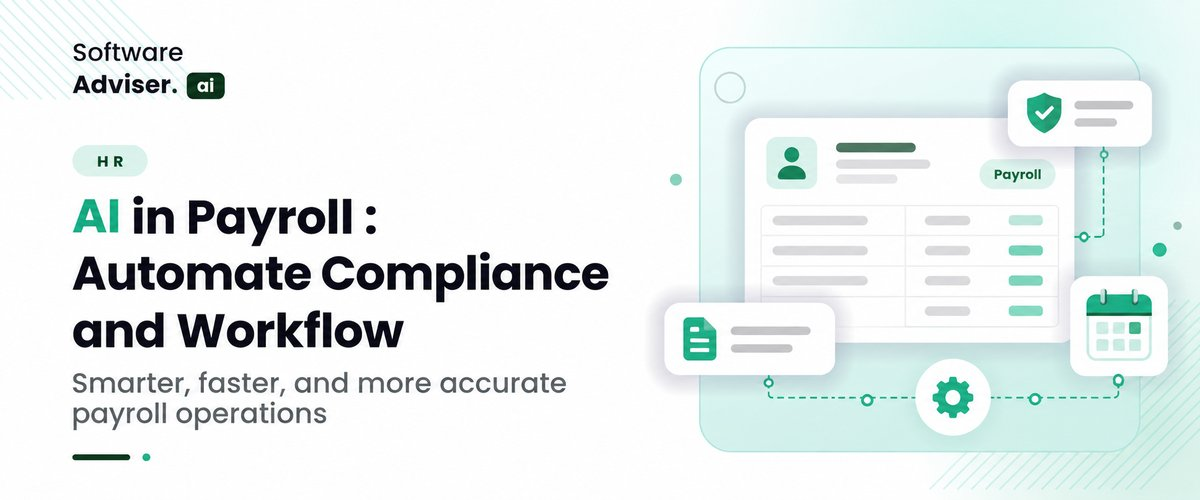
AI in Payroll : Automate Compliance and Workflow
 Dokas mile
A mid-sized company hires its first remote employee. Payroll runs the numbers, posts the job the same week, and gets flagged for a pay-transparency violation it didn't know applied outside its home state. When you multiply that scenario by twelve states, several tax areas, plus a payroll group which is already stretched very thin, it becomes clear why running payroll correctly has quietly turned into one of the tougher compliance issues inside US business today.
That's the gap AI in payroll is built to close. Instead of displacing payroll experts, AI systems currently scan regulatory changes, detect math mistakes prior to payment issuance, and signal compliance dangers instantly tasks formerly requiring manual monitoring of fifty distinct rule collections. This piece analyzes current capabilities of artificial intelligence within payroll sectors, identifies areas providing genuine utility, highlights existing limitations, and explains methods for assessing if adoption suits your organization.
What Is AI in Payroll?
Payroll AI denotes software utilizing machine learning and automation to handle wages, enforce tax and labor statutes, identify irregularities, and oversee regulatory adherence requiring little manual entry. Rather than someone manually verifying each computation and rule modification, the system constantly takes in data, implements active laws, and highlights items appearing incorrect prior to payroll completion.
It's a step beyond basic payroll automation. Traditional payroll software automates calculations; AI-driven payroll also automates judgment calls deciding which rule set applies, catching a suspicious pattern in overtime hours, or predicting where a compliance gap is likely to appear next cycle.
How AI in Payroll Actually Works
- Rules engines that map federal, state, and local tax and labor requirements to each employee's work location and classification.
- Anomaly detection that compares each pay run against historical patterns to catch outliers a sudden overtime spike, a missing deduction, a duplicate payment.
- Predictive analytics that use past payroll data to flag upcoming compliance risk, such as a jurisdiction where a new law takes effect next quarter.
- Agentic workflows, an emerging layer where the system doesn't just flag an issue but takes a defined next step rerouting an exception for review or applying a pre-approved correction without waiting for a person to prompt every stage.
Most vendors are deliberately conservative about how much autonomy they give the system. Moving actual money requires a level of predictability that pure algorithmic judgment doesn't reliably offer, so the more common design pattern is AI for detection and analysis paired with rule-based automation for the actual transaction. That combination is also what makes the process auditable regulators increasingly expect documented logic behind every calculation, not just an accurate result.
Where AI Makes the Biggest Compliance Difference
Compliance is the area where AI in payroll earns its keep, largely because US payroll compliance has gotten measurably harder to do by hand.
- Tax penalties are common and expensive: IRS data shows that roughly 40% of small and mid-sized businesses incur a payroll tax penalty in a given year, and in fiscal year 2024 the IRS assessed more than 4.4 million employment tax penalties. Federal penalties for late or incorrect deposits range from 2% to as much as 15% of the tax due, and a missed or inaccurate W-2 can carry its own separate penalty per form. AI-driven systems reduce this exposure by catching deposit timing and calculation errors before they become filings.
- Pay transparency has become a real multi-state burden: As of 2026, roughly 16 states plus Washington, D.C. require salary range disclosure at some point in the hiring process, and enforcement has moved from warnings to active penalties in states like Massachusetts and New Jersey with fines that scale sharply for repeat violations in places like New York City. A remote job posting can trigger obligations in every state where it could reasonably be filled, which is exactly the kind of cross-jurisdiction tracking AI rules engines are suited to.
- Multi-country payroll multiplies the problem: Once a company processes payroll across borders, the volume of jurisdiction-specific rules grows to a point where manual auditing becomes impractical. This is one of the clearest cases for Global Payroll Software or Multi-Country Payroll Software built with AI-driven compliance monitoring the system tracks salary, tax, and benefit rules per country even as those rules change independently of each other.
Benefits
- Fewer costly errors: Automated cross-checks catch miscalculations before payday instead of after an audit.
- Faster processing: Routine reconciliation and data entry that used to take days can run in the background.
- Real-time regulatory awareness: Rule changes are reflected in the system rather than depending on someone reading every legislative update.
- Better forecasting: Predictive analytics can flag likely overtime cost spikes or compliance exposure before the next cycle, not after.
- Documented audit trails: Every calculation has a traceable logic path, which matters when a tax authority or auditor asks how a number was produced.
Who Benefits Most
Small businesses get the most relative benefit from basic automation catching the kind of manual data-entry mistakes that drive that 40% penalty rate but should be realistic about cost versus a simpler payroll processor if their footprint is a single state and a small headcount.
Mid-market companies typically feel the pain first in multi-state hiring, where pay transparency and tax withholding rules start to diverge by location. This is where Payroll & Benefits Software with built-in compliance monitoring tends to pay for itself quickly.
Enterprises benefit from the scale of anomaly detection across thousands of pay records, but need to evaluate how a vendor's Enterprise Payroll Software integrates with existing HRIS and general ledger systems rather than operating as a bolt-on tool.
Industry-specific operations trucking is a good example carry wage rules (per-mile pay, multi-state driver time, overtime exemptions) that generic payroll tools handle poorly. Purpose-built Trucking Payroll Software with AI-driven rule handling tends to outperform general-purpose platforms here.
Companies already outsourcing payroll should ask whether their provider's Payroll Outsourcing Software actually includes AI-driven compliance monitoring, or whether outsourcing has just moved the manual-error risk to a third party instead of removing it.
Where AI Still Has Limitations
No credible vendor claims AI should run payroll unsupervised, and the limitations are worth stating plainly:
- It's dependent on clean data. AI catches anomalies against a baseline; if the underlying employee, tax, or time data is wrong to begin with, the system can miss it or, worse, treat bad data as the new normal.
- It doesn't replace judgment on ambiguous classification. Whether a worker is an employee or contractor, or how a bonus should be taxed, still often needs human sign-off.
- Rule-based automation, not full autonomy, still handles the money movement in most serious systems and that's a deliberate design choice, not a current limitation to be "solved."
- Newer regulations lag in rules engines. A brand-new state law can take time to get correctly encoded, so a compliance team still needs to verify anything genuinely novel.
Cost Considerations
Pricing for AI-enabled payroll platforms generally follows the same structure as traditional payroll software a base platform fee plus a per-employee, per-month charge with AI-driven compliance monitoring and predictive analytics often bundled into a higher tier rather than sold separately. Businesses evaluating cost should weigh the subscription against the penalty exposure it's meant to reduce: even a single avoided IRS penalty (averaging several hundred to over a thousand dollars per incident) or one avoided pay-transparency fine can offset a meaningful share of the annual software cost. Vendors rarely publish exact tier pricing publicly, so getting a quote based on actual headcount and state footprint is usually necessary before comparing options.
How to Evaluate an AI Payroll Solution
|
Factor |
What to Check |
|
Compliance coverage |
Does it track state and local rules, not just federal? |
|
Audit trail |
Can it show why a calculation was made, not just the result? |
|
Data integration |
Does it connect cleanly to your Accounting Software and time-tracking systems? |
|
Human override |
Can a person review and correct flagged items before payroll finalizes? |
|
Multi-jurisdiction support |
Does it handle your actual footprint — multi-state, multi-country, or industry-specific rules? |
|
Vendor transparency |
Will they explain what's rule-based automation versus actual predictive AI? |
Common Mistakes When Adopting AI Payroll
- Assuming AI eliminates the need for a compliance-literate payroll person on staff.
- Migrating messy historical data without cleaning it first, which undermines anomaly detection from day one.
- Choosing a platform based on AI marketing language rather than actual jurisdiction coverage for where employees work.
- Skipping a parallel-run period where AI-flagged output is checked against the old process before fully switching over.
What's Changing Through 2026 and Beyond
Adoption is accelerating but unevenly. Industry surveys point to a substantial share of payroll organizations already using AI for tasks like data entry and error detection, with compliance monitoring and employee-facing chatbots following close behind. At the same time, staffing shortages in payroll teams are pushing more organizations to look at automation not as an efficiency upgrade but as a necessity many report they simply can't find enough people with the right compliance and systems skills externally.
The clearer trend is agentic AI handling multi-step tasks flagging an anomaly, routing it for review, and applying an approved correction in sequence while final money-movement decisions stay rule-based. That's an emerging pattern worth watching rather than an established standard yet, and vendor claims about full autonomy should be treated with some skepticism until third-party audit data catches up.
Conclusion
AI in payroll isn't about replacing payroll teams it's about giving them the tools to keep up with a compliance environment that has genuinely gotten more complex, from state-by-state pay transparency rules to real-time tax reporting expectations. The businesses getting the most value are treating it as a way to catch errors earlier and free up staff for judgment calls, not as a way to remove oversight entirely. If you're evaluating a move, start by mapping your actual compliance exposure states, countries, worker classifications before comparing vendors on feature lists.
FAQ's
No. Most systems are designed to automate repetitive calculations and flag risks, while people still review exceptions, handle ambiguous classifications, and approve final payments.
AI systems reduce the kind of manual data-entry and calculation errors that drive the roughly 40% annual small-business IRS penalty rate, but accuracy still depends heavily on the quality of the underlying data feeding the system.
Often the compliance benefit is smaller for a single-state, single-entity business. The value grows quickly once you hire across state lines or add contractor classifications.
Yes, that's one of its stronger use cases tracking which of the roughly 16 states plus D.C. with disclosure laws applies to a given posting is exactly the kind of rules-mapping AI does well.
Automation executes predefined steps consistently. AI adds pattern detection, prediction, and (in newer systems) multi-step exception handling on top of that automation.
It's particularly useful there, since manually auditing payroll across many countries' tax and labor rules is close to impossible at scale this is a core use case for multi-country payroll platforms.
Pricing typically follows a base fee plus per-employee charge, with AI compliance features often included in a higher-tier plan. Exact pricing usually requires a quote based on headcount and jurisdictions.

The rope walk today in the hyper-competitive US startup environment is to scale swiftly without burning up precious funds. Meet the AI-powered CRM, a [...]

David N. Wilks
Managing a small enterprise today requires wearing multiple hats, but the digital shifts of this year are completely transforming how local companies [...]
David N. Wilks
Insurance has in no way been an industry recognised for velocity. Forms, again-and-forth telephone calls, weeks of waiting on a claim choice- that was [...]