
What we'll cover
Share with your community!


Get Free Consultation
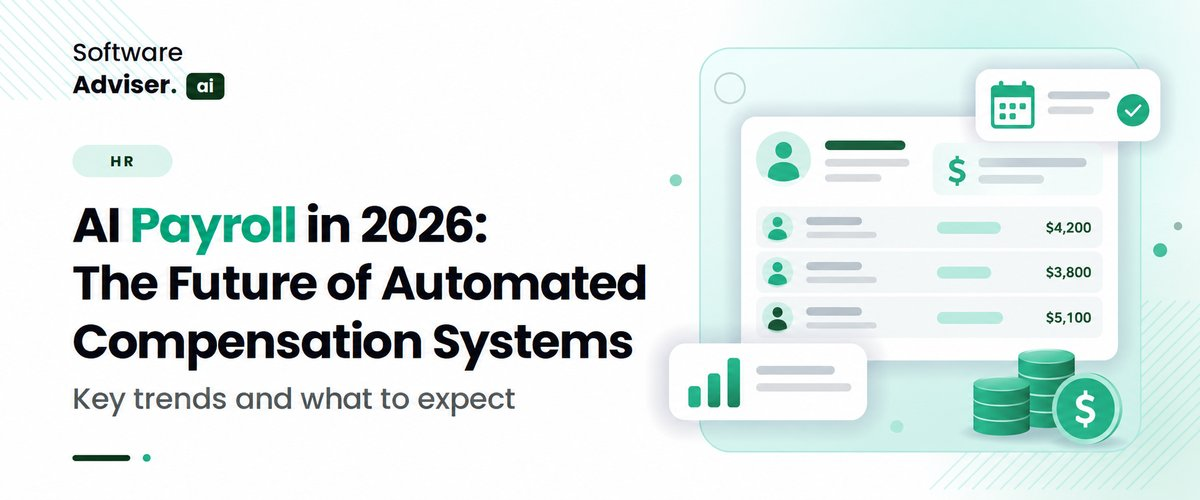
AI Payroll in 2026: The Future of Automated Compensation Systems
 Dokas mile
Payroll mistakes are usually small. A miscounted overtime hour. A new hire missing from the system for their first pay run. A tax withholding that quietly drifted out of range over a few months. None of these are dramatic on their own. Each one still lands on someone's paycheck, and that is why payroll teams have never really been able to trust a pay run without checking it first.
 Looking for AI Payroll Software? Check out Softwareadviser.ai List of the Best AI Payroll Software in USA for Your Business.
AI payroll software is built around changing that. It is not a chatbot bolted onto an old system in 2026. The calculation, the verification, and the actual payout are being restructured so that less of the checking happens after the fact, by a person, and more of it happens before, by the system itself.
What Is AI Payroll Software?
Payroll AI software, often integrated with HR software, handles calculations automatically, enforces tax and compliance rules independently, and verifies every pay cycle for errors before release. Some products also manage routine employee questions without HR having to step in, streamlining processes across departments.
The core difference from older payroll software is not really the calculation itself; software has calculated payroll correctly for decades. The difference lies in how much of the checking now happens automatically instead of being done by hand, enhancing efficiency and reducing the potential for errors.
A few vendors split this into separate functions rather than one engine. One piece reads timesheets. Another checks worker classification. Another runs the actual payment calculation. A fourth watches for compliance issues. For a business running payroll for twenty people out of one office, that architecture is invisible either way. Run payroll across a dozen states, and it stops being invisible. A rule change in one state should not require someone to manually patch the system for that state alone.
Do You Know?
Payroll tech coverage for 2026 usually says AI cuts out boring manual tasks, data typing, math, and normal rule checks, instead of taking away the thinking choices that a payroll group has to make.
How AI Payroll Software Works
Old-style payroll runs on a fixed order: collect the hours, apply the rate, apply deductions, review, process. Every one of those steps used to need a person watching for mistakes. The system had no way of knowing whether a number was reasonable or wrong.
AI payroll software changes that review step specifically, not the whole process. It compares a pay run against past patterns and flags anything unusual. An employee logging triple their normal overtime. A deduction that does not match anyone else's on the same plan. A withholding that shifted for no obvious reason. A person still reviews payroll. What they review is different now. Instead of every line, they check the handful of lines the system could not confidently sign off on itself.
A lot of vendors also push faster processing generally: same-day pay, validation as data comes in instead of one big check at the end, tax rules that update on their own when regulations shift, and an employee database that integrates seamlessly with these features. How much of that is real in any given product varies a great deal. It's worth confirming with an actual example, rather than just relying on a feature list.
How AI Payroll Connects to Onboarding, Scheduling, and Attendance
Payroll accuracy depends entirely on the data entering the system. This explains why AI payroll currently blends significantly with hiring, timetabling, and presence tracking rather than remaining a distinct operation alone.
A new hire's details often get typed into HR, payroll, and benefits systems separately, three times for one person. That is exactly where errors tend to land, right on someone's first paycheck. AI employee onboarding tools that feed straight into payroll cut that risk down by keeping one employee database as the actual source of record, instead of three slightly different versions drifting apart over time.
Scheduling and attendance work the same way. Employee scheduling data matters here as much as onboarding data does. If the scheduling system already knows an employee picked up a double shift, payroll should not need that hour typed in again by hand.
AI employee scheduling tools that adjust automatically for a last-minute shift swap are one part of this, and a good AI employee scheduling setup pays for itself the first time it stops a double-booked shift from becoming a payroll error.
Attendance management systems that catch a missed clock-out before it turns into a payroll dispute are the other piece. Both are really payroll accuracy tools, just filed under a different name.
AI Workforce Management and Where Payroll Fits
AI workforce management handles payroll, scheduling, attendance, and staffing as one linked system rather than four tools operating separately. A company seeing labor cost, coverage, and compliance risk in the same spot makes superior staffing choices compared to one piecing that view together from distinct dashboards.
Size decides whether this matters. A ten-person team does not need a full workforce management platform. A retail chain scheduling hundreds of hourly staff across several locations usually does, since payroll and scheduling working off the same data actually saves someone real time each week.
AI Employee Monitoring Is a Different Question
AI employee monitoring gets lumped in with other workforce AI tools fairly often, but it serves a different purpose than payroll accuracy work, and it deserves to be evaluated on its own. Tools that track productivity signals, activity levels, or time spent on a task are not the same category as tools that simply confirm hours worked for pay purposes.
Any person assessing AI worker surveillance needs to inform staff clearly on what data is monitored and the reasons behind it. Verify exactly what laws within your specific state mandate regarding required disclosures before proceeding. Trust breaks fast if a system rolled out for payroll accuracy quietly turns into something employees never agreed to.
Where AI Payroll and AI Accounting Software Overlap
Payroll is one of the largest recurring transactions moving through a company's books. Thus, direct communication between AI payroll systems and AI accounting tools is no real shocker. Once a pay cycle finishes, finance requires these numbers immediately: salaries, tax debts, benefit payments, all sorted out without anyone manually transferring sums from a payroll statement into a main ledger.
Companies using AI accounting tools for other records should verify if their payroll vendor links correctly. Viewing payroll as something merely located beside accounting instead of communicating with it allows wrong figures to stay hidden until month-end arrives.
What to Check Before Choosing AI Payroll Software
Feature lists across vendors look nearly identical. What actually differs is how those features hold up once a business is running real payroll for real employees. A few things worth pressing on directly, in a demo, rather than accepting a general pitch.
- Does the compliance coverage match the states or countries the business actually operates in, or does broader coverage cost extra later?
- What exactly does the error flagging catch? A vague answer about "detecting anomalies" is itself worth noting.
- Can onboarding, scheduling, and attendance information move into the staff record automatically, or does every system continue working alone?
- Does the AI employee onboarding system update payrolls automatically, or does a person still manually type identical new-employee data again?
- Can employees resolve payslip and tax questions themselves through the system, or does every question still land on HR?
- Can a person correct a pay run before it goes out, and is that correction visible later in the audit trail?

Pro-tip
When assessing suppliers, detail one truly complex pay cycle drawn from personal payroll records, such as a backdated salary increase, a fired worker, or a schedule exchange, then request that the provider explain precisely how their software handles these events. This exposes far more than a demonstration constructed using streamlined example figures.
Limitations of AI Payroll Software
None of this makes payroll fully hands-off. A person still has to classify a genuinely ambiguous worker. Someone still has to approve an unusual compensation change. A person remains liable when regulators inquire regarding the choice made. Payroll systems powered by artificial intelligence cut down mistakes and accelerate standard tasks within work. This tool fails to substitute for an individual grasping figures alongside those involved personally.
Data security is easy to skip past in a sales pitch, and it should not be. Payroll data, salaries, bank details, tax IDs- are about as sensitive as company data gets. Every additional AI layer built into that system is another surface that needs to be secured properly. Not just a convenience feature.
Conclusion
The direction here is consistent even if the pace varies by vendor. Payroll systems that check themselves continuously instead of once per cycle. Pay information linked with hiring and planning rather than kept separate from those areas. Reduced hours spent on typing data manually, increased focus on choices individuals truly need to decide upon.. AI payroll software in 2026 is not really about shrinking payroll teams. It is about giving them a system that catches the mistake before it goes out the door, not after.
FAQ's
Software for payroll that applies artificial intelligence to manage computations, identify mistakes or irregularities prior to finalizing a payment cycle, and frequently address standard worker inquiries without needing direct HR participation.
No, though the benefit grows with complexity. Small businesses see less impact than companies running payroll across multiple states or countries.
Usually no. It reduces manual, repetitive tasks such as data entry and standard reviews, yet categorization choices and atypical instances still require a human.
Many platforms put onboarding, attendance, and scheduling data straight into payroll from one employee database, which lowers the mistakes that occur when systems fail to speak with each other.
Verify that coverage matches actual sites, request a specific instance of flagged data, and examine how simple it is for staff to audit or amend payroll prior to release.
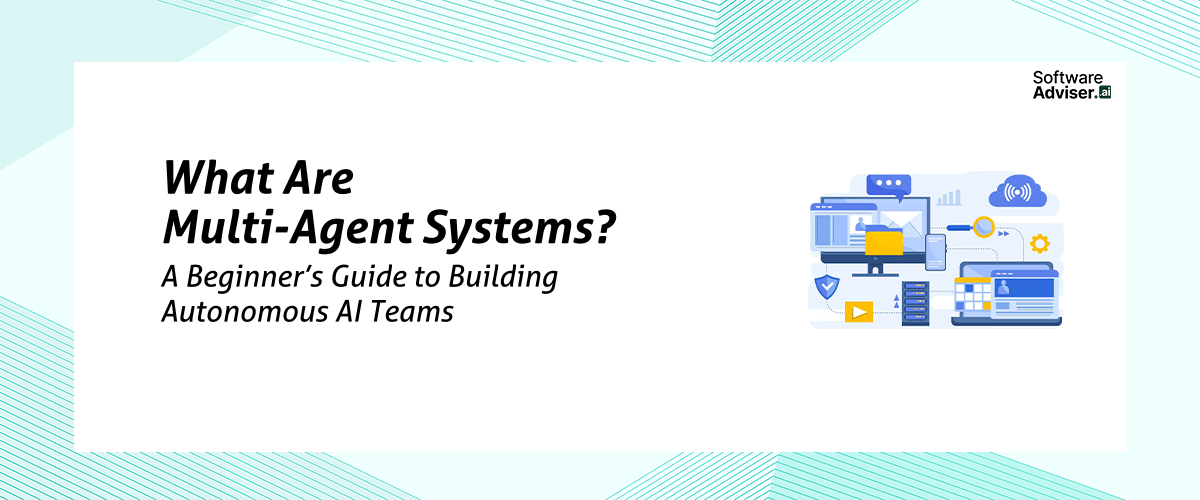
Chatbots that cope with just one single query at a time are swiftly becoming a thing of the past. Modern company spaces are fast transferring toward n [...]
Dokas mile
Step into almost any office floor today, and you will catch teams scrambling to get new software tools up and running to drop their daily workloads. Y [...]
Dokas mile
Many transformations have occurred in the digital realm of communication, from robotic assistants in corporations to much more humanized forms of digi [...]