
What we'll cover
Share with your community!


Get Free Consultation
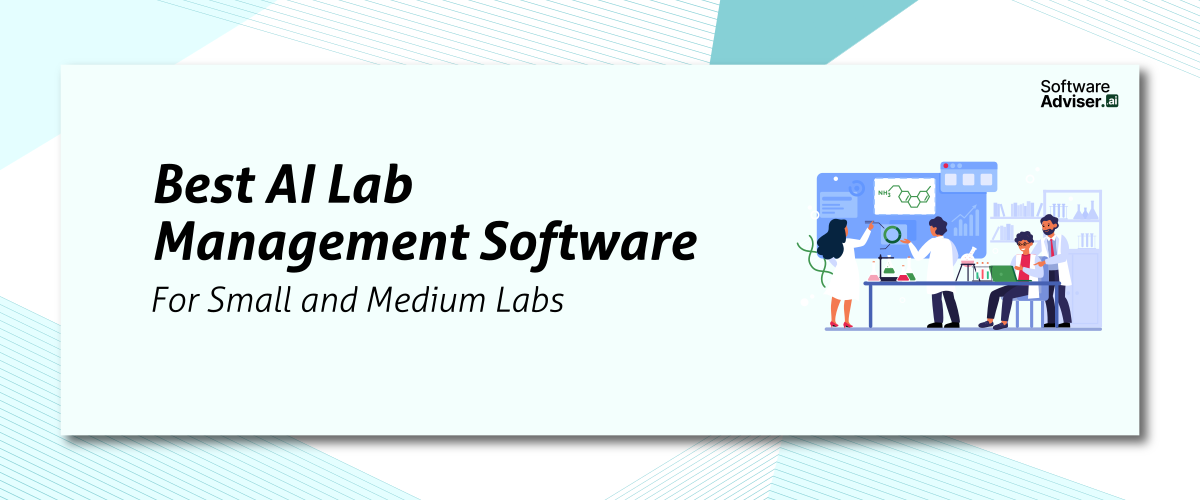
Best AI Lab Management Software for Small and Medium Labs
 David N. Wilks
If you are a small or medium-sized US laboratory wanting to modernize without all the enterprise baggage, CloudLIMS is your best AI-ready option. Scispot is a contemporary, cloud-native Scientific Data Lakehouse that leverages its native conversational AI agent, Scibot, to enable technicians to follow samples and automate procedures using easy natural language. CloudLIMS is also of great value for highly regulated installations with no upfront expenses and rapid deployment. Both solutions remove the heavy IT load of old systems, providing the appropriate mix of powerful data automation with the budget and agility demands of developing laboratories.
What is AI Lab Management Software?
AI Lab Management Software is the next generation of digital platforms meant to facilitate daily laboratory operations and leverage machine learning and data automation. Traditional, static laboratory information management systems (LIMS) are akin to digital file cabinets for data entry, but AI-driven software takes the grunt work out of sample tracking, inventory management, and instrument scheduling. These technologies bring together all the different lab equipment by centralizing operations in the cloud and automatically suck in the raw data, turning messy spreadsheets into organized, searchable data stores.
The key distinction of this software is its predictive and conversational intelligence. For today's laboratories, AI management solutions can predict when expensive equipment will need repair before it fails, streamline workflow bottlenecks, and even generate compliance reporting AI document management software. These platforms can also be equipped with natural-language AI assistants that allow personnel to access past assay findings, check chemical inventories, or log new sample matrices all by just typing or speaking. Ultimately, it takes the laboratory process away from manual data administration so scientists may focus exclusively on real discoveries.
Why Do Small and Medium Labs in the US Need AI Lab Management Software?
Small and medium-sized laboratories (SMB labs) in the US have a unique, stressful paradox: they must fulfill the same tight regulatory and data standards as multi-billion-dollar corporate facilities, but they have to do it with a fraction of the people, funding, and IT equipment.
Here’s why SMB laboratories in the US are quickly leaving outdated spreadsheets and conventional LIMS behind for AI-powered solutions:
1. Leveling the Regulatory Playing Field
In the United States, labs are highly regulated by agencies such as the FDA, EPA, and CMS (via CLIA certifications). Traditional data monitoring gives a lot of space for human mistakes; one mislabeled cell on an Excel sheet might destroy an audit. The AI-powered technologies give an automatic, immutable audit trail. The AI automatically ingests data from linked instruments directly into a cloud-based AI employee database, significantly transcription and enabling smaller teams to effortlessly manage compliance without the need for a professional compliance officer.
2. Addressing the Lab Tech Labor Shortage
The US science industry still has a huge lack of specialist lab workers. In an SMB lab, losing a worker might bring things to a standstill. AI software is an operational force multiplier:
Workflow Automation Automates repetitive operations such as inventory alerts, sample logging, and scheduling. Conversational AI Knowledge Retrieval Junior or new technicians may just ask for complicated past testing methods or where to obtain certain reagents using simple text searches, significantly reducing onboarding times.
3. Getting Rid of the Tax of Having a Dedicated IT Department
Massive financial outlay, pricey server rooms, and specialized IT staff are needed merely to keep legacy corporate software up and running. AI-native, lightweight, cloud-hosted AI lab management software solutions. They can construct complex data pipelines in weeks, not years, with self-configuring instrument integrations and zero-code interfaces, all maintained through a predictable monthly subscription by a small lab.
4. Maximizing Thin Margins
Small laboratories work on constrained financial flows, unlike big pharma. AI software uses predictive intelligence to aggressively defend those margins. With consumption patterns being tracked, the program can forecast when a lab will be running low on a crucial chemical or a mass spectrometer is on the verge of failing. A developing lab may save thousands of dollars a month by preventing surprise equipment downtime and emergency overnight shipping expenses for expiring chemicals.
What Features Should You Look for in AI Lab Management Software?
1. Natural Language Assistants: Embedded conversational AI bots that allow technicians to enter samples, search records, or check inventories using simple text instructions.
2. Automated Instrument Ingestion: Plug-and-play digital pipelines for automated capture and standardization of data straight from your physical hardware to avoid transcription mistakes.
3. Unified Data Architecture: A single, unified cloud platform that connects your LIMS, electronic lab notebook (ELN), and inventory management effortlessly.
4. Predictive Maintenance and Alerts: Machine learning algorithms that follow equipment behaviors to predict hardware problems and prevent unplanned downtime.
5. Autonomous Audit Trails: AI-driven compliance tracking that logs chain-of-custody changes with timestamps and alerts non-conformance with FDA or CLIA requirements.
6. No-Code Workflow Builders: Easy-to-use, drag-and-drop tools for customizing testing procedures without having IT experience to make tweaks for your scientific method personnel.
How Does AI Lab Management Software Improve Lab Efficiency?
1. Data Ingestion and Structuring in Real Time
In a typical configuration, after a liquid chromatography-mass spectrometry (LC-MS) run is completed, a technician needs to export the file, manually rename it according to naming conventions, and transfer it to a network disk. That’s something that the AI program does natively. As soon as an instrument produces data, an AI data pipeline grabs it, re-formats it into a defined schema, and ties it directly to the relevant sample ID and electronic notebook entry. That eliminates the bottleneck of data transcription.
2. Eliminate Downstream Errors
Human data input has an average error rate of 1% to 3%. Flip a digit in a dilution ratio or a decimal in a potency test, and you can invalidate a multi-week batch of data in a laboratory environment. AI software functions as an automatic quality assurance buffer, minimizing the need for human data transfers altogether, avoiding expensive, time-consuming repetitions from minor clerical mistakes.
3. Optimisation of Dynamic Resources
Lab scheduling is a massive logistical problem. A standard calendar cannot change dynamically when a certain extraction run takes 45 minutes longer than intended. AI-enabled systems monitor run-times in real time and automatically change downstream equipment reservations, tech timetables, and reagent preparation durations. If a machine is a bottleneck, the system automatically reorganizes the daily queue to enhance throughput.
4. Intelligent Inventory Management
Rather of relying on human stock checks or static reorder thresholds, machine learning models look at your real past consumption data. The program will tell you exactly how fast your team is burning through particular reagents, cross-check that against current supplier shipping timeframes throughout the US, and generate auto-purchase orders so you never have to stop an experiment because you ran out of a vital buffer.
5. Automation of Regulatory Reporting
Drafting a Certificate of Analysis (CoA) or assembling compliance papers for an audit frequently requires hours of gathering data from several departments. An AI platform can trace the whole, continuous lineage of a sample from reception to the end outcome, and hence can produce organized, fully audit-compliant documentation in seconds.
What Are the Best AI Lab Management Software Options for US Labs?
1. LabWare
LabWare is an enterprise-class LIMS platform, an industry standard, that has aggressively integrated sophisticated data analytics and predictive capabilities. It is widely regarded by big clinical, manufacturing, and contract research organizations (CROs) for its automated lot management, stability testing, and environmental monitoring capabilities. Very sturdy, although hefty configuration requirements make it more suited to mid-to-large companies than small startups.
2. Thermo Fisher Scientific
Thermo Fisher’s digital ecosystem is mainly focused on automation, using “Edge AI” to handle and analyze huge datasets locally, directly at the instrument source. It specializes in real-time data interpretation, automating worklist distribution, and avoiding transcribing mistakes via direct integration with lab gear. It is the first solution for research centers that are heavy users of Thermo Fisher devices and need automated, audit-ready data formats.
3. Labsmart Mobile App
Labsmart is a lean, cloud-based platform designed primarily for small-to-medium pathology and diagnostic clinics looking for a reduced IT load. It works on smartphones and tablets and eases daily tasks, including billing, patient check-in, inventory management, and delivery of test results. It is known for its immediate creation of PDF reports and seamless contact channels with patients, making it a very accessible solution for fast-growing diagnostic enterprises.
4. MediXcel EMR
MediXcel is a flexible hybrid platform that serves as an interface between an EMR system and a comprehensive laboratory information system. It is very scalable and used extensively by multi-location diagnostic chains, clinical genomics laboratories, and hospitals to facilitate coordination of sample collection operations with direct patient files. The software is ideal for labs within a healthcare delivery paradigm that require one system for asset, inventory, and patient data management.
5. Quartzy
Quartzy is an extremely popular, cloud-based productivity and eProcurement application purpose-built to consolidate lab supply operations and chemical inventories. Instead of only analytical data, it avoids messy spreadsheets by allowing scientists to request reagents and lab managers to authorize orders, all from one screen. It’s popular among budget-conscious academic and life sciences laboratories, with an integrated barcode scanning mobile app and automated budgeting features.
How Do You Successfully Implement AI Lab Management Software?
Implementing an AI lab platform needs balancing technical setup with cultural transformation. To reduce operational disruption and achieve high staff acceptance, use this deployment roadmap:
1. Clean Up Your Current Data Hygiene
- Current Assets Audit: Clean up historical data, terminology, and naming standards before migration so that you don’t train the AI on flawed data structures.
- Map Existing Workflows: Map out your current physical workflows to see which phases you want to automate and which you want to leave for human validation.
2. Use a Phased Rollout Approach
- Initiate a Pilot Program: Start by deploying the software to only one department or testing process to pinpoint configuration issues early on without impacting the entire lab.
- Parallel Testing: Run your old system or spreadsheets in parallel to the new platform for a period of time to validate the correctness and integrity of data.
3. Assess Hardware and IT Readiness
- Check if the instrument is compatible: Collaborate with the vendor to ensure current mass spectrometers, liquid handlers, or balances can connect via API or edge devices for automated data collecting.
- Set up Role-Based Permissions: Data security: Implement tight user access restrictions early to support US security regulations (e.g., HIPAA, SOC 2).
Conclusion
The correct AI lab management software is the ultimate catalyst to scale a small or medium-sized laboratory. Growing laboratories need to quickly meet enterprise-grade throughput and regulatory compliance with little expense by moving away from inflexible legacy infrastructure to dynamic, automated, and predictive systems. When you are ready to analyze, choose, and acquire the perfect technology for your lab’s specific clinical or operational procedures, visit softwareadviser.ai. The platform is a complete SaaS marketplace that allows you to easily find, evaluate, and buy leading business software solutions to future-proof your laboratory operations.
FAQ's
Traditional LIMS act as passive digital filing cabinets for manual data entry, whereas AI lab software actively automates data ingestion, structures data pipelines, and provides predictive operational insights.
By automatically capturing and standardizing data directly from connected instruments, the software completely eliminates manual transcription and data entry mistakes.
Yes, modern platforms use affordable, cloud-based subscription models that eliminate the massive upfront hardware costs and dedicated IT personnel required by legacy enterprise systems.
Yes, the software automatically logs unalterable, time-stamped audit trails and chain-of-custody data to simplify compliance with FDA, CLIA, and ISO standards.
While legacy enterprise setups can take over a year, agile cloud-based AI platforms can be fully deployed, integrated with instruments, and operational in as little as two to six weeks.
Online shopping used to be like going around a certain huge department store, like a really enormous supermarket. It was difficult to distinguish one [...]

Dokas mile
Almost every AI tool now has a free version, which is both a gift and a trap. The gift is obvious: you can test powerful software without spending a c [...]
David N. Wilks
The traditional "payday" turned into a source of dread, described by past due-night spreadsheets and the consistent fear of a unmarried decimal errors [...]