
What we'll cover
Share with your community!


Get Free Consultation
AI Attrition Prediction: What Signals Models Use and Which Ones Are Off Limits
 Dokas mile
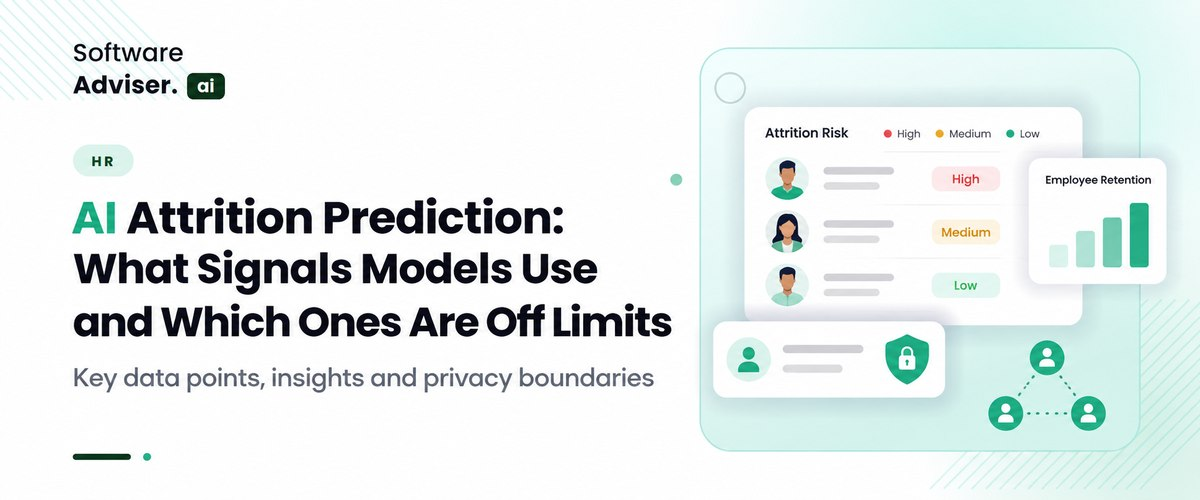
Due to massive turnover expenses and up-to-the-minute workforce analytics, companies in America are becoming more familiar with machine learning tools that are capable of predicting employee turnover even before the resignation letter reaches HR's desk. These predictive tools analyze an enormous amount of workplace metrics, collecting information concerning potential risks of flight; however, they act under a strict legal framework represented by the EEOC, FTC, and federal civil rights legislation.
What standard HR Metrics can AI models Safely Analyze?
AI programs can use standard measurements such as tenure, intervals of promotion, salary comparisons, and training completion. Under proper circumstances, these data points become very useful for AI models since they describe the career path and engagement of an employee at a workplace. By not using any elements that indicate protected characteristics, such data allow AI systems to predict retention problems or skill deficiencies in accordance with requirements of the law.
It’s interesting to mention that predictive AI HR software determine potential resignation better by looking at minor changes in routine participation than by using moments of importance. For instance, a drastic decline in voluntary meeting attendance along with little PTO usage is much more indicative of burnout than an anniversary or an annual review.
Do You Know?
In addition to basic operational metrics, AI technologies can effectively interpret real-time operational data such as delivery periods, side movements, and activity on the employee recognition platform. Companies focusing solely on behavioral and performance indicators closely associated with business results create predictive models that ensure confidentiality and compliance with the EEOC Act.
What is the typical ROI for Deploying Predictive Attrition Software?
- 10%-25% Voluntary Turnover Reduction: Companies report a voluntary turnover reduction of 10%-25% in the first year of operation, as they mitigate the risk of possible resignations.
- Substantial Savings for Every Employee Saved: The cost of replacing a qualified employee ranges from 50% to 200% of the annual salary; stopping just 5-10 resignations per year makes it possible to cover the cost of the license.
- Higher Rate of Retention Intervention Success: Predictive analytics help HR enhance the effectiveness of interventions by allowing managers to conduct stay interviews and change workloads 3-6 months before the employee starts looking for a new job.
- The platform's overall ROI of 200%-400%: There are companies using enterprise HR solutions that have seen returns of 200%-400% on their investment within a span of the first 12 to 24 months thanks to savings in different recruitment, AI employee onboarding, and ramp-up areas.
- Lower Off-Cycle Talent Acquisition Costs: The reduced turnover drastically decreases the dependency on expensive hiring processes like third-party agencies, costly job ads, and rush hire-related expenses.
- Maintaining Team Productivity and Organizational Knowledge: Preventing sudden departures ensures that project completion is more on track and fewer indirect expenditures appear due to company knowledge losses and team stress.
How do Businesses Choose Compliant HR Software for Attrition Prediction?
- Check Third-Party Bias Reviews: The procurement department should ensure independent bias reviews are conducted by the vendor each year to evaluate adverse effects involving protected categories and compliance with provisions such as NYC Local Law 144.
- Mandate the Use of Explainable AI (XAI): The platform must enable the transparent attribution of individual features so that HR departments can determine the exact factors causing a risk score instead of relying on a mysterious algorithm for it.
- Ensure Exclusion and Data Minimization: Be sure the vendor's ingestion pipeline explicitly avoids any non-permitted variables like health records, leaves taken, biometric information, and personal data from social media.
- Mandate Built-in Adverse Testing: The software must have built-in dashboard tools to automatically compare the chosen outputs against the EEOC requirements and inform the HR department if the predictions are approaching the threshold of the four-fifths rule.
- Check Data Governance and Security Policies: Make sure employee telemetry data is encrypted, anonymized when necessary, and is separate enough to prevent the use of private employee data for the training of any public AI model.
- Verify Workflow Affordability with Human-in-the-Loop Guidelines: Make use of systems that are developed only for the production of advisory risk assessments and actionable insights, indicating that the technology does not implement automatic penalties, wage suspensions, and dismissals without human approval.
How do HR teams ethically intervene once AI Flags an Employee as a Risk?
When AI identifies a worker as a potential turnover candidate, the HR department should refrain from taking urgent measures such as sudden confrontations or blocking access to the system. Instead, it should pursue caring and non-intrusive support within the framework of discussions organized by immediate superiors through stay interviews and career conversations. The managers are to carry out these discussions in a delicate manner to determine people’s satisfaction with their jobs, their current job stress, and opportunities for their career development, but without revealing that the person falls into a risk category according to the algorithm. The approach should be based on the idea of mutual growth, assuring that the employee will feel appreciated rather than supervised.
By combining proactive measures and prediction-related information received about the employee’s status, the HR department will be able to tackle the problem of burnout among workers without losing trust and psychological safety in the workplace. To assess the effectiveness of the attrition model, HR specialists monitor the accuracy metric, which shows how many employees marked as potential leavers end up in fact wanting to leave, and compare it with the results of the decline of voluntary turnover among top employees. It is also important to observe the retention practice success indicator, which shows how many employees marked as high-risk stay with the firm after undergoing a stay AI video interviewing increase during a specific period of time. Finally, the savings from not needing to recruit and train new personnel serve as sound proof of the software's profitability.
How does AI Spot Turnover Risk through daily work Patterns?
- Collaboration Decrease: The gradual reduction in the number of an employee's active professional network, determined by the decreasing number of distinct coworkers messaged or tagged weekly within channels like Slack or Microsoft Teams.
- Disengagement from Voluntary Activities: Ceasing to participate in all company-related channels, not taking part in all-hands Q&A, and quitting participation in voluntary discussion groups and forums.
- Response Delays and Working Time Changes: Significant delays in answering typical messages alongside sudden alterations in working hours, for example, moving away from the usual high productivity times or blocking some hours.
- Isolation of Knowledge Artifacts: A significant decline in the use of public file sharing platforms, common editing performed on documents that are mutually accessible, and the extent of contributions to shared repositories.
- Internal Mobility Indications: An increase in activity on internal job postings, establishing new virtual resumes, and the level of visits to the office’s website where benefits, PTO, and stock vesting schedules are stated.
When does AI monitoring violate US workplace privacy rules?
AI workplace monitoring violates U.S. privacy, labor, and civil rights laws when it crosses boundaries regarding consent, location, off-duty conduct, and protected employee activity.
- Failure to Give Pre-Notice: States such as New York, consider it compulsory to provide a written notice before gathering information about emails or other electronic communications. Secret data collection about the employee’s keystrokes, emails, or use of the internet without prior notice is a contravention of the law.
- Private Space Surveillance: AI-based video surveillance and hidden microphones in places that employees regard as reasonably confidential (washrooms, cafes, locker rooms, or mother rooms) violate the regulations of common law privacy and the state penal code.
- Out-of-Working Hours Tracking: Using permanent GPS identification beyond working hours or obtaining information from an employee’s personal device, private social media account, or emails breaches privacy during non-working hours.
- Collecting Biometric Information Without Authorization: The scanning involved in facial recognition, keystroke dynamics, and voiceprint for AI risk models without proper authorization is contrary to strict state biometric laws (for example, BIPA in Illinois), attracting serious penalties by law.
- Monitoring of Labor Union Activities: The practice of using AI tools to monitor employee discussions around wages, conditions of work, or unionization efforts, whether done via official or unofficial channels, violates Section 8(a)(1) of the National Labor Relations Act (the NLRA).

Pro-tip
Employers can ensure compliance by having clear monitoring policies that provide information on their electronic monitoring activities. In order to avoid legal repercussions, companies need to act in accordance with strict separation of the monitoring in professional activities performed during working hours and preventing any monitoring on private devices and in personal time. Finally, HR should have a strong human component and make sure that automated flags do not punish employees for the use of their rights.
How do HR teams stop AI from discriminating against protected classes?
- Performing Adverse Impact & Four-Fifths Rule Testing: Human Resources panels routinely conduct statistical tests to determine the efficacy of the AI selection rates. According to the Uniform Guidelines on Employee Selection Procedures, AI models are considered to have adverse impact if the selection or retention prediction rates of a protected group are lower than 80% of the rate for the highest-rated group.
- Removing Related Variables During Feature Engineering: Teams ensure that any clear demographic data shown along with some indicators with a strong correlation that can be linked to protected categories is removed.
- Requiring Independent Vendor Audits: HR departments require independent audits of third-party vendors that develop artificial intelligence systems before the usage of their systems in practice. In places like New York City (Local Law 144), it is compulsory to conduct and make public the results of audits conducted by the companies using automated systems.
- Providing Human Oversight: Organizations use the output of AI only for the purposes of risk assessment and do not rely on AI in their decision-making processes. Implementation of measures and decision-making are only carried out by HR specialists.
Conclusion
The evolution of predictive AI models changes the way companies ensure employee retention. Predictive AI allows HR professionals to identify early signals of employee disengagement and to implement preventive strategies in order to eliminate HR risks, as long as companies comply with various laws and regulations. It is important to understand what tools can guarantee smooth compliance with the laws and regulations of the country when establishing your employee retention strategy. If you are looking for a reliable software platform to develop an effective HR analytics strategy, softwareadviser.ai is a great place to find the most relevant tools for your business operations.
FAQ's
Yes, provided the AI model relies on job performance and engagement telemetry while strictly excluding protected characteristics under EEOC and civil rights guidelines.
The primary risk is disparate impact bias, where models inadvertently penalize protected groups using proxy variables like ZIP codes or career gaps.
No, monitoring personal devices, off-duty geolocation, or private social media violates state privacy statutes and off-duty conduct laws.
Advanced models typically detect subtle shifts in work patterns and engagement signals 3 to 6 months before an employee resigns.
Yes, multiple US state laws mandate written disclosures regarding electronic monitoring to ensure legal compliance and workplace transparency.
Think about the last time you waited two days for customer service to answer an easy query. Now believe your customers having that identical problem a [...]

David N. Wilks
Retail in the United States is undergoing a huge transition as brick-and-mortar establishments and e-commerce platforms battle to suit the wants of th [...]
David N. Wilks

The trading floor is no longer dominated by shouting voices, chaotic phone calls, and piles of printed financial sheets. Today, the fastest shifts in [...]